In brief
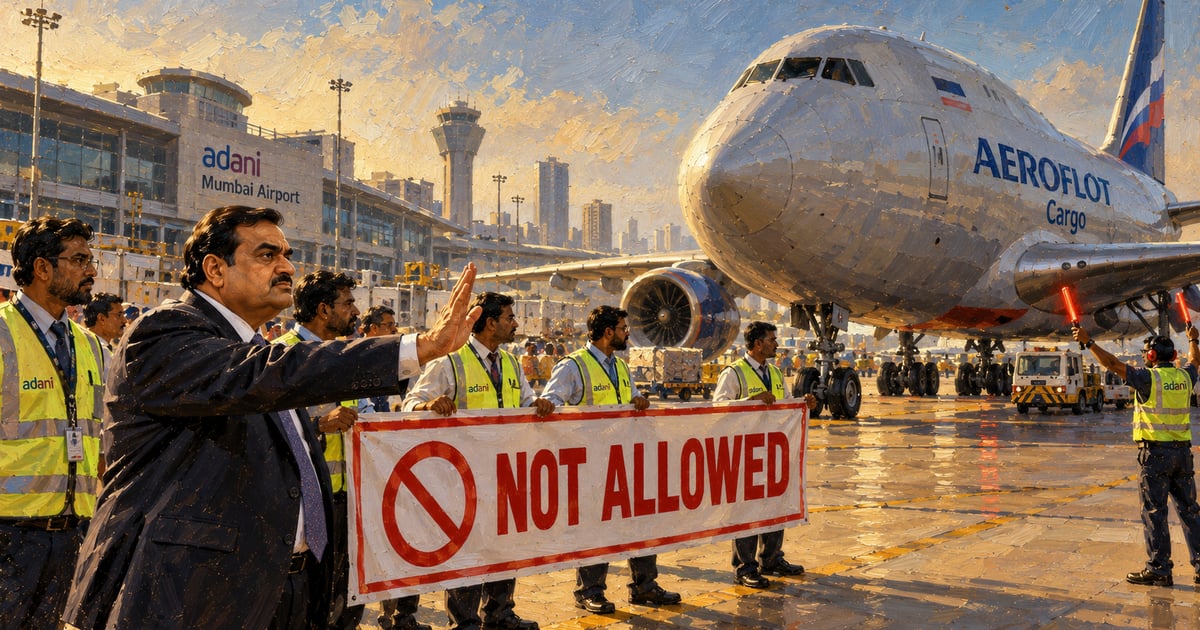
- In the last week of September 2026, Adani-run Mumbai airport stopped taking cargo for Russian airlines like Aeroflot and Volga-Dnepr. About 150 tonnes of freight, mostly medicines and machinery from 100+ Indian companies, got stuck.
- This came less than two weeks after Adani Airport Holdings signed a $1.04 billion (₹8,700 crore) fundraise led by BlackRock, with Temasek, Alpha Wave and Premji Invest.
- The article’s view is that US investors likely pushed Adani to avoid trouble with US sanctions. It says there’s no public proof that BlackRock demanded it.
- Only Russian airlines were blocked. The same cargo sent through Emirates, Turkish or Ethiopian Airlines via Dubai, Istanbul or Addis Ababa was still cleared.
- It clashes with India’s own stand, since India doesn’t back Western sanctions on Russia. Delhi airport, run by GMR, still handles Aeroflot flights as normal.
In the final week of September 2026, commercial cargo operations at Mumbai’s Chhatrapati Shivaji Maharaj International Airport (CSMIA) ground to an abrupt, unannounced halt for shipments destined for the Russian Federation. Within days, roughly 150 tonnes of high-value freight—overwhelmingly life-saving pharmaceuticals, engineering components, and industrial machinery from more than 100 Indian manufacturers—lay stranded across terminal warehouses and parked container lorries, accumulating demurrage penalties according to The Times of India.
The immediate operational disruption was severe. Yet the commercial timing of the decision attracted far sharper scrutiny: the cargo freeze was initiated less than a fortnight after airport operator Adani Airport Holdings Limited (AAHL) formally signed agreements to raise $1.04 billion (approximately ₹8,700 crore) in primary equity from a group of elite global institutional investors led by US-based BlackRock, alongside Singapore’s Temasek, Alpha Wave Global, and Premji Invest, as detailed by the SWFI.
Is there a direct causal connection between this capital injection and the sudden refusal to process Russian freight?
An examination of corporate filings, international sanctions jurisprudence, and logistics documentation indicates that whilst no public contract contains an explicit "Russia clause", the connection is neither coincidental nor conspiratorial. Rather, it represents a classic case of corporate de-risking and secondary sanctions compliance: an infrastructure platform welcoming marquee American institutional capital cannot risk servicing entities designated by the US Department of the Treasury's Office of Foreign Assets Control (OFAC).
What Actually Happened at Mumbai Airport?
To understand why goods were blocked, one must examine how air freight moves out of western India.
Mumbai airport does not host scheduled direct passenger or freighter flights operated by Russia’s national carrier, Aeroflot. However, Mumbai functions as the primary customs clearance and export registration gateway for pharmaceutical manufacturing clusters in Maharashtra, Gujarat, and southern India. Cargo is trucked into CSMIA’s air cargo complex, screened by security, processed through Indian Customs, and subsequently flown or transported via bonded trucks to Indira Gandhi International Airport in Delhi or to Goa, where Aeroflot operates daily scheduled services to Moscow, as reported by The Times of India.
On 23 September 2026, SW Trading, the pan-India cargo sales agent for Aeroflot, dispatched an urgent letter to Mumbai International Airport Limited (MIAL), an AAHL subsidiary. Freight lorries carrying export consignments had been denied entry permits ("carting orders") for several days without written explanation, as documented by Logistics Insider.
According to representations submitted to the Ministry of Civil Aviation, Ministry of External Affairs, and the Central Board of Indirect Taxes and Customs (CBIC) by SW Trading and Delmos Aviation (general sales and service agent for Aeroflot and Russian cargo airline Volga-Dnepr), airport ground staff stated verbally that they were acting on strict instructions from corporate headquarters. Beyond scheduled Aeroflot flights, an ad-hoc charter flight operated by Volga-Dnepr at the upcoming Navi Mumbai International Airport was also denied operational clearance and slot confirmation, according to The Loadstar.
The Capital Infusion: The September 9 Equity Agreement
The operational freeze followed on the heels of one of the largest private equity raises in the Indian infrastructure sector in 2026.
According to regulatory filings with the National Stock Exchange of India (NSE) dated 9 September 2026, Adani Enterprises Limited announced that its airport subsidiary, AAHL, had entered into definitive share subscription agreements to issue compulsorily convertible preference shares and equity instruments totalling approximately $1.04 billion (around ₹8,700 crore).
The capital was subscribed across three tranches by institutional funds, including:
Funds managed by BlackRock, the world’s largest asset manager headquartered in New York.
Temasek Holdings, Singapore’s sovereign investment company.
Alpha Wave Global, a US-headquartered global alternative asset manager.
Premji Invest, the private investment office of Azim Premji.
The transaction placed a pre-money equity valuation on Adani’s airport portfolio of roughly $18 billion (approx. ₹1.51 lakh crore), with the new investors slated to hold a 5.54% stake upon completion, as recorded by Dealroom.
For the Adani Group, which has spent the past three years rehabilitating its global standing following allegations by US-based short-seller Hindenburg Research, securing direct equity sponsorship from BlackRock was a major financial and reputational endorsement.
The Sanctions Reality: Why Western Capital Changes Compliance
Why would an equity investment in an Indian airport operator affect freight operations involving Russia? The answer lies in the extraterritorial mechanics of US financial regulations and secondary sanctions.
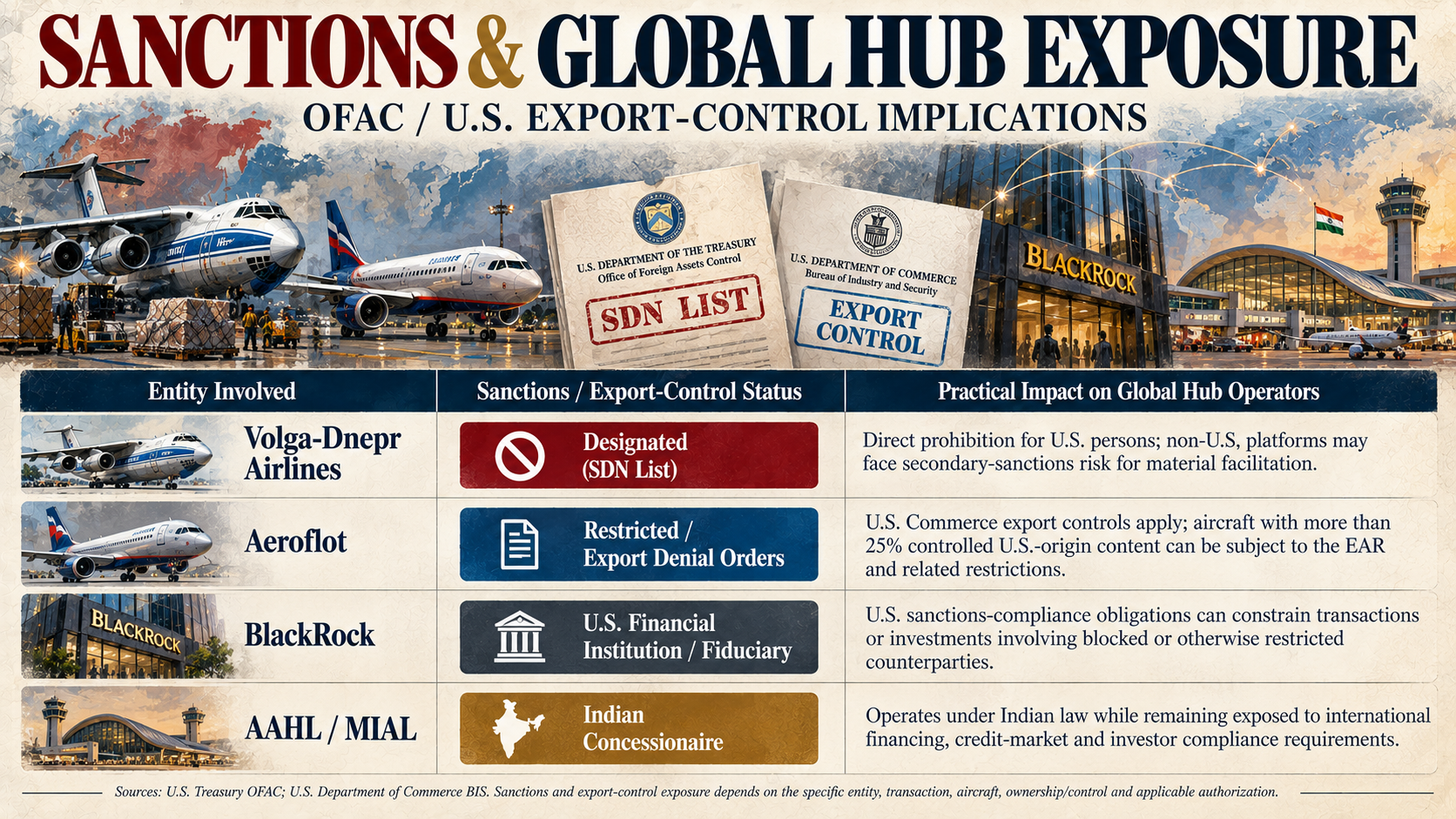
Under OFAC regulations, non-US entities that provide "material support, goods, or services" to Specially Designated Nationals (SDNs)—such as Volga-Dnepr—face the threat of secondary sanctions or exclusion from the US dollar clearing system. Furthermore, international institutional investors like BlackRock and Alpha Wave are governed by stringent compliance covenants. When an entity takes direct US equity, its legal and compliance architecture is immediately subjected to institutional audits.
As industry analysts noted in The Economic Times, when global compliance officers inspect cargo operations, handling Russian flag carriers and sanctioned heavy-lift freighter fleets is categorised as an uncompensated risk. Rather than negotiating complex exemptions or evaluating individual consignments on a case-by-case basis, corporate risk committees routinely enforce sweeping administrative embargoes—a process known in global finance as "de-risking" or "over-compliance".
The Carrier Paradox: A Targeted, Not Blanket, Ban
Crucially, the stoppage at Mumbai Airport was not an embargo on Russian trade per se, but an embargo specifically targeting Russian carriers, as reported by Outlook India.
In their representations to the Ministry of Civil Aviation, cargo agents highlighted a telling inconsistency:
Consignments booked on Aeroflot and Volga-Dnepr were systematically turned away at the gate.
Identical Russian-destined cargo (such as Indian medicines and consumer goods) booked through third-country international carriers—such as Emirates, Turkish Airlines, or Ethiopian Airlines transiting through Dubai, Istanbul, or Addis Ababa—continued to be processed and cleared through CSMIA without hindrance.
This discrepancy underscores that Mumbai Airport’s actions were driven by airline counterparty risk rather than the nature of the cargo itself. Refusing to service an aircraft or airway bill issued by an OFAC-designated or Western-restricted Russian airline directly neutralises secondary sanctions exposure.
The Sovereign Collision: Corporate De-risking vs Indian Foreign Policy
The Adani Airports decision has ignited significant friction because it cuts directly across the official geopolitical and commercial posture of the Indian government:
Strategic Bilateral Trade: New Delhi has adamantly refused to endorse unilateral Western sanctions against Moscow. India and Russia maintain a "Special and Privileged Strategic Partnership," conducting bilateral trade in national currencies and actively expanding export volumes in pharmaceuticals, agricultural goods, and industrial machinery, as noted by The Loadstar.
The Custodial Mandate: Under Section 45 of the Indian Customs Act, 1962, the airport concessionaire operates as a designated public custodian of cargo on behalf of the Government of India. In its petition, SW Trading argued that an airport custodian is legally obligated to handle all lawful, customs-approved cargo non-discriminatorily and possesses no statutory authority to enforce unilateral foreign sanctions that the Government of India does not recognise, as reported by The Times of India.
The Gateway Divide: While Adani-operated hubs (Mumbai, Navi Mumbai, and Ahmedabad) restricted these operations, Indira Gandhi International Airport in Delhi—operated by the GMR-led consortium DIAL—continues to handle direct Aeroflot passenger and cargo flights daily without disruption.
The Verdict: Direct Causation or Pragmatic Alignment?
Is there a connection between the $1.04 billion fundraising round and the cargo halt?
Yes, but with an important distinction between direct coercion and institutional self-preservation:
What the evidence does NOT show: There is no public evidence that BlackRock executives issued a direct fiat demanding that Adani Airports turn back Russian cargo trucks as an explicit pre-condition of the funding.
What the evidence DOES show: The entry of marquee US institutional capital created an immediate imperative for AAHL’s legal and risk teams to eliminate sanctions vulnerability. For an enterprise that relies heavily on global bond markets, international credit ratings, and Western sovereign wealth partnerships, generating nominal handling fees from Russian freighters was vastly outweighed by the catastrophic risk of an OFAC inquiry or banking friction.
In modern global logistics, private infrastructure operators increasingly sit on the fault line between national foreign policy and international capital markets. For Adani Airports, when forced to choose between the custodial expectations of India-Russia bilateral trade and the rigorous compliance demands of the Western financial system, the $1.04 billion (₹8,700 crore) reality of global capital prevailed.