In brief
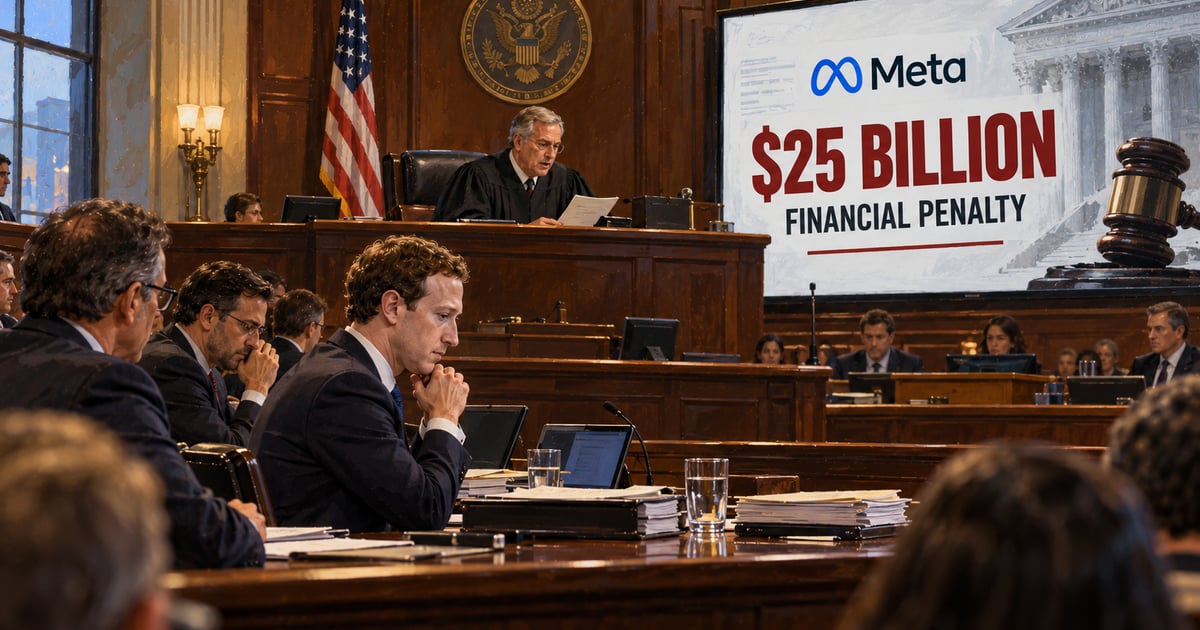
- New Mexico judge ordered Meta to pay $25 billion in civil penalties for deceptive privacy statements linked to Cambridge Analytica, the largest single-state award against a public company in US history.
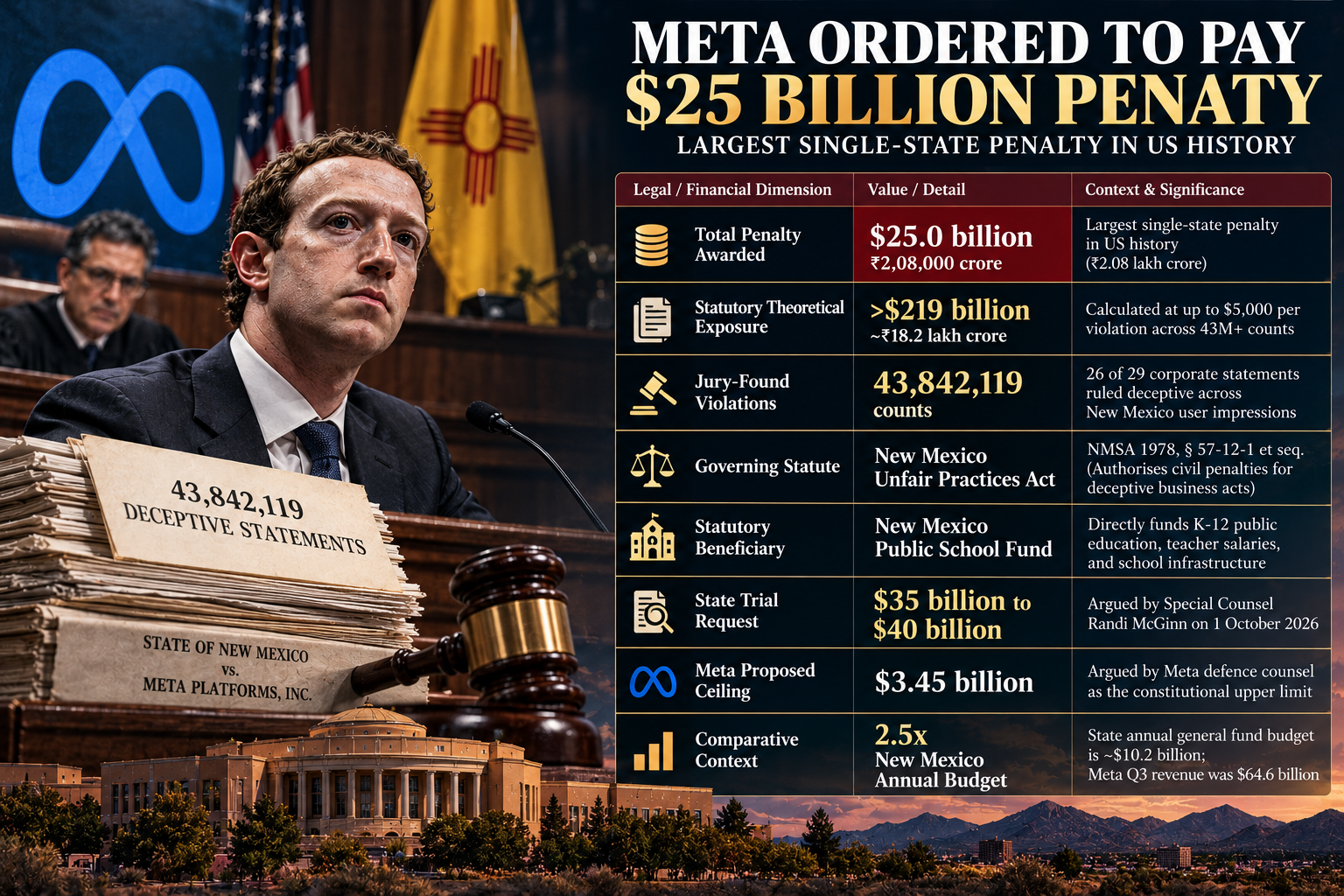
- Jury found 43 million willful violations of New Mexico's Unfair Practices Act at $5,000 each, creating $219 billion exposure; judge reduced it by nearly 90% to $25 billion.
- The full $25 billion is earmarked for New Mexico public schools, nearly 2.5 times the state's $10.2 billion annual budget, potentially doubling the Land Grant Permanent Fund.
- Meta will appeal arguing the penalty violates Due Process and Eighth Amendment protections, while the state argues statutory penalties deter corporate deception regardless of direct financial harm.
On Wednesday, 21 October 2026, inside the First Judicial District Court in Santa Fe, State District Judge Francis Mathew delivered a judicial ruling that sent shockwaves through Silicon Valley and Wall Street.
In a scathing, 48-page order, Judge Mathew directed Meta Platforms Inc. (NASDAQ: META) to pay $25 billion (approx ₹2.08 lakh crore) in civil penalties to the State of New Mexico. The judgment concluded a high-stakes consumer fraud lawsuit stemming from the Cambridge Analytica scandal and years of deceptive statements regarding user privacy on Facebook.
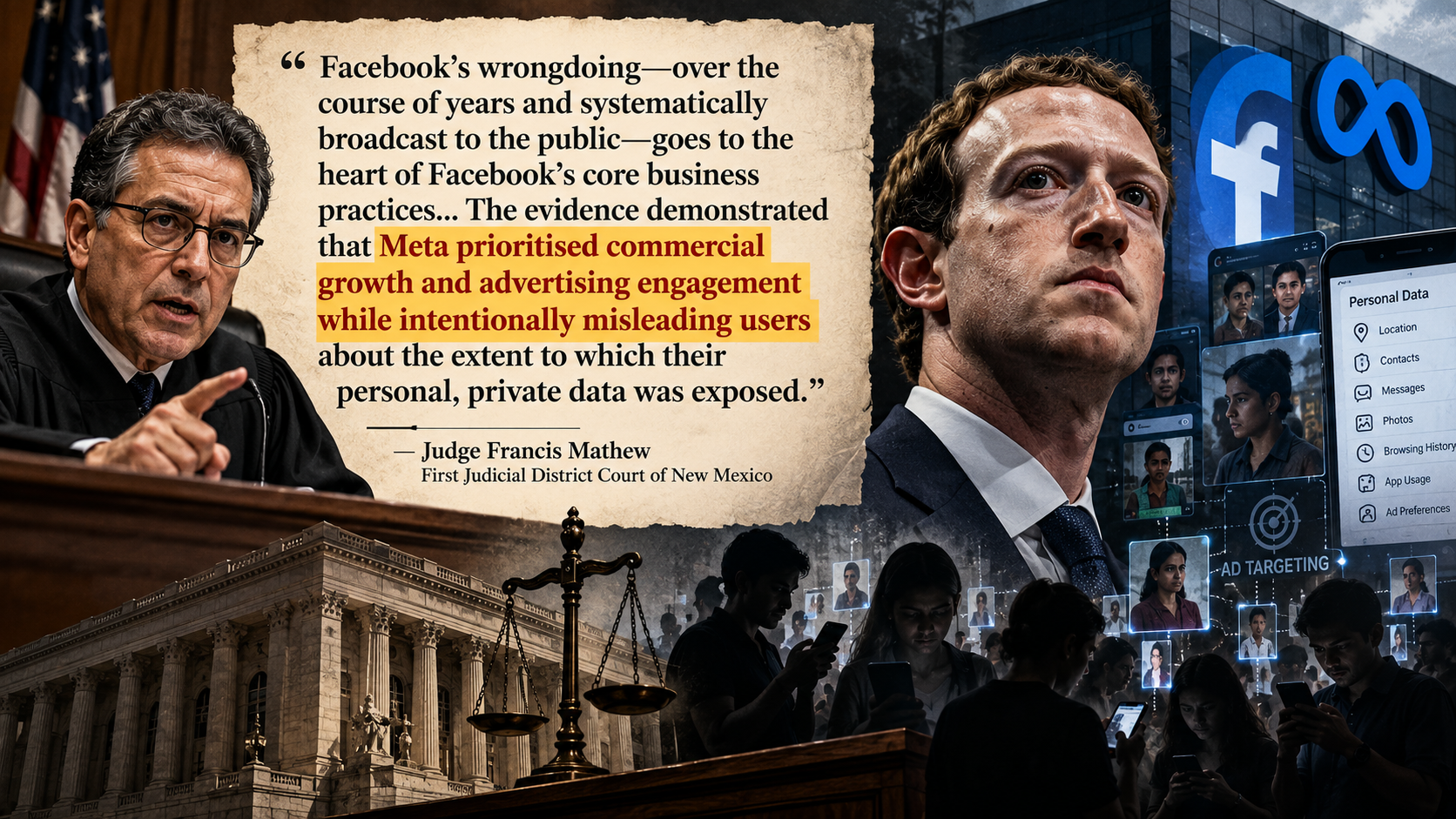
The penalty is five times larger than the Federal Trade Commission’s (FTC) then-record $5 billion penalty against Facebook in 2019, and represents the largest single-state judicial award ever entered against a publicly traded company in United States history.
Crucially, under New Mexico statutory law, the entirety of the $25 billion recovery is designated not for general executive coffers or legislative pet projects, but is earmarked directly for the New Mexico public school system.
1. The Origins: The Unclosed Chapter of Cambridge Analytica
While public memory of the Cambridge Analytica scandal had largely faded into the mid-2010s political lexicon, the legal machinery in New Mexico never stopped grinding.
In 2018, investigative reporting revealed that British political consulting firm Cambridge Analytica—working on Donald Trump’s 2016 presidential campaign—harvested personal profile data from up to 87 million Facebook users through a third-party personality quiz app developed by researcher Aleksandr Kogan. The breach revealed that Facebook’s Open Graph API permitted developers to scrape not only the data of users who downloaded an app, but the personal data of all their unwitting Facebook "friends."
In 2019, Meta settled with the US Federal Trade Commission for $5 billion and agreed to governance reforms, while in 2022 it agreed to pay $725 million to resolve a federal class-action lawsuit.
However, the State of New Mexico, under former Attorney General Hector Balderas and aggressively escalated by his successor, Attorney General Raúl Torrez, refused to participate in global settlement releases. New Mexico filed an independent enforcement action in 2021, alleging that Meta’s corporate leadership engaged in a sustained, multi-year campaign of deception targeting New Mexico residents in violation of state consumer protection statutes.
The state’s complaint went far beyond the physical data extraction by Cambridge Analytica. It accused Meta of systematically lying to users between 2015 and 2021 regarding:
Third-Party Data Access: Falsely reassuring users that their data was locked down while maintaining backchannel data-sharing agreements (whitelists) with preferred corporate partners.
Content Moderation: Misrepresenting the efficacy of its automated systems in detecting and removing hate speech, misinformation, and predatory material.
Monetisation Models: Concealing the degree to which personal behavioral data was catalogued and monetised across the open web.
2. The Math of 43 Million Violations: How the Fine Reached $219 Billion
The astronomical scale of the award was not pulled out of thin air; it was generated by the strict arithmetic of statutory consumer protection law applied to digital platforms.
Under the New Mexico Unfair Practices Act (UPA), the state can seek civil penalties of up to $5,000 (around ₹4.15 lakh) for each willful violation.
During a month-long trial in Santa Fe, lead trial attorney Randi McGinn presented jurors with 29 specific public representations made by Mark Zuckerberg, Sheryl Sandberg, and official Meta corporate disclosures regarding privacy safeguards.
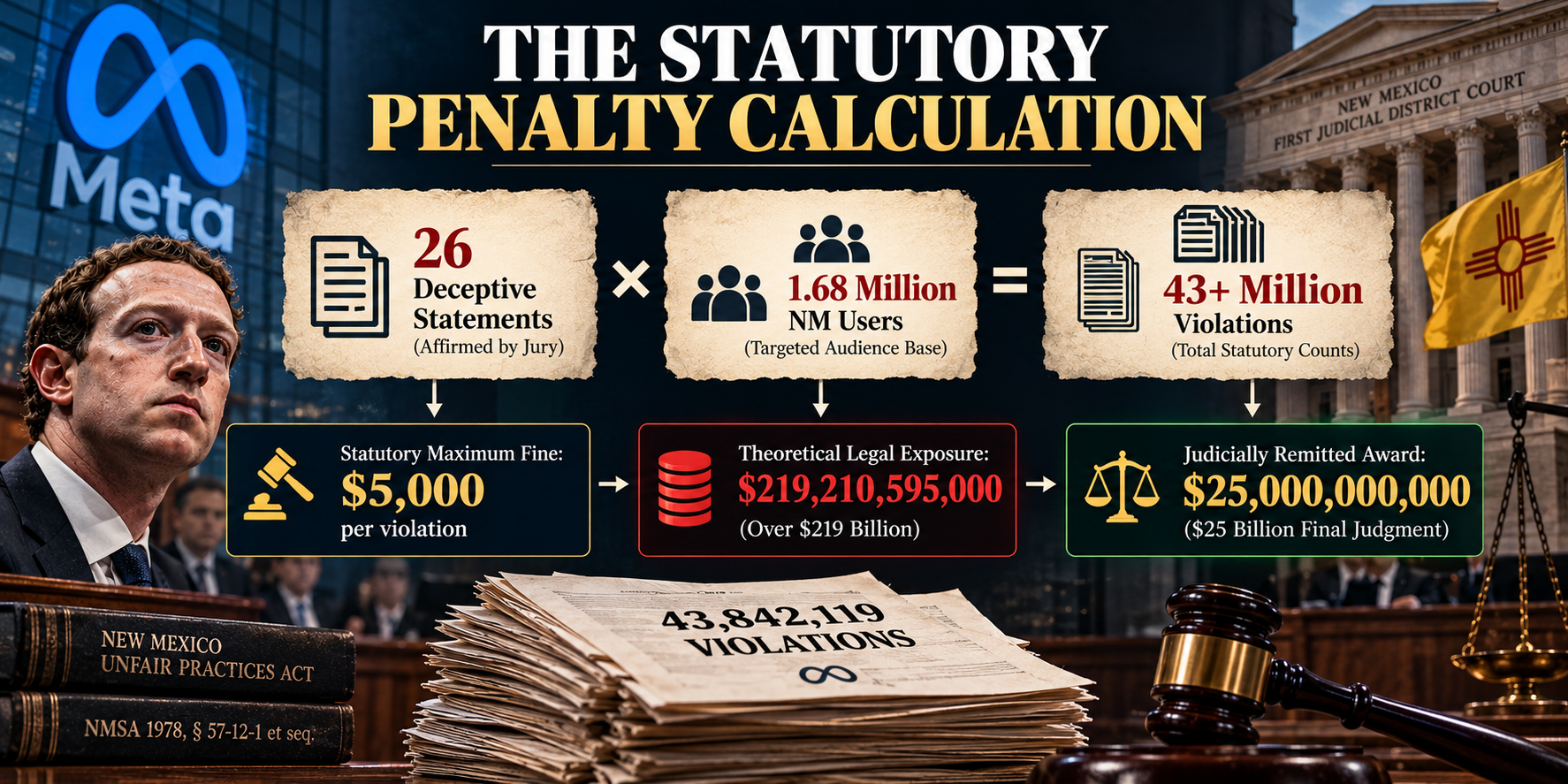
On 25 September 2026, the Santa Fe jury reached a unanimous verdict: 26 out of the 29 statements were willfully false, deceptive, and misleading.
Because each dissemination of a misleading statement to a registered user within the state constitutes an individual consumer exposure under New Mexico case law, the jury found that Meta had committed over 43 million individual statutory violations.
At the maximum allowable statutory penalty of $5,000 per count, Meta faced theoretical legal exposure exceeding $219 billion (₹18.2 lakh crore).
3. The 1 October Penalty Hearing: "The Only Language Meta Understands"
At the formal penalty hearing on 1 October 2026, the courtroom witnessed a fierce constitutional battle between the State of New Mexico and Meta's defence team over how Judge Mathew should exercise his judicial discretion.
Randi McGinn urged the court to impose a penalty between $35 billion and $40 billion, pointing to Meta’s $600+ billion annual market capitalisation and immense free cash flow:
"This court should speak to Meta in the only language it understands, which is money, and the value of its stock price. A nominal fine of a few hundred million dollars is treated in Menlo Park as a minor cost of doing business—an unnoticeable line item on an advertising balance sheet. The penalty must reflect the gravity of 43 million deceptive acts."
Meta’s defence counsel countered that any penalty exceeding $3.45 billion (approx ₹28,600 crore) would violate the Due Process Clause of the Fourteenth Amendment and the Eighth Amendment’s prohibition on excessive fines. Meta argued:
New Mexico failed to prove that a single resident suffered direct out-of-pocket financial harm.
Meta does not "sell" raw personal data to brokers in the colloquial sense.
Levying tens of billions of dollars in state civil penalties would create a catastrophic chilling effect, scaring technology employers and enterprise data centres away from New Mexico.
Judge Mathew rejected Meta's arguments, finding that Meta’s corporate deception was deliberate, continuous, and directed from the highest executive levels. However, acknowledging federal constitutional proportionality constraints, he slashed the $219 billion statutory calculation by nearly 90%, landing on the $25 billion final figure.
4. A $25 Billion Windfall: The Public Education Mandate
The most consequential structural feature of the judgment is where the money goes.
Unlike federal regulatory fines, which typically flow into the US Treasury’s general fund, New Mexico state law mandates that civil penalties recovered under the Unfair Practices Act are transferred directly into the Current School Fund of the State of New Mexico.
To appreciate the fiscal scale of this transfer:
The Entire Annual Budget of New Mexico: In fiscal year 2026, New Mexico’s total state general fund budget stood at approximately $10.2 billion.
The Judgment vs the State: The $25 billion award represents nearly two and a half times the state’s entire operating budget for a full year.
Educational Impact: New Mexico consistently ranks near the bottom of national US rankings for public educational outcomes, child literacy, and school infrastructure. If collected, the $25 billion would permanently double the state’s multi-billion-dollar Land Grant Permanent Fund, generating over $1.2 billion (₹10,000 crore) in perpetual annual dividend revenue for teacher compensation, universal early childhood education, and school modernisation across rural and tribal districts.
5. Attorney General Raúl Torrez’s Winning Playbook Against Big Tech
The $25 billion judgment marks the crown jewel in a series of courtroom victories orchestrated by New Mexico Attorney General Raúl Torrez against Meta in 2026.
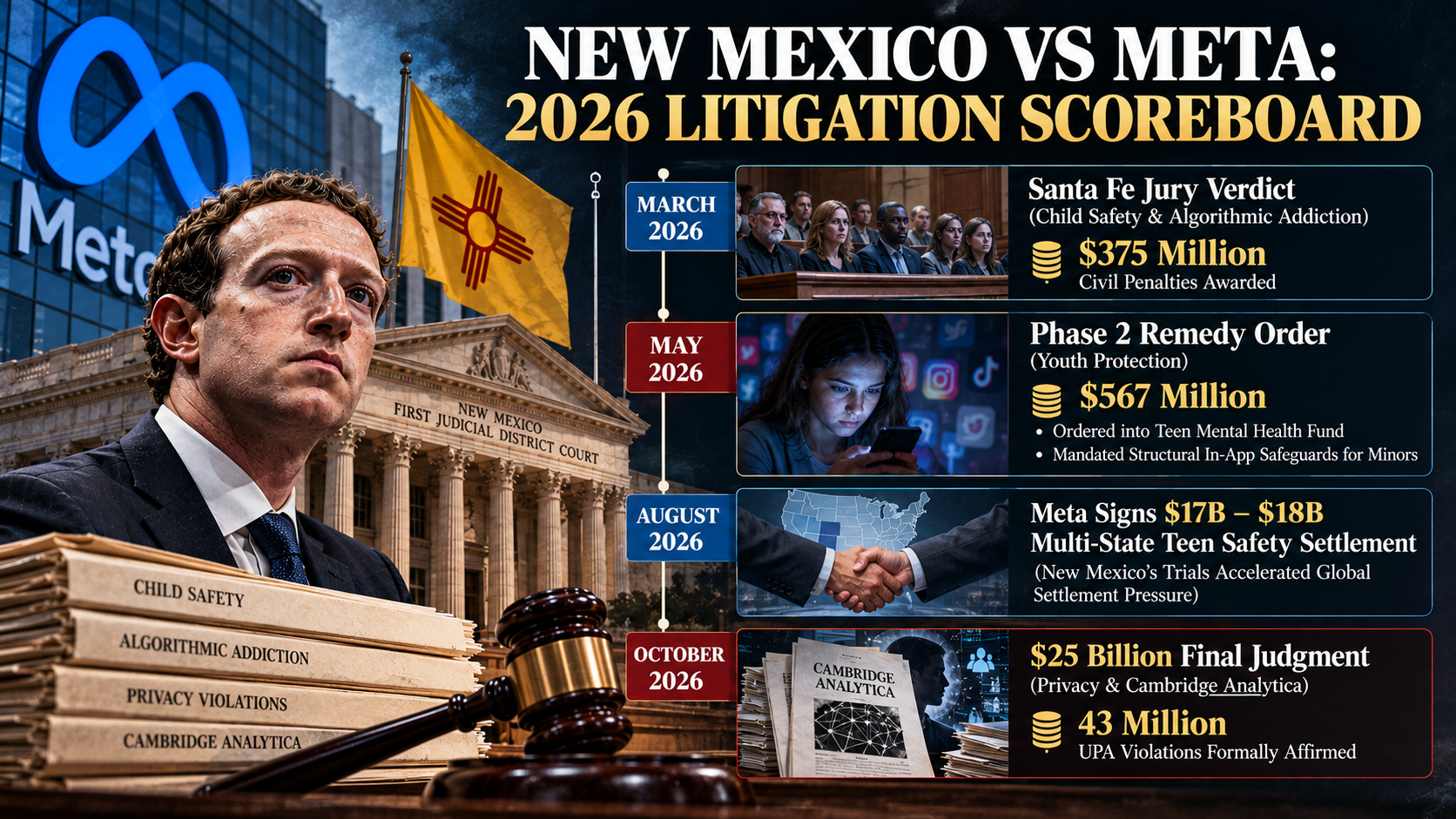
By refusing to join multi-state settlement committees that negotiated modest per-state payouts, Torrez pursued a high-risk, high-reward strategy: empannelling local New Mexico juries and putting internal corporate emails, algorithm designs, and executive depositions on open trial.
The strategy shattered Meta’s standard legal defence that consumer tech platforms are shielded from state-level consumer deception lawsuits by federal preemption or Section 230 of the Communications Decency Act.
6. Meta’s Financial Impact and the Looming Appellate Battle
Meta immediately announced it will file an emergency appeal with the New Mexico Court of Appeals, escalating the matter to the New Mexico Supreme Court and ultimately the United States Supreme Court.
The Financial Balance Sheet
Meta’s operational performance remains an advertising juggernaut. In its Q3 2026 earnings report, Meta reported a 26% year-on-year surge in quarterly revenue to $64.6 billion (around ₹5.36 lakh crore). However, quarterly net income missed analyst estimates significantly after Meta recorded a $9.9 billion pre-tax litigation charge associated with ongoing state settlements.
While Meta holds over $65 billion in cash, cash equivalents, and marketable securities, paying out $25 billion in cash would absorb nearly 40% of its total liquid treasury, severely restricting its planned capital expenditures in Nvidia AI compute clusters, custom silicon design, and Llama foundation model training.
The Constitutional Battleground
Meta’s appeal will hinge on three bedrock constitutional doctrines:
The Punitive-to-Compensatory Due Process Ratio: In State Farm Mutual Automobile Insurance Co. v. Campbell (2003), the US Supreme Court ruled that punitive awards exceeding a single-digit ratio (greater than 9:1) relative to actual compensatory damages violate Fourteenth Amendment Due Process. Meta will argue that because New Mexico proved zero direct economic compensatory loss, a $25 billion civil penalty is unconstitutionally punitive.
Eighth Amendment Excessive Fines Clause: Following Timbs v. Indiana (2019), which incorporated the Excessive Fines Clause against the states, Meta will argue that a $25 billion penalty is grossly disproportional to the gravity of the underlying conduct.
Statute of Limitations and Prior Settlement Preclusion: Meta contends that claims regarding the 2018 Cambridge Analytica events are time-barred under New Mexico’s four-year statute of limitations, and that its 2019 consent decree with the FTC already resolved federal claims governing the same conduct.
The State of New Mexico will counter that statutory civil penalties enacted by a legislature to deter unlawful corporate conduct are not subject to private common-law punitive damages ratios, and that each day Meta maintained its deceptive statements constituted an ongoing, independent consumer violation.