In brief
- Jio Platforms Limited raised 30,213 crore across the public issue, after starting with an anchor book on 19 October and closing the offer on 23 October 2026.
- The issue priced in a band of ₹1,065 to ₹1,119 per share and became the biggest public issue in Indian financial history.
- Day one saw a 100 percent subscription in 100 minutes, with the issue subscribed 3.01 times by the end of the first day and over ₹66,500 crore in committed capital within six hours of trading.
- By the close on 23 October 2026, overall subscription stood at 7.01 times with total bid capital exceeding ₹2.1 lakh crore, and QIBs and high net worth investors drove the demand across investor categories.
On 28 October 2026, when Mukesh Ambani strikes the ceremonial gong at the BSE rotunda in Mumbai, it will formalise the public debut of Jio Platforms Limited (JPL). Yet, in the annals of Indian capital markets, the history of this public offer was already written well before the shares were credited to investor demat accounts.
Between the opening of the anchor book on 19 October and the closing bell of public bidding on 23 October 2026, the digital and telecommunications arm of Reliance Industries Limited (RIL) staged an unprecedented display of financial absorption.
Priced in a band of ₹1,065 to ₹1,119 per share, the public issue raised ₹30,213 crore ($3.62 billion). It did not merely surpass the previous record holders; it completely redefined the scale of capital that domestic and foreign institutional investors can commit to a single Indian equity issuance.
The All-Time Leaderboard: India’s Mega-IPOs Compared
To understand the magnitude of Jio Platforms' pre-listing performance, one must compare it against the historical giants of Dalal Street:
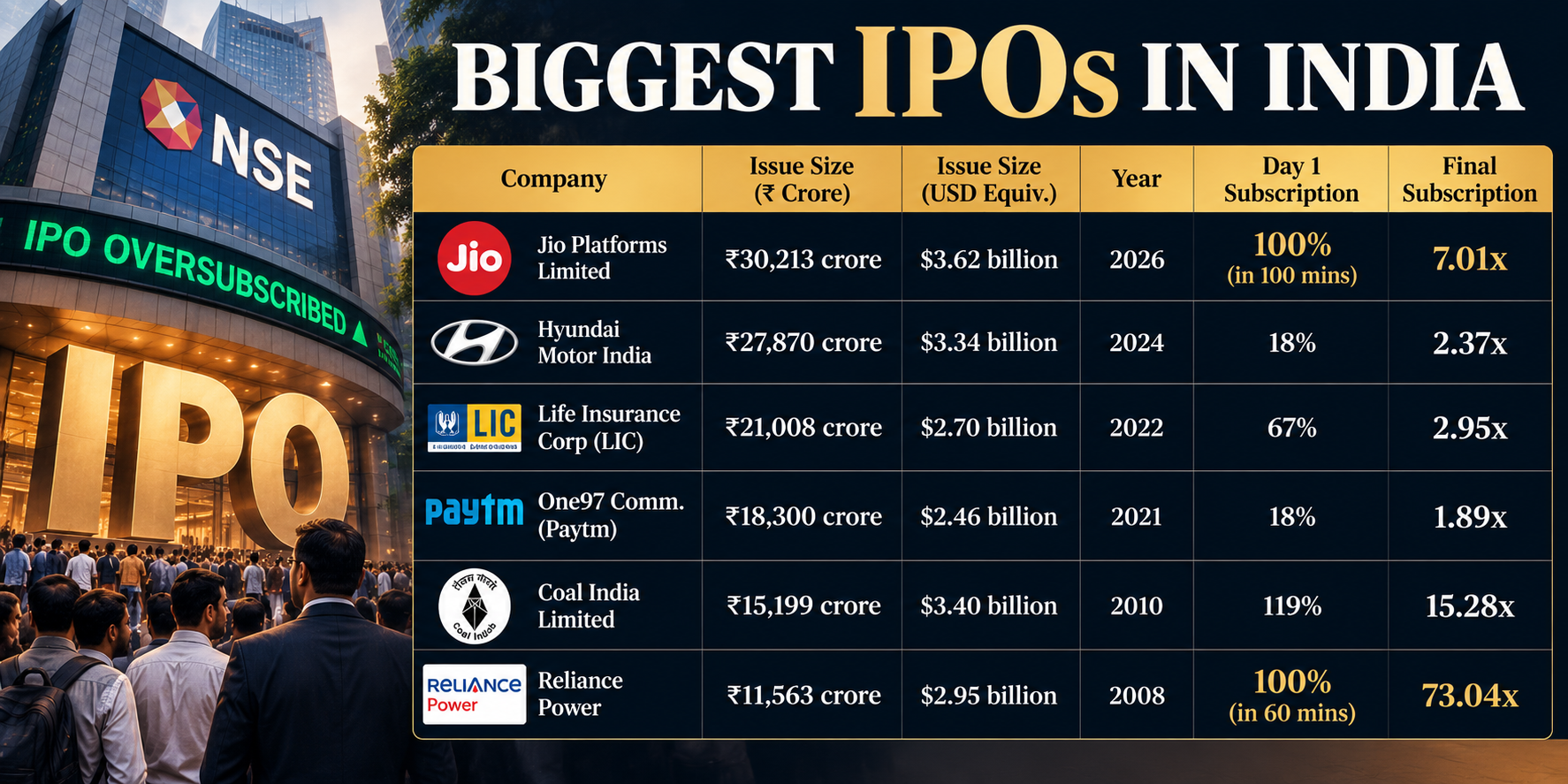
Historically, Indian mega-issues exceeding ₹15,000 crore suffered from severe demand fatigue. Hyundai Motor India in October 2024 required deep institutional underwriting on Day 3 to rescue an offer that retail investors largely avoided. LIC required state-backed domestic institutional support. Paytm became a cautionary tale of valuation overreach.
Jio Platforms, by contrast, broke through the liquidity ceiling across four distinct records before a single share changed hands on the secondary market.
Record 1: The ₹2.5 Lakh Crore Anchor Book Avalanche
The tone for the entire issue was established on Monday, 19 October 2026, when Jio Platforms opened its anchor book.
Under SEBI regulations, up to 60% of the Qualified Institutional Buyer (QIB) portion can be allocated to anchor investors to de-risk the public sale. Jio offered ₹8,110 crore ($970 million) to institutional anchors.
What followed was the largest institutional demand backlog ever recorded in an emerging market:
Over ₹2.5 lakh crore ($30 billion) in formal bids flooded the merchant bankers—representing an oversubscription rate of more than 30 times.
Over 70 sovereign wealth funds, global pension systems, and marquee asset managers submitted commitments.
Tier-1 allocations were secured by sovereign giants including Singapore’s GIC, the Abu Dhabi Investment Authority (ADIA), the Canada Pension Plan Investment Board (CPPIB), BlackRock, and Fidelity, alongside leading domestic asset managers such as SBI Mutual Fund, ICICI Prudential, and HDFC Mutual Fund.
The demand was so fierce that sovereign funds that routinely demand 5% to 10% anchor blocks were scaled back to fractional allocations, creating an intense "fear of missing out" (FOMO) that spilled directly into the public bidding window.
Record 2: The 100-Minute Sellout on Day 1
When public bidding commenced at 10:00 AM IST on Wednesday, 21 October 2026, retail and institutional bids entered the exchange order books at an unprecedented velocity:
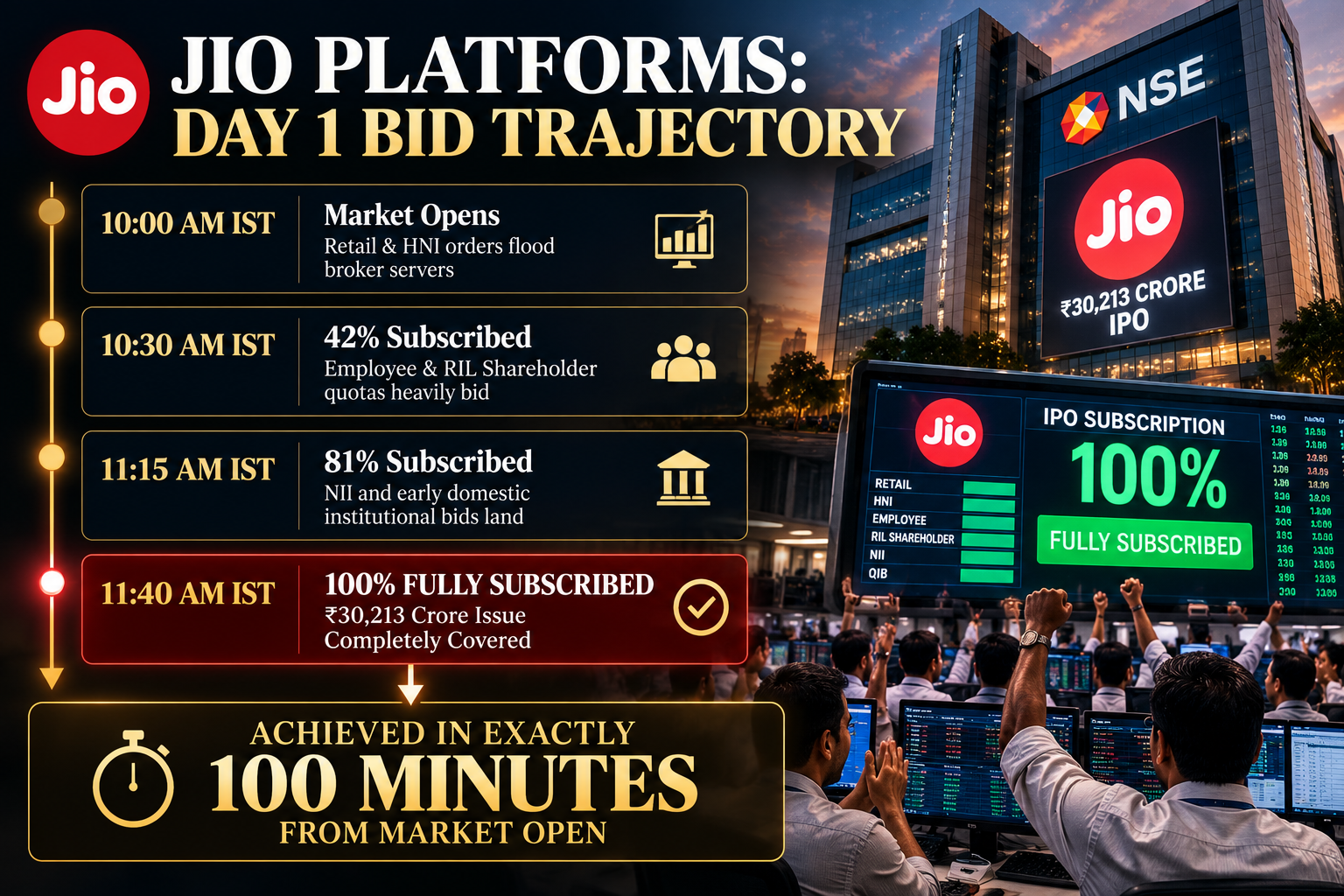
Achieving 100% subscription in 100 minutes on an issue size exceeding ₹30,000 crore was a historic milestone. While Reliance Power’s ₹11,563 crore IPO in January 2008 technically was booked in 60 minutes, that occurred in a market one-third the size, with a fraction of modern compliance and ASBA (Application Supported by Blocked Amount) verification checks.
By the end of Day 1, the issue was subscribed 3.01 times, securing over ₹66,500 crore in committed capital within six hours of trading.
Record 3: Aggregate Bidding Crosses ₹2.1 Lakh Crore on Day 3
As the issue closed on Friday, 23 October 2026, the final subscription tallies demonstrated deep institutional and broad-based retail support:
Overall Subscription: 7.01 times the net offer.
Total Bid Capital Committed: Exceeding ₹2.1 lakh crore ($25.2 billion) across all investor categories.
Qualified Institutional Buyers (QIB): Bounded past 14.06 times, with international long-only funds competing aggressively against domestic financial institutions for unallocated shares.
Non-Institutional Investors (NII / High Net-Worth Individuals): Subscribed 6.38 times in the big HNI (applications above ₹10 lakh) category.
Retail Individual Investors (RII): Subscribed 1.95 times, ensuring healthy widespread distribution without the speculative over-leveraging that plagued earlier cycles.
Record 4: India's Largest Corporate Spin-Off Valuation
At the upper price band of ₹1,119 per share, Jio Platforms commands a post-money market capitalisation of approximately ₹10.3 lakh crore (approx $123 billion).
To contextualise this valuation:
It establishes Jio Platforms as the fourth most valuable corporation in India, trailing only its parent Reliance Industries Limited, Tata Consultancy Services (TCS), and HDFC Bank.
It instantly surpasses the standalone enterprise valuations of global telecom titans including SoftBank Group, Vodafone Group, and Telefónica.
It trades at an enterprise value to EBITDA (EV/EBITDA) multiple of approximately 13.5x, reflecting a deliberate premium over traditional telecom utilities (Bharti Airtel historically trades between 10x and 11.5x EV/EBITDA).
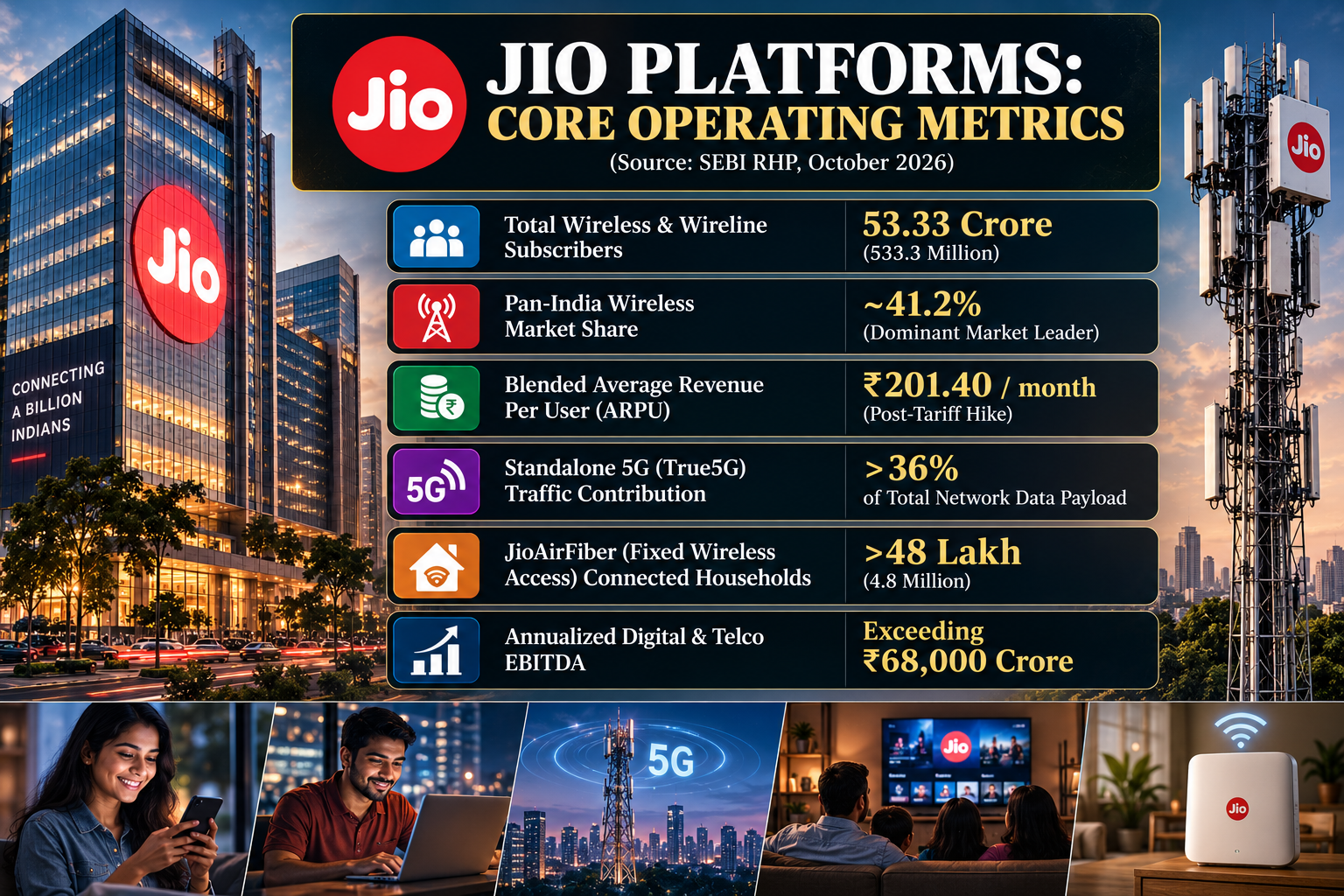
Dalal Street granted this valuation premium because of the operational metrics revealed in the company's SEBI filings:
Grey Market Dynamics: What the ₹245 GMP Signals
In the unofficial grey market—where unlisted shares and application rights are traded ahead of formal exchange listing—Jio Platforms equity traded at a premium (GMP) of ₹245 per share on the final day of bidding.
At a cut-off price of ₹1,119:
Projected Listing Price: ₹1,364 per share.
Implied Listing Gain: Approximately 21.9%.
Implied Initial Market Cap on Debut: North of ₹12.5 lakh crore ($150 billion).
For an IPO of this magnitude, delivering a projected 20%+ listing day expansion indicates that foreign institutional investors who were scaled back in the anchor and QIB books plan to purchase stock aggressively in the secondary market post-listing to fulfill passive benchmark tracking requirements.
The Broader Market Implications for Dalal Street
The structural success of Jio Platforms’ pre-listing phase sends ripples across the Indian financial ecosystem:
Passive Benchmark Rebalancing: As one of the largest market-cap entities in the country, Jio Platforms will fast-track into the Nifty 50, BSE Sensex, and MSCI Emerging Markets indices. Index-tracking exchange-traded funds (ETFs) will need to reallocate an estimated $1.8 billion to $2.4 billion in passive capital into JPL stock within 60 to 90 days of listing.
The Reliance Industries (RIL) Value Unlock: RIL shares, which held an embedded discount for its unlisted telecommunications assets, will see holding-company clarity. Analysts project that RIL’s remaining ~66% controlling stake in Jio Platforms provides an unshakeable asset backing that will support RIL’s ongoing capital expenditure into green hydrogen, solar gigafactories, and retail expansion.
Validation of Domestic Capital Pools: The ease with which the domestic market absorbed a ₹30,213 crore issue without causing secondary market liquidity distress underscores the growing maturity of Indian domestic mutual fund systematic investment plans (SIPs), which currently channel over ₹22,000 crore monthly into equity markets.
When the opening trade prints on Wednesday, 28 October 2026, the market will measure Jio Platforms by quarterly ARPU expansion and enterprise margins. But before the first public trade was executed, Jio Platforms demonstrated that the Indian capital market can underwrite global-scale liquidity entirely on its own terms.