In brief
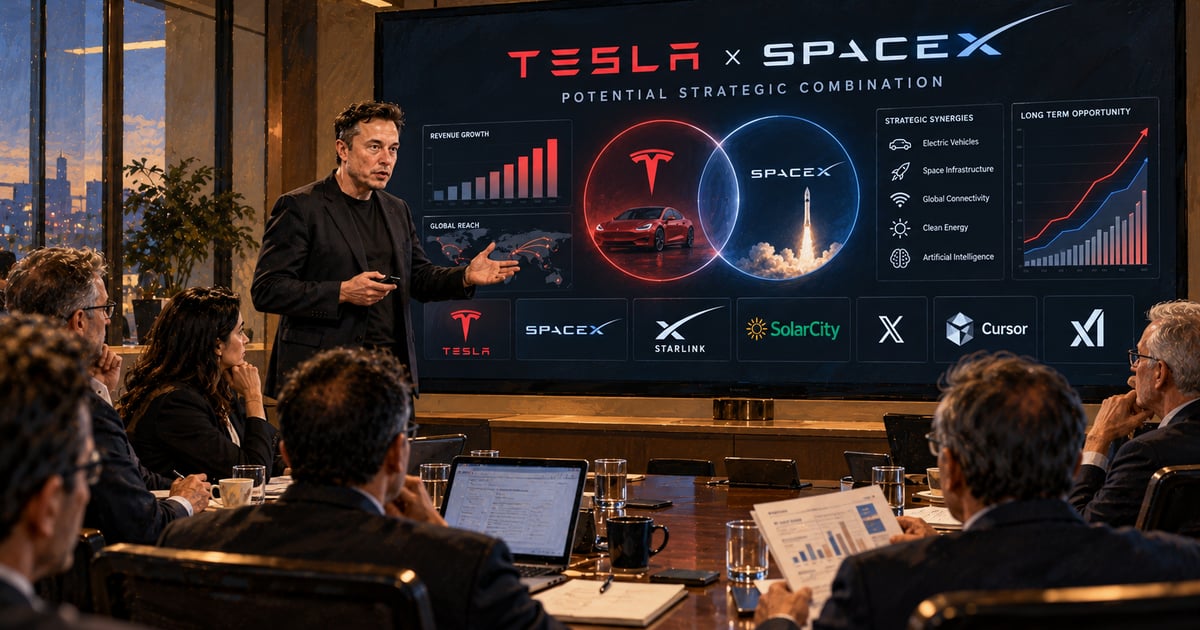
- Elon Musk confirmed that the boards of Tesla and SpaceX have formed independent special committees to evaluate a full corporate merger of the two companies, which would create a consolidated industrial behemoth valued at between $3.5 trillion and $3.7 trillion.
- The proposed merger integrates four domains into a vertically integrated stack: robotics and autonomous transport, space logistics and broadband, frontier artificial intelligence, and custom silicon manufacturing.
- SpaceX is the vehicle for space logistics and the Starlink constellation, with the Grok models from xAI integrated into the corporate structure, and Terafab will manufacture proprietary silicon.
- The timetable focuses on an Exploratory Phase in Q4 2026 driven by the American political and regulatory calendar, with due diligence supported by advisers Morgan Stanley for SpaceX and Goldman Sachs for Tesla, among others.
On 20–21 October 2026, during back-to-back earnings and operational presentations, Elon Musk confirmed what Wall Street analysts and aerospace insiders had debated for years: the boards of directors of Tesla Inc. (NASDAQ: TSLA) and Space Exploration Technologies Corp. (SpaceX) have formally chartered independent special committees to evaluate a full corporate merger of the two companies.
Musk publicly endorsed the combination while noting that he had recused himself from formal committee negotiations, characterising the governance landscape as "tap dancing through a minefield."
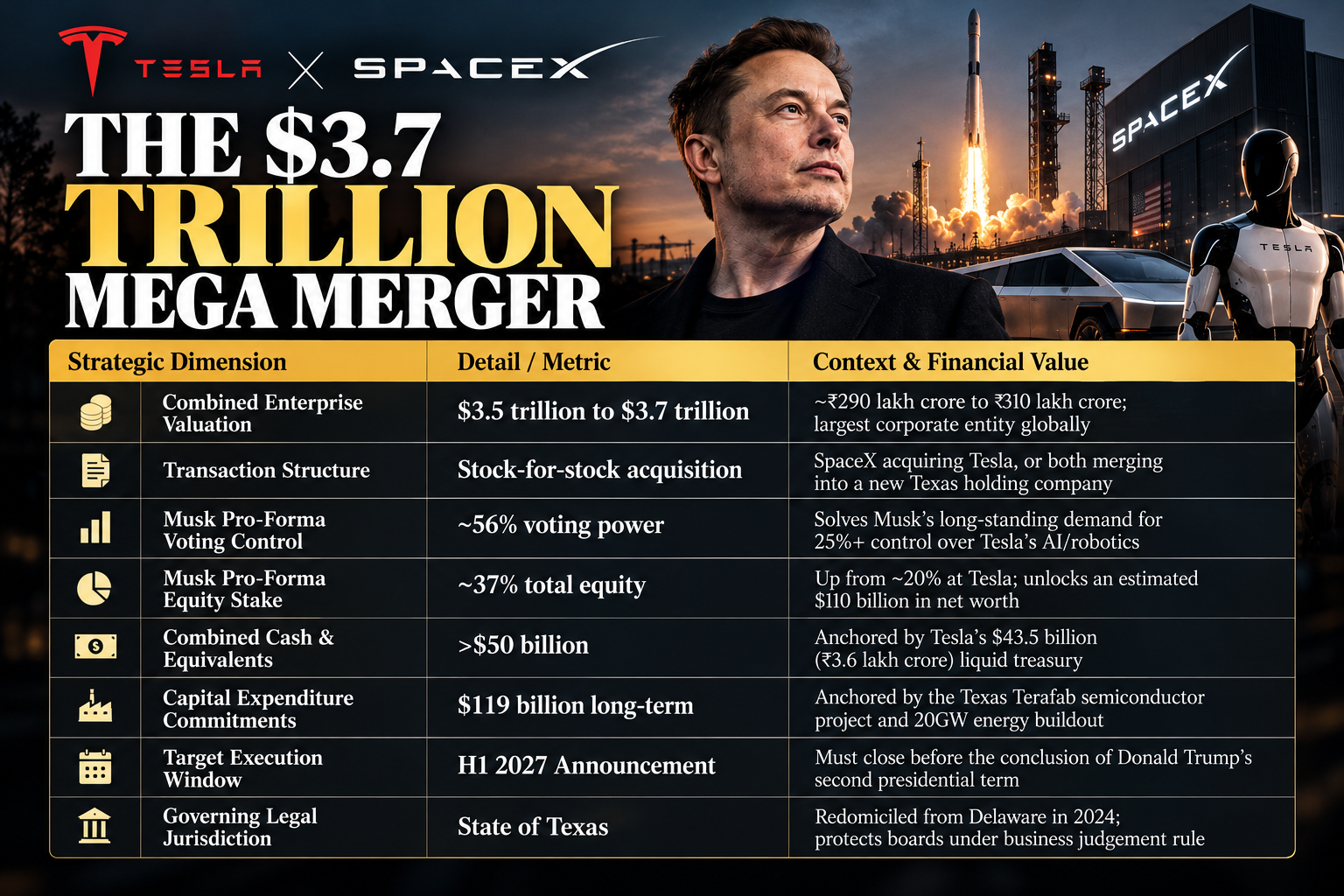
If executed, the transaction will create a consolidated industrial behemoth valued at between $3.5 trillion and $3.7 trillion (roughly ₹290 lakh crore to ₹310 lakh crore). It would instantly surpass Microsoft, Apple, and Nvidia to become the most valuable single corporate entity on the planet.
Below is the definitive breakdown of what the proposed merger involves, how it is legally and mathematically structured, why it is happening now, the strict timetable governing its execution, the critical numbers, and its geopolitical implications.
1. WHAT: The Creation of an End-to-End Industrial Sovereign
The entity envisioned by the boards of Tesla and SpaceX is not merely a conglomerate in the mould of General Electric or Berkshire Hathaway. It is designed as a vertically integrated physical-and-digital infrastructure stack:
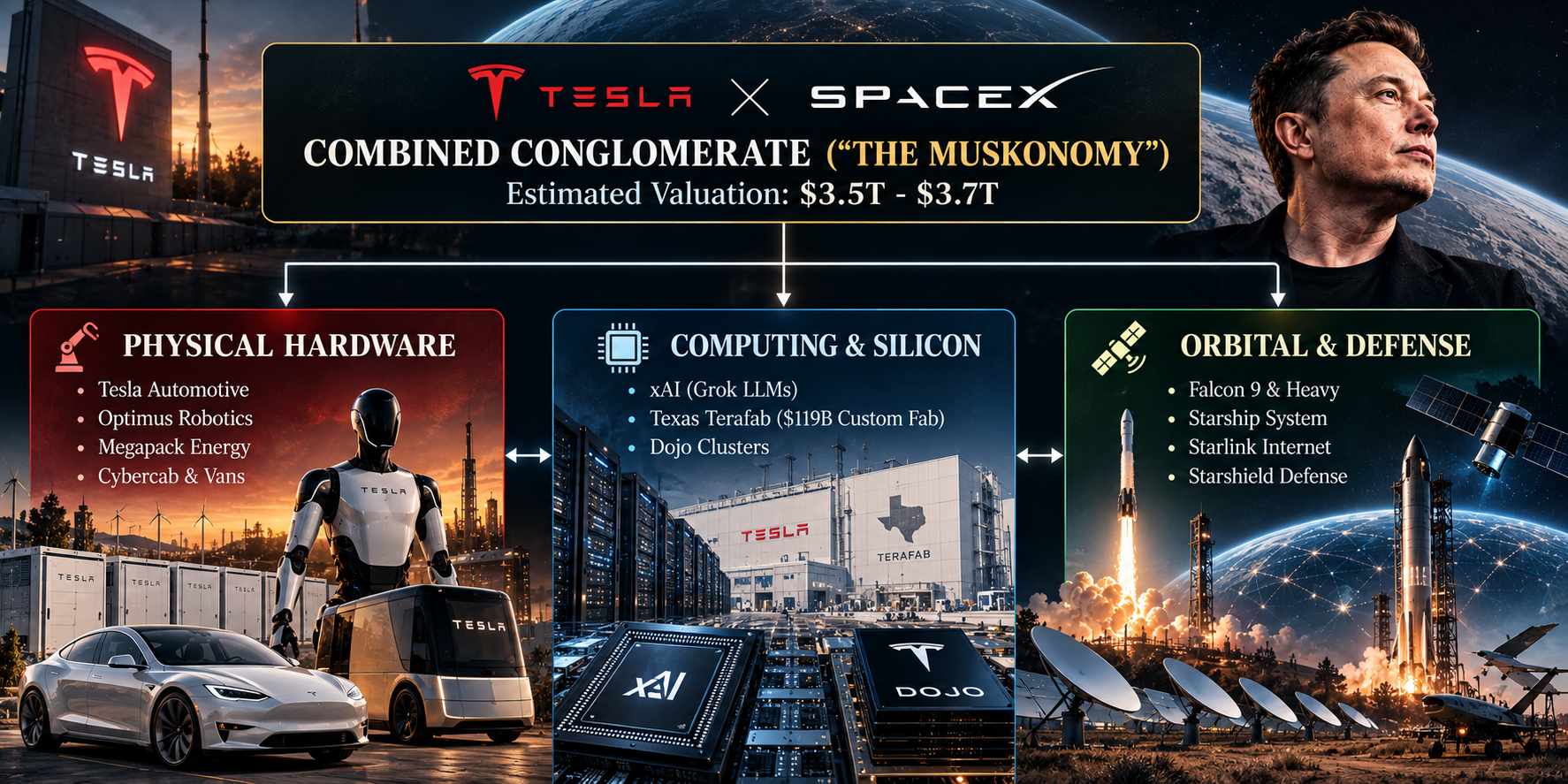
This entity brings together four previously fragmented technological domains:
Robotics and Autonomous Transport: Tesla’s Full Self-Driving (FSD) fleet, the Cybercab platform, and the Optimus humanoid robotics division.
Space Logistics and Broadband: SpaceX’s fully reusable Starship orbital launch architecture and the Starlink satellite mega-constellation (now exceeding 22 million direct-to-cell users).
Frontier Artificial Intelligence: xAI, which was formally acquired by SpaceX in February 2026 at a $1.25 trillion valuation, integrating the Grok reasoning models directly into the corporate structure.
Custom Silicon Manufacturing: The Terafab, a massive semiconductor manufacturing initiative in Texas designed to produce proprietary silicon for vehicles, robots, and orbital compute nodes.
2. HOW: The Governance Playbook, Texas Law, and Voting Math
Structuring a merger between a publicly traded, widely held company (Tesla) and an intensely guarded private enterprise with dual-class stock (SpaceX) presents acute governance complexities.
The Voting Control Arbitrage
For years, Musk publicly insisted that he felt "uncomfortable growing Tesla to be a leader in AI & robotics without having ~25% voting control." Following his sale of Tesla shares to finance the acquisition of Twitter (now X) in 2022 and the Delaware Chancery Court’s invalidation of his $56 billion compensation package, his voting stake in Tesla hovered around 20%.
In SpaceX, however, Musk controls approximately 82% of the voting power through Class B super-voting shares (which carry 10 votes per share), despite owning roughly 42% of the underlying equity.
According to deal models compiled by Barclays:
If SpaceX acquires Tesla in a stock-for-stock merger, SpaceX’s dual-class capital structure will be superimposed over Tesla’s single-class public equity.
In the merged pro-forma entity, Musk would own roughly 37% of the total equity, but his super-voting stock would grant him approximately 56% of the aggregate voting power.
This permanently secures majority voting control over Tesla’s automotive balance sheet and robotics IP, eliminating activist hedge fund pressure without requiring Musk to spend personal capital.
The Texas Jurisdiction Shield
A transaction of this nature would have faced near-certain legal death in Delaware, where the Court of Chancery applies the exacting "entire fairness" doctrine to transactions where a controlling shareholder sits on both sides of the negotiating table (as demonstrated during the protracted litigation surrounding Tesla’s 2016 acquisition of SolarCity).
In 2024, Musk orchestrated the re-incorporation of both Tesla and SpaceX to Texas. Texas corporate law provides a radically different corporate governance framework:
Texas courts adhere strictly to the business judgement rule and statutory safe harbours.
Under Chapter 7 of the Texas Business Organizations Code, shareholders bringing a derivative claim against directors for breach of fiduciary duty must clear a formidable threshold: proving that directors engaged in "fraud, intentional misconduct, an ultra vires act, or a knowing violation of law."
Simply proving that a founder stood on both sides of a merger negotiation is legally insufficient to overturn a transaction approved by an independent special committee and ratified by shareholders.
3. WHY: The Industrial Rationale and Balance Sheet Arbitrage
The operational justification for combining Tesla and SpaceX rests on three interlocking imperatives: capital reallocation, silicon independence, and the emergence of "physical AI."
A. Balance Sheet Arbitrage: The $43.5 Billion Cash Engine
While Tesla’s electric vehicle deliveries have experienced margin compression and slowing growth due to intense competition from Chinese manufacturers (such as BYD), the business remains an exceptional cash generator. As of mid-2026, Tesla holds $43.5 billion (₹3.6 lakh crore) in liquid cash, cash equivalents, and marketable securities.
SpaceX, conversely, is experiencing exponential top-line expansion driven by Starlink's dominance, but faces staggering capital expenditures:
SpaceX management expects fourth-quarter 2026 capex alone to reach $35 billion to $40 billion.
The company is building out 20 gigawatts (GW) of dedicated power generation and cooling infrastructure through 2027 to support orbital and terrestrial AI clusters.
Developing the fully reusable Starship system and building lunar/Martian infrastructure requires continuous capital infusions.
Merging the companies allows SpaceX to directly tap Tesla’s massive cash reserves and cash-generating operations to fund space exploration and computing infrastructure, completely bypassing volatile private debt and equity markets.
B. The Terafab: Silicon Self-Sufficiency
In March 2026, Musk announced the Terafab—a joint semiconductor manufacturing venture in Texas projected to require up to $119 billion (around ₹9.9 lakh crore) in total long-term capital deployment.
Tesla’s Optimus humanoid robots, Cybercabs, and Dojo supercomputers require millions of specialized AI inference chips. Concurrently, SpaceX plans to deploy orbital AI data centres linked via Starlink optical laser cross-links. Rather than remaining vulnerable to Taiwan Semiconductor Manufacturing Company (TSMC) allocation constraints and geopolitical risks in the Taiwan Strait, the merged firm intends to manufacture its own silicon domestically. Operating the Terafab under a single corporate entity eliminates complex inter-company transfer pricing and IP-licensing disputes.
C. Pre-Existing Inter-Company Web
The two companies are already commercially entangled:
SpaceX has purchased roughly $1 billion in Tesla Megapack industrial battery installations and utility storage to power its launch complexes in Starbase, Texas, and Cape Canaveral.
SpaceX purchased $131 million worth of Tesla Cybertrucks in 2025 alone for fleet and transport operations.
Tesla’s original $2 billion strategic investment in xAI was converted directly into SpaceX equity when SpaceX acquired xAI in February 2026.
Grok AI models are already embedded natively into Tesla vehicles as conversational assistants.
Consolidating the entities cleanses these tangled related-party transactions off the books, replacing opaque board-level procurement approvals with unified corporate reporting.
4. WHEN: The Timetable and the "Trump Window"
The timing of the merger is dictated less by financial quarters and more by the American political and regulatory calendar.
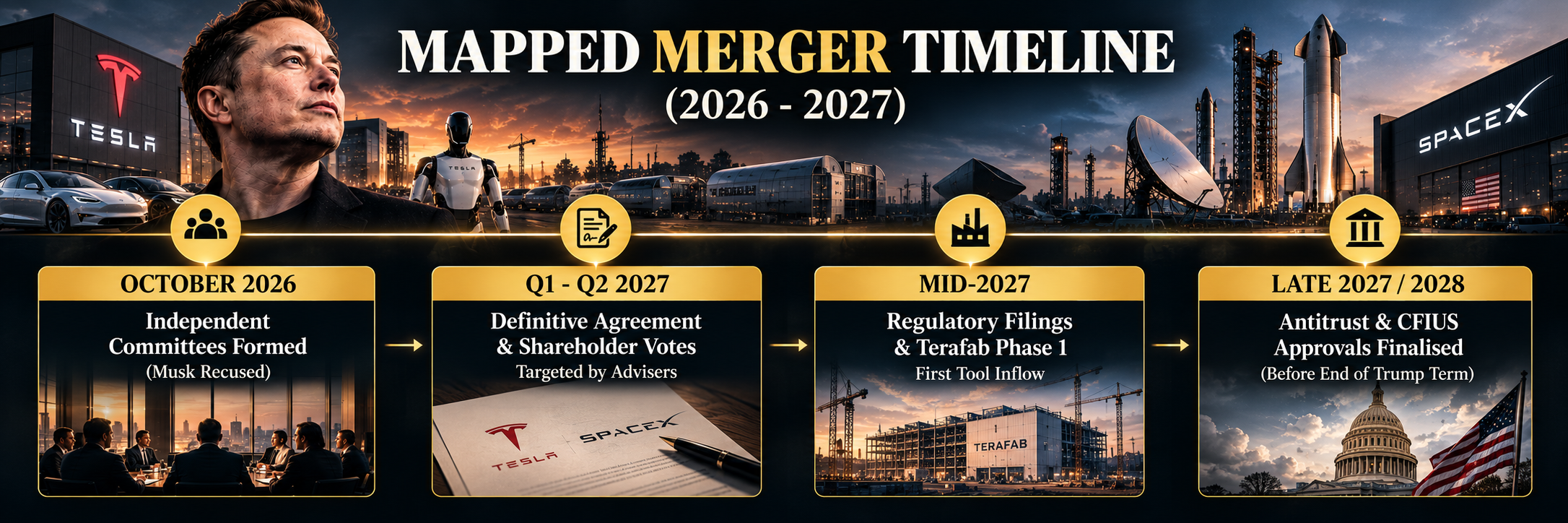
Exploratory Phase (Q4 2026): Independent special committees of both boards conduct due diligence, supported by financial advisers (Morgan Stanley advising SpaceX; Goldman Sachs and independent counsels advising Tesla).
Definitive Terms (H1 2027): Advisers are targeting a formal merger agreement announcement in the first half of 2027, accompanied by an information statement and proxy solicitation for public Tesla shareholders.
The Regulatory Deadline (Pre-2028): Insiders emphasise that the transaction must achieve definitive regulatory closure before the conclusion of Donald Trump’s second presidential term. The current antitrust leadership at the Federal Trade Commission (FTC) and the Department of Justice (DOJ) is considered structurally receptive to domestic industrial consolidation, particularly given Musk’s close advisory role in the administration. A future, potentially hostile Democratic administration could tie up the merger in antitrust and national security reviews for years.
5. THE NUMBERS: Valuations, Stakes, and Dilution
The mathematical scaffolding of the transaction reflects an extraordinary concentration of wealth and industrial scale:
Valuation Breakdown:
Tesla Inc. Market Capitalisation: Fluctuating between $850 billion and $1.1 trillion (depending on quarterly automotive margins and autonomy milestones).
SpaceX Enterprise Valuation: Valued between $1.5 trillion and $2.5 trillion, incorporating its commercial launch monopoly, Starlink's expanding cash flows, and the assets of xAI (valued at $250 billion at acquisition).
Combined Market Value: Modelled at $3.5 trillion to $3.7 trillion at closing.
Musk's Personal Net Worth Arbitrage: Bloomberg estimates that the consolidation and subsequent re-rating of the combined stock will expand Elon Musk’s personal fortune by more than $110 billion (approx ₹9.1 lakh crore), solidifying his status as the world’s first half-trillionaire.
Terafab Capital Escalation: Initial Phase 1 capital applications in Texas call for $10.37 billion to $16.8 billion in facility and tooling investments, scaling to "tens of billions" by 2028 and north of $100 billion across its operational lifecycle.
Capital Synergies: Tesla's annual R&D budget (exceeding $4 billion) and capital expenditure envelope can be immediately pooled with SpaceX's launch infrastructure, creating an annual combined R&D engine exceeding $15 billion.
6. IMPLICATIONS: Geopolitics, Defence, and Shareholder Risks
While the industrial logic is formidable, the merger introduces profound geopolitical, regulatory, and corporate governance risks.
A. The China-Pentagon National Security Conflict
This represents the deal’s most dangerous fault line:
The Pentagon’s Dependence on SpaceX: SpaceX is arguably the United States military's most critical non-state asset. It holds exclusive or dominant contracts for National Security Space Launch (NSSL) missions, operates the classified Starshield satellite network for US intelligence agencies, and provides the lunar landing system for NASA's Artemis programme.
Tesla’s Dependence on Beijing: Tesla relies heavily on mainland China. Its Gigafactory Shanghai produces approximately 50% of its global vehicle volume, and the company is deeply integrated into Chinese battery supply chains (primarily via CATL) while seeking expanded regulatory approval for Full Self-Driving within Chinese borders.
National security analysts and the Committee on Foreign Investment in the United States (CFIUS) will face an unprecedented dilemma: Can America’s primary military launch provider and orbital surveillance operator be corporate twin to an automaker whose assets and intellectual property are subject to the regulatory coercion of the Chinese Communist Party?
Chinese regulators may reciprocate by banning merged-entity vehicles from Chinese roads or government facilities, fearing onboard sensors could transmit data to a primary US defense contractor.
B. The "SolarCity 2.0" Risk for Public Shareholders
Public Tesla shareholders will be asked to exchange their liquid, transparent public equity for shares in a massive conglomerate carrying immense aerospace and experimental capital risk.
If a Starship test launch fails, an orbital AI data centre malfunctions, or space capex balloons uncontrollably, public automotive investors will absorb the financial impact. Critics will argue that, much like the 2016 acquisition of debt-laden SolarCity, Tesla’s pristine corporate balance sheet is being deployed to insulate Musk’s high-risk personal passion projects.
C. Unchecked Planetary Monopolistic Power
A single corporate entity controlling orbital access, satellite internet, terrestrial autonomous transportation, humanoid workforce robotics, frontier large language models, and private semiconductor foundries will hold structural power exceeding that of most sovereign states. Regulators in the European Union and the United Kingdom are likely to subject the combination to intense antitrust scrutiny, questioning whether any market can remain competitive when one company controls both the physical launch infrastructure and the digital computing networks of the modern economy.