In brief
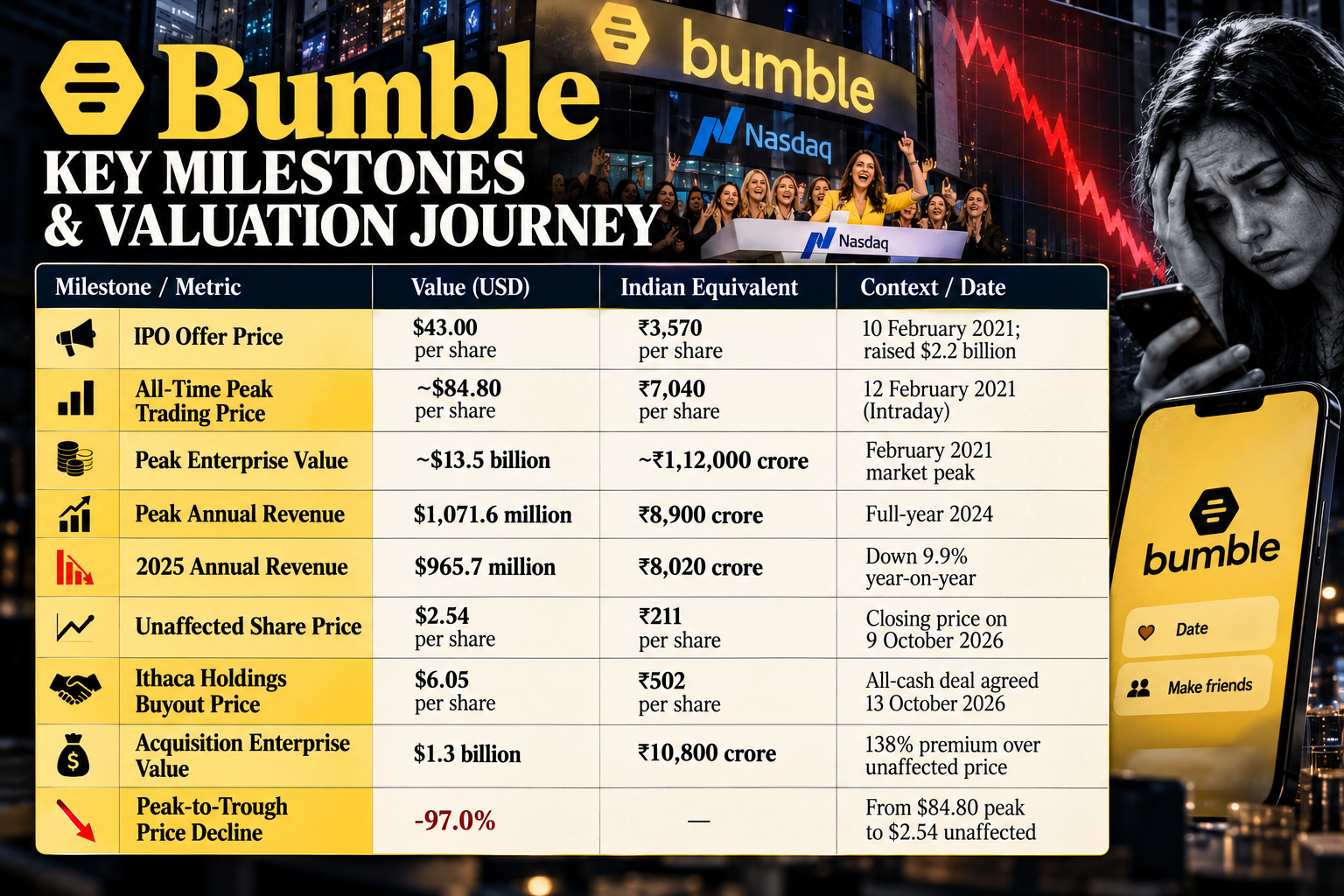
- Bumble rose from a 2021 IPO to a 97 per cent public market wipeout and is now being taken private by Ithaca Holdings in a deal valued at $1.3 billion, with common shareholders receiving $6.05 per share.
- The deal comes after Bumble's stock collapsed from its IPO surge and peak, and its new private status is part of restructuring after years of monetisation pressure and product fatigue.
- The withdrawal from public markets follows structural issues including the exhaustion of the founding product mechanic, aggressive monetisation penalties on younger users, failed diversification, and cultural shifts away from gamified dating apps.
- An independent Special Committee of Bumble’s Board, chaired by Ann Mather, unanimously recommended the sale to Ithaca Holdings, with Whitney Wolfe Herd recusing herself from board deliberations but joining Blackstone in authorising the transaction.
When Bumble Inc. debuted on the Nasdaq Global Select Market on 11 February 2021, it represented more than a lucrative Silicon Valley liquidity event. At 31, founder Whitney Wolfe Herd became the youngest woman to take an American company public, ringing the opening bell with her toddler on her hip while confetti rained across the trading floor.
Investors rushed into the stock. Priced at $43 per share, Bumble shares opened at $76 and peaked intraday near $84 on their second day of trading, giving the company a market capitalisation exceeding $8.6 billion and an enterprise valuation approaching $14 billion (around ₹1.1 lakh crore).
Five years later, that triumph came to an ignominious end. On 13 October 2026, Bumble announced a definitive agreement to be acquired by Ithaca Holdings in an all-cash take-private transaction valuing the business at $1.3 billion (roughly ₹10,800 crore). Common shareholders will receive $6.05 per share.
While the headline transaction offered a 138% premium over Bumble’s unaffected closing price of $2.54 on 9 October 2026, it marked an 86% destruction of capital relative to its IPO offer price, and a 93% collapse from its peak. For early public market backers who bought during the initial trading surge, the equity was effectively obliterated.
Bumble did not fall because of a single catastrophic executive blunder. Its unravelling was structural, stemming from the exhaustion of its founding product mechanic, an aggressive monetisation strategy that penalised younger users, failed diversification attempts, and a cultural revolt against gamified dating apps.
1. The Core Mechanic Paradox: The Exhaustion of the "First Move"
Bumble was founded in 2014 following Wolfe Herd’s high-profile, acrimonious exit from Tinder. Its central premise was both a brand identity and a product feature: in heterosexual pairings, only women could send the first message, and they had to do so within 24 hours of matching, or the match vanished forever.
In 2014, this design was ingenious. It addressed the single worst aspect of mobile dating for women: an inbox inundated with unsolicited, vulgar, or aggressive opening messages. By giving women control of the opening salvo, Bumble fostered a perceived haven of civility, quickly establishing itself as the premier "feminist" dating alternative.
Over a decade, however, that protective shield transformed into a severe cognitive tax:
The Choreification of Swiping: Women began complaining of "first-move fatigue." Rather than feeling empowered, having to craft clever, engaging opening messages for dozens of matches felt like unpaid administrative labour.
The "Hey" Degradation: To prevent matches from expiring under the 24-hour clock, female users increasingly resorted to sending low-effort placeholders: a single wave emoji, a full stop, or "hey".
Male Disengagement: Men, who were paying for premium subscriptions to see their matches, frequently saw those matches expire without a single word spoken. This created resentment and reduced their willingness to keep paying for subscriptions.
The product had painted itself into a corner. If women initiated, they felt burnt out; if women did not initiate, the platform ground to a halt.
2. The Dilution of Identity and the 2024 Rebrand Disaster
By early 2024, user churn was accelerating. Wolfe Herd had stepped back to Executive Chair in January 2024, handing the reins to former Slack chief executive Lidiane Jones. The mandate was clear: reignite growth among Gen Z daters and fix the first-move bottleneck.
In April 2024, Bumble launched its most extensive product overhaul, introducing Opening Moves. The feature allowed women to set a pre-written question on their profile—such as "What’s your dream Sunday?"—to which male matches could reply directly.
While practically useful, the move was symbolically fatal. In attempting to relieve conversational pressure, Bumble abandoned its core philosophical differentiator. The app suddenly operated like Hinge. If men could initiate the conversation by answering a canned prompt, Bumble’s foundational identity as the app where "women make the first move" ceased to exist.
Worse was the marketing blitz deployed to promote the revamp. In May 2024, Bumble erected billboards across the United States and Europe carrying slogans such as:
"A vow of celibacy is not the answer."
"Thou shalt not give up on dating and become a nun."
The reaction was immediate and overwhelmingly hostile. A generation of young women, increasingly opting out of toxic dating cultures, prioritising mental health, and embracing celibacy movements (including South Korea’s 4B movement gaining traction in the West), viewed the campaign as patronising, tone-deaf, and sexist. Users took to TikTok and Instagram to accuse Bumble of gaslighting and shaming women back into the dating pool solely to protect its corporate subscription revenue.
The backlash was so intense that Bumble was forced to issue a public apology, dismantle the billboards, and donate $25,000 to domestic abuse charities. The brand equity painstakingly accumulated over a decade was fractured within weeks.
3. The Freemium Squeeze: Punishing Users to Hit Wall Street Targets
As a public company, Bumble faced quarterly pressure to maintain revenue expansion. When net user acquisition stalled after the 2021–2022 pandemic boom, management turned to the only lever available: aggressive monetisation.
Free functionality was progressively restricted. Features once accessible to casual users—such as seeing who liked you, advanced filters, and geographic flexibility—were locked behind escalating tiers: Bumble Boost, Bumble Premium, and the top-tier Bumble Premium+, priced as high as $50 (around ₹4,150) or more per month. Microtransactions for "SuperSwipes" and "Spotlights" were heavily pushed into user flows.
This strategy produced immediate negative feedback loops:
Younger Daters Were Priced Out: Gen Z users, facing acute pressures from inflation, rent, and student debt, balked at recurring subscriptions running hundreds of dollars a year.
The "Pay-to-Play" Perception: Non-paying users reported feeling invisible in the algorithm, concluding that free profiles were suppressed to compel subscription purchases.
Churn of the Best Users: In software as a service (SaaS), customer retention is rewarded. In dating apps, the central paradox is that genuine success results in customer churn: when two users fall in love, they delete the app. By hyper-monetising friction rather than matchmaking quality, Bumble incentivised frustrated users to quit rather than upgrade.
The consequence became painfully clear in its regulatory filings. By Bumble’s second quarter of 2026, total paying users fell 16.4% year-on-year to 3.16 million (31.6 lakh), down from 3.78 million (37.8 lakh) in the prior-year period. Full-year revenue had already dropped 9.9% in 2025 to $965.7 million (₹8,020 crore), and quarterly revenues contracted another 14% to 15% across early 2026.
4. Failed Diversification: The Ghost Towns of BFF and Bizz
Early in its corporate journey, Bumble pitched investors on an expansive vision: it would not merely be a dating app, but a comprehensive "social network for connection." It launched two sister modes:
Bumble BFF: To find platonic friends.
Bumble Bizz: For professional networking.
Neither ever justified the capital invested.
Bumble Bizz became an uncomfortable hybrid of LinkedIn and Tinder, plagued by unwanted romantic advances masked as professional networking and low engagement from established professionals.
Bumble BFF experienced initial curiosity, but suffered from abysmal long-term retention. Making friends online lacks the primal biological and emotional urgency of dating. Users would meet one or two friends, exchange phone numbers, and never return. In 2023, Bumble spun BFF out into a standalone app and relaunched it in September 2025, but its revenue contribution remained negligible compared to the core dating product.
Meanwhile, Bumble’s legacy asset, Badoo—the European and Latin American dating pioneer acquired via Andrey Andreev's MagicLab in 2019/2020 by Blackstone—experienced steady secular decline. Once a reliable cash cow subsidising Bumble’s international expansion, Badoo’s declining margins became a persistent drag on the consolidated balance sheet.
5. Macro Dating App Fatigue and Gen Z’s Offline Revolt
Bumble’s internal missteps coincided with an industry-wide reckoning. Between 2022 and 2026, the entire online dating sector ran into a demographic wall.
Surveys consistently indicated that more than 75% of Gen Z daters experienced severe emotional burnout from swiping apps. What had begun in the 2010s as a novel, frictionless way to meet people had evolved into an exhausting, hyper-commercialised slot machine. Users cited endless superficial conversations that rarely converted to real-world dates, frequent ghosting, and a pervasive sense that algorithmic feeds commodified human relationships.
This cultural fatigue triggered an intentional pivot back towards offline interactions:
Run clubs, singles mixers, and hobby-based meetups experienced unprecedented attendance across major global cities.
Younger singles turned to Instagram DMs, TikTok mutuals, and shared Discord communities for organic discovery.
For those remaining on apps, Match Group’s Hinge—marketing itself explicitly as "designed to be deleted"—captured relationship-minded daters by emphasising rich prompt answers and mutual comment threads rather than binary swiping.
Caught in a squeeze between Tinder’s ubiquitous hookup network and Hinge’s thoughtful relationship interface, Bumble lost its demographic foothold.
6. Leadership Turmoil and Strategic Paralysis
The corporate suite mirrored the product’s disarray. In November 2023, Whitney Wolfe Herd announced she would step down as chief executive after nine years.
Her successor, Lidiane Jones, assumed the post on 2 January 2024. Just weeks into her tenure, in February 2024, Jones oversaw the termination of 350 employees—roughly 37% of the global workforce. The restructuring was intended to streamline product engineering and trim operational expenses, but it disrupted institutional knowledge just as the app was embarking on its ill-fated redesign.
Following the billboard PR crisis and continued revenue contractions, Jones’s tenure proved short-lived. In January 2025, Bumble announced that Jones would depart in mid-March, and Wolfe Herd would return as chief executive to engineer a turnaround.
Upon her return, Wolfe Herd acknowledged that the dating landscape had reached an "inflection point." In June 2025, she executed another punishing round of layoffs, cutting 30% of the remaining global workforce. Despite promises to rebuild the platform around artificial intelligence and automated match curation, public markets had exhausted their patience.
With debt obligations, contracting top-line numbers, and the share price hovering near $2.50, Bumble had become an unviable public asset.
The Final Chapter: The Ithaca Holdings Take-Private
By mid-2026, Bumble was quietly working with Morgan Stanley and Goldman Sachs to explore strategic alternatives. With activist investors circling and Match Group battling its own operational headwinds, a trade sale to a competitor was untenable due to antitrust scrutiny and debt burdens.
The exit came from private equity. On 13 October 2026, an independent Special Committee of Bumble’s Board of Directors, chaired by Ann Mather, unanimously recommended the sale to Ithaca Holdings at $6.05 per share in cash. Whitney Wolfe Herd recused herself from board deliberations, but joined principal owner Blackstone in executing written consents to provide immediate shareholder approval.
Ithaca Holdings, led by Co-CEOs Ravi Gupta and John Hegeman (a former Meta advertising vice president), structured the deal as a long-term technology reboot. Gupta and Hegeman will step in as Co-CEOs of the privately held entity, partnering with Wolfe Herd to fundamentally redesign the product away from the traditional swipe mechanic and towards algorithmic, AI-assisted pairing.