In brief
- India's Technology Development Board signed a ₹200 crore agreement with Agnikul Cosmos on 25 September 2026 to develop a fully reusable Agnibaan launch vehicle using optionally convertible debentures, not a grant.
- The funding targets advancing Agnibaan RLV from technology readiness level 4 to 8, focusing on full-system recovery including a reusable upper stage, with orbital missions planned for the first half of 2027.
- Skyroot Aerospace reached orbit first with Vikram-1 on 18 July 2026, while India's private space startups grew from one in 2014 to 440 by August 2026, supported by a public-capital stack including a ₹1,000 crore venture fund.
- Analysts warn that government procurement remains a bottleneck, as private launch providers depend on ISRO infrastructure and await sovereign contracts, while IN-SPACe targets a $44 billion space economy by 2033 requiring 16.2% annual growth.
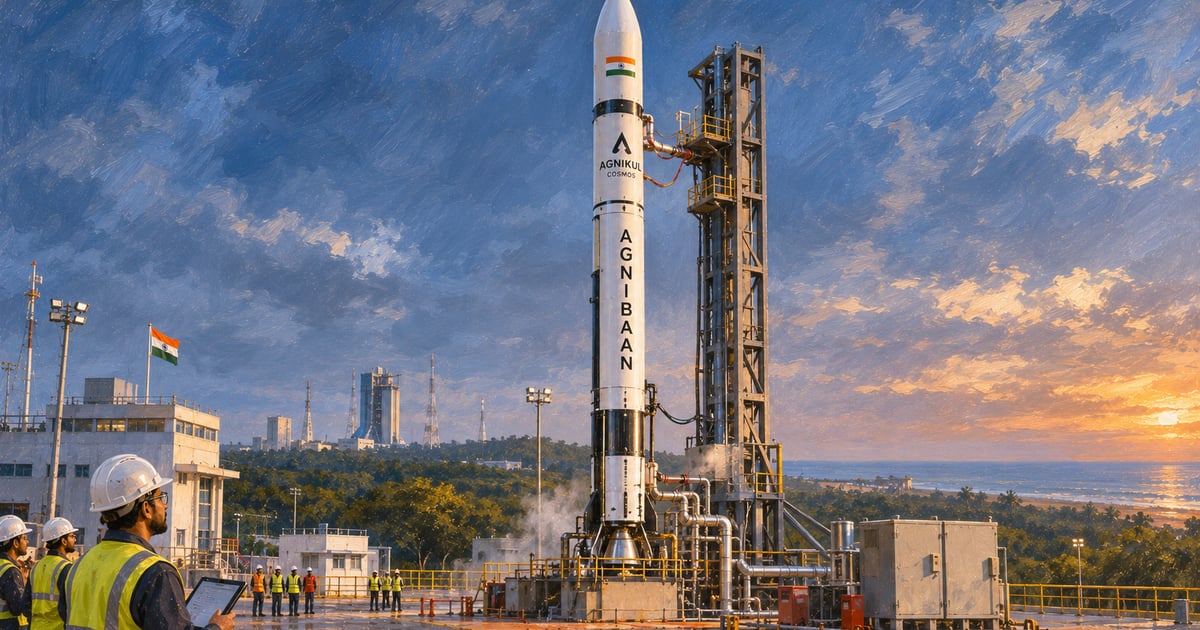
In the commercial launch business, reaching orbit proves engineering competence; reusing the hardware determines whether a company survives commercially. That distinction explains the significance of New Delhi’s ₹200 crore (approximately $21–24 million) backing for Chennai-based Agnikul Cosmos to build a fully reusable version of its Agnibaan launch vehicle.
Signed on 25 September 2026 between the Technology Development Board (TDB) of the Department of Science and Technology (DST) and Agnikul Cosmos under the Research Development and Innovation (RDI) Fund, the agreement is widely described in shorthand as a government grant. In practice, it is something far more deliberate: structured risk capital deployed through Optionally Convertible Debentures (OCDs) designed to carry Agnikul’s Agnibaan RLV (Reusable Launch Vehicle) from early laboratory validation to flight-qualified readiness.
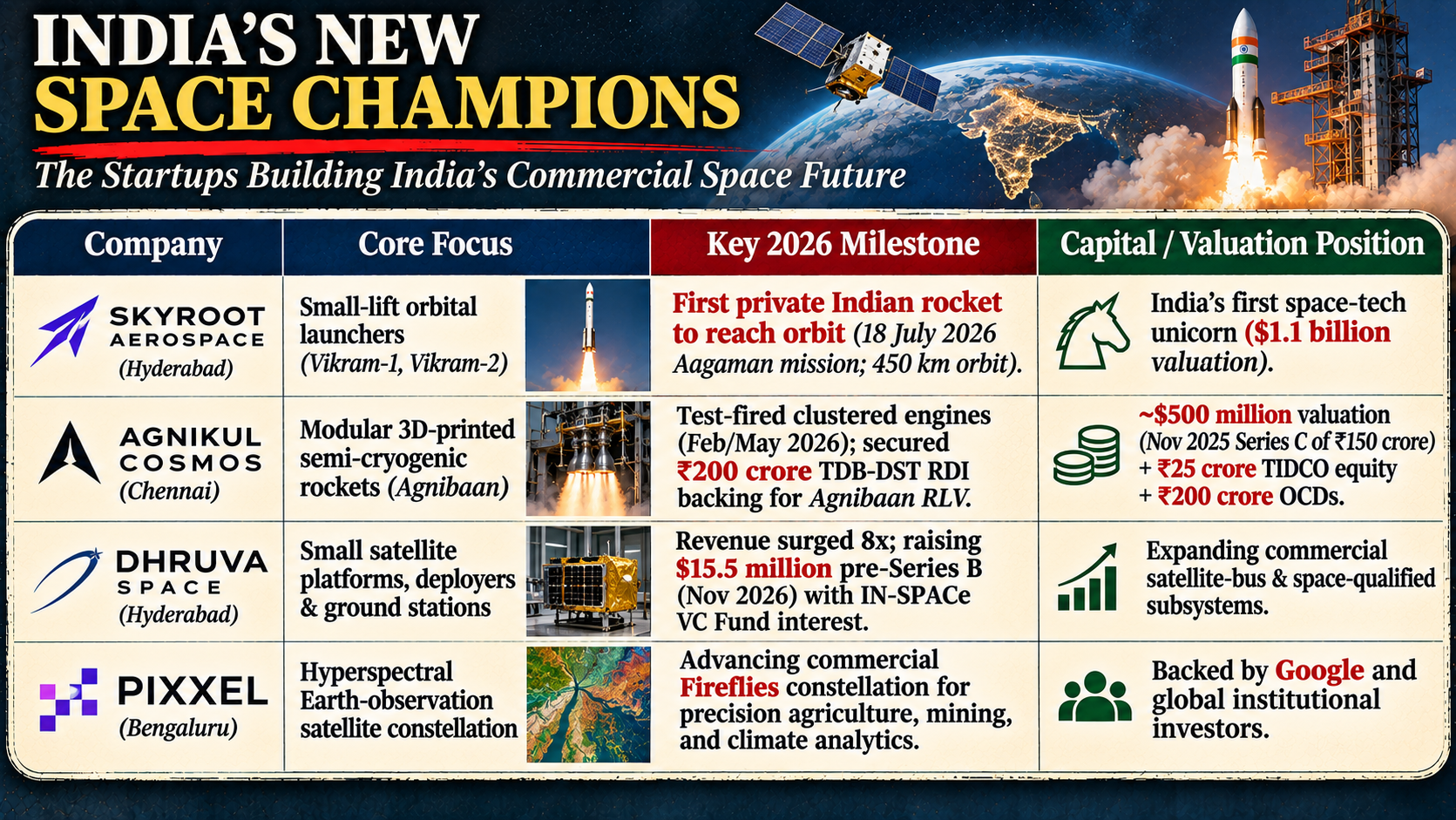
The timing is strategic. Just two months earlier, on 18 July 2026, Hyderabad-based rival Skyroot Aerospace had become the first private Indian company to reach orbit with its Vikram-1 rocket. With the symbolic "first-to-orbit" milestone already claimed, Agnikul and its state backers are betting on the harder, more lucrative second act of the space race: repeatable, low-cost orbital access.
Not a Plain Grant: How the ₹200 Crore RDI Deal Actually Works
Conventional government research grants are non-repayable subsidies that rarely enforce commercial discipline. Under the TDB-DST RDI Fund agreement, India’s science ministry is instead using Optionally Convertible Debentures—a hybrid debt instrument that gives the government the option to convert its loan into equity under predefined conditions.
For a capital-intensive rocket startup, this structure achieves two outcomes simultaneously:
Patient Deep-Tech Runway: Private venture capital firms typically resist funding multi-year propulsion and re-entry R&D due to long payback horizons. OCDs supply non-dilutive near-term liquidity without forcing Agnikul into distressed equity markdowns.
Public Upside & Accountability: Rather than writing off taxpayer funds as sunk R&D, the state retains a financial stake in commercial success—mirroring a broader shift in Indian industrial policy. Earlier in 2026, the Government of Tamil Nadu (via its industrial arm TIDCO) invested ₹25 crore directly into Agnikul, marking the first time an Indian state government took an equity stake in a private space startup.
The Engineering Mandate: From TRL-4 to TRL-8
According to the Ministry of Science & Technology release, the ₹200 crore programme is tasked with advancing Agnibaan RLV from Technology Readiness Level 4 (TRL-4)—where core components are validated in laboratory environments—to TRL-8, meaning a complete, flight-qualified system ready for operational deployment.
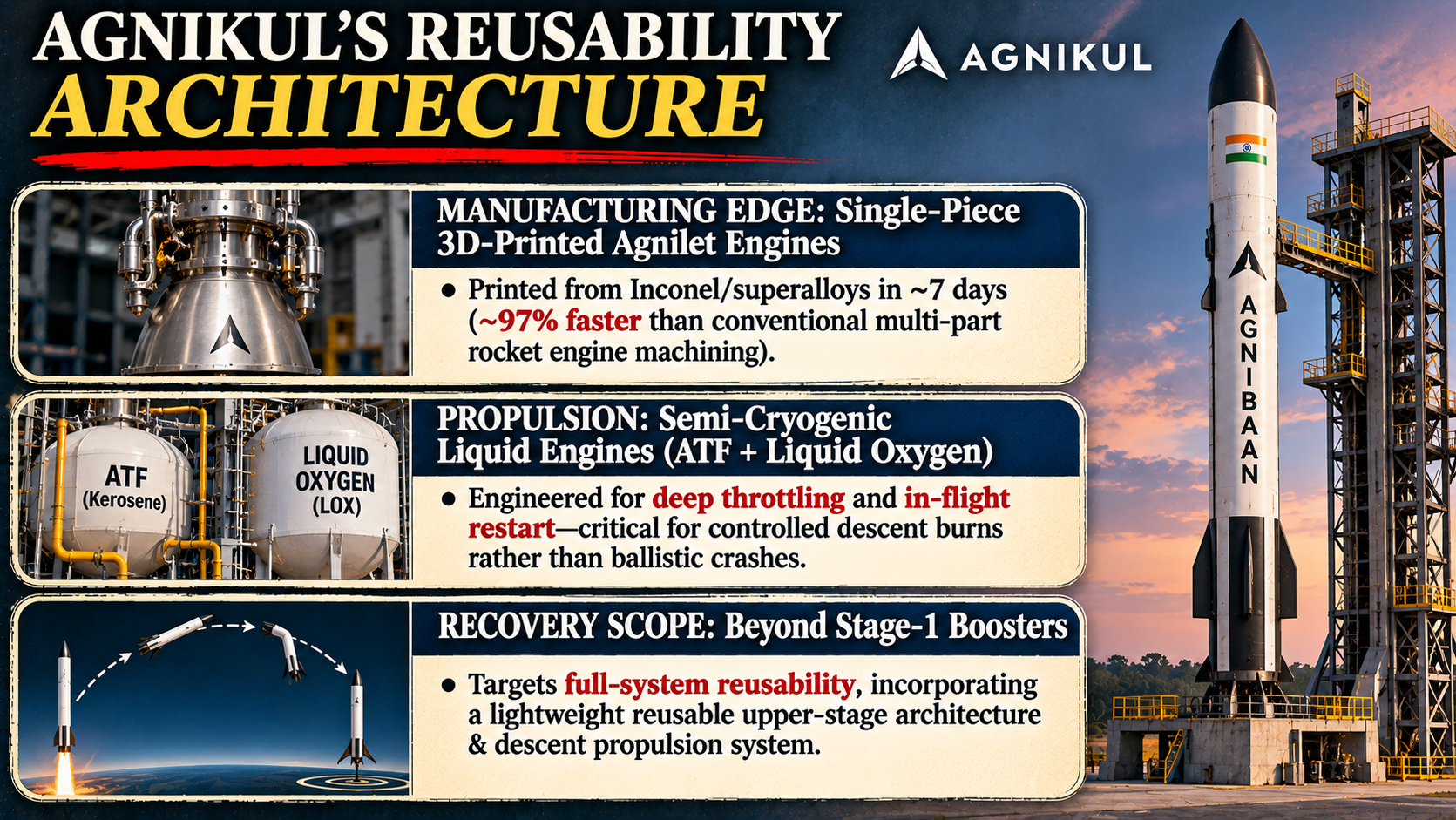
What separates Agnikul’s ambition from standard reusability blueprints is its stated focus on full-system recovery. While SpaceX’s Falcon 9 routinely lands its first-stage booster, the upper stage is still expended on every flight. Agnikul’s RDI-backed design explicitly targets a lightweight reusable upper-stage architecture paired with precise orbital insertion and a controlled descent propulsion system.
The company brings genuine manufacturing momentum to the challenge. Incubated at IIT Madras in 2017 by Srinath Ravichandran, Moin SPM, and Professor SR Chakravarthy, Agnikul built India’s first private launchpad and mission control centre at ISRO’s Sriharikota spaceport in November 2022. On 30 May 2024, it executed a 66-second suborbital test flight (Agnibaan SOrTeD) powered by a single-piece 3D-printed Agnilet engine. In February and May 2026, the startup successfully test-fired clustered semi-cryogenic engines at its Chennai facilities, laying the groundwork for its first two orbital missions scheduled for the first half of 2027 (targeting payloads of 100 kg to 300 kg).
The Indian Private Space Race in Late 2026
Agnikul’s funding lands in a sector that has expanded rapidly since New Delhi opened space activities to Non-Government Entities (NGEs) in 2020 and codified commercial rules under the Indian Space Policy 2023. Between 2014 and August 2026, the number of DPIIT-registered space startups in India grew from a single company to 440, backed by 113 IN-SPACe authorisations across launch vehicles, satellites, and ground segments.
To sustain this momentum, the government has assembled a multi-layered public-capital stack:
FDI Liberalisation (Feb 2024): Allows up to 100% automatic FDI in satellite component manufacturing, 74% in satellite manufacturing and operations, and 49% in launch vehicles and spaceports.
Targeted Risk Funds: Complementing the TDB-DST RDI Fund are a ₹1,000 crore Venture Capital Fund managed by SIDBI Venture Capital under IN-SPACe (investing ₹10 crore–₹60 crore per startup), a ₹500 crore Technology Adoption Fund, and a ₹75 crore Satellite Bus as a Service (SBaaS) scheme.
The Catch: R&D Capital Cannot Replace Anchor Customers
Despite record state support and cumulative private space funding exceeding $618 million by early 2026, industry analysts point to a structural bottleneck: government procurement.
As analysis by The CapTable noted in November 2026, India has built an impressive pipeline to fund deep-tech R&D, yet lacks an equivalent procurement pipeline to buy the finished hardware. In the United States, SpaceX did not achieve commercial dominance on venture capital or R&D grants alone; it scaled on multi-billion-dollar NASA COTS and Commercial Resupply contracts that guaranteed flight cadence.
In India, by contrast, the Department of Space’s FY2026–27 budget (₹13,705.63 crore, or roughly $1.46 billion) remains heavily concentrated within ISRO and its commercial arm, NewSpace India Limited (NSIL). Even after two recent setbacks to ISRO’s workhorse PSLV, private launch providers remain dependent on ISRO’s Sriharikota infrastructure and still await large-scale, recurring sovereign launch contracts from Indian defence, earth-observation, or civil ministries.
What It Means for India’s $44 Billion Goal
IN-SPACe’s Decadal Vision aims to expand India’s space economy from $8.4 billion (about 2%–3% of the global market) to $44 billion by 2033, including $11 billion in exports. Reaching that target requires roughly 16.2% compound annual growth—a pace impossible to achieve through government spending alone.
Agnikul’s ₹200 crore RDI backing signals that India’s private space race has entered its economic-viability phase. Skyroot has already proved that a four-year-old private Indian firm can reach orbit. Now, Agnikul’s test—first with its debut orbital flights in 2027, and subsequently with Agnibaan RLV—is whether Indian private engineering can bring a rocket back, refurbish it rapidly, and undercut global small-launch competitors on price per kilogram.