In brief
- Ethereal Machines, a Bengaluru startup, built a 2-micron 5-axis CNC machine after four and a half years of work, challenging Indian factories that initially refused to buy it.
- The company now carries a ₹1,470 crore valuation and reports ₹11.45 crore in audited annual revenue, financed by global semiconductor and venture capital.
- India’s machine tool market shows imports at ₹18,686 crore versus production of ₹14,566 crore, with consumption at ₹31,781 crore, indicating foreign suppliers still meet a large share of demand.
- The story argues that owning the mother machines, not just the assembly line, is needed for India to become a genuine manufacturing power, as evidenced by Ethereal Machines’ pivot and progress.
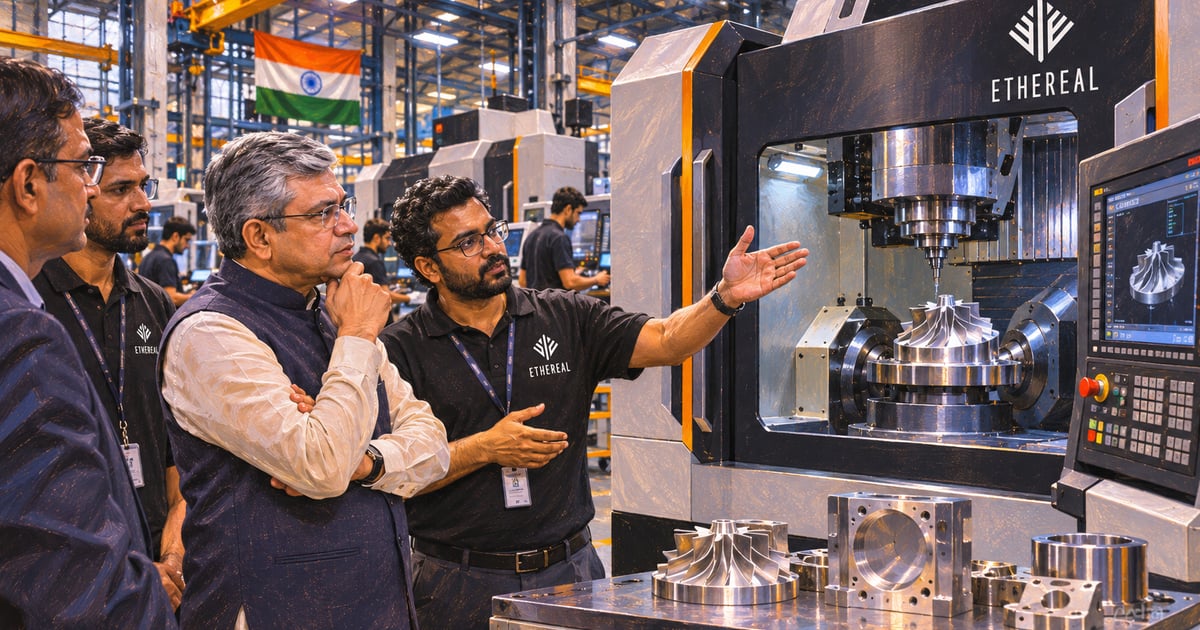
On 14 November 2026, Union Electronics and IT Minister Ashwini Vaishnaw walked into a Bengaluru factory floor and used a human hair to make a point about industrial sovereignty. Posting on X after visiting Ethereal Machines, Vaishnaw pushed back against critics who dismiss India’s electronics and hardware boom as mere assembly:
"For those calling our manufacturing as screwdriver technology: Designed in India, Made in India 5-axes precision CNC machines with the accuracy of 2 microns! For reference, the thickness of human hair is about 80 microns"
(ETV Bharat).
A tolerance of two microns—0.002 millimetres, or roughly one-fortieth the width of a human hair—is not an arbitrary bragging right. According to an official IT Ministry statement reported by Business Standard, components machined at tolerances between 2 and 20 microns have historically been sourced from Germany and Japan, feeding directly into semiconductor equipment, aerospace, defence, and medical technology.
Yet the story of Ethereal Machines is far more complicated—and revealing—than a triumphant ministerial photo-op. It is the story of a company that spent four and a half years building a machine that Indian factories initially refused to buy, pivoted to selling finished parts instead of equipment, and now carries a ₹1,470 crore (~$158 million) valuation on ₹11.45 crore (~$1.2 million) in audited annual revenue (The Invincible India). More broadly, it exposes why Computer Numerical Control (CNC) machine tools—the "mother machines" that build all other machines—remain the decisive test of whether India can become a genuine manufacturing powerhouse.
From a Bengaluru Dorm Room to a Four-Year Engineering Slog
Ethereal Machines began not as a grand industrial thesis, but as a student frustration. Around 2010, Kaushik Mudda and Navin Jain, then electronics and communication engineering students at RV College of Engineering in Bengaluru, were trying to build a robotic arm that kept missing its target angles (The Invincible India). Tracing the error to poorly machined parts, they discovered that the CNC equipment required to cut metal accurately cost upwards of half a million dollars—far beyond a student budget.
Pooling roughly ₹1.75 lakh ($2,100) from debate and robotics competition winnings, the pair built a basic CNC machine in a friend’s apartment by early 2015, tested demand via classifieds ads on OLX and Quikr, and incorporated Ethereal Machines Private Limited in November 2016 (The Invincible India). Their early hybrid additive-and-subtractive desktop machine, the Ethereal Halo, won a Best of Innovation Award at CES 2018 in Las Vegas (Avataar VC, 3D Printing Asia).
However, consumer-grade prototyping was not where industrial leverage lay. By 2018, Mudda and Jain decided to build an industrial-grade 5-axis CNC machine—a market dominated by entrenched European and Japanese incumbents such as DMG Mori and Willemin-Macodel, with machines costing over $500,000 and carrying eight-to-ten-month waiting lists (The Invincible India).
A 5-axis machine is exponentially harder to engineer than a conventional 3-axis mill. Whereas a 3-axis machine moves a cutting tool along linear X, Y, and Z planes, a 5-axis system adds two rotational axes, allowing the cutter to approach a workpiece from multiple angles in a single setup (ETV Bharat). Eliminating manual repositioning prevents cumulative alignment errors when carving complex turbine blades, semiconductor manifolds, or surgical implants.
Building one required solving mechanical rigidity, thermal drift, control electronics, and real-time kinematics simultaneously. As Blume Ventures—which seeded the startup in 2019 and remained its sole institutional backer through a four-year funding drought until 2023—noted, India lacked engineers fluent in both mechanical design and computer control mathematics (The Invincible India). What was planned as a one-year build stretched from 2018 to mid-2022.
The MaaS Pivot: Why Selling Parts Beat Selling Machines
By mid-2022, Ethereal Machines had a working 5-axis platform—later refined into its flagship production machine, Nimbus, which pairs a 12,000 RPM spindle and laser tool setter with 4-micron linear positioning across metals hardened up to 65 HRC (Ethereal Machines). Yet commercial reality hit hard. Indian industrial buyers, accustomed to German and Japanese badges, balked at approving heavy capital expenditure for an unproven domestic startup, with some demanding 12-month post-delivery payment terms (The Invincible India).
Rather than lose a major prospective customer during a live demonstration, Mudda improvised: Ethereal would keep the machine on its own floor, run it around the clock, and sell the finished, precision-machined components instead (The Invincible India).
That concession became Machining-as-a-Service (MaaS), transforming Ethereal from a capital-equipment vendor into a vertically integrated manufacturing utility:
Lower Friction for Buyers: Customers start with $10,000–$20,000 trial orders billed as operating expenditure rather than multi-crore capital approvals; the company says five to six of these accounts have scaled past $1 million annually, including aerospace and defence clients such as Hindustan Aeronautics Limited (HAL), Bharat Electronics Limited (BEL), and Collins Aerospace (The Invincible India).
Deep Vertical Integration: Each 5-axis machine contains roughly 3,200 parts, some of which India’s domestic supply chain cannot produce to specification—forcing Ethereal to machine its own internal components on its own fleet (The Invincible India).
Utilisation Economics: By expanding from roughly 21 machines in 2024 to more than 60 machines running three shifts 24/7, fixed machine costs are amortised across billable spindle hours (The Invincible India).
Valuation vs. Audited Reality
The MaaS pivot unlocked institutional capital at speed. After Peak XV Partners (via Surge) and Steadview Capital co-led a $13 million Series A in June 2024 at a ₹383 crore valuation, Avataar Venture Partners led a $28.5 million (₹264.5 crore) Series B in April 2026 at a post-money valuation of ₹1,470 crore (~$158 million)—a 3.8-fold jump (The Invincible India). Notably, semiconductor-equipment maker Novellus Systems joined the Series B with a ₹27.9 crore strategic cheque, underscoring Ethereal’s push into semiconductor supply chains alongside plans for a 300,000 sq. ft. automated facility near Bengaluru (The Invincible India, Avataar VC).
Still, a sober look at regulatory filings shows the scale of execution still ahead:
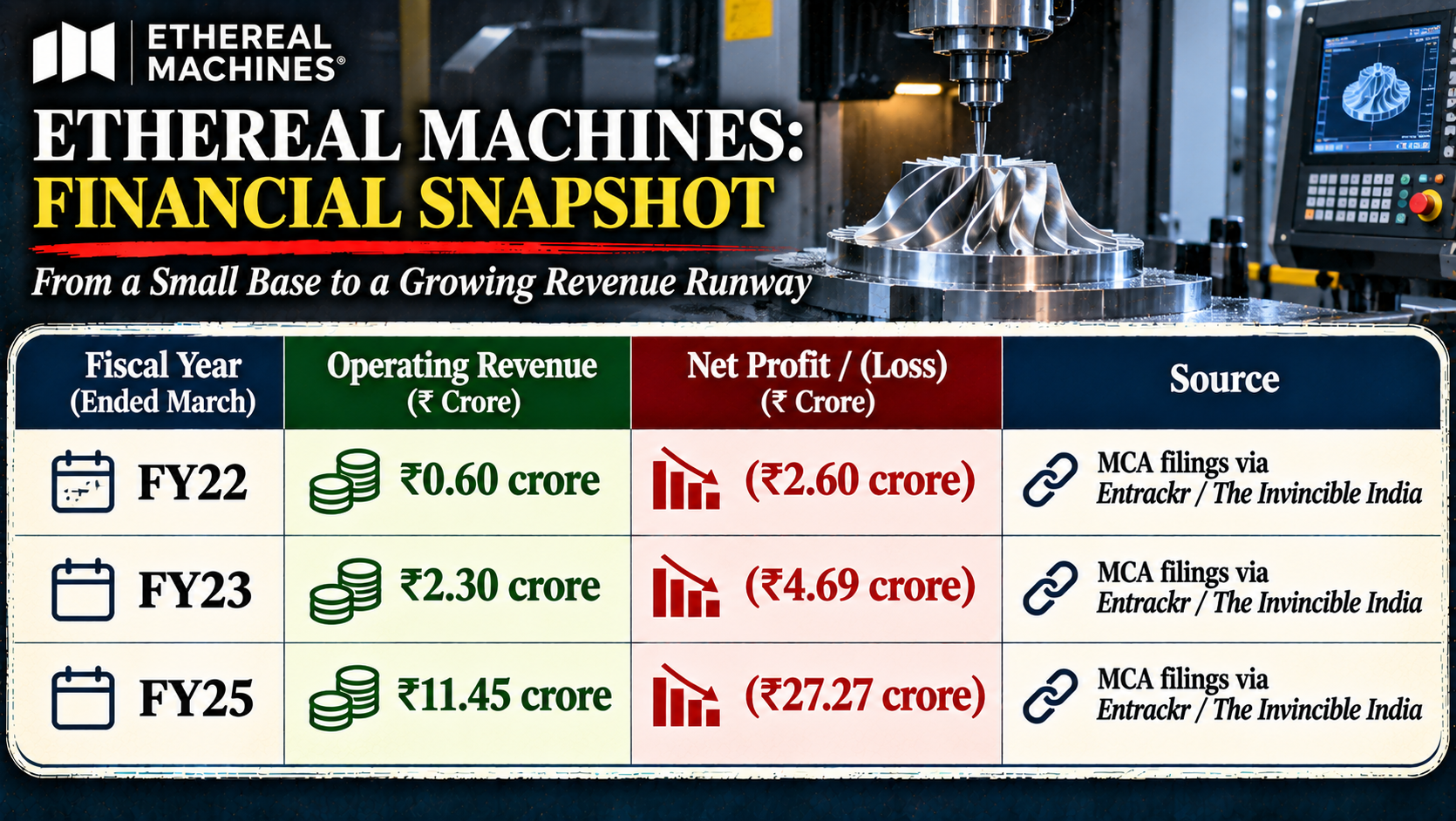
(Note: Standalone FY24 figures were not independently locatable in public summaries; FY26 audited filings are pending.)
While company executives have pointed to 3–5x year-on-year MaaS growth and claimed 30% cost savings and 40% shorter lead times for clients, those metrics remain company-stated rather than independently audited (The Invincible India). Meanwhile, FY25 net losses (₹27.27 crore) were more than double revenue (₹11.45 crore), reflecting heavy upfront capital expenditure and headcount expansion (277 employees) ahead of scale (The Invincible India). Scaling toward a 1,000-machine mega-factory will test both capital discipline and customer diversification beyond a handful of $1 million-plus accounts.
Why 5-Axis CNC Is India’s Crucial Manufacturing Pillar
Vaishnaw’s remark about moving from assembly to making "things that go into things that go into things" (ETV Bharat) cuts to the core of India’s industrial vulnerability.
According to Indian Machine Tool Manufacturers’ Association (IMTMA) data for FY2024–25, India’s total machine tool consumption reached ₹31,781 crore, while domestic production stood at ₹14,566 crore and imports hit ₹18,686 crore—meaning foreign suppliers still meet roughly 59% to 65% of Indian factory demand (The Machining World, Credence Research, Ken Research). While India ranked 4th globally in machine-tool consumption in CY2024, it ranked 9th in production (The Machining World).
That gap is widest at the high-precision frontier:
Semiconductor & Electronics Capital Goods: Semiconductor fabs, wafer-handling robotics, and vacuum chambers require sub-10-micron tolerances on exotic alloys such as Inconel and titanium. Without domestic 5-axis machining capacity, India’s semiconductor incentives simply subsidise imported Japanese, German, and Taiwanese machinery.
Defence & Aerospace Localisation: With India’s defence production reaching a record ₹1.78 lakh crore in FY2025–26, aerospace and defence demand is the fastest-growing segment of Indian machine tools (Credence Research). Relying on foreign CNC builders—and foreign CNC controllers—creates strategic choke points during geopolitical disruptions.
Moving Beyond 3-Axis Commodity Tools: Established Indian builders such as Jyoti CNC Automation, Bharat Fritz Werner, Ace Designers, and Macpower CNC are expanding domestic capacity rapidly (Credence Research), yet India’s historical strength has been in 3-axis lathes and machining centres rather than simultaneous multi-axis platforms and proprietary CNC controllers (Avataar VC, The Invincible India).
Ethereal Machines alone will not close a ₹18,686 crore import deficit. Its FY25 revenue is a rounding error against national demand, and its MaaS model is still proving its unit economics at scale. Yet by proving that 2-micron 5-axis hardware can be designed, controlled, and operated on Indian soil—and financed by global semiconductor and venture capital—it has demonstrated what the next phase of Indian manufacturing actually requires: owning the mother machines, not just the assembly line.