In brief
- Bengaluru faces a daily water shortfall of about 70 crore litres after the Cauvery river supplies around 190 crore litres and the city needs approximately 260 crore litres, prompting a search for alternatives for data centre cooling needs.
- Boson Whitewater, backed by Rainmatter, installs decentralised 11 stage filtration systems inside residential basements to turn surplus wastewater from apartment STPs into potable grade industrial water.
- The company supplies over 14 lakh litres (1.4 million litres) a day directly to data centres, electronics manufacturers and commercial laundries for cooling and other uses.
- The model faces constraints including STP reliability, logistics and policy enforcement gaps, which affect scalability and continuous supply for high-volume industrial users.
Bengaluru requires approximately 260 crore litres (2.6 billion litres) of water every day.
The Cauvery river supplies around 190 crore litres, leaving the city short by roughly 70 crore litres each morning—a deficit bridged by an informal fleet of more than 1 lakh private water tankers pumping relentlessly from over-exploited underground aquifers.
At the same time, the city’s rapid emergence as an artificial intelligence and cloud computing hub has brought a new, thirsty industrial consumer into the mix: the enterprise data centre. A traditional facility relies on evaporative cooling towers that consume up to 70,000 litres of water per megawatt (MW) of server capacity daily.
Yet just a few kilometres away from these server farms, large apartment complexes face the exact opposite dilemma: they have millions of litres of clean, treated wastewater that they are legally prohibited from dumping and have been paying private tankers to haul away.
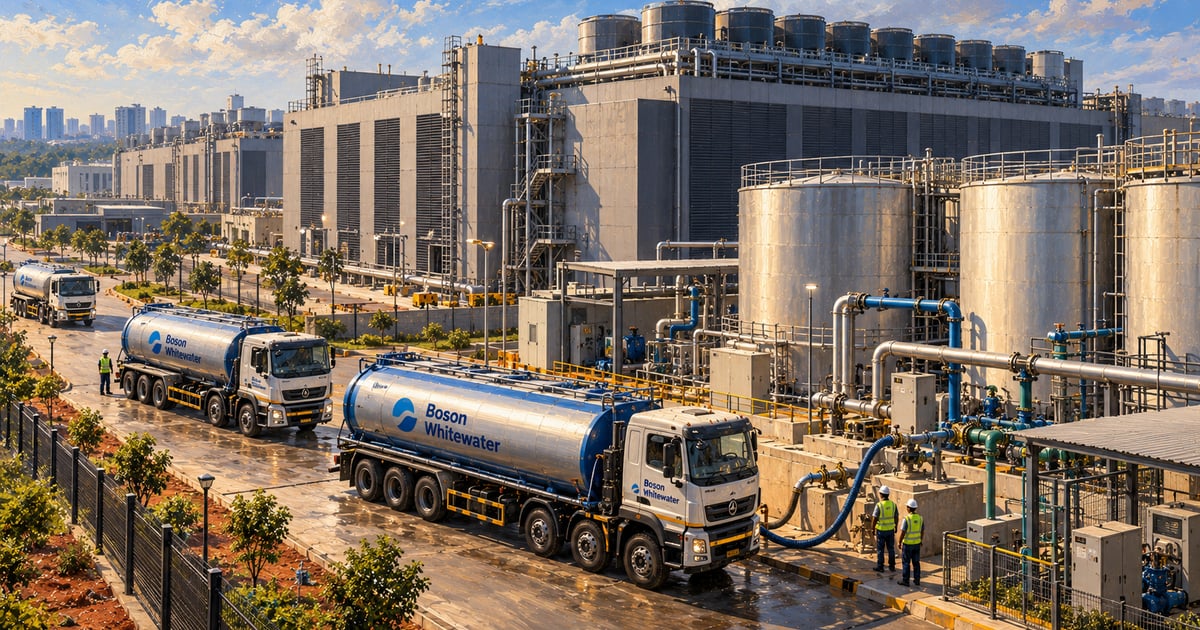
Bengaluru-based water-utility startup Boson Whitewater, backed by Zerodha’s investment fund Rainmatter, has built a business model out of this imbalance. By installing decentralised, 11-stage filtration systems directly inside residential basements, the company converts surplus sewage treatment plant (STP) effluent into potable-grade industrial water, supplying over 14 lakh litres (1.4 million litres) a day directly to data centres, electronics manufacturers, and commercial laundries.
The Residential Dilemma: Overflowing STPs and Tanker Penalties
The foundation of Boson’s supply chain is an environmental mandate introduced by the Karnataka State Pollution Control Board (KSPCB). Under local regulations, every residential apartment complex with 120 or more flats must construct and operate an on-site Sewage Treatment Plant.
These decentralised plants typically treat raw sewage using primary and secondary biological processes (such as sequencing batch reactors or moving bed biofilm reactors) to a standard permitted for two domestic uses:
Toilet flushing (~45 litres per resident daily)
Landscaping and lawn maintenance (~12 litres per resident daily)
In practice, a modern 300-to-500-unit apartment complex generates substantially more treated water than its gardens and toilets can absorb. An acre of residential lawn requires roughly 5,000 litres of water per day. Over-irrigating gardens waterlogs soil, weakens boundary walls, and seeps back into underground car parks.
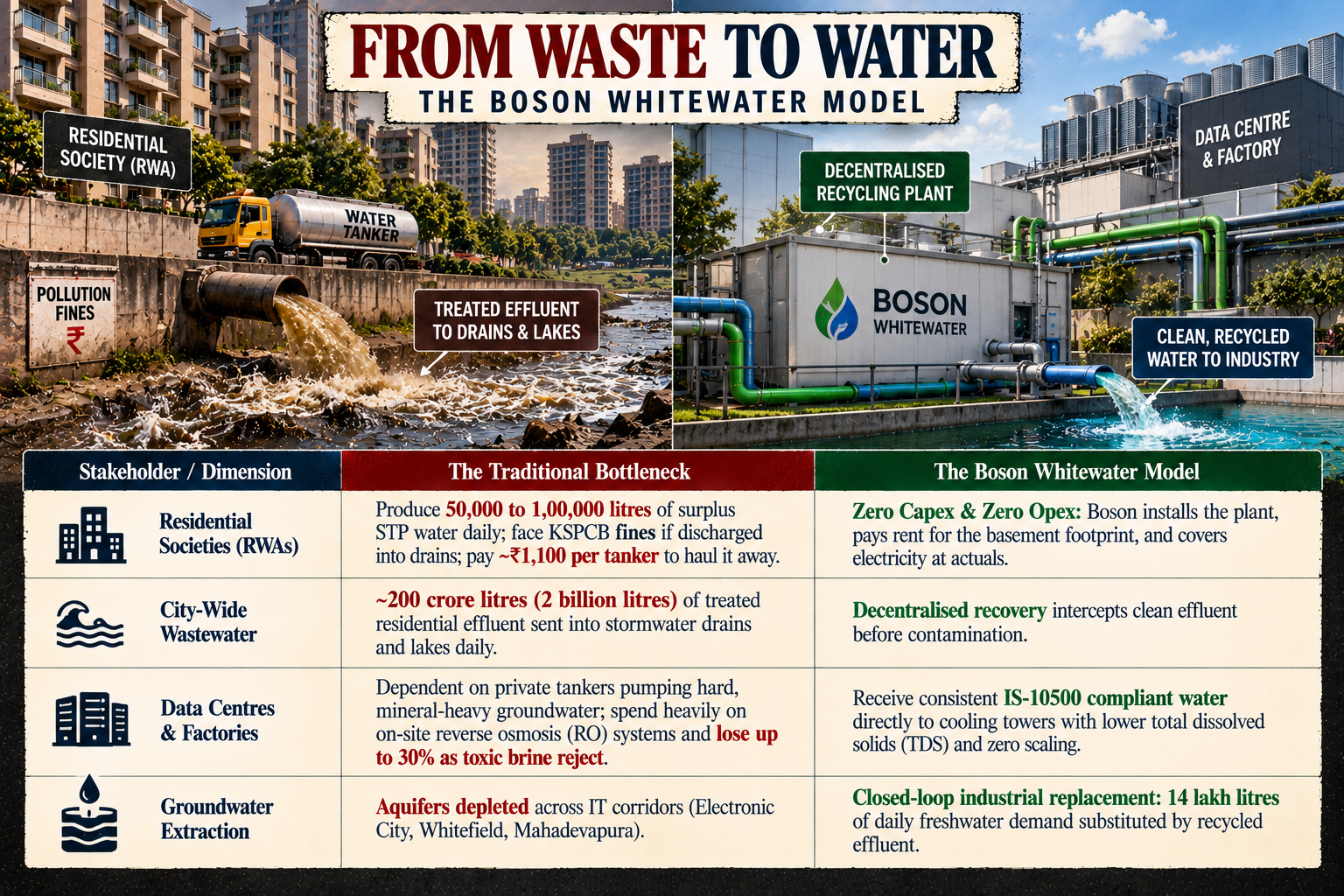
Because municipal environmental regulations prohibit discharging surplus treated effluent into public stormwater drains, Resident Welfare Associations (RWAs) were trapped. In suburban hubs like Electronic City, societies were spending tens of thousands of rupees each month hiring private commercial tankers at ₹1,100 per load simply to transport excess water to distant construction sites or agricultural plots.
City-wide, an estimated 200 crore litres (2 billion litres) of treated residential wastewater went unutilised every single day.
The Technology: The 11-Stage Transformation
Founded by water engineer Vikas Brahmavar and co-founder Gowthaman Desinghu, Boson Whitewater approaches apartment basements as distributed water utilities.
Rather than asking residential societies to invest capital in tertiary water polishing, Boson operates on a zero-capex infrastructure model:
Boson leases a small corner of the apartment’s utility basement.
It pays monthly rent to the society for the floor space.
It installs, maintains, and monitors its proprietary 11-stage tertiary treatment system.
It pays for all electricity consumed by the plant at actual metered cost.
The technology skid takes secondary treated STP water and puts it through an automated sequence:
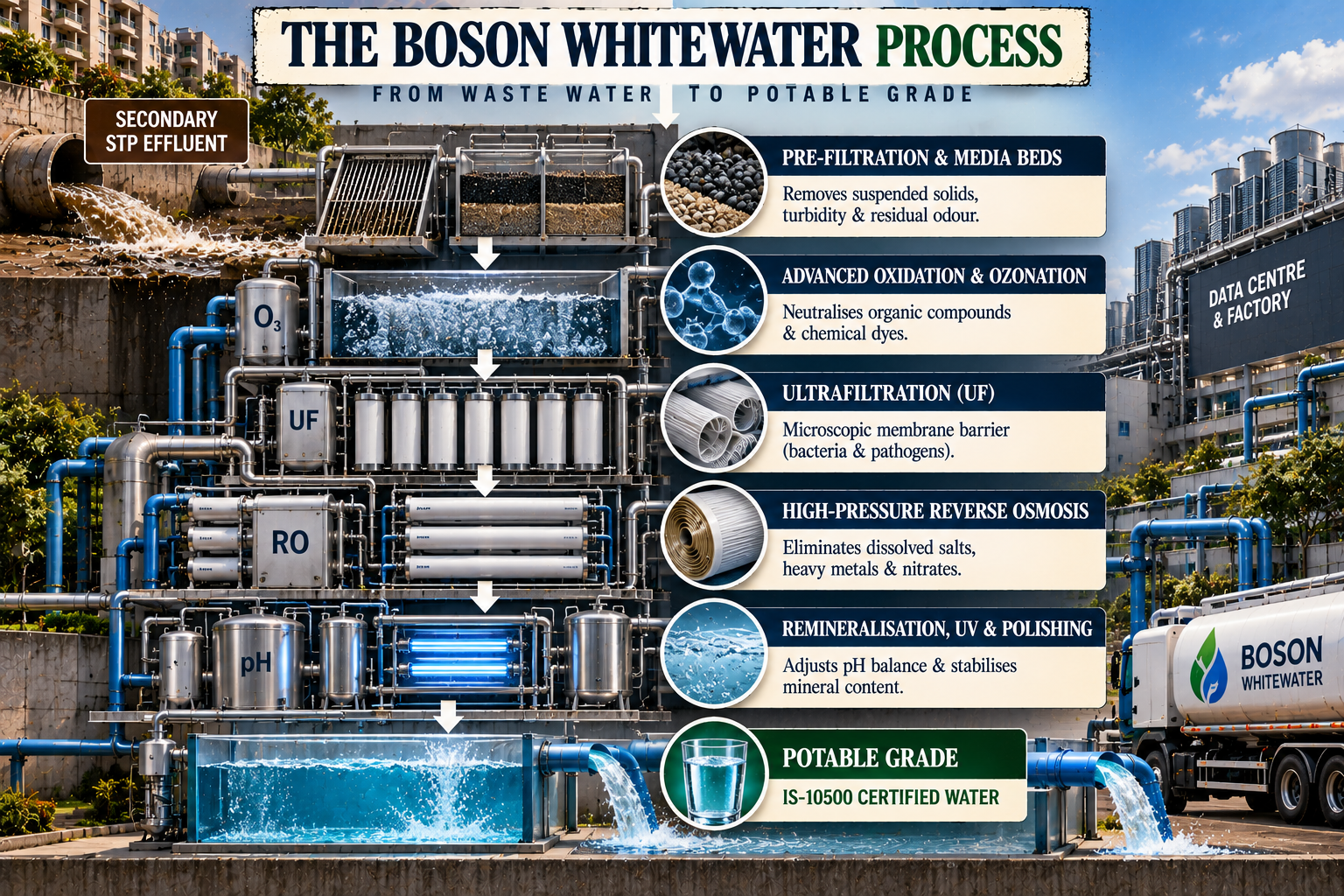
The resulting output meets Indian Standard IS-10500—the national benchmark for drinking water. However, recognising the psychological resistance and complex municipal regulations surrounding direct potable reuse (drinking recycled toilet water), Boson does not pump this water back into kitchen taps.
Instead, it addresses high-volume industrial demand.
Why Data Centres Need Ultra-Pure Water
Data centres do not cool their servers with ordinary water.
Computer servers generate massive thermal loads. In traditional open-loop cooling systems, water is circulated through computer room air handlers (CRAHs), absorbs heat from the server racks, and is pumped to external cooling towers where it is sprayed into an airflow and evaporated.
If a data centre uses raw tanker water or borewell water, it faces high concentrations of calcium, magnesium, silica, and dissolved chlorides. When that water evaporates in a cooling tower, these minerals are left behind, forming hard scale on heat exchanger pipes, reducing thermal efficiency, and causing corrosive equipment failure.
To prevent scaling, data-centre operators typically must install expensive internal reverse osmosis (RO) plants. This creates two problems:
Capital and Energy Cost: Operating high-pressure RO membranes consumes significant electricity and expensive anti-scalant chemicals.
Brine Wastage: Standard industrial RO systems reject 25% to 35% of the input water as concentrated, unrecoverable toxic brine, exacerbating water stress.
By purchasing Boson’s water—which arrives with low mineral content, neutral pH, and zero suspended biological matter—data centres can circulate the water through cooling towers for significantly more cycles of concentration before blowdown is required.
For semiconductor testing units, precision plastic extrusion lines, commercial laundries, and industrial steam boilers in Bengaluru's industrial belts, using water that is already purified to IS-10500 standards reduces chemical treatment costs and avoids maintenance shutdowns.
Hyperlocal Water Grids
Boson operates a distributed distribution network. Instead of building massive, expensive underground pipe networks across congested urban corridors, the company leases dedicated clean-water tankers to transport water within tight geographic clusters.
A residential complex in Electronic City generates surplus water; Boson processes it on-site and hauls it 3 to 5 kilometres away to a nearby data-centre campus or tech park.
This hyper-local circularity ensures that the industrial facility stops pumping from the same regional groundwater aquifer that the apartment community relies upon for its borewells.
To date, the company processes over 14 lakh litres (1.4 million litres) daily, translating to more than 90 crore litres (~945 million litres) of water saved annually. Following its capital infusion from Zerodha’s Rainmatter Foundation, Boson has begun deploying its model in Chennai and Hyderabad—cities grappling with identical combinations of growing data-centre footprints and severe municipal groundwater depletion.
Scalability and Systemic Constraints
While the model offers a clear circular solution, scaling distributed wastewater recovery faces structural hurdles:
STP Operational Reliability: Boson's system depends entirely on the apartment complex maintaining its biological STP correctly. If an apartment's internal STP fails or suffers a biological die-off due to improper chemical disposal by residents, the feed water quality drops, forcing Boson’s automated sensors to shut the intake to protect downstream membranes.
Logistics Overhead: Transporting water by road tankers introduces diesel fuel emissions and traffic dependencies. Piped distribution within designated industrial parks (such as ongoing pilot schemes in Chennai) represents the necessary next step for high-volume consumers.
Policy Enforcement Gaps: The model relies on local pollution control boards actively enforcing zero-discharge norms. In cities where pollution penalties are loosely monitored, apartment societies often choose to covertly dump wastewater rather than partner with formal recycling utilities.
The Broader Lesson for Urban Infrastructure
Bengaluru’s water crisis is frequently framed as a simple story of physical scarcity. Yet the city receives ample monsoon rainfall and generates billions of litres of wastewater daily. The true failure has been one of structural intermediation: treating wastewater as an inconvenient disposal problem rather than a valuable industrial feedstock.
By aligning the financial interests of residential societies, clean-tech investors, and water-stressed data centres, Boson Whitewater has proved that the water needed to power the digital economy does not have to come at the expense of the people living next door.