
In brief
- On 14 October 2026, California startup Reflect Orbital booked two launches with India’s Skyroot Aerospace. Flight 1 is on Vikram-1 (about 350 kg to low orbit) and Flight 2 is on Vikram-1U (about 550 kg). Price and dates weren’t shared.
- It’s Skyroot’s first big American contract for dedicated Vikram launches, three months after Vikram-1’s first orbital flight on 18 July 2026.
- Reflect’s CEO says there’s a launch capacity shortage. Russia’s Soyuz is off the market, European small rockets are delayed, and SpaceX has stopped taking new rideshare bookings beyond 2029.
- Reflect wants to put giant mirrors in orbit to bounce sunlight onto solar farms at dusk and dawn. The test satellite was approved by the FCC in July, and the plan is about 50,000 mirrors.
- Astronomers and dark-sky groups are against it, citing interference with telescopes, effects of artificial twilight, and crowding in orbit.
California space startup Reflect Orbital has purchased two dedicated rocket launches from Indian launch services provider Skyroot Aerospace, turning to Hyderabad to deploy its next-generation constellation of orbital sunlight reflectors.
Under the agreement announced on 14 October 2026, Reflect Orbital has contracted two dedicated missions using Skyroot’s Vikram family of small-satellite launch vehicles:
Flight 1: A dedicated launch on the baseline Vikram-1 vehicle, which can deliver roughly 350 kg to low-Earth orbit (LEO).
Flight 2: A dedicated launch on the upgraded Vikram-1U rocket, a booster-augmented variant capable of carrying approximately 550 kg to LEO.
Financial terms and target launch dates have not been disclosed, though Skyroot confirmed that Reflect Orbital will serve as the sole primary payload on both flights.
The transaction represents a notable milestone for both companies. For Skyroot, it marks the first major American commercial contract for dedicated orbital missions on its Vikram rockets, coming three months after the vehicle's maiden orbital flight. For Reflect Orbital, it offers a pragmatic solution to a tightening Western launch market where secondary rideshare slots are increasingly constrained.
Breaking Free from the Western Launch Squeeze
Reflect Orbital’s decision to procure launch services from an Indian provider is directly tied to a growing bottleneck in commercial spaceflight: launch capacity.
Over the past three years, satellite developers have faced severe manifest backlogs. Geopolitical sanctions removed Russia’s Soyuz from the international commercial market, Europe’s small launcher alternatives suffered protracted development delays, and American launch manifests have been dominated by heavy constellation deployments.
While SpaceX’s Transporter programme made low-Earth orbit accessible for small satellites, rideshare flights carry rigid operational trade-offs. Secondary payloads must conform to fixed inclinations—predominantly Sun-Synchronous Orbits (SSO)—and endure multi-month waitlists. In 2026, the supply crunch tightened further after SpaceX stopped accepting new reservations beyond 2029 for its standard Transporter missions, compelling constellation builders to secure dedicated small-launch capacity elsewhere.
"There's a real launch capacity shortage right now. We're excited to work with a new launch provider, Skyroot, to help ensure access to space," said Reflect Orbital Co-founder and Chief Executive Ben Nowack in the joint announcement.
Dedicated small launchers like the Vikram series allow operators to bypass the scheduling compromises of large rideshare missions, offering tailored launch windows and direct injection into specific orbital inclinations required for operational constellations.
Skyroot’s Commercial Ascendancy
Headquartered in Hyderabad, Skyroot Aerospace was founded in 2018 by former Indian Space Research Organisation (ISRO) scientists Pawan Kumar Chandana and Naga Bharath Daka. The startup has moved steadily through a series of technical and financial milestones:
November 2022: Became the first Indian private company to reach space with the suborbital launch of the Vikram-S rocket.
May 2026: Raised $60 million (approximately ₹500 crore) in a funding round led by Sherpalo Ventures, lifting its post-money valuation to $1.1 billion (around ₹9,200 crore) and making it India's first spacetech unicorn.
18 July 2026: Successfully placed payloads into low-Earth orbit during the maiden orbital test flight of Vikram-1 (Mission Aagaman), launched from the Satish Dhawan Space Centre at Sriharikota.
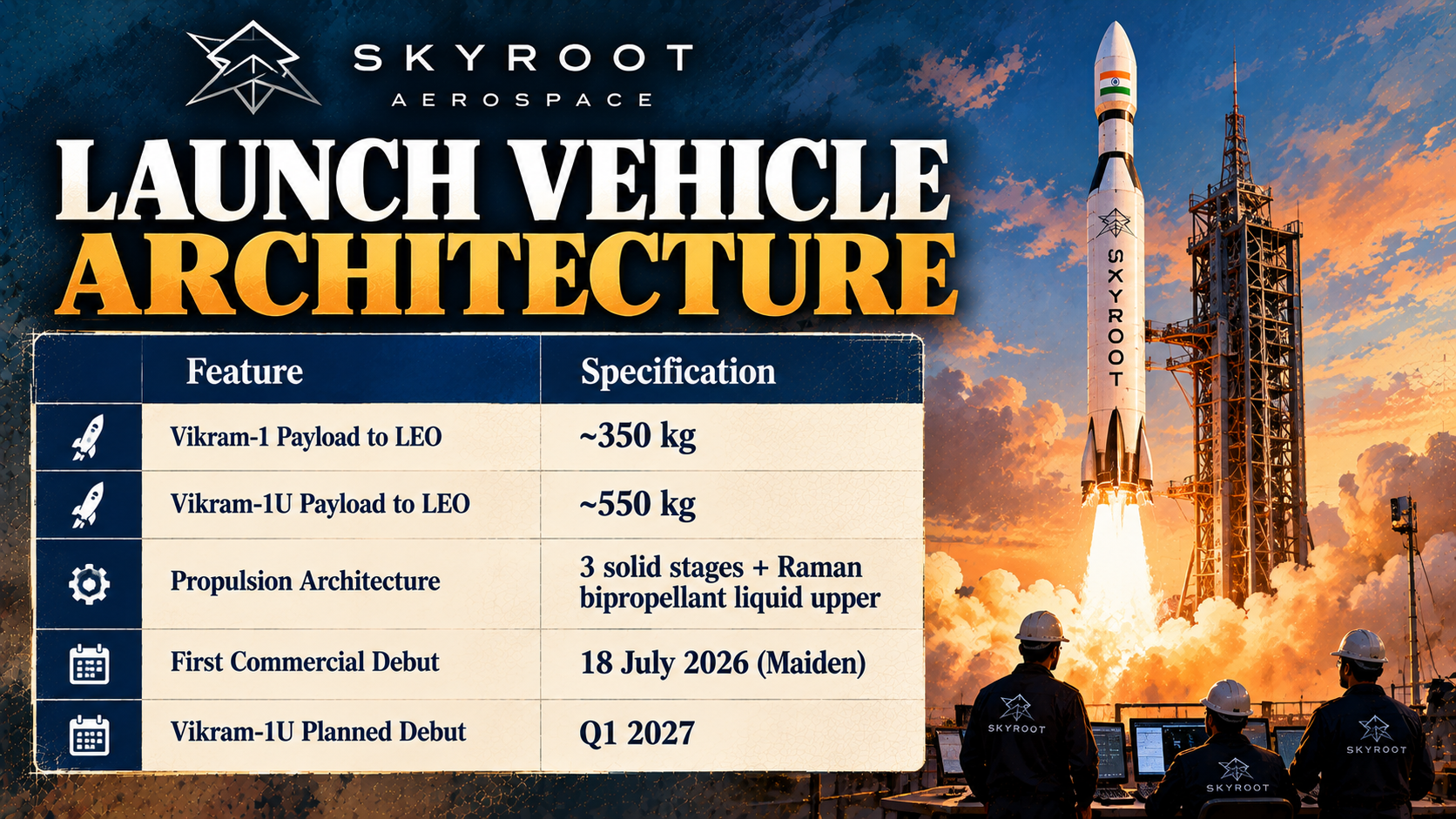
The upgraded Vikram-1U vehicle features strap-on solid rocket boosters on the core first stage, providing the additional thrust required to orbit heavier payloads. According to industry disclosures, the Vikram-1U is scheduled to make its flight debut in the first quarter of 2027.
"Reflect Orbital represents the kind of ambitious global space mission the Vikram family is being built to serve," noted Pawan Kumar Chandana, Skyroot's CEO. "We are pleased to partner with Ben and the Reflect Orbital team across two dedicated launches, providing schedule certainty and mission flexibility."
The deal also highlights the tangible commercial impact of India’s space reforms. Since the formation of the Indian National Space Promotion and Authorization Centre (IN-SPACe) and the liberalisation of foreign direct investment in early 2024—permitting up to 74% FDI in private rocket manufacturing under the automatic route—Indian aerospace ventures have systematically positioned themselves as cost-effective launch alternatives for Western satellite developers.
Beaming Sunlight from Orbit: The Business and the Backlash
Based in Hawthorne, California, Reflect Orbital is attempting to commercialise on-demand solar illumination. The startup’s concept involves placing large, highly reflective mylar-style mirrors in low-Earth orbit to reflect sunlight down to targeted ground installations after dusk and before dawn.
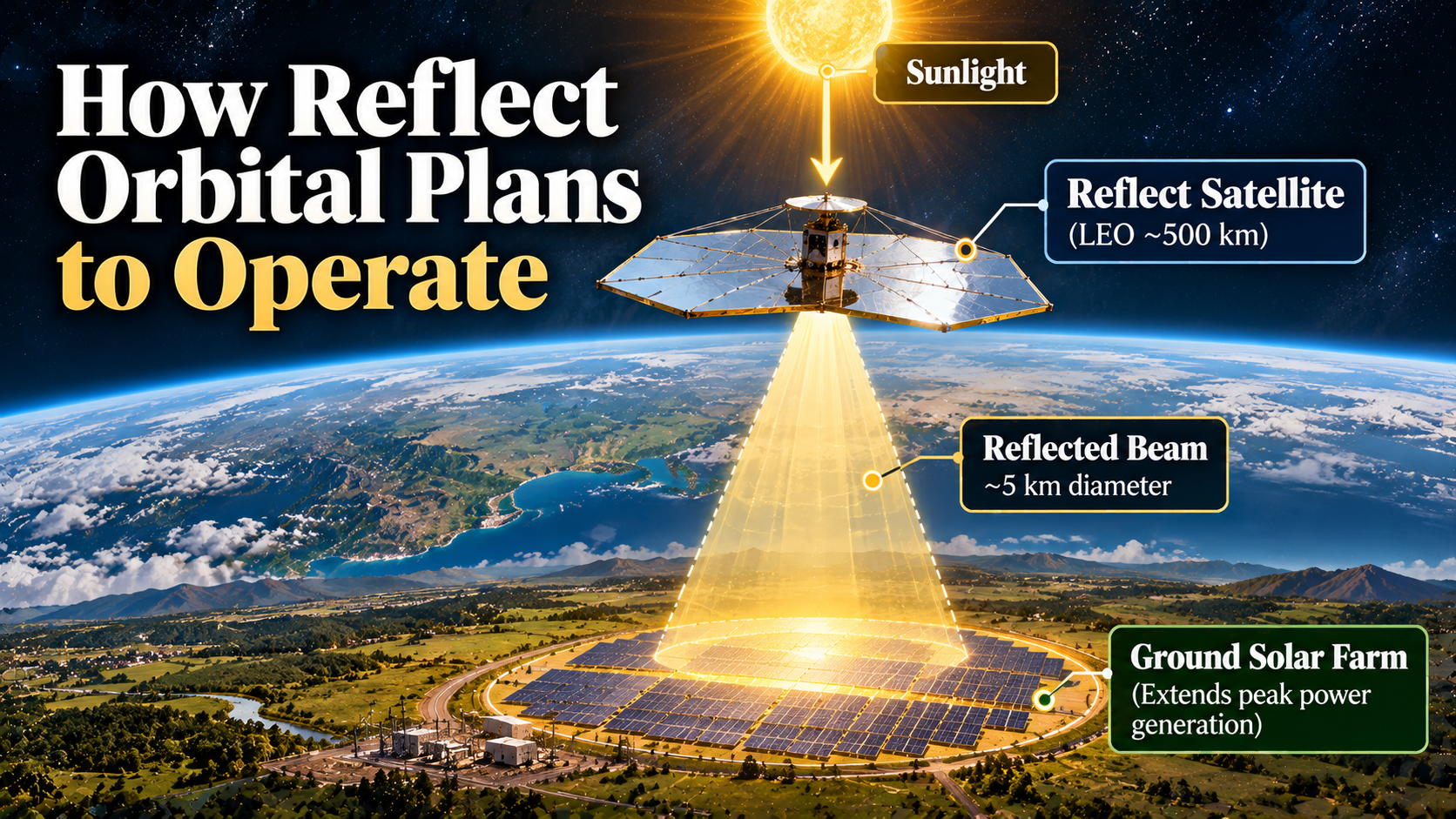
The venture's primary economic proposition targets utility-scale terrestrial solar farms. Solar installations produce maximum power during midday when wholesale electricity prices are frequently depressed, but generate nothing during the evening peak demand window (the infamous "duck curve"). By redirecting sunlight onto solar arrays during twilight hours, Reflect Orbital aims to enable operators to sell clean power when wholesale tariff rates are highest. Secondary applications cited by the company include emergency illumination for nighttime search-and-rescue teams and around-the-clock infrastructure construction.
In July 2026, the US Federal Communications Commission granted Reflect Orbital regulatory authority to launch and test its first demonstration spacecraft, Eärendil-1. Weighing approximately 134 kg and carrying an 18-metre by 18-metre deployable reflector, Eärendil-1 is slated to ride as a secondary payload aboard a SpaceX Falcon 9 mission into an ~500 km near-polar orbit.
However, scaling the concept beyond a lone test satellite to the company’s planned operational constellation of roughly 50,000 mirrors faces intense pushback from the global scientific community.
Astronomers and dark-sky organisations have voiced sharp opposition, warning that thousands of orbital mirrors could disrupt optical telescope observations and ground-based sky surveys, such as the Vera C. Rubin Observatory in Chile. Orbital reflectors produce bright visible-light streaks that can saturate sensitive optical sensors. Research by astronomical groups, including DarkSky International, has raised additional questions regarding the ecological effects of artificial twilight on nocturnal ecosystems, as well as the collision hazards posed by tens of thousands of large-surface reflective surfaces in congested LEO altitudes.
Nowack has acknowledged these criticisms, stating that the company intends to work closely with astronomers, municipal communities, and international regulators before attempting to scale commercial operations.
What to Watch Next
As Skyroot and Reflect Orbital move into mission integration, three variables will determine whether this contract sets a broader precedent:
Integration and Manifest Timelines: Skyroot has shipped flight hardware for its second Vikram-1 mission to the Sriharikota spaceport. Confirmation of the exact launch windows for Reflect Orbital’s dedicated flights—particularly the timeline for the upgraded Vikram-1U—will provide a benchmark for Skyroot’s production cadence.
Eärendil-1 Orbital Demonstration: Data from Reflect Orbital's upcoming test satellite will determine whether orbital pointing accuracy, beam dispersion (aiming a roughly 5 km illumination spot from 500 km altitude), and thermal loads perform as modeled on orbit.
Regulatory Scrutiny on Constellation Scaling: While the FCC licensed a single demonstration satellite, securing international frequency allocations and orbital authorizations for thousands of light-reflecting spacecraft will test whether space regulators are willing to accommodate orbital illumination alongside dark-sky protections.
For the international space market, the partnership signals that small-satellite operators are no longer waiting on Western launch manifests. As private Indian launch vehicles prove their orbital reliability, contracts that once went exclusively to American or European providers are increasingly heading east.