In brief
- Over 1.35 million Albertans cast early ballots in a ten-question referendum, setting an all-time record for advance voting in Canadian provincial history.
- Exactly 1,356,873 votes were cast during the advance voting window (13 to 17 October) and through mail-in special ballots, representing 43.1% of the province's registered electorate.
- The referendum questions cover immigration caps, healthcare access, court appointments, and constitutional reform, culminating in a multi-stage vote on the legal framework of separation.
- Question 10 is the Separation Mechanism and is not a binary Yes or No vote; voters choose between remaining a Canadian province or directing the provincial government to commence the legal process toward a subsequent binding separation vote.
More than 1.35 million Albertans—representing 43.1% of the province’s registered electorate—cast their ballots ahead of Monday, 19 October 2026, setting an all-time record for early voter participation in Canadian provincial history.
According to preliminary data released by Elections Alberta, exactly 1,356,873 votes were cast during the advance voting window (13–17 October) and through mail-in special ballots. That turnout eclipses the 809,988 advance votes recorded during the 2023 provincial general election, where early turnout reached 27.5% of eligible electors. Out of 3,148,343 registered voters on the provincial rolls, more than four in ten electors made their choice before voting stations opened on Monday morning.
While national attention has centred on whether Alberta will initiate a divorce from the Canadian federation, the ballot itself is more complex than a binary independence plebiscite. Voters are confronting ten distinct ballot questions covering immigration caps, healthcare access, court appointments, and constitutional reform—culminating in a multi-stage vote on the legal framework of separation.
The Ten-Ballot Structure
The referendum, convened under Premier Danielle Smith’s United Conservative Party (UCP) government, splits into three distinct policy blocks across ten individual ballots:
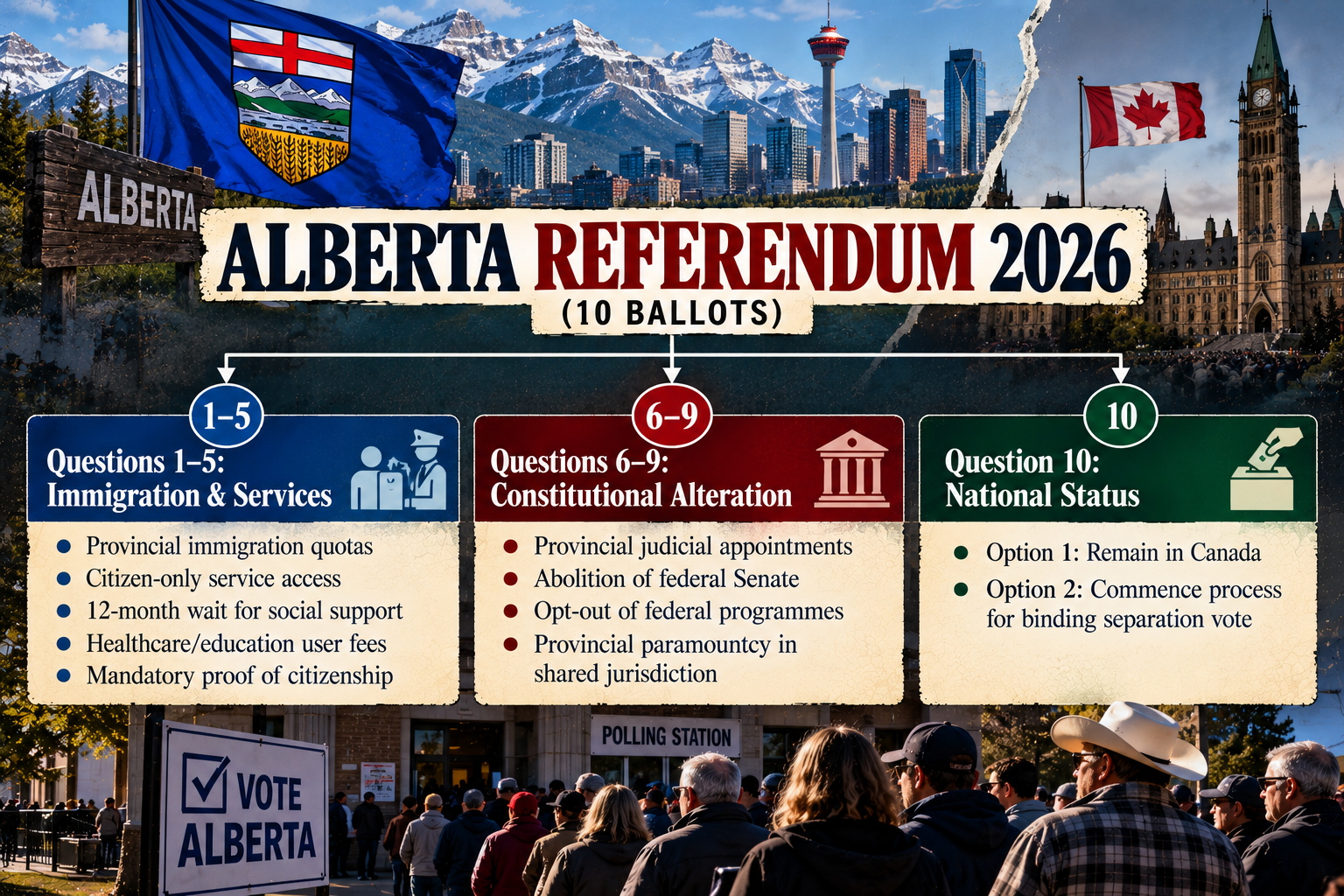
Questions 1 to 5 (Immigration and Public Services): These questions ask whether Alberta should unilaterally restrict immigration intake, mandate proof of Canadian citizenship to vote provincially, require a 12-month residency period before temporary residents qualify for social benefits, and impose user fees on non-permanent residents accessing publicly funded healthcare and education.
Questions 6 to 9 (Constitutional Powers): These four questions propose working with other provinces to amend the Canadian Constitution. They seek to grant provincial cabinets the power to appoint King's Bench and Appeal Court judges, abolish the federal Senate, secure the right to opt out of federal social programmes with full unconditional cash compensation, and establish provincial paramountcy where federal and provincial statutes conflict.
Question 10 (The Separation Mechanism): The sole ballot that is not a binary "Yes" or "No" vote. Voters are asked to select between remaining a Canadian province or directing the provincial government to commence the legal process toward a subsequent binding separation vote.
The Exact Wording of Question 10
The text of Ballot Question 10 was deliberately framed to navigate provincial statutory constraints:
"Should Alberta remain a province of Canada, or should the government of Alberta commence the legal process required under the Canadian Constitution to hold a binding provincial referendum on whether or not Alberta should separate from Canada?"
Option 1: Alberta should remain a province of Canada.
Option 2: The government of Alberta should commence the legal process required under the Canadian Constitution to hold a binding provincial referendum on whether or not Alberta should separate from Canada.
A vote for Option 2 does not dissolve Alberta’s ties with Canada, nor does it mandate immediate secession negotiations in Ottawa. Instead, it instructs the Legislative Assembly of Alberta to draft formal terms and introduce enabling legislation for a future, legally binding secession referendum.
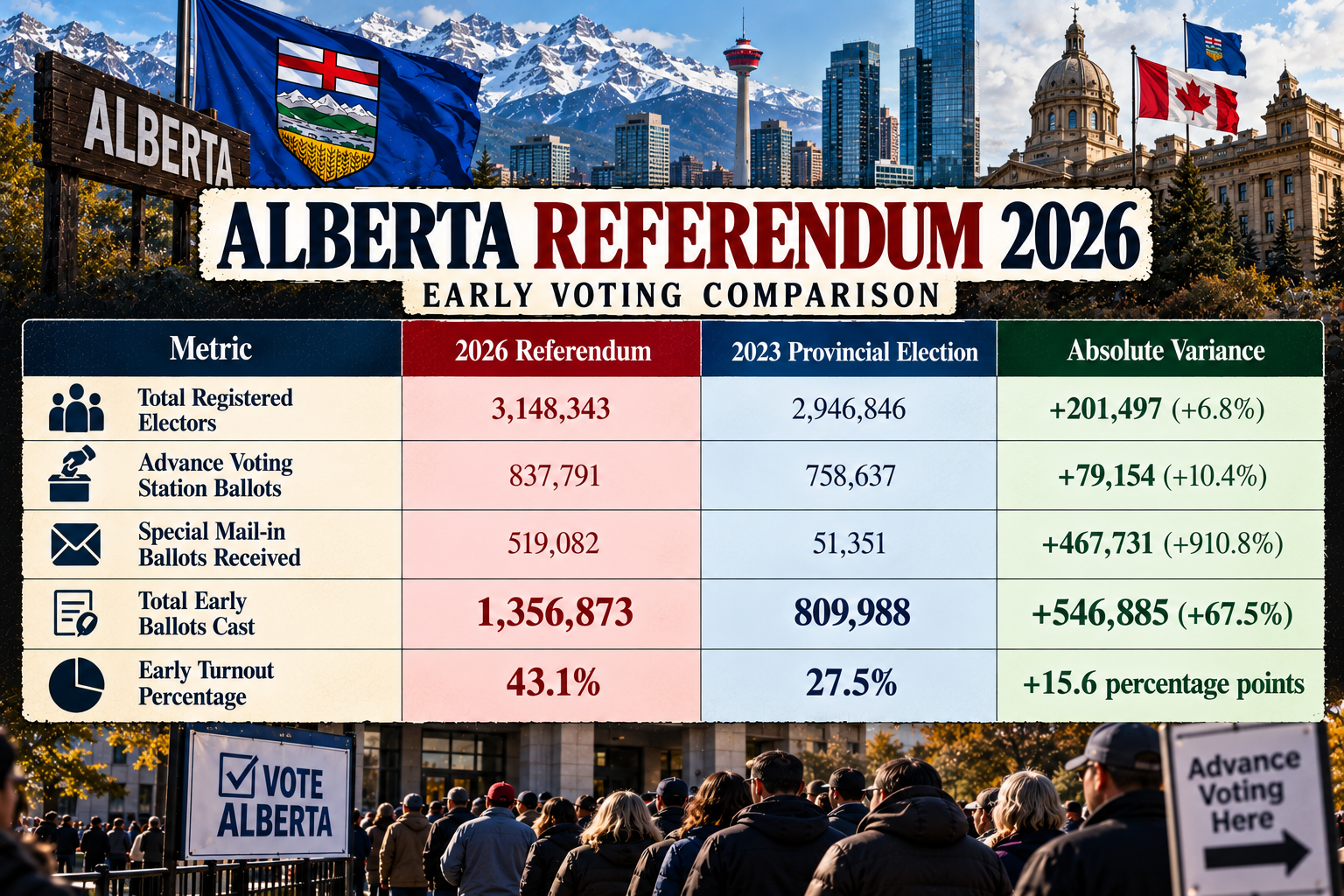
The tenfold surge in special mail-in ballots reflects administrative changes implemented by the provincial legislature, which made vote-by-mail kits universally accessible to all eligible electors without requiring a specific statutory excuse, such as travel, physical disability, or election-day employment.
The Political Strategy of Danielle Smith
Premier Danielle Smith called the referendum following sustained pressure from the party’s grassroots libertarian and rural base, organised under banners like the Free Alberta Strategy and Take Back Alberta.
However, Smith has executed a careful political manoeuvre throughout the autumn campaign. She publicly confirmed that she cast her own ballot for Option 1 ("Remain in Canada"), while actively touring the province to urge a double-digit "Yes" sweep on Questions 1 through 9.
Speaking to reporters in Calgary ahead of the vote, Smith stated that she intends the referendum to act as an unignorable mandate for structural devolution, rather than an exit:
"If Albertans vote to stay in Canada, that matter is settled. Not as long as I’m premier will we revisit a separation vote. But Ottawa must understand that a massive ‘Yes’ on provincial powers means the old arrangement of unilateral federal intrusion is over."
This bifurcated stance serves two objectives: it keeps radical separatist factions inside the UCP coalition while providing Smith with a documented electoral mandate to challenge federal carbon legislation, clean electricity regulations, and health transfer conditions in intergovernmental meetings.
The Legal and Economic Realities
Regardless of the final tally on Question 10, constitutional law and economic realities impose severe constraints on any path to separation.
1. The Supreme Court Framework
Under the Supreme Court of Canada’s landmark 1998 ruling in the Reference re Secession of Quebec, no province can unilaterally secede under Canadian constitutional law. A provincial referendum—no matter how high the turnout or decisive the margin—cannot legally alter the boundaries of the Canadian state. The court ruled that only a "clear majority on a clear question" triggers an obligation on the federal government and other provinces to enter constitutional negotiations.
Furthermore, under the federal Clarity Act (2000), the Parliament of Canada retains the sole authority to determine whether a referendum question and its resulting majority are sufficiently clear before any negotiations can commence.
2. Indigenous Treaties 6, 7, and 8
Alberta’s entire geographic landmass is governed by historic numbered treaties between sovereign First Nations and the British Crown (now represented by the federal Crown in right of Canada). Leadership across Treaty 6, Treaty 7, and Treaty 8 have repeatedly stated that their agreements are with the Canadian Crown, not the province of Alberta. Any attempt to alter the status of lands without free, prior, and informed consent would violate Section 35 of the Constitution Act, 1982, immediately triggering structural legal injunctions.
3. The Cost of Separation
An independent Alberta would face substantial economic and administrative liabilities. A detailed fiscal study reviewed by CBC News estimated that building duplicate provincial institutions—including an independent central bank, tax collection administration, border security, passports, military, and pension management—would require initial establishment outlays of up to $170 billion over five years. Furthermore, as a landlocked jurisdiction, an independent Alberta would remain subject to international transit treaties and Canadian federal jurisdiction to transport crude bitumen and liquefied gas to international tidewater.
What Polling Suggests
Pre-referendum polling shows that early turnout is largely driven by voters seeking to decisively defeat the independence initiative.
A survey conducted by Ipsos for Global News found that 70% of Albertans plan to vote for Option 1 (Remain in Canada), holding steady across September and October tracking.
The proportion favouring Option 2 (commencing the legal separation process) rose slightly to 23%, with support concentrated predominantly among men (27%), electors aged 35–54 (27%), and rural voters outside Edmonton and Calgary (29%).
Parallel polling published on 16 October by the Angus Reid Institute corroborated that "Remain" holds an insurmountable lead, but noted that 62% of respondents doubt a federalist victory will permanently put western alienation to rest.
Elections Alberta confirmed that counting will begin immediately after polls close at 8:00 PM Mountain Time on Monday, 19 October, with tabulation officials processing Question 10 first to deliver an early indication of the province's constitutional posture.