In brief
- Basketball has moved past its rivals to become the world’s number two sport behind football, driven by participation, media deals and cross‑continental reach. This matters because it shows basketball’s rising global prominence.
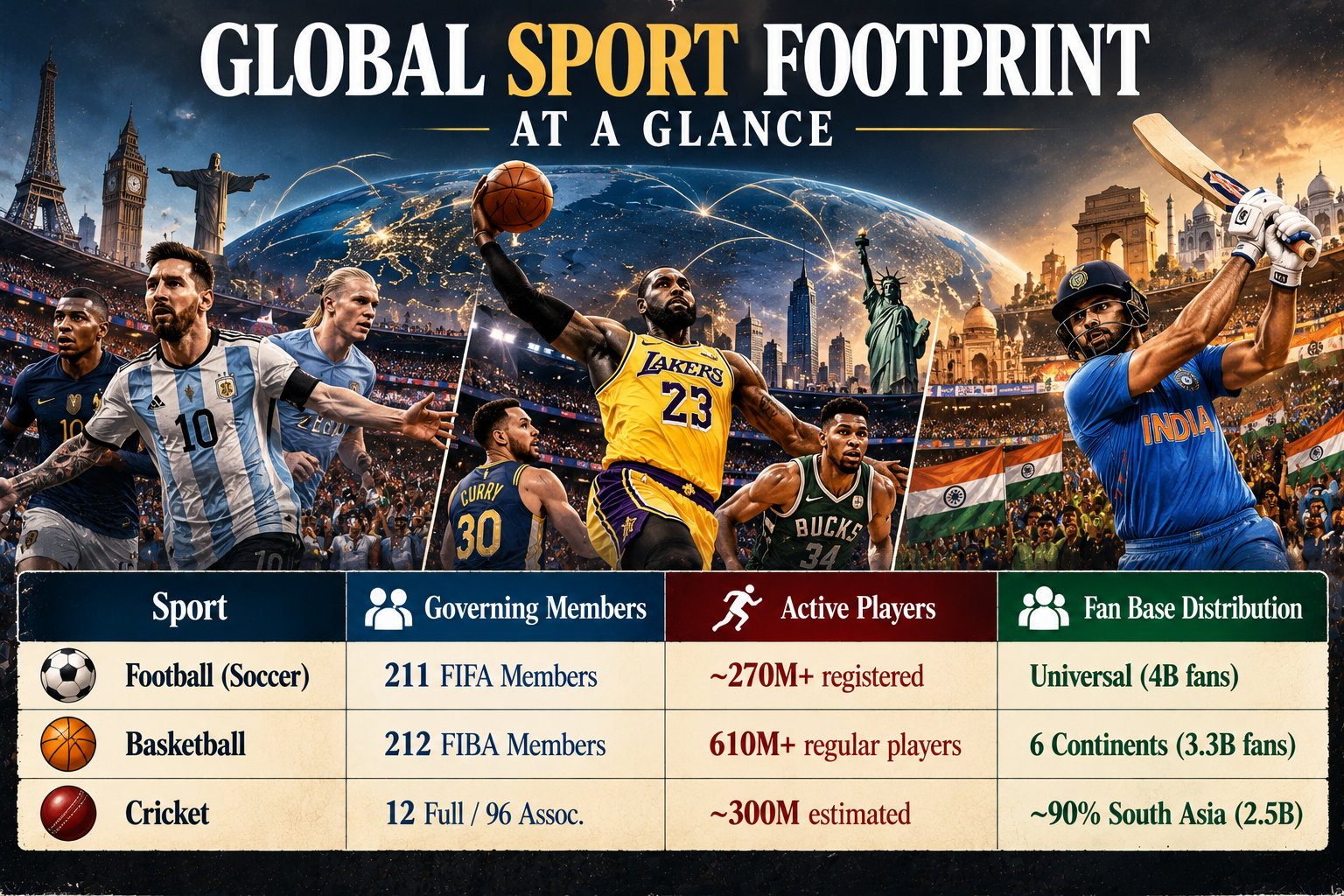
- Nielsen Sports data across 18 major international markets indicates 74% express an active interest in basketball, yielding a projected global audience of 3.3 billion people aged 16 to 69.
- In late 2024, more than 610 million people between six and 54 play basketball at least twice a month, as reported by the Global Sports Barometer for World Basketball Day.
- Basketball’s growth is supported by 212 federation territories and strong urban youth appeal, with the sport becoming a broadly internationalised elite professional league system.
For decades, international sports analysts have debated which game sits directly behind association football on the global podium. While football remains an untouchable titan—commanding an estimated four billion followers and an audience of five billion for the FIFA World Cup—the runner-up position was long contested among cricket, basketball, tennis, and field hockey.
That debate has now largely settled. According to comprehensive consumer tracking by Nielsen Sports, basketball is the second most popular sport on earth behind football. Across 18 major international markets surveyed for the International Basketball Federation (FIBA), 74% of the population expressed an active interest in the game, yielding a projected global audience of 3.3 billion people aged 16 to 69.
This ascent is not an accident of marketing; it is the product of structural advantages in urban access, demographic dominance among younger generations, and the systematic internationalisation of elite professional leagues.
The Scale of the Court: 610 Million Active Players
Measuring a sport's health begins with participation rather than passive viewing. In late 2024, the United Nations marked the second annual World Basketball Day with the release of the Global Sports Barometer, produced by CSM Media Research and KantarSport Asia across 32 markets covering 65% of the world's population.
The census revealed that more than 610 million people between the ages of six and 54 play basketball at least twice a month.
Geographic distribution sets basketball apart from almost every other team sport:
China: Over 200 million people play regularly, making it the country's single most popular team sport by participation.
The Philippines: Nearly one in three citizens plays basketball on a regular basis, anchoring a cultural obsession that dates back more than a century.
India: Rapidly emerging as one of the world's top three participation markets by volume, with basketball courts becoming standard infrastructure in schools and private residential developments across tier-1 and tier-2 cities.
The Americas and Europe: The United States, Spain, France, Lithuania, Serbia, and Germany maintain deep grassroots player pipelines that consistently supply global professional leagues.
Part of this participation boom stems from basketball's spatial efficiency. As urban populations densify, dedicating 7,000 square metres to a full-sized football pitch or an entire cricket ground becomes prohibitive. A standard basketball court requires roughly 420 square metres, while half-court 3x3 setups require less than 150 square metres. By lowering the spatial and financial barrier to entry, basketball has become the default team sport of the twenty-first-century city.
The Cricket Counter-Claim: Geographic Breadth Versus Regional Density
Sceptics often point to cricket as the true claimant to the number-two spot, noting that the sport commands approximately 2.5 billion followers.
The distinction lies in geographic concentration versus global distribution:
Cricket’s Regional Weight: Cricket's immense numbers are overwhelmingly driven by South Asia. India alone accounts for 1.4 billion people, where cricket functions as a secular religion, complemented by intense followings in Pakistan, Bangladesh, and Sri Lanka. Outside South Asia and traditional Commonwealth nations such as the United Kingdom, Australia, and parts of the Caribbean, cricket has limited grassroots uptake and modest broadcast penetration. The International Cricket Council has only 12 full member nations with Test match status.
Basketball’s Universal Spread: FIBA oversees 212 national federations—one more than FIFA and more than the 193 member states of the United Nations. Basketball is played at an elite, professional level across North America, South America, Southern and Eastern Europe, East Asia, and Africa.
When international sports federations evaluate global depth—assessing whether a sport maintains domestic professional leagues, school curricula, and television viewership across multiple continents—basketball displays a balanced global distribution that cricket cannot match.
Youth Demographics and the Digital Highlight Economy
Basketball's current trajectory is reinforced by its appeal to younger demographics. Nielsen’s fan research established that across surveyed markets, 80% of individuals aged 16 to 29 are interested in basketball—an increase of 10 percentage points between 2019 and 2023.
Several factors drive this Gen Z and Gen Alpha engagement:
The Pace of Play: Basketball produces frequent scoring events, changes of possession every 14 to 24 seconds, and dynamic athletic plays suited to short-form video algorithms.
Sneaker and Fashion Culture: From Air Jordans in the 1980s to modern collaborations with luxury fashion houses, basketball shoes and streetwear operate as global cultural currencies independent of game results.
Individual Star Visibility: Unlike American football, where players are obscured by helmets, or association football, where players are often viewed from distant wide-angle cameras, basketball operates on an intimate stage. Five players per side, sleeveless jerseys, and courtside cameras create unmistakable personal brands.
The NBA’s Transformation into an International League
The commercial engine of basketball remains the National Basketball Association. While the league once relied on domestic stars to generate interest, its modern era is distinctly international.
Opening-night rosters for the 2025–26 season featured a record 135 international players from 43 countries across six continents. Every single franchise carried at least one non-US player.
More tellingly, the game's individual honours have been dominated by international talent:
Nikola Jokić (Serbia) has secured three Most Valuable Player awards and an NBA Championship.
Giannis Antetokounmpo (Greece) has claimed two MVP trophies and a Finals MVP.
Joel Embiid (Cameroon) won the 2023 MVP award.
Shai Gilgeous-Alexander (Canada), Luka Dončić (Slovenia), and Victor Wembanyama (France) have become central figures in global marketing campaigns.
This international talent pipeline has driven immense corporate confidence. In mid-2024, the NBA concluded an 11-year domestic and global media rights agreement with Disney, NBCUniversal, and Amazon Prime Video valued at $76 billion (~£60 billion), running from the 2025–26 through the 2035–36 seasons. Averaging roughly $6.9 billion per year, the deal guarantees that live NBA broadcasts will be streamed seamlessly across hundreds of millions of international devices.
The Next Frontiers: BAL, 3x3, and Women’s Basketball
Basketball's growth is expanding along three specific avenues:
1. The Basketball Africa League (BAL)
Co-founded by the NBA and FIBA, the Basketball Africa League established a permanent professional club ecosystem across the continent. Operating out of hubs in Dakar, Cairo, Kigali, and Pretoria, the BAL is transitioning towards permanent, privately owned franchises. Africa holds the youngest median population in the world (roughly 19 years), providing a massive long-term base of players and consumers.
2. The Rise of 3x3 Basketball
Introduced to the Olympic programme at Tokyo 2020 and expanding dramatically at Paris 2024, 3x3 basketball provides an accessible pathway for smaller sporting nations. Teams from Latvia, the Netherlands, and Mongolia have achieved international prominence, proving that nations without standard indoor arena infrastructure can still field world-class squads.
3. The Women's Basketball Surge
Women's basketball has delivered historic broadcast metrics. In the United States, regular-season WNBA viewership jumped over 170% on ESPN platforms, while the WNBA Finals and draft broadcasts repeatedly surpassed 1.5 million to 2.5 million live viewers. Internationally, the FIBA Women’s Basketball World Cup saw fan awareness expand by over 40%, cementing women’s hoops as one of the fastest-growing commercial properties in sport.
Where Basketball Goes From Here
Basketball cannot realistically surpass association football in total global scale. Football's century-long head start, simplicity, and cultural integration across Europe, Latin America, and Africa make it an unmatched global phenomenon.
However, the empirical evidence demonstrates that basketball has effectively distanced itself from other contenders for second place. With 610 million regular participants, 3.3 billion interested consumers, institutional federation backing across 212 territories, and unmatched appeal among urban youth, basketball has built an enduring foundation as the world's clear second-favourite sport.