In brief
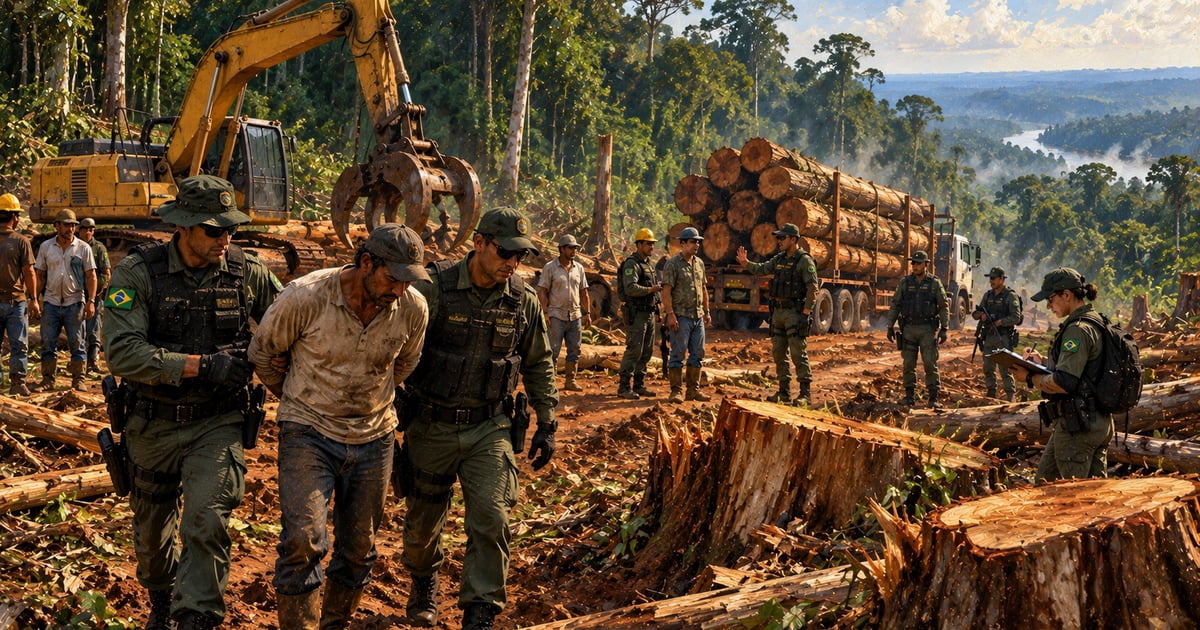
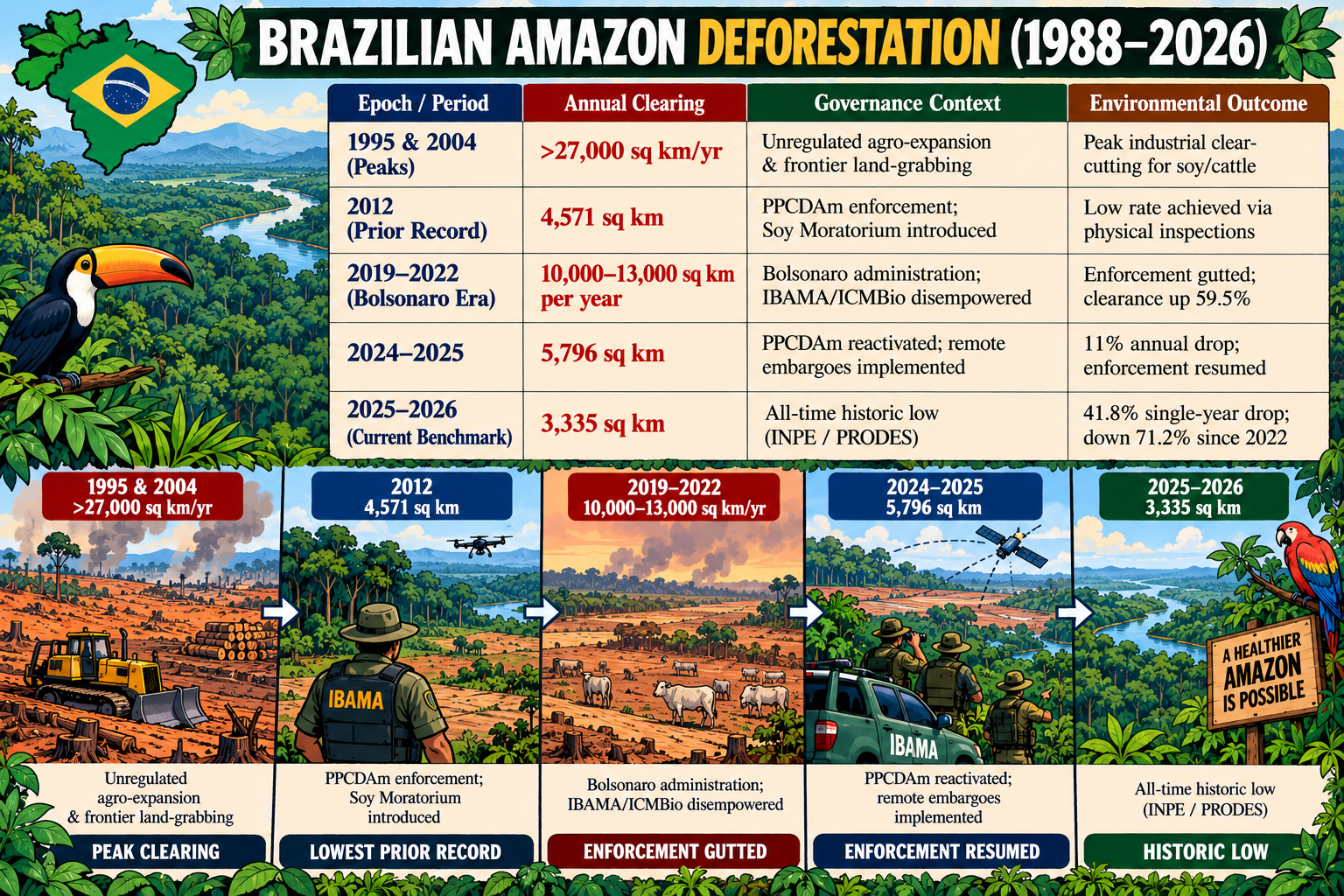
- Deforestation in the Brazilian Legal Amazon fell to 3,335 square kilometres for the twelve month period ending July 2026, the lowest since satellite tracking began in 1988, representing a 41.8 percent single year drop.
- The previous low was 4,571 square kilometres set in 2012, so the current figure is 1,236 square kilometres lower than that level.
- Under Lula and Environment and Climate Change Minister Marina Silva, intentional rainforest clearing has collapsed by 71.2 percent in under four years.
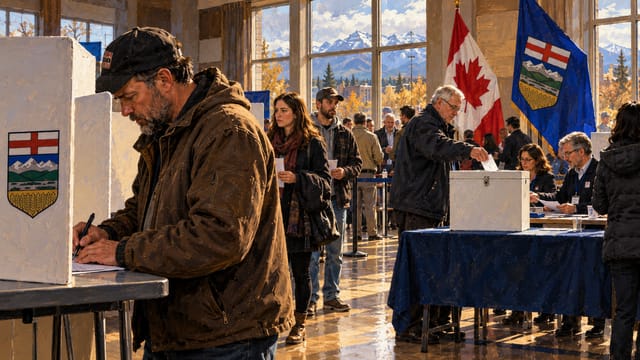
- The data were released by Brazil’s National Institute for Space Research on 16 October 2026, nine days before the 25 October 2026 presidential election run-off between Lula and Flávio Bolsonaro.
For four decades, the accelerating destruction of the Amazon basin was treated across international capitals as an irreversible global tragedy. Under the administration of former President Jair Bolsonaro, industrial clearcutting for cattle ranching and soy monocultures surged to twelve-year highs, exceeding 13,000 square kilometres annually. Environmental agencies were gutted, illegal miners operated with impunity on Yanomami territories, and scientists warned that the world's most critical terrestrial carbon sink was hurtling toward a fatal ecological "tipping point."
On 16 October 2026, Brazil’s National Institute for Space Research (INPE) released figures that upended that fatalistic narrative.
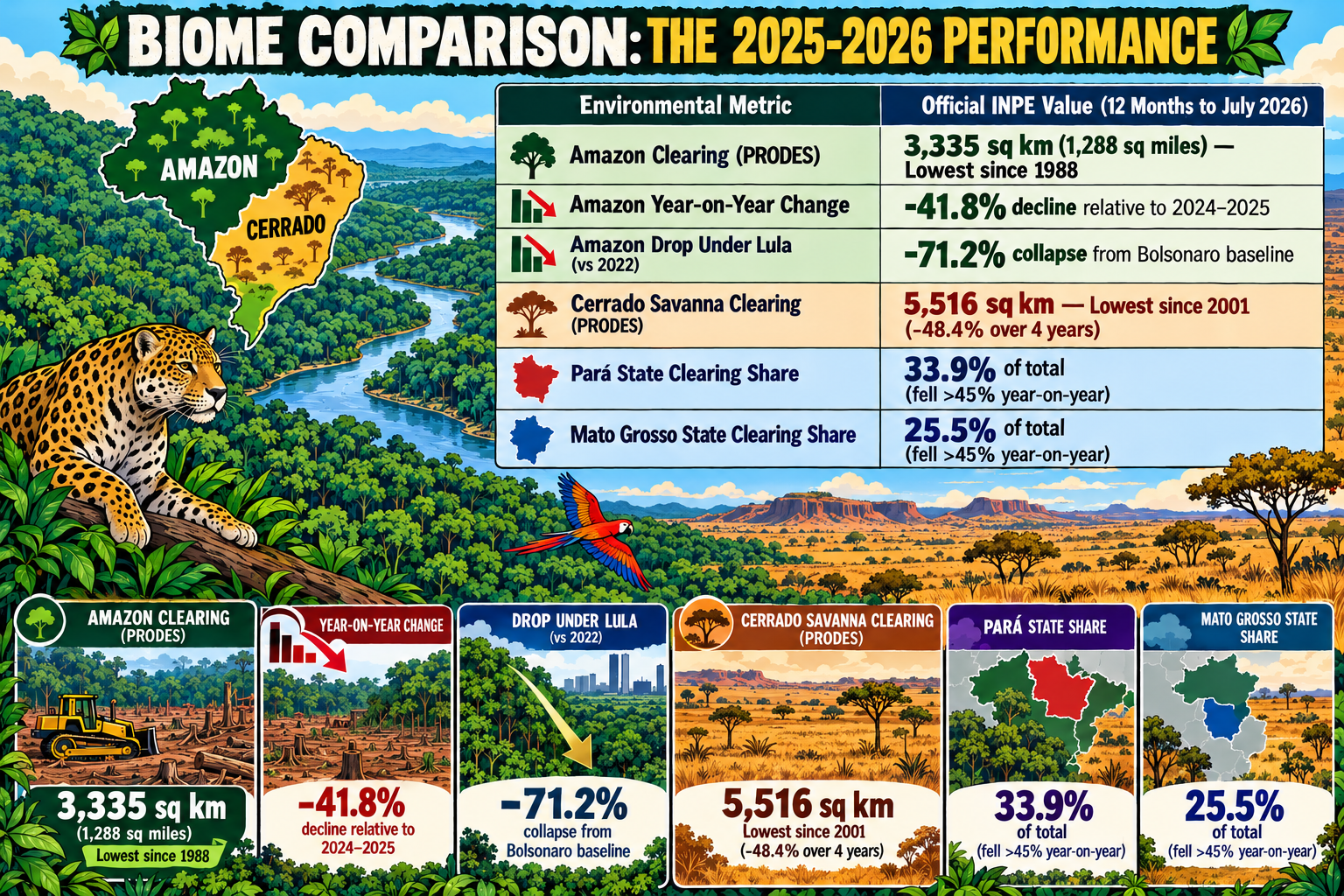
According to consolidated data from the PRODES satellite programme—the international gold standard for measuring tropical deforestation—forest clearance across the Brazilian Legal Amazon dropped to 3,335 square kilometres (1,288 square miles) for the twelve-month monitoring cycle ending July 2026.
The figure represents a 41.8% single-year plunge and stands as the lowest annual deforestation rate recorded since satellite tracking began in 1988. It beats the previous historic low of 4,571 square kilometres, set in 2012, by 1,236 square kilometres—an area larger than the city of Rio de Janeiro.
Under the administration of President Luiz Inácio Lula da Silva and Environment and Climate Change Minister Marina Silva, intentional rainforest clearing has collapsed by 71.2% in under four years.
Yet this conservation triumph arrives in an atmosphere of extraordinary political tension. Published just nine days before Brazil's 25 October 2026 presidential election run-off, the data has turned the Amazon into the defining battleground of the nation's political future. The election pits Lula against conservative senator Flávio Bolsonaro, whose coalition has pledged to dismantle environmental regulations and reopen the rainforest to extractivist commerce.
Whether the historic 3,335-square-kilometre benchmark marks the permanent preservation of the biome or the high-water mark of a temporary truce depends entirely on the ballot box.
The Architecture of the 71% Plunge: Marina Silva’s Machine
The drop from 11,500 square kilometres in 2022 to 3,335 square kilometres was not the result of an economic downturn. During this exact four-year window, Brazil’s agricultural exports broke global volume records.
The decline was driven by the systematic reconstruction of the state's environmental enforcement machinery, directed by Minister Marina Silva and Secretary of Deforestation Control João Paulo Capobianco—the architects who authored Brazil’s original Action Plan for the Prevention and Control of Deforestation in the Legal Amazon (PPCDAm) twenty years ago.
The turnaround rested upon four strategic operational pillars:
1. Re-empowering IBAMA and ICMBio
During the Bolsonaro presidency, field inspections by the environmental protection agency (IBAMA) and the national park service (ICMBio) were deliberately curtailed, fines were nullified by political conciliation boards, and inspectors were banned from destroying heavy machinery seized on illegal mining sites. Lula reversed these policies by executive decree, re-funding enforcement budgets and deploying joint tactical operations with the Federal Police and the Armed Forces.
2. The Power of "Remote Embargoes"
The decisive operational breakthrough was technological. Historically, illegal land-grabbers (grileiros) operated with impunity because inspectors had to physically navigate unmapped jungle terrain to serve notices.
Under updated regulatory frameworks, IBAMA automated remote embargoes. By cross-referencing daily canopy disturbance alerts from INPE’s real-time DETER satellite system with boundaries logged in the Rural Environmental Registry (CAR), authorities issued administrative embargoes digitally.
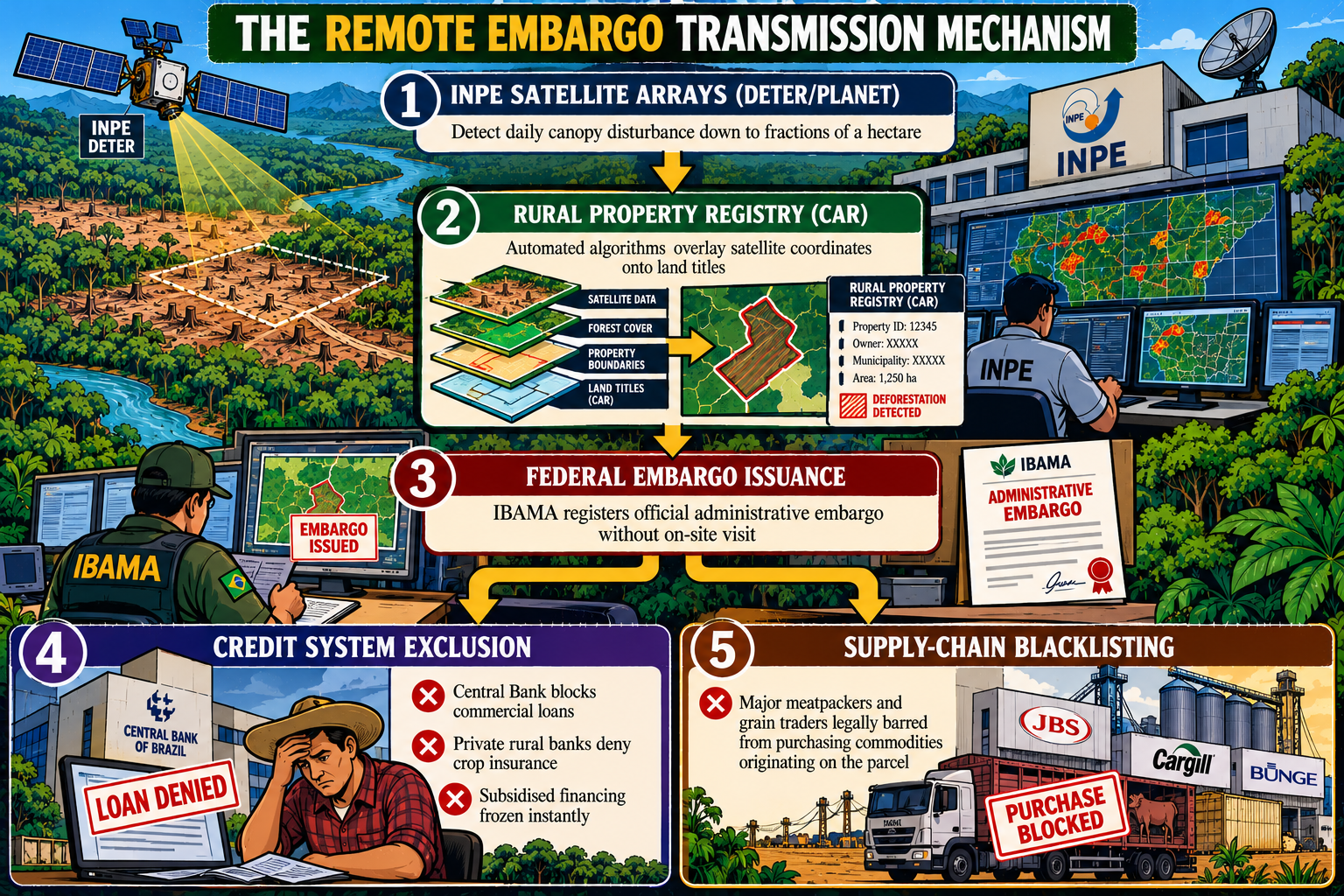
Once an embargo was registered, Central Bank of Brazil compliance mandates automatically blocked the property owner from receiving agricultural loans, subsidized rural credit, or commercial crop insurance. Cut off from working capital, illegal clearing operations collapsed.
3. State-by-State Dissection
The geographic breakdown of the 2026 data illustrates the efficacy of this targeted pressure:
Pará, historically the most violent deforestation frontier, accounted for 33.9% of all clearing, but saw its total forest loss drop by more than 45% year-on-year.
Mato Grosso, the epicentre of commercial grain production, accounted for 25.5%, also contracting by over 45%.
Amazonas, where agricultural expansion along the BR-319 highway had threatened pristine wilderness, registered 15.7%, down by more than 45%.
The single state where deforestation increased was Roraima (up 0.4%)—a conservative stronghold on the northern frontier where illegal wildcat gold mining (garimpo) on Indigenous territories remains entrenched.
4. Demarcating Indigenous Bastions
Academic studies confirm that demarcated Indigenous lands constitute the most formidable physical bulwark against deforestation in South America. The federal government ratified dozens of new Indigenous reserves, transferring constitutional land rights to local communities and empowering them to expel wildcat miners and illegal timber gangs.
Disproving the Cerrado "Leakage" Threat
A primary anxiety among international conservationists was the leakage effect—the hypothesis that choking off clearcutting in the Amazon rainforest would merely displace the bulldozers into the neighbouring Cerrado savanna, an immense biodiversity hotspot that covers more than 20% of Brazil.
The October 2026 satellite data disproved this fear.
Deforestation in the Cerrado fell to 5,516 square kilometres, marking its lowest level since 2001. Over the four years of the current administration, Cerrado vegetation loss has fallen by 48.4%.
Because major international grain traders and retail food conglomerates expanded their deforestation-free procurement covenants to cover both biomes, commercial farmers in the Cerrado could no longer find legal off-takers for crops grown on newly cleared savanna, shutting down the displacement loop.
The Wildfire Paradox: Clearcutting vs. Forest Degradation
While the PRODES data confirms an indisputable triumph against intentional land clearing, satellite thermal sensors recorded a deeply troubling parallel trend: thick blankets of wildfire smoke choking major Amazonian urban centres, including Manaus and Porto Velho.
This apparent contradiction stems from the scientific distinction between deforestation and forest degradation:
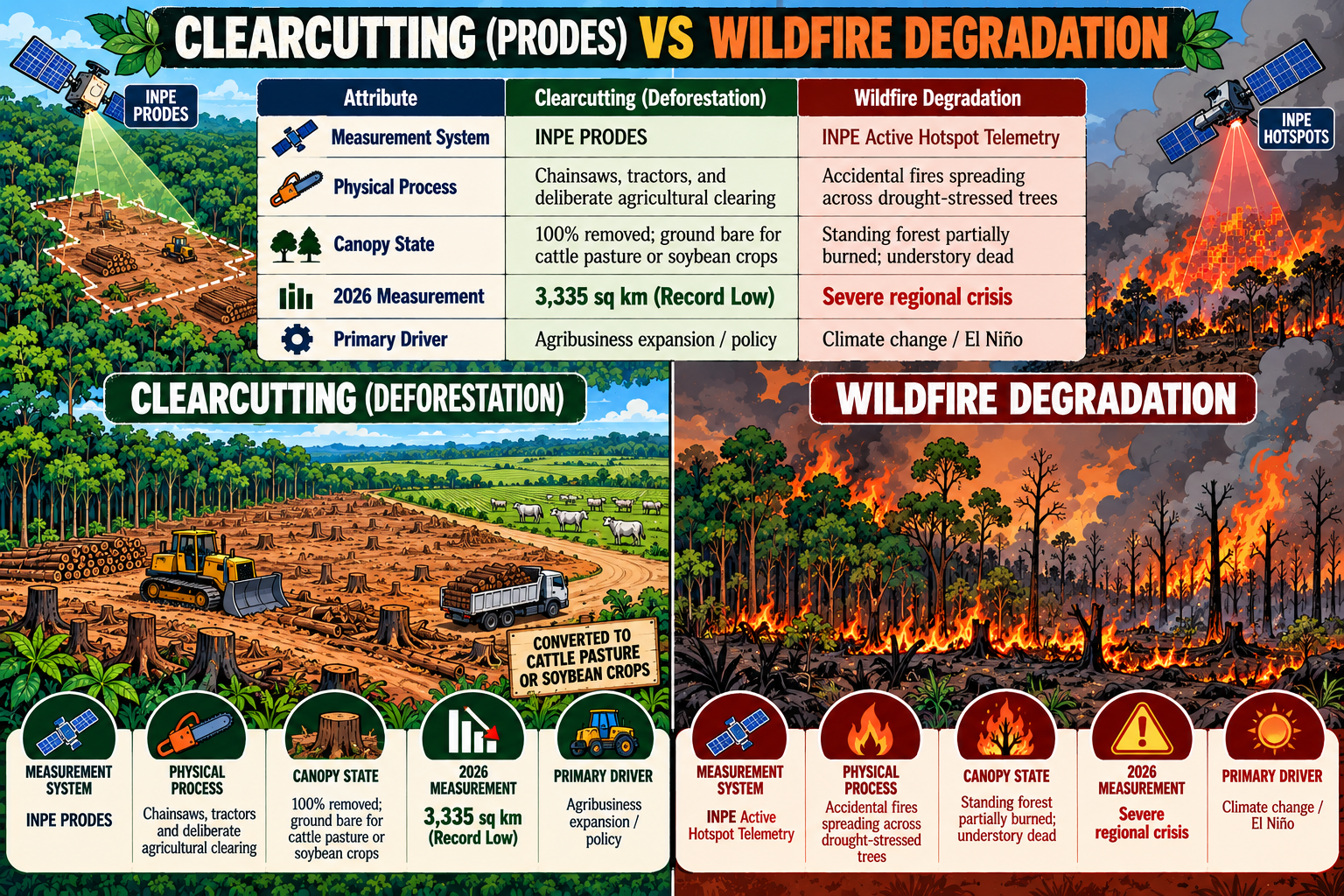
PRODES measures the complete, permanent removal of primary forest cover. This intentional activity was suppressed by regulatory and economic enforcement.
However, during 2024, 2025, and 2026, the Amazon basin experienced historic, climate-induced megadroughts exacerbated by El Niño weather patterns. Major tributaries of the Amazon River system dropped to unprecedented lows, drying out the forest undergrowth.
In a healthy tropical rainforest, dense moisture prevents fires from spreading. In a drought-stricken forest, minor pasture burn-offs set by ranchers escape into primary forest understories, killing up to half of the canopy trees without immediately clearing the ground.
While Brazilian law enforcement successfully halted the commercial bulldozers, atmospheric planetary warming has introduced an existential threat that domestic police operations cannot resolve alone.
The 25 October Crossroads: A Knife-Edge Election
The survival of Brazil’s conservation revolution now rests on the outcome of the 25 October 2026 presidential election run-off.
Despite delivering historic deforestation reductions, record grain harvests, and falling national poverty rates, President Lula entered the run-off facing a formidable challenge from conservative senator Flávio Bolsonaro.
The electoral map in the Amazon states reflects deep ideological divisions:
The Conservation Coalition: Lula commands overwhelming support in major urban centres (such as Belém and Manaus) and in regions with intact forest cover, strong Indigenous populations, and traditional rubber-tapper reserves.
The Extraction Front: Flávio Bolsonaro carried heavy majorities in rural frontier municipalities dominated by cattle ranching, illegal mining, timber processing, and large-scale grain production.
The policy contrast could not be starker. Flávio Bolsonaro has aligned his platform with predatory extractivist interests, pledging to curtail IBAMA’s seizure powers, deregulate environmental licensing, and open protected Indigenous lands to commercial mining. His campaign has cultivated close political ties with conservative movements in the United States, vowing to realign Brazil’s critical mineral and agricultural trade away from multilateral environmental covenants.
Marina Silva, who entered politics alongside legendary rubber-tapper leader Chico Mendes in the 1980s, issued a stark warning following the data release, stating that Flávio Bolsonaro would attempt to finish his father’s "perverse project" of dismantling the rainforest’s legal protections.
Marcio Astrini, executive secretary of the Climate Observatory, summarised the stakes facing Brazilian voters:
"The figure makes it clear that putting an end to forest destruction in Brazil is entirely possible. However, everything depends on the election result. The country will decide whether we move toward the end of deforestation or toward the end of the forest."
Conclusion: Sovereign Will and Planetary Limits
The drop in Brazilian Amazon deforestation to 3,335 square kilometres is a profound validation of environmental governance. It proves that forest destruction is not an uncontrollable economic inevitability, but a policy choice. Through rigorous remote satellite enforcement, financial credit blacklists, and the political resolve to confront criminal extraction cartels, Brazil demonstrated that a major agricultural powerhouse can expand food production while cutting forest destruction by more than 70%.
Yet the achievement remains tragically fragile.
As climatologist Carlos Nobre has warned, cumulative Amazonian deforestation and degradation currently stands between 17% and 18%. If that threshold crosses 20% to 25%, the self-sustaining hydrological cycle that creates the Amazon's rainfall will collapse, locking in a catastrophic transition toward degraded savanna.
Brazil’s environmental agencies have bought the planet invaluable time. They have proved that the clearing can be stopped. But as voters head to the polls on 25 October, the fate of the earth's greatest terrestrial climate shield will be decided not by satellite algorithms or international summits, but by the ballot papers of the Brazilian electorate.