In brief
- Elon Musk announced on X that he will give one SpaceX share to every American child next year, calling it the first of many such gifts.
- With SpaceX trading at about $149.50 per share and roughly 73 million United States minors, the giveaway would cost around $10.7 to $10.9 billion, requiring Musk to surrender about 1.5% of his SpaceX stake.
- The transfer can use the Treasury’s Trump Accounts programme, which allows private donors to gift listed equity to minors without triggering taxable capital gains, building on a 2026 pilot by SpaceX President Gwynne Shotwell.
- Obstacles include unclear eligibility for all minors, the need for custodial brokerage accounts for older children, and potential IRS gift tax filing requirements.
In the early hours of Monday, 19 October 2026, the world’s wealthiest individual opened a new front in his long-running critique of institutional philanthropy. In a typically abrupt post on X, Elon Musk announced:
"Next year, I will give one of my SpaceX shares to every kid in America. This will be the first of many."
The declaration immediately ignited speculation across Wall Street, Capitol Hill, and Silicon Valley. Coming four months after SpaceX completed the largest initial public offering in commercial history, the pledge proposed an unprecedented corporate giveaway: transferring direct equity in the world's pre-eminent aerospace and satellite conglomerate to an entire generation of American minors.
Yet behind the populist rhetoric lies a sharp ideological collision with artificial intelligence rival Anthropic, a complex financial equation involving roughly 73 million young people, and a tangled web of securities regulations that make distributing shares to minors one of the most fraught administrative exercises in modern finance.
The Spark: An Ideological Feud with Anthropic
Musk’s announcement was not a premeditated policy rollout; it was an instinctive counter-punch.
Twenty-four hours earlier, San Francisco-based artificial intelligence developer Anthropic—creators of the Claude model family—had published a major corporate governance initiative. Anticipating its own multi-hundred-billion-dollar public listing, Anthropic announced that it was formally committing 5% of its equity, valued at roughly $48 billion, to a newly incorporated "Public Benefit Fund."
According to Anthropic’s corporate disclosures, the fund was designed to issue grants to charitable institutions and mitigate the broader societal fallout—including structural labour displacement—caused by frontier artificial intelligence systems. Anthropic further pledged to inject an additional 2% of company equity for every 50% increase in the corporation's market capitalisation above a baseline threshold.
Musk, who has spent years criticising institutional non-profit foundations as self-serving bureaucracies designed to generate "the appearance of goodness rather than the reality of goodness," responded with unconcealed disdain.
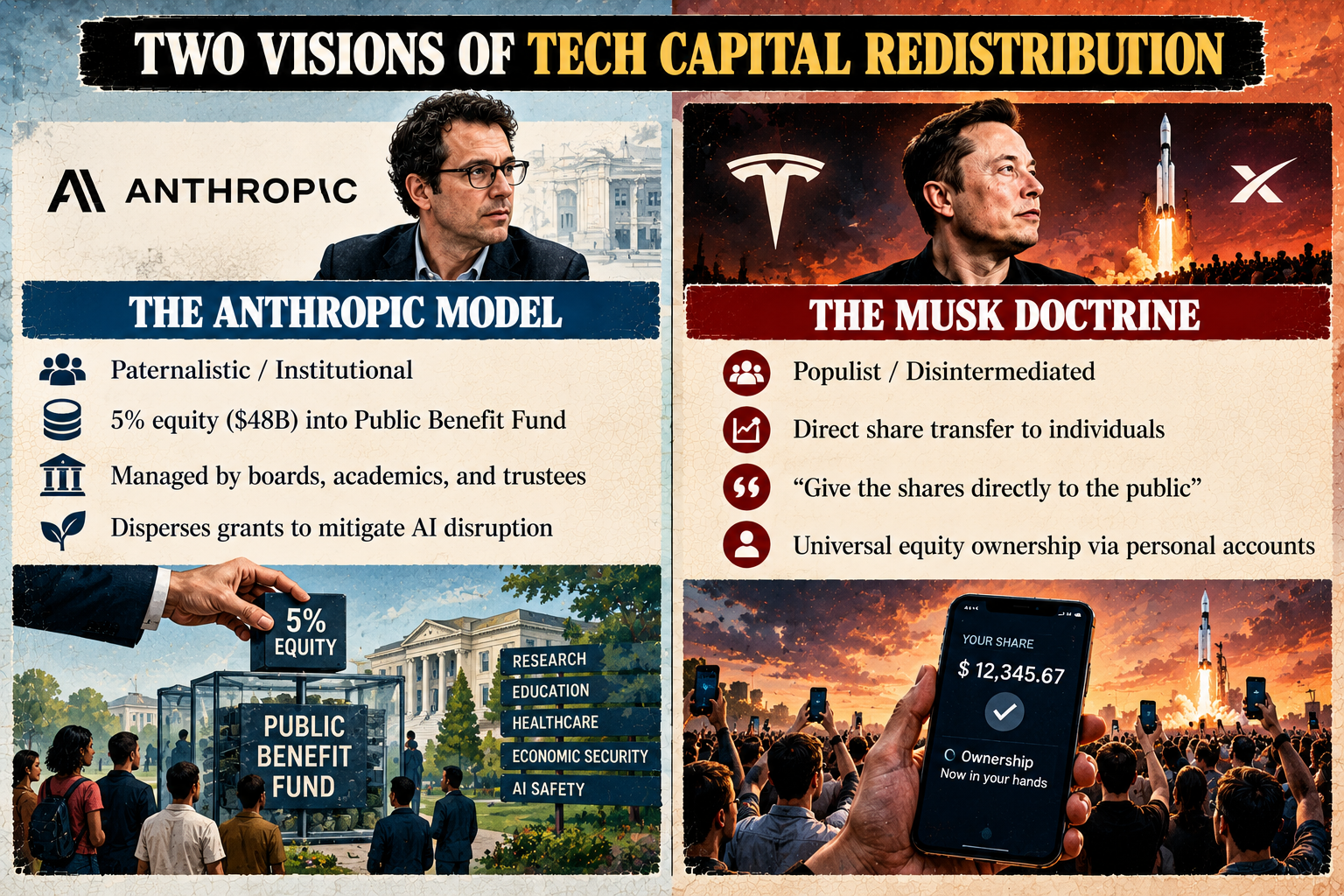
Replying to coverage of Anthropic's announcement, Musk dismissed the intermediary structure entirely: "I recommend giving the shares directly to the public… This is what I will be doing." Hours later, his promise to distribute SpaceX stock was posted.
Sizing the Dividend: The Demographics and the Math
While Musk’s social media missive was characteristically spare on detail, the underlying financial arithmetic is straightforward.
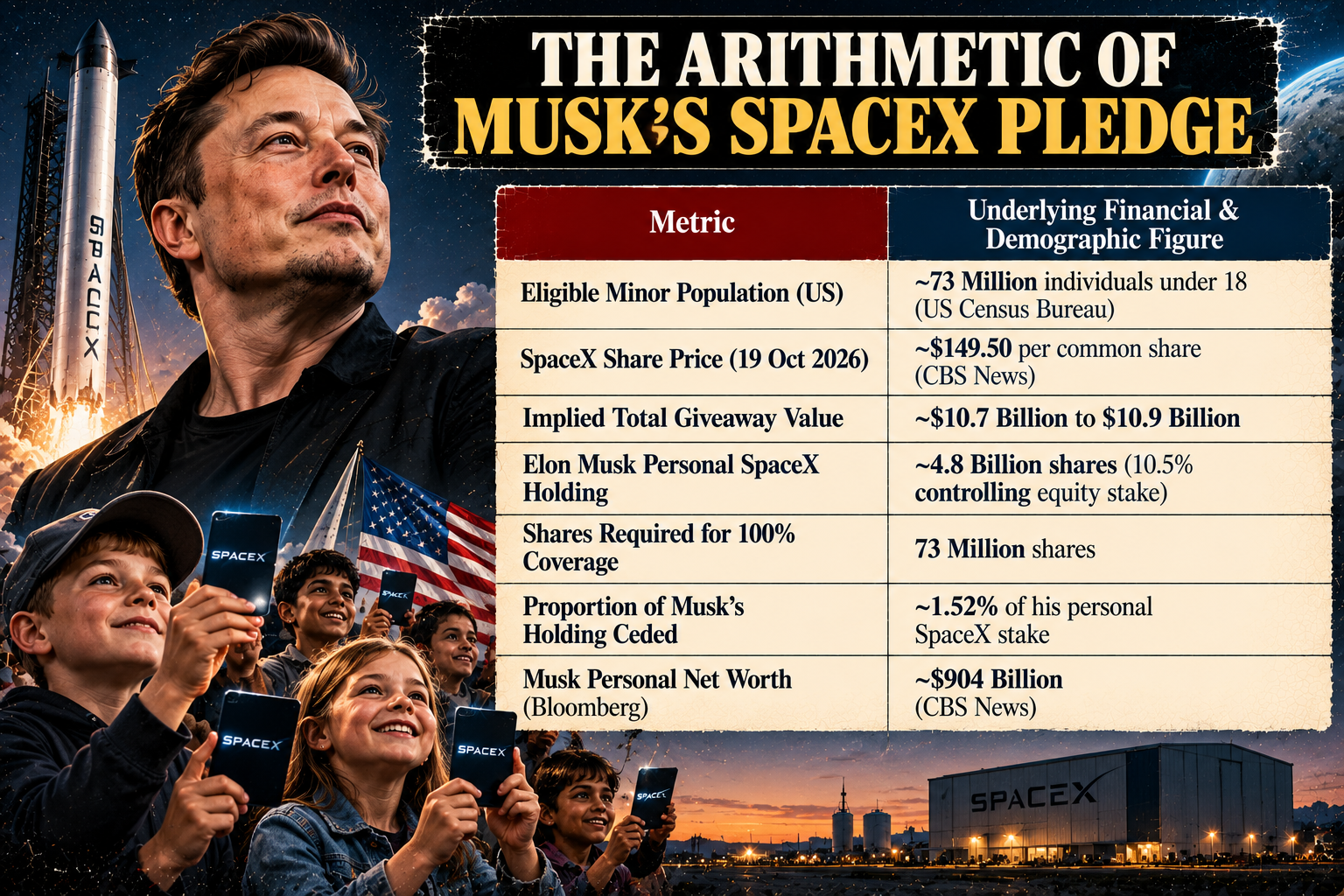
Following its transition to the public markets in June 2026, SpaceX common stock was changing hands on Monday at approximately $149.50 per share, giving the Hawthorne, California-based enterprise an aggregate market capitalisation hovering near $2.05 trillion.
According to the latest demographic data from the United States Census Bureau, there are currently approximately 73 million American citizens under the age of 18.
The arithmetic reveals two critical realities:
First, from a net-worth perspective, the pledge is well within Musk’s financial capacity. Distributing 73 million shares would cost roughly $10.7 billion to $10.9 billion at current trading prices. With Musk’s personal fortune estimated at $904 billion on the Bloomberg Billionaires Index and his personal holding in SpaceX standing at roughly 4.8 billion shares (a 10.5% equity stake), fulfilling the pledge would require surrendering merely 1.52% of his SpaceX holdings. It would not materially alter his supermajority voting control over the aerospace giant.
Second, for the recipient, the gift represents a modest but non-trivial financial endowment. A single share worth roughly $150, gifted to an infant or young child and left to compound over fifteen to eighteen years in a space exploration and satellite broadband monopoly, could realistically appreciate into a meaningful nest egg by the time the beneficiary attains adulthood.
The Transmission Rail: "Trump Accounts" and the Shotwell Precedent
The central question vexing market observers is operational: how can an individual donor legally transfer publicly listed securities to 73 million separate minors without drowning in brokerage compliance, identity verification, and tax disputes?
The answer lies in a newly established federal financial vehicle: Trump Accounts.
Created under the Trump administration’s sweeping tax and economic legislation, the "Trump Accounts" initiative functions as a universal child savings and investment programme. Administered directly by the US Department of the Treasury, the federal government began automatically enrolling tens of millions of American minors into these tax-deferred trust accounts in October 2026. Children born between 1 January 2025 and 31 December 2028 are eligible to receive a $1,000 cash seed contribution funded directly from the federal treasury.
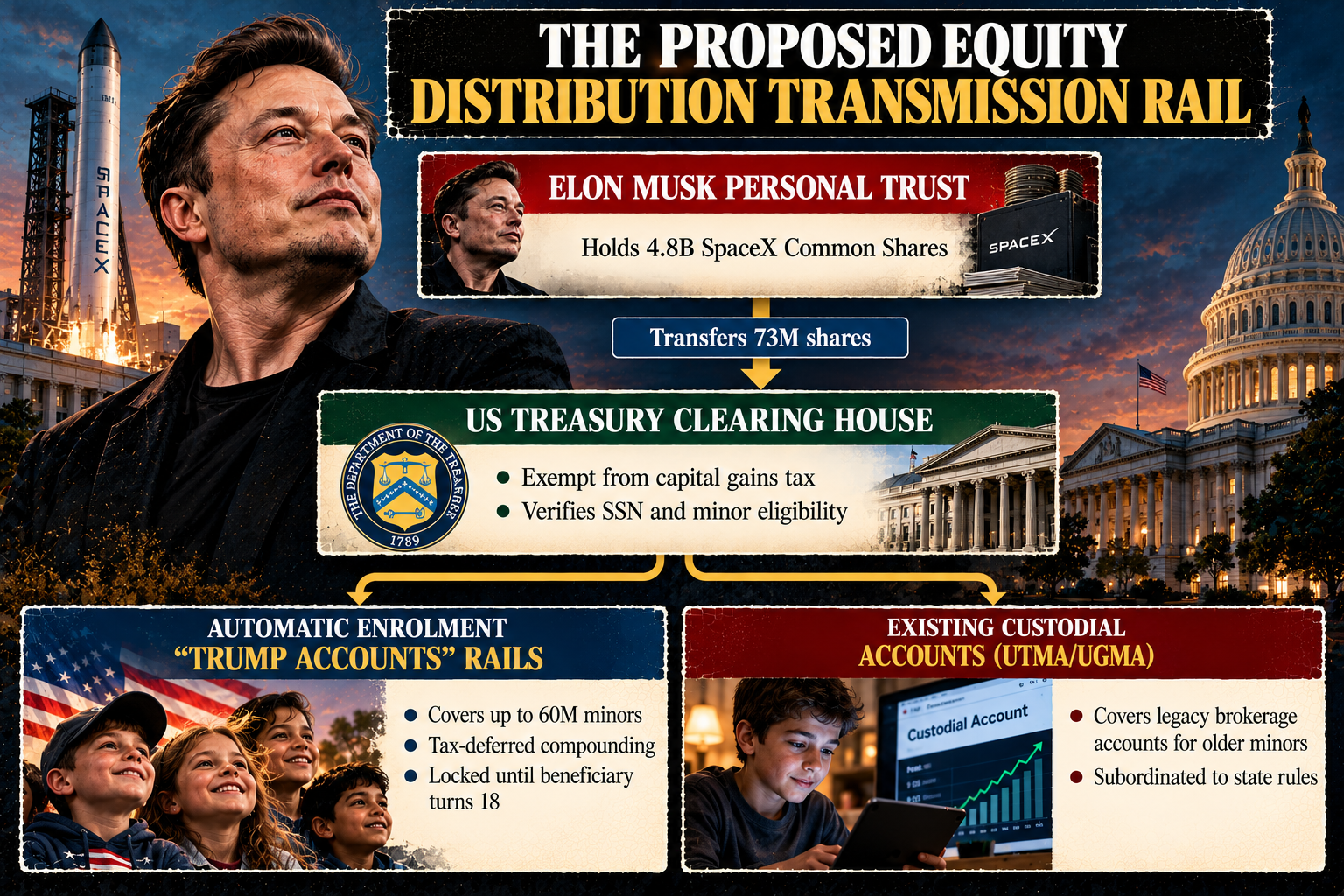
Crucially, Treasury regulations established that private philanthropic donors could gift listed equity directly into these accounts without triggering taxable capital gains events for either the donor or the recipient child.
Musk’s proposal also builds upon an internal corporate pilot. In July 2026, SpaceX President and Chief Operating Officer Gwynne Shotwell and her husband announced an initial donation of one SpaceX share to each of roughly two million children already enrolled in the federal accounts programme, specifically prioritising lower-income households and families residing in Texas, the home of SpaceX's Starbase launch facility.
By scaling Shotwell's targeted regional pilot into a universal national programme, Musk has an existing regulatory conduit to execute the distribution.
The Structural Hurdles: Custody, Taxes, and Verification
Despite the presence of the Treasury’s new accounts system, implementing a universal 73-million-share transfer by 2027 faces formidable legal and operational obstacles:
1. The Eligibility Boundary
Musk’s phrasing—"every kid in America"—is legally ambiguous. Does eligibility require US citizenship, or does it extend to lawful permanent residents, undocumented minors, or foreign nationals residing temporarily in the United States? Establishing eligibility requires cross-referencing Social Security Administration databases with Census records, a process that risks triggering immediate privacy challenges and administrative bottlenecks.
2. The Custodial Brokerage Gap
While the Treasury is working to enrol up to 60 million children into the new federal savings structure, millions of older minors remain outside the system. Under standard American securities jurisprudence, minors cannot legally own or trade equities in their own names; shares must be held in trust under the Uniform Transfers to Minors Act (UTMA) or Uniform Gifts to Minors Act (UGMA) through a designated adult custodian. Establishing individual custodial brokerage sub-accounts for tens of millions of disengaged households would impose enormous transaction and compliance expenses.
3. IRS Gift Tax Constraints
Under current US Internal Revenue Code provisions, annual gifts exceeding the statutory exclusion threshold require the filing of federal gift tax returns. While transferring shares into designated government-sanctioned child trust accounts may confer specific exemptions, a coordinated transfer of $10.7 billion in private wealth will require bespoke IRS private letter rulings to clarify Musk's tax deductions and lifetime unified gift-and-estate tax exclusions.
Visionary Altruism or Calculated PR?
Scepticism surrounding Musk’s pledge is rooted in his long history of using social media to make grandiose, populist commitments that subsequently stall or quietly dissolve:
The $420 Take-Private (2018): Musk claimed on Twitter that he had "funding secured" to take Tesla private at $420 per share, triggering an SEC fraud lawsuit that stripped him of his Tesla chairmanship and imposed $40 million in fines.
The UN World Food Programme Challenge (2021): Musk famously challenged the United Nations World Food Programme to demonstrate how $6 billion would "solve world hunger," pledging to sell Tesla stock immediately if they provided the financial breakdown. The WFP produced a detailed plan, but the donation never materialised.
The Self-Driving and Hyperloop Timelines: Musk has repeatedly promised that fully autonomous robotaxis and operational vacuum-tube transit networks were arriving "next year"—predictions that have routinely slipped by years or been abandoned altogether.
However, treating the SpaceX giveaway as pure theatrical bluster risks underestimating the convergence of Musk's current political, corporate, and technological incentives.
Having integrated his aerospace empire deeply into federal defence, intelligence, and civil infrastructure, and having forged close strategic ties with Donald Trump's administration, a universal equity giveaway directly complements the populist economic messaging of the White House. Furthermore, turning 73 million American families into direct equity stakeholders in SpaceX provides a permanent grassroots political shield for his aerospace and satellite broadband monopoly against future regulatory or antitrust scrutiny.
The New Politics of "Citizen Capitalism"
Regardless of whether Musk executes the full 73-million-share distribution in 2027, the announcement reflects an important evolution in the debate over wealth distribution in an automated society.
For decades, the standard philanthropic model—epitomised by the Bill & Melinda Gates Foundation and echoed in Anthropic’s Public Benefit Fund—has relied on billionaire donors transferring corporate equity into tax-exempt endowments governed by boards of trustees, academics, and non-profit administrators who decide how capital is dispersed.
Musk’s proposal, however erratic in its initial formulation, champions an alternative doctrine: direct citizen capitalism. In an economy where artificial intelligence and advanced robotics threaten to shift an ever-larger share of national income away from human labour and toward owners of capital, providing citizens with direct, sovereign stakes in foundational technology monopolies may soon cease to be viewed as eccentric billionaire vanity—and emerge as a core demand of 21st-century economic survival.