
In brief
- Argentina is back in a technical recession, with GDP contracting by 0.6% quarter on quarter in Q2 2026, driven by a 2.4% fall in private activity. This matters because it shows the economy shrinking despite policy efforts under Javier Milei.
- A flawed currency reset in January 2026 and a flexible band system after an IMF programme left imports cheapened and dollar reserves drained, as inflation outpaced the band and the peso appreciated in real terms.
- A five quarter investment freeze and credit crunch followed, with prime lending rates spiking to 81%, non performing loans rising, and consumer lending in pesos falling 9.6% year on year by September 2026.
- The recession hides a structural split where energy, mining, and soy generate dollars while textiles, footwear, metals, and construction employ many Argentines, and poverty rose to 32.3% while extreme poverty reached 7.5% in the first half of 2026.
Argentina is back in a technical recession. Official figures from the National Institute of Statistics and Censuses (INDEC) show gross domestic product (GDP) contracted by 0.6% quarter-on-quarter in the second quarter of 2026, dragged down by a 2.4% fall in private consumption and an 11.1% year-on-year drop in fixed investment (IntelliNews). Monthly activity data has since worsened: INDEC’s Monthly Economic Activity Estimator (EMAE) fell 2.8% month-on-month in July and edged up just 0.1% in August, leaving output 1.7% lower than a year earlier (IntelliNews, Trading Economics). Ahead of official third-quarter numbers due in December, private consultancies including Orlando Ferreres y Asociados (-1.2%) and the University of San Andrés (-2.66%) estimate a second consecutive quarterly decline, meeting the standard threshold for a technical recession (IntelliNews).
For critics of President Javier Milei, the downturn looks like the predictable unravelling of free-market shock therapy. Nearly three years after he took office in December 2023 promising to take a chainsaw to the state, disinflation has stalled above 30%, formal private employment has shrunk for 13 consecutive months, and poverty jumped from 28.2% in late 2025 to 32.3% in the first half of 2026 (AP News, IntelliNews).
Yet calling Milei’s programme a simple failure misreads both what it achieved and why it stalled. Argentina did not return to hyperinflation. Instead, it walked into a classic macroeconomic squeeze: a monetary regime that lost its inflation anchor in early 2026, a severe credit drought, and a two-speed economy where booming commodity exports cannot offset the collapse of urban factories and construction.
What Milei’s Shock Therapy Actually Fixed—and Where It Broke
To judge whether the experiment failed, it helps to recall the wreckage Milei inherited in December 2023. Annual inflation stood at 211.4% (with monthly price rises hitting 25.5% in December alone), the fiscal deficit sat at roughly 4.4% to 5% of GDP, the central bank’s net foreign-exchange reserves were deeply negative at -$11.2 billion, and a 170% gap separated the official and parallel exchange rates (Deloitte Insights, Reason, IISS).
Milei’s initial stabilisation worked faster than most economists expected. By slashing public spending—including an 87% real cut in public infrastructure investment in 2024—and halting central bank money-printing to finance deficits, the government eliminated the fiscal shortfall (Economics Observatory, PIIE). After a 1.3% contraction in 2024, real GDP rebounded by 4.4% in 2025 (OECD). Annual inflation plunged from a peak of 289.4% in April 2024 to 31.3% by October 2025, delivering Milei’s La Libertad Avanza party 41% of the vote and 64 of 127 lower-house seats up for renewal in the October 2025 midterms (IntelliNews, BNP Paribas).
The trouble began when stabilisation had to turn into durable growth. Three mechanisms pulled the economy back into contraction in 2026:
1. A flawed currency reset in January 2026. Throughout 2024 and 2025, Milei used a tightly controlled exchange rate to force inflation down—first via a crawling peg depreciating at 2% (later 1%) a month, and then, after securing a 48-month, $20 billion International Monetary Fund (IMF) programme in April 2025, via a currency band of ARS 1,000 to ARS 1,400 per dollar widening by 1% monthly (IMF, BCRA). Because domestic inflation ran faster than 1% a month, the peso appreciated sharply in real terms, cheapening imports and draining dollar reserves. Argentina only avoided a currency crash before the October 2025 midterms thanks to a $20 billion US Treasury swap line and roughly $2.5 billion in direct US intervention (PIIE).
On January 2, 2026, the government patched the problem by indexing the exchange-rate band’s monthly expansion to inflation from two months earlier—2.5% in January and 2.8% in February (PIIE). As Peterson Institute economist Maurice Obstfeld warned, that adjustment prevented mechanical overvaluation but stripped away the economy’s nominal anchor (PIIE). Because month T’s inflation automatically became month T+2’s permitted depreciation, expectations locked in. Annual inflation stopped falling, edging back up to 33.4% in September 2026, with consultancy FIEL estimating 2% monthly inflation in October (IntelliNews).
2. A five-quarter investment freeze and credit crunch. Firms do not commit capital based on a single month’s interest rate; they price the risk of another policy reversal. During the pre-midterm peso scare in 2025, prime lending rates spiked to 81% and non-performing loans rose, scarring bank balance sheets (Economics Observatory). By September 2026, consumer lending in pesos had fallen 9.6% year-on-year in real terms, retail sales tracked by the CAME business federation were down 9.2% over the first nine months of the year, and fixed investment had contracted for five straight quarters (IntelliNews).
3. Political scandals and stalled structural reforms. In 2026, Milei’s administration was hit by the $Libra cryptocurrency controversy, leaked recordings alleging pharmaceutical kickbacks involving his sister and Secretary General Karina Milei, and scrutiny over Cabinet figures, culminating in a top aide’s resignation in October (The Guardian, LA Times, Financial Times). With approval ratings sliding and provincial governors losing tax revenue, major tax and pension reforms stalled in Congress (Inter-American Dialogue). Financial markets reacted immediately: Argentina’s JP Morgan country risk spread more than doubled from roughly 400 basis points in July 2026 to 925 basis points on November 5 (IntelliNews).
The Two-Speed Economy: Why Exports Boom While Cities Hurt
The aggregate recession conceals a sharp structural split. Removing import restrictions and currency controls exposed Argentina’s long-protected domestic industries to foreign competition while unleashing its primary exporters.
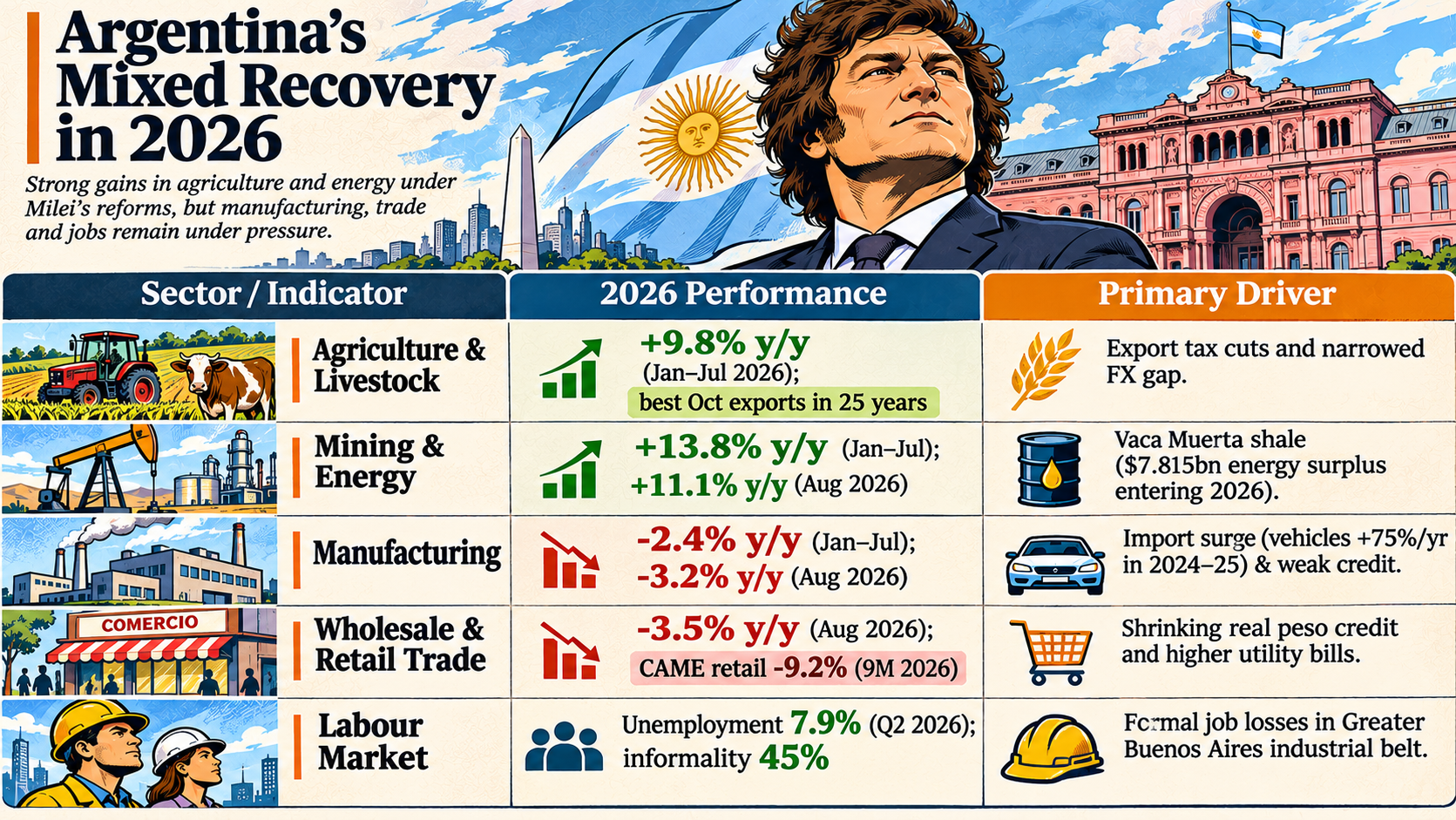
This divergence explains why macro stability has failed to translate into popular relief. Energy, mining, and soy generate dollars, not mass urban employment. By contrast, textiles, footwear, metals, and construction—industries concentrated in the Greater Buenos Aires industrial belt—employ millions of Argentines (Economics Observatory). When consumers began buying imported cars and appliances instead of locally assembled goods, job losses hit immediately, driving poverty up to 32.3% (roughly 9.7 million people in surveyed urban areas) and extreme poverty to 7.5% in the first half of 2026 (AP News, Anadolu Agency).
Is Argentina Permanently Doomed?
Looking at the past century, pessimism looks rational. In 1913, Argentina ranked among the world’s ten wealthiest nations per capita, with incomes at 72% of the US level, buoyed by agricultural exports and European capital (Our World in Data, Mercatus Center). Since independence in 1816, however, the country has defaulted on its external sovereign debt nine times and entered more than 21 IMF programmes since 1956 (SMU Scholar). It took until the year 2000 for Argentina merely to double its early-century per capita GDP (Harvard Business School).
The pattern across decades has been remarkably consistent: governments either finance expansive social spending by printing money—triggering triple-digit inflation—or anchor prices with an overvalued currency that destroys domestic industry, swells foreign debt, and ends in a sudden devaluation.
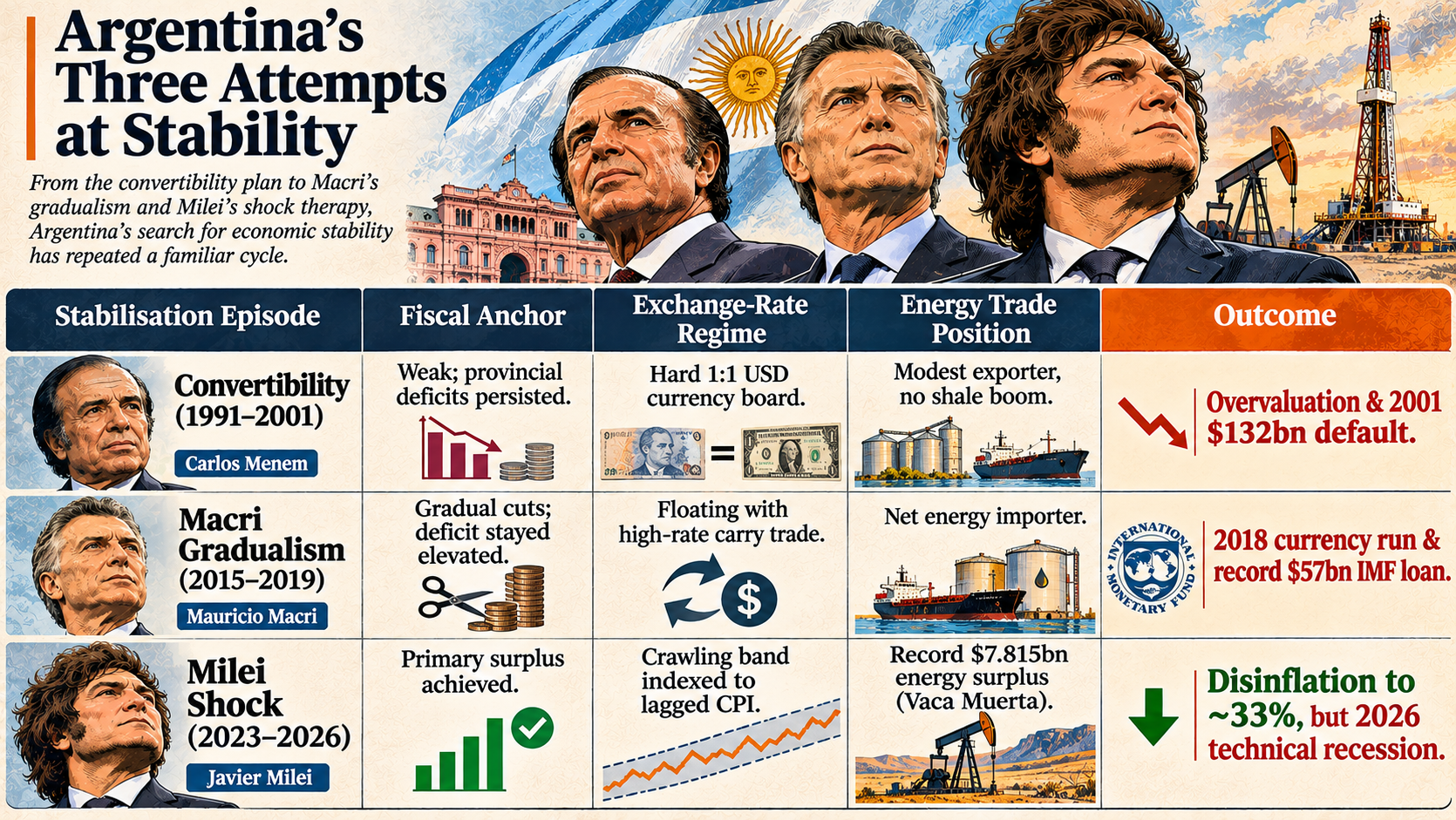
Yet three facts argue against the idea that Argentina is permanently condemned to repeat 2001 or 2018:
First, fiscal discipline has held. Unlike Mauricio Macri’s gradualist administration, which kept running deficits while borrowing abroad, Milei eliminated the central government’s primary deficit and stopped central bank deficit financing (PIIE). Even critics who note that capitalised bond interest complicates the headline balance acknowledge the scale of the primary turnaround.
Second, geology has altered Argentina’s external accounts. Past stabilisation plans collapsed because Argentina ran out of dollars whenever growth resumed. The development of the Vaca Muerta shale formation has turned Argentina into a net energy exporter for the first time since 2010, generating a $7.815 billion energy surplus entering 2026 (Economics Observatory, Shale24). Under the Large Investment Incentive Regime (RIGI), announced projects in LNG, oil, lithium, and copper have reached roughly $100 billion, with analysts projecting total Argentine exports could climb from around $105 billion to $180 billion by 2035 (Economics Observatory, Comunicaciones Mineras).
Third, regional peers proved chronic inflation can be beaten. Neighbouring Brazil, which shared Argentina’s history of hyperinflation and defaults in the 1980s, grew 2% year-on-year in Q2 2026 with inflation at just 4.6% in October, anchored by a floating currency and an independent central bank targeting inflation (IntelliNews, PIIE).
Argentina’s curse is therefore institutional, not permanent. Its real vulnerability ahead of the October 2027 presidential election is a credibility trap: Vaca Muerta and RIGI investments take years to build, and investors will only deploy capital if they believe the rules will survive the next election. Meanwhile, urban voters facing 7.9% unemployment and 32.3% poverty may not wait for Patagonia’s oil and northern lithium to trickle down to Buenos Aires. Milei has not failed—he defused a hyperinflationary bomb that many thought unstoppable—but unless he replaces his fragile currency band with a credible inflation-targeting framework and rebuilds political consensus, Argentina’s latest stabilisation risks becoming another unfinished chapter.