In brief
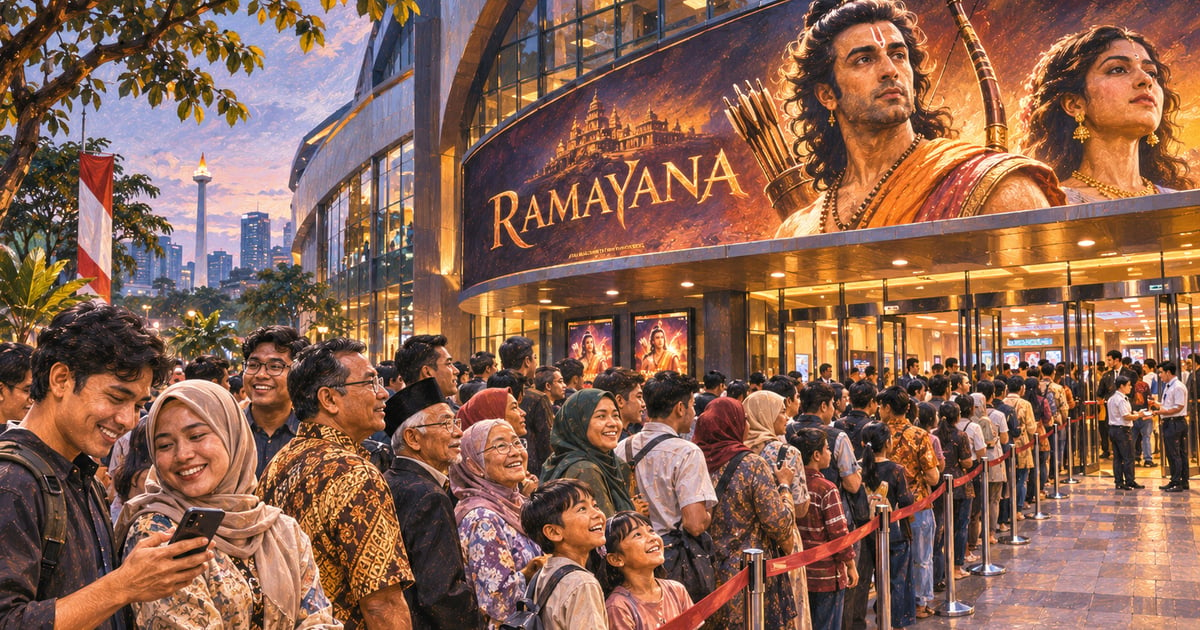
- Ramayana: Part 1 shattered Indian box office records in Thailand, Indonesia, Vietnam, and Cambodia within 11 days of its 5 November 2026 release, helping overseas gross reach $49.40 million by 15 November 2026.
- The film entered Southeast Asia not as a foreign export but in markets where the story was already local canon, with Hollywood grade visual effects and local language dubbing.
- The five tracked ASEAN markets contributed roughly $4.78 million of the overseas total, about 9.7 percent, while other regions such as the United States and United Kingdom supplied 75.8 percent.
- Southeast Asia showed that non-Indian audiences will buy tickets when the shared civilisational memory and IMAX scale presentation meet local sensibilities, though Ramayana succeeded only where Rama, Sita, and Hanuman were familiar beforehand.
What the film has achieved—within 11 days of its 5 November 2026 release—is arguably more significant for Indian cinema. Across Southeast Asia, a region where Indian films outside Malaysia and Singapore rarely register beyond small expatriate audiences, Ramayana: Part 1 has shattered Indian box-office records in Thailand, Indonesia, Vietnam, and Cambodia. By 15 November 2026, those territories helped push the film's overseas gross to $49.40 million (₹465 crore at ₹94.25 per US dollar), overtaking Jawan ($48.20 million) to become the highest-grossing Indian film overseas excluding China.
That breakout happened because Ramayana did not enter Southeast Asia as a foreign Bollywood export. It arrived in markets where the story was already local canon, packaged with Hollywood-grade visual effects and local-language dubbing.
The Southeast Asian Numbers Through 15 November 2026
Territorial tracking compiled by Pinkvilla and Hindustan Times shows how broadly the film performed across ASEAN:
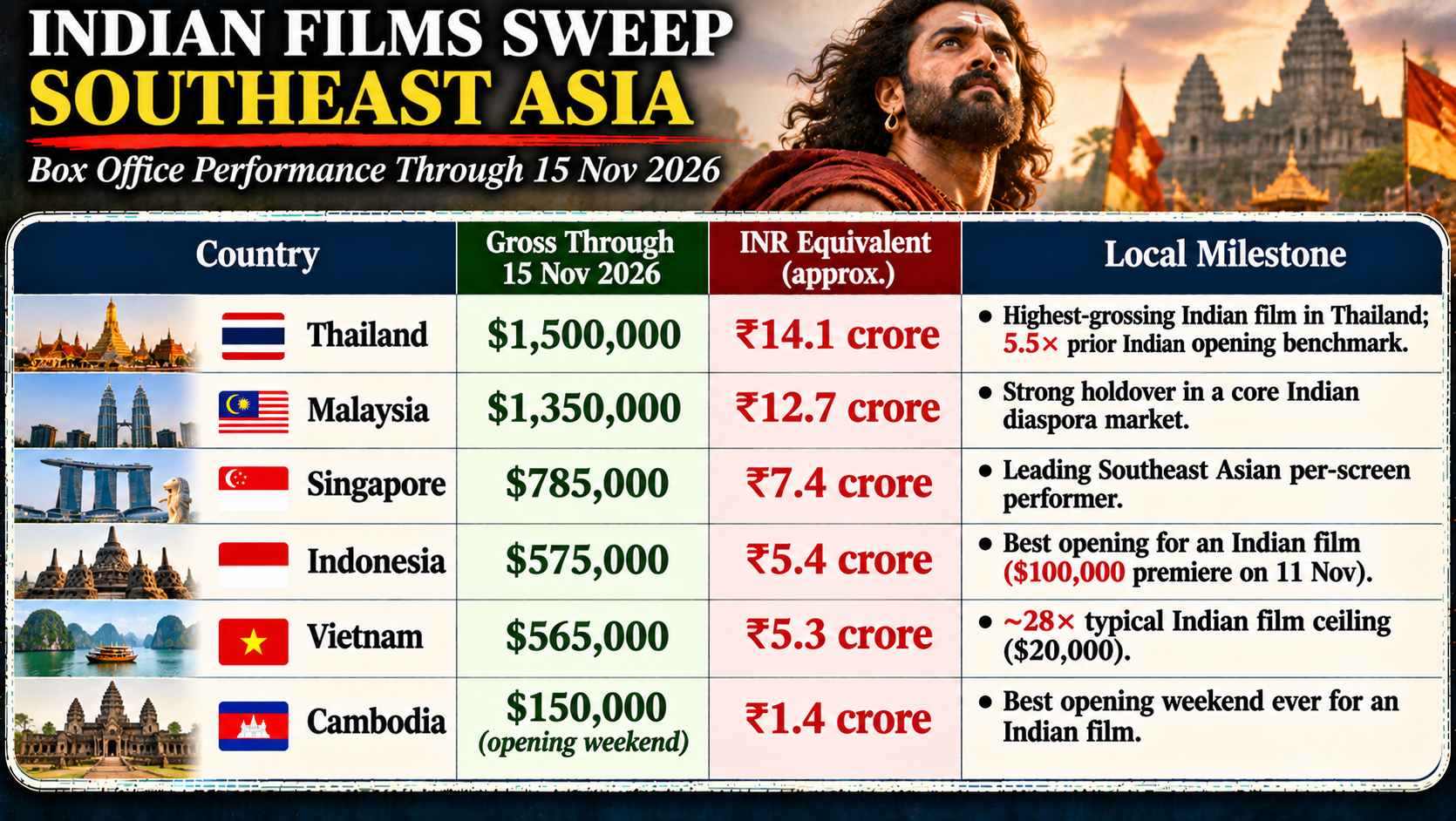
Source: Pinkvilla (16 November 2026) and Hindustan Times (13 November 2026); INR conversions calculated at ₹94.25/USD.
Measured against the $49.40 million overseas total, the five tracked ASEAN markets contributed roughly $4.78 million (9.7%), while Western and Gulf diaspora hubs—the United States ($17.10 million), the United Kingdom ($5.55 million), the Middle East ($5.40 million), Canada ($5.20 million), and Australia ($4.20 million)—supplied 75.8%. Southeast Asia's importance lies not in out-earning North America, but in proving that non-Indian audiences will buy tickets in markets that usually ignore Hindi cinema.
Why Vietnam and Cambodia Prove This Was Not Just Diaspora Buying
Malaysia and Singapore have large ethnic Indian populations that routinely support major Tamil and Hindi releases. Thailand, Cambodia, Indonesia, and Vietnam do not have comparable diaspora-driven cinema markets—making their turnouts the clearest measure of local crossover.
Vietnam offers the sharpest example. According to Hindustan Times and The Times of India, Indian releases in Vietnam typically struggle to cross $20,000 (₹15–18 lakh). Ramayana: Part 1 passed that figure on its first day, reached $350,000 (₹3 crore) in its opening week, and climbed to $565,000 by Day 11.
That appetite rests on historical roots rather than sudden marketing luck. Central and southern Vietnam were governed for roughly 1,500 years by the Champa civilisation, which blended Hindu and Buddhist traditions and left behind a 1,300-year-old shrine dedicated to Valmiki, the traditional author of the Ramayana. Today, Vietnamese high schools and universities teach the Ramayana as part of their world literature curriculum rather than as a religious text.
A similar dynamic played out in Cambodia, where the epic is known as the Reamker and appears on the national school syllabus. In a country home to Angkor Wat, Ramayana: Part 1 delivered a $150,000 opening weekend—an all-time high for an Indian release.
Thailand and Indonesia: Turning Shared Heritage Into Event Cinema
In Thailand and Indonesia, Ramayana is embedded even deeper in national identity. Thailand's adaptation, the Ramakien, was compiled under King Rama I, and monarchs of the ruling Chakri dynasty still carry the title Rama (with Rama known locally as Phra Ram). As The Indian Express reported, Thai audiences attended screenings in traditional attire and watched the film in Thai-dubbed formats alongside Hindi and English versions, propelling its gross to $1.50 million in 11 days—after opening at more than 5.5 times the previous highest-grossing Indian film in the country.
Indonesia, the world's largest Muslim-majority nation, has preserved its own Ramayana traditions for more than 1,900 years through the Javanese Kakawin Ramayana, the Balinese Ramakavaca, and the Hikayat Seri Rama. When Ramayana: Part 1 opened in Jakarta on 11 November—six days after its global launch—fans arrived dressed as Rama, Sita, and Ravana, generating $100,000 (nearly ₹1 crore) from the premiere alone and $575,000 over its first five days.
Hollywood Packaging Unlocked the Cultural Advantage
Cultural recognition alone does not fill IMAX auditoriums; earlier Indian adaptations of the Ramayana never scaled across ASEAN multiplexes. Three production and distribution decisions separated Nitesh Tiwari's film from past attempts:
International Studio Distribution: Backed by Sony's global distribution network and an aggressive overseas marketing campaign, the film secured wide multiplex and IMAX placements normally reserved for Hollywood tentpoles, rather than limited diaspora-circuit bookings.
Global Technical Credentials: With visual effects led by Oscar-winning studio DNEG (headed by producer Namit Malhotra), a score co-composed by Hans Zimmer and A. R. Rahman, and stunts coordinated by Hollywood veterans Terry Notary (Planet of the Apes) and Guy Norris (Mad Max: Fury Road), the film met the technical expectations of Southeast Asian audiences accustomed to Avatar and Dune.
Local-Language Access: Releasing Thai-dubbed prints in Thailand—and localising subtitles across East and Southeast Asia—removed the language barrier that usually confines Bollywood films to Hindi-speaking expatriates.
The Limit of the ASEAN Breakthrough
Southeast Asia's turnout proves that Indian cinema can cross cultural borders when the underlying story is already shared and the presentation matches Hollywood standards. Yet it also highlights a clear boundary. Ramayana succeeded in Thailand, Indonesia, Cambodia, and Vietnam because those societies already knew Rama, Sita, and Hanuman before a single trailer dropped.
Whether Indian studios can replicate that reception in markets with no Ramayana canon—such as China, Japan, and South Korea, where Ramayana: Part 1 is currently undergoing censor submissions for early 2027—remains an open question. For now, Southeast Asia has given Indian cinema its clearest proof yet that shared civilisational memory, paired with IMAX-scale execution, can turn a niche export into a regional event.