In brief
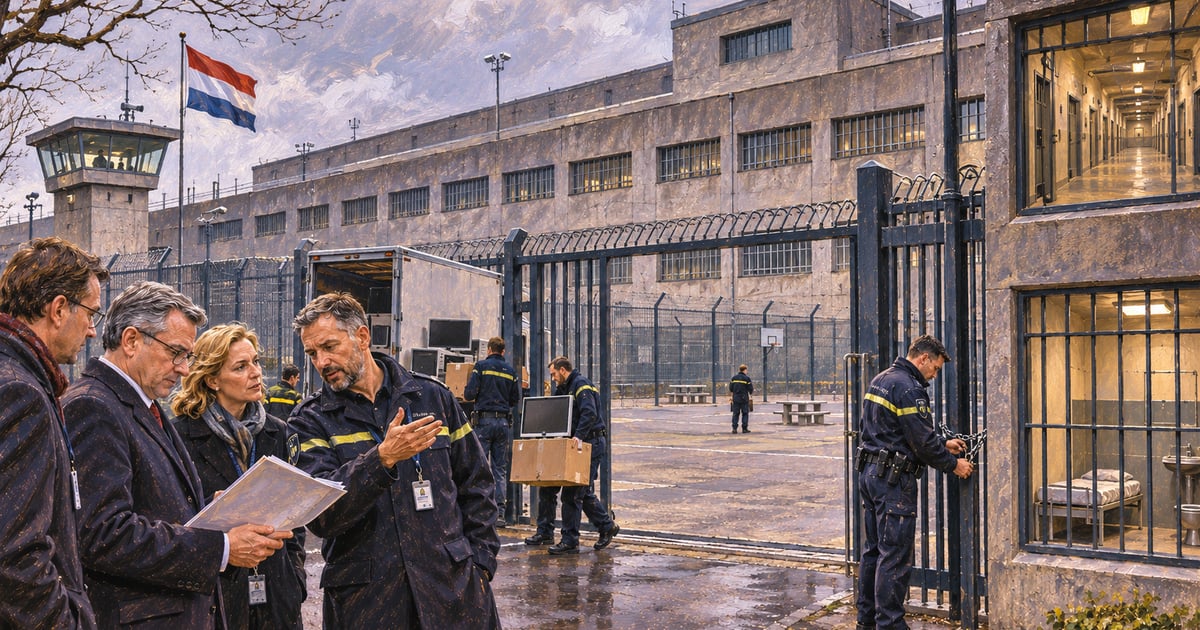
- The Netherlands closed many prisons in the 2000s and 2010s, leaving hundreds of cells empty, but the country now faces a capacity crisis due to severe correctional staff shortages and overuse of remaining facilities.
- From 2024 to 2026 the Dutch Custodial Institutions Agency has battled a code black overcrowding emergency, prompting plans to reopen previously closed capacity in June 2026.
- As of December 2024 a code black was declared in Dutch prisons, and by December 2025 about 3,300 convicted criminals remained free in the community waiting for a prison cell, with many inmates in pre-trial detention in overcrowded facilities.
- On 26 June 2026 the government unveiled a prison action plan to restore breathing space, including reopening the Almere prison to add 320 cells over time and making other adjustments to release and reintegration pathways.
For more than a decade, the Netherlands stood as the world’s favourite counter-example in criminal justice debates. While the United States and the United Kingdom struggled with chronically overcrowded jails, the Dutch closed facility after facility—8 prisons in 2009, 19 announced in 2013–2014, and 5 more in 2016—leaving hundreds of cells empty (AEI; Sydney Criminal Lawyers).
That headline still circulates widely online. Yet stopping the story in the 2010s misses a critical twist: the Netherlands is no longer shutting down prisons because of empty cells. After cutting its physical estate too deeply and running into severe correctional staff shortages, the Dutch Custodial Institutions Agency (Dienst Justitiële Inrichtingen, DJI) has spent 2024–2026 battling a "code black" overcrowding emergency—forcing the government in June 2026 to outline plans to reopen previously closed capacity.
Understanding both halves of this story—why the Netherlands closed its prisons in the first place, and why that surplus evaporated—reveals the real mechanics of modern penal policy.
Why Did the Netherlands Close So Many Prisons?
Between 2005 and 2015, the Dutch prison population dropped by 44% (University of Portsmouth). Having once held one of the higher incarceration rates in Western Europe, the Netherlands fell to roughly 54 to 57 prisoners per 100,000 residents—less than a tenth of the US rate and far below Britain or Australia.
Four structural forces drove that collapse in inmate numbers:
A Sustained Drop in Recorded Crime: Overall recorded crime in the Netherlands fell by roughly 25% over an eight-year span (averaging nearly 0.9% annually), with significantly fewer serious offences reaching the courts from 2005 onward.
Non-Custodial Sentencing by Default: Dutch judges routinely reserve prison solely for violent, dangerous, or repeat offenders requiring intensive intervention—sending only around 10% of convicted offenders to jail. The rest receive fines, community service orders, or electronic ankle-tagging, allowing minor offenders to keep jobs and family ties rather than entering a custodial cycle.
Shorter Prison Terms and Targeted Rehabilitation: Even when custodial sentences were imposed, judges handed down shorter terms paired with tailored interventions—such as debt counselling, anger-management courses, and mental-health treatment—keeping reoffending rates unusually low.
Public-Health Approach to Drugs: By treating soft-drug possession and addiction primarily as a public-health and regulatory issue rather than a mass-incarceration priority, the Netherlands avoided filling cells with low-level narcotics offenders.
With dozens of cell blocks standing idle, the Dutch government briefly leased surplus cells to Norway and Belgium to keep prison officers employed, while repurposing shuttered jails into asylum-seeker housing, hotels, and cultural spaces (World Economic Forum).
What Changed? From "Empty Cells" to "Code Black"
The mistake many international commentators make is assuming that a decade-long fall in inmate numbers guarantees permanent surplus capacity. By autumn 2023 and throughout 2024–2026, the Dutch prison system swung into acute deficit:
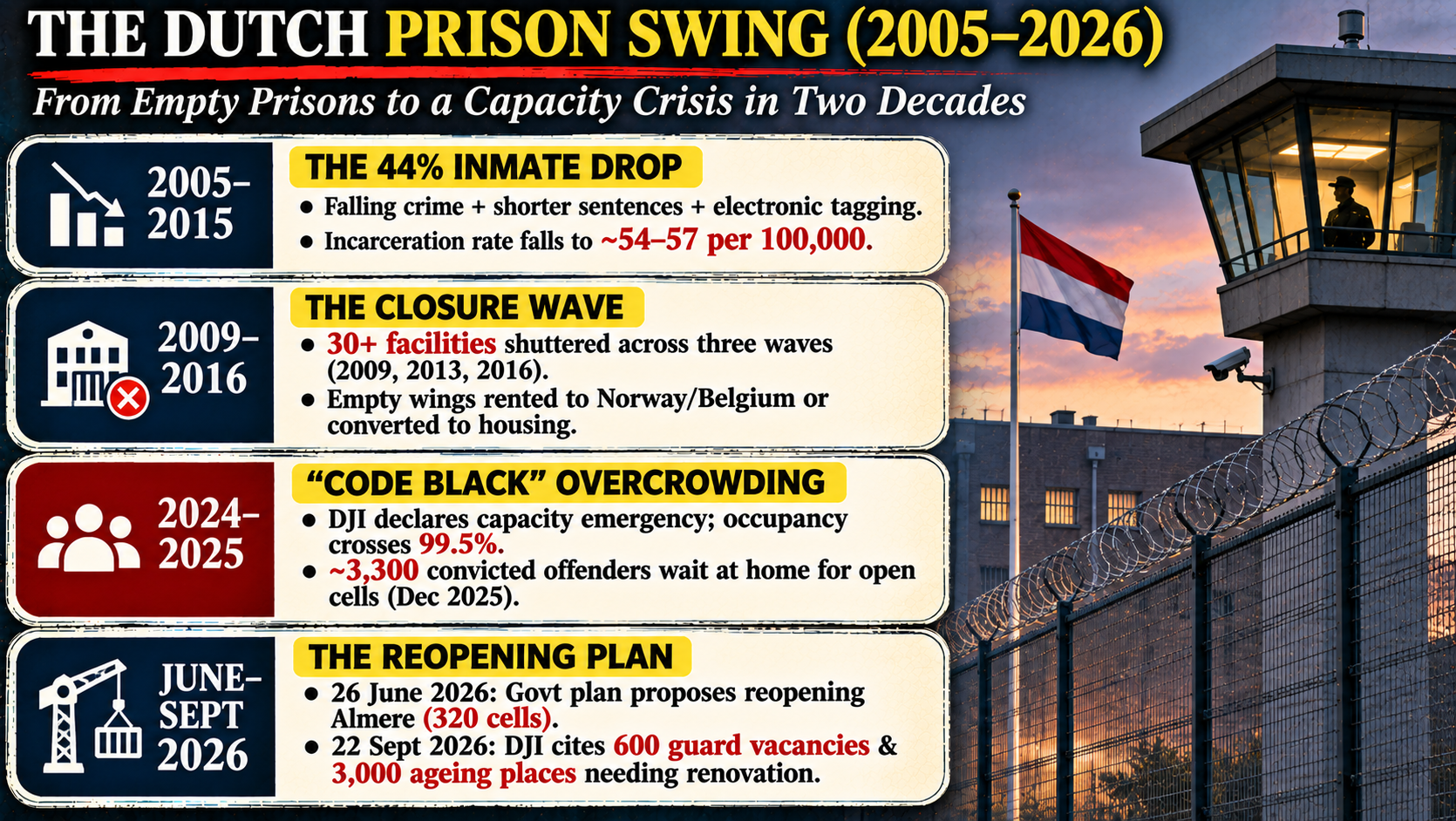
In December 2024, the State Secretary for Justice and Security declared a "code black" in Dutch prisons (Prison Insider). By December 2025, NL Times reported that approximately 3,300 convicted criminals remained free in the community simply waiting for a prison cell to open—while nearly half of all inmates inside overcrowded facilities were in pre-trial detention.
Three factors triggered this reversal:
No Buffer Left After Closures: Having sold off or repurposed so many 2010s facilities, the DJI lost the spare wing capacity needed to absorb routine fluctuations in organised-crime arrests, longer remand periods, and courtroom backlogs.
Chronic Guard Shortages: A prison cell is unusable without officers to staff it. On 22 September 2026, DJI reported roughly 600 unfilled staff positions across the service, leaving 150 to 200 physically available cells locked and empty purely because there were not enough guards to supervise them safely (The Globalist Mind).
Ageing Infrastructure: In the same September 2026 operational update—after cell occupancy crossed 99.5% in 2025—DJI warned that around 3,000 existing prison places could become unusable in the coming years unless major maintenance and renovations are carried out. (Periodic ward closures due to renovation and understaffing are now the reason Dutch cells still go offline—not a lack of prisoners.)
The 2026 Policy Reality
On 26 June 2026, the Dutch government unveiled a prison action plan aimed at restoring breathing room—including a proposal to reopen the Almere prison to add 320 cells over time, alongside early-release adjustments and accelerated reintegration pathways (Government of the Netherlands; The Globalist Mind).
The Dutch experience offers a nuanced lesson rather than a simple slogan. The Netherlands genuinely proved in the 2000s and 2010s that alternatives to custody, shorter sentences, and health-focused drug policies can dramatically shrink a prison population without sparking a crime wave. Yet its 2026 capacity crisis proves an equally practical rule of governance: a physical building is not the same as operational detention capacity, and dismantling infrastructure too aggressively leaves a justice system with zero margin for labour shortages or shifting crime patterns.