In brief
- A 1995 project by DMA Design became Grand Theft Auto after a pathfinding bug made police cars ram the player, turning the game into a crime themed open world rather than a conventional chase game.
- The game was renamed Grand Theft Auto and shifted to a criminal role, moving away from the original police pursuit idea.
- When it launched on PC in Europe in November 1997 and on PlayStation in December 1997, players could roam three top down cities, Liberty City, San Andreas, and Vice City, stealing cars, shooting police, and running over pedestrians.
- To boost its appeal, the publisher hired Max Clifford to publicise the game, turning parliamentary condemnation into free advertising through coverage in newspapers and moral campaigns.
- GTA faced mixed reviews for its graphics and controls in 1997, and the marketing approach contributed to creating a controversial public profile around the game.
On 19 November 2026, Grand Theft Auto VI (GTA VI) generated $3.79 billion in day-one retail sales—approximately ₹32,215 crore at an exchange rate of ₹85 to the US dollar—after selling 32.5 million units (3.25 crore copies) prior to release, setting a new single-day record for any entertainment product in history (MakeTechEasier / Take-Two, Game Developer). Across nearly three decades, the Grand Theft Auto series has sold more than 475 million copies (47.5 crore units) worldwide (Crowdfunded Wealth / Take-Two 10-Q).
Yet the franchise’s ascent was neither accidental nor purely the result of technical brilliance. It was built on three interlocking pillars: a programming accident that gave players unprecedented freedom to play the villain, a deliberate 1997 public relations campaign engineered to provoke British tabloids and politicians, and a subsequent 3D open-world revolution that turned notoriety into repeat engagement.
The Broken Prototype That Flipped Gaming’s Moral Rules
In April 1995, a small Scottish studio in Dundee called DMA Design—best known for the puzzle-platformer Lemmings—began developing a top-down driving game titled Race'n'Chase (The Guardian, GTA Wiki). The original concept was conventional: players could take the role of a police officer pursuing criminals across city streets.
In practice, the prototype was a disaster. Speaking to Gamasutra (Game Developer) in 2011, creative director Gary Penn recalled that the project "never really felt like it was going anywhere" and that publisher BMG Interactive repeatedly tried to cancel it (Game Developer, PC Gamer). The build crashed constantly, preventing designers from testing mechanics, and the car handling was, in Penn’s words, "appalling" (Game Developer).
What saved the project was a pathfinding bug. Instead of pulling the player over orderly, a quirk in the route-finding code caused police cars to drive straight through the player’s vehicle. "One day, I think it was a bug, the police suddenly became mental and aggressive," Penn explained (Game Developer). "Their route finding was screwed I think and that was an awesome moment because suddenly the real drama where, 'Oh my God, the police are psycho—they're trying to ram me off the road.'"
Playtesters ignored the scripted objectives and spent hours provoking the hyper-aggressive police. DMA Design scrapped the police-officer campaign entirely, cast the player as a criminal, and renamed the game Grand Theft Auto (Wikipedia).
When Grand Theft Auto launched on PC in Europe in November 1997 and on PlayStation in December 1997, it inverted the unwritten contract of 1990s video games. Rather than saving a princess or fighting alien invaders, players chose one of eight criminals and roamed three top-down cities—Liberty City, San Andreas, and Vice City—stealing cars, shooting police officers, and running over pedestrians (The Guardian).
DMA Design leaned hard into dark, irreverent provocation. Among the pedestrians strolling the streets were lines of orange-robed Hare Krishna devotees chanting in single file; mowing down an entire procession in one sweep triggered a 25,000-point "GOURANGA!" bonus—appropriating a Hare Krishna term for happiness as a grim arcade reward (Film Stories, GTA Wiki). Even in its crude 2D form, GTA established a design philosophy that persisted into GTA III (2001) and beyond: the game rarely forced players to commit specific atrocities outside missions, but it refused to stop them. As The Guardian later observed of GTA III’s infamous ability to pick up sex workers for a health boost and kill them to reclaim the cash, the series’ core hook was giving players unpoliced agency to act out amoral impulses (The Guardian).
Max Clifford and the Art of Manufactured Outrage (1997–1998)
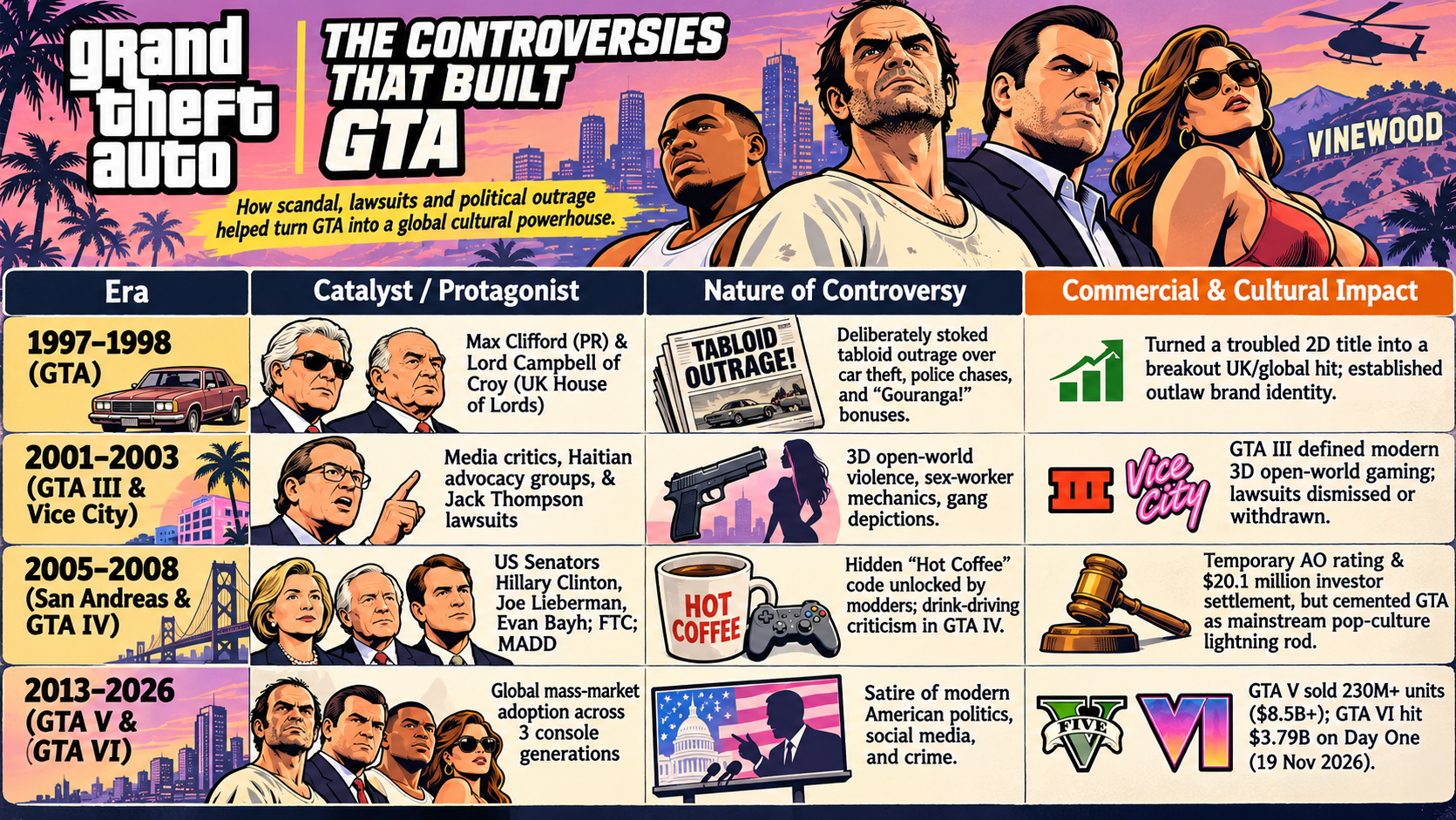
Having an edgy game was not enough to guarantee commercial survival in 1997. Grand Theft Auto looked dated compared to early 3D PlayStation hits and drew mixed reviews for its graphics and controls (Wikipedia). To break through, publisher BMG Interactive executed one of the most cynical marketing gambits in entertainment history: it hired Max Clifford, then Britain’s most notorious tabloid publicist (The Guardian, The Courier).
Instead of pitching GTA to gaming magazines, Clifford fed details of the game’s carjackings, hit-and-run bonuses, and cop-killing mechanics directly to conservative British newspapers and moral campaigners (GTA Wiki, Medium / Bubba Gaeddert). The press took the bait. British tabloids ran alarmed headlines such as "Criminal computer game that glorifies hit-and-run thugs" (Medium / Bubba Gaeddert). As former DMA Design producer Colin Macdonald later recalled, the Dundee team knew the uproar was being stoked—when reports surfaced of a supposed warehouse ram-raid in which thousands of copies of GTA were stolen, developers assumed Clifford had orchestrated the story just to keep the title in the news (The Courier).
Clifford’s masterstroke was turning parliamentary condemnation into free advertising. On 3 December 1997—within days of the game’s UK launch—Lord Campbell of Croy, a former Secretary of State for Scotland, raised Grand Theft Auto in the UK House of Lords (UK Parliament Hansard). He returned to the issue on 9 February 1998 during a debate on the Video Recordings Act 1984, warning peers that GTA was "setting an alarming precedent" by glamorising "thefts of cars, joyriding, hit-and-run accidents, and police chases" (Historic Hansard, The Courier).
For BMG Interactive and DMA Design, an 18-rated crime game being denounced by British peers—and subsequently banned in Brazil in 1998—was marketing gold (The Courier). Parents and politicians had effectively certified Grand Theft Auto as the forbidden fruit of late-1990s youth culture, driving massive word-of-mouth sales on PlayStation and PC.
When Outrage Turned Real: Hot Coffee, US Senators, and Jack Thompson
By the early 2000s, Rockstar Games—founded by Sam and Dan Houser after Take-Two Interactive acquired BMG Interactive—no longer needed to plant tabloid stories. The scale of GTA’s cultural footprint meant politicians and activists targeted the franchise unprompted.
In 2005, the series faced its sharpest legal and political crisis when modders discovered "Hot Coffee", an explicit sexual minigame that had been cut from Grand Theft Auto: San Andreas (2004) but left dormant inside the game’s code (The Guardian, Blackswan Law). Unlike Clifford’s 1997 PR stunt, Hot Coffee threatened Rockstar’s retail distribution: the Entertainment Software Rating Board (ESRB) reclassified San Andreas from Mature (17+) to Adults Only (AO) in July 2005, forcing major retailers to pull it from shelves (Blackswan Law).
US lawmakers seized the moment. In December 2005, Senators Hillary Clinton, Joe Lieberman, and Evan Bayh introduced the Family Entertainment Protection Act to penalise retailers selling Mature-rated games to minors (EFF, GTA Wiki). Sam and Dan Houser were interrogated by the US Federal Trade Commission (FTC), resulting in a 2006 consent order requiring full content disclosure, alongside a $20.1 million (approximately ₹171 crore) investor class-action settlement in 2009 (The Guardian, Blackswan Law).
Simultaneously, Florida attorney Jack Thompson waged a multi-year legal crusade against Take-Two and Rockstar, labelling GTA a "murder simulator" and filing wrongful-death suits alleging the games inspired real-world killings (Wikipedia, Blackswan Law). Every suit failed or was withdrawn, and in September 2008 the Supreme Court of Florida permanently disbarred Thompson for frivolous filings and misconduct (CNET, Blackswan Law). Rockstar folded the backlash directly into its satire—even placing Hillary Clinton’s likeness on GTA IV’s Statue of Happiness holding a steaming cup of coffee (Wikipedia).
Sources: UK Parliament Hansard, The Guardian, Blackswan Law, Crowdfunded Wealth / Take-Two 10-Q, MakeTechEasier.
Why Controversy Alone Wasn’t Enough: The 3D and Live-Service Revolutions
Outrage can sell a novelty once; it cannot sustain a 29-year, 475-million-unit empire. What converted GTA from a cheeky British provocation into a global cultural institution was how Rockstar North (the Edinburgh successor to DMA Design) evolved the underlying product.
First came the 2001 3D leap. Grand Theft Auto III moved the camera down to street level inside a living, breathing Liberty City, fusing The Legend of Zelda’s spatial freedom with Goodfellas-style crime cinema and bespoke satirical radio stations (Wikipedia / Open world, The Guardian). Vice City (2002) and San Andreas (2004) layered licensed 1980s and 1990s soundtracks, Hollywood voice casts, and vast geographic scale onto that template.
Second came satire of American excess. Rather than glorifying crime mindlessly, Sam and Dan Houser built sprawling parodies of US politics, consumerism, and media hypocrisy—turning every GTA map into an interactive cultural commentary (The Guardian, Japan Times).
Third, and most lucratively, came GTA Online (2013). Launching alongside Grand Theft Auto V—which itself grossed $1 billion in three days and went on to sell over 230 million copies and generate over $8.5 billion across three console generations—GTA Online transformed a single-player crime sandbox into a persistent multiplayer economy of heists, supercars, and regular content updates (Fortune, EmeraldBook, The Guardian).
By the time Grand Theft Auto VI arrived on 19 November 2026—featuring over 600,000 unique NPC animations and the series’ first female protagonist, Lucia, in modern Vice City—Rockstar no longer needed Max Clifford or a scandal in the House of Lords (Wikipedia / GTA VI, The Guardian). The 1997 strategy of weaponising moral panic had done its job decades ago: it handed a broken Scottish driving prototype to a global audience, and the sandbox itself did the rest.