In brief
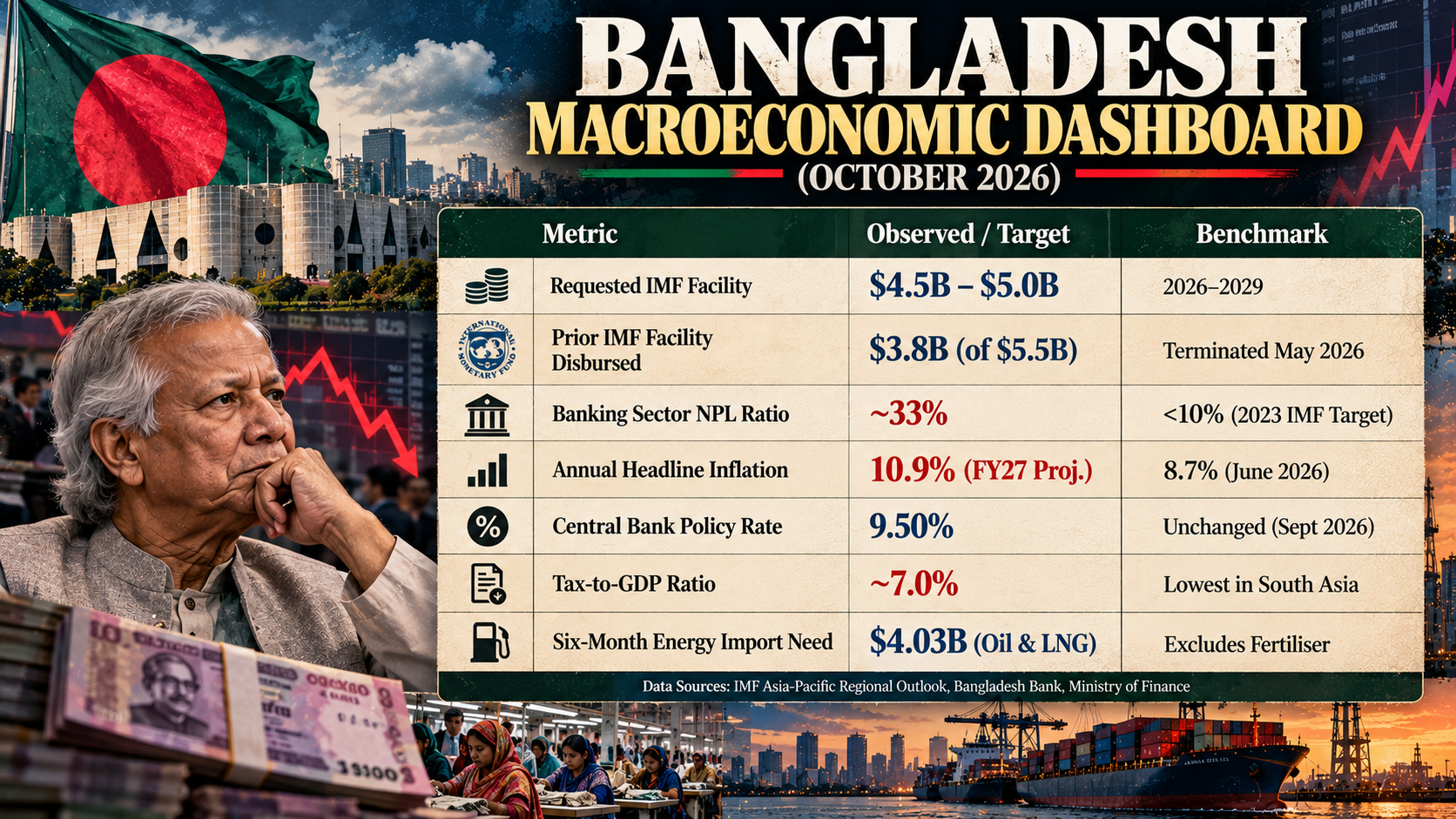
- In May 2026, Bangladesh ended its IMF programme eight months early, after drawing $3.8 billion. It now wants a new $4.5-5.0 billion loan, paid in six instalments through December 2029.
- Banks are the main problem. Bad loans reached about 33% against a target of under 10%. The central bank says over $17 billion was siphoned out by politically connected business groups.
- Tax collection is weak at about 7% of GDP. A quarterly VAT filing change cut VAT collection by 21% in July and August, and a 14 October order brought back monthly filing.
- Inflation is expected to hit 10.9% this year. The central bank held its rate at 9.5% on 30 September, and growth slowed to 3.7% in FY25.
- The IMF is expected to ask for tougher bank clean-ups, lower energy and fertiliser subsidies, and a reform of the tax board. An IMF deal would also unlock about $4 billion from the World Bank and ADB.
Facing 33% bad loans, a 7% tax ratio, and double-digit inflation, Dhaka seeks a $4.5 billion facility through 2029 to underwrite structural reconstruction.
In May 2026, Bangladeshi authorities took an unorthodox step: they walked away from an active $4.7 billion loan programme with the International Monetary Fund, which had been expanded to $5.5 billion by the post-uprising interim administration. Despite having drawn $3.8 billion across five successive tranches, Dhaka terminated the arrangement eight months before its scheduled expiry.
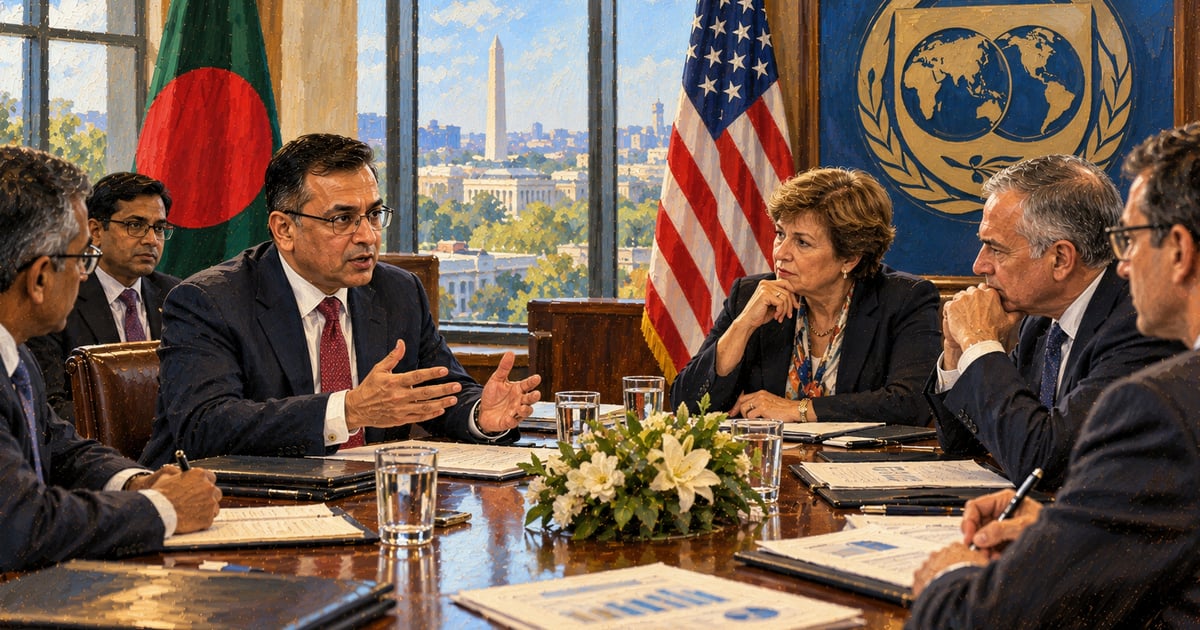
The decision was not born of sudden fiscal self-sufficiency. Rather, as delegations gathered at the IMF-World Bank Annual Meetings in Bangkok in October 2026, the underlying motive became unmistakable. Bangladesh had not exited the IMF’s orbit; it was attempting to trade an inherited, ill-fitting structural adjustment framework for a comprehensive, multi-year successor facility. Finance and Planning Minister Amir Khosru Mahmud Chowdhury opened formal discussions for a fresh $4.5 billion to $5.0 billion arrangement to be disbursed in six quarterly tranches through December 2029.
Behind this institutional renegotiation lies a compounding economic reckoning. The macroeconomic stability that once underpinned Bangladesh’s reputation as an export powerhouse has eroded. Two years after political upheaval unseated the previous regime, the country is grappling with an acute banking crisis, stubborn double-digit inflation, and a collapse in domestic revenue mobilisation that ranks among the most severe in the developing world.
The Anatomy of a Banking Sector Reckoning
The primary catalyst driving Dhaka back to Washington is the rot inside its domestic financial architecture. Under the 2023 IMF arrangement, Bangladesh committed to reducing the banking sector’s gross non-performing loan (NPL) ratio to below 10% by 2026. Instead, following the withdrawal of artificial loan-rescheduling windows and the launch of forensic audits, the acknowledged bad-loan ratio surged to around 33%.
This figure is not merely a reflection of cyclical trade distress; it represents the structural plundering of the credit system over more than a decade. The central bank had previously documented that political tycoons and oligarchic conglomerates siphoned off more than $17 billion through targeted board takeovers, forged letters of credit, and uncollateralised insider lending.
Distressed private commercial institutions, notably Sammilito Islami Bank and National Bank, experienced crippling liquidity runs throughout late 2025 and 2026. While the central bank initiated targeted repayment mechanisms to settle retail deposit claims, restoring solvency requires capital injections that the state budget cannot absorb alone.
Senior IMF officials, led by Asia and Pacific Deputy Director Sonali Jain-Chandra, have stated that any successor programme must include strict, time-bound deadlines for resolving weak banks, enforcing asset quality reviews, and executing forced mergers or liquidations for unviable non-bank financial institutions. For Dhaka, an IMF seal of approval is mandatory to unlock an estimated $4 billion in complementary budget support from the World Bank and the Asian Development Bank.
The Fiscal Trap: South Asia’s Lowest Tax Yield
If the financial sector is insolvent, the state treasury is starved. Bangladesh’s tax-to-GDP ratio has slipped to roughly 7%, cementing its position as one of the lowest revenue-mobilising sovereigns on earth. By comparison, peers across South and Southeast Asia routinely collect between 12% and 18% of GDP.
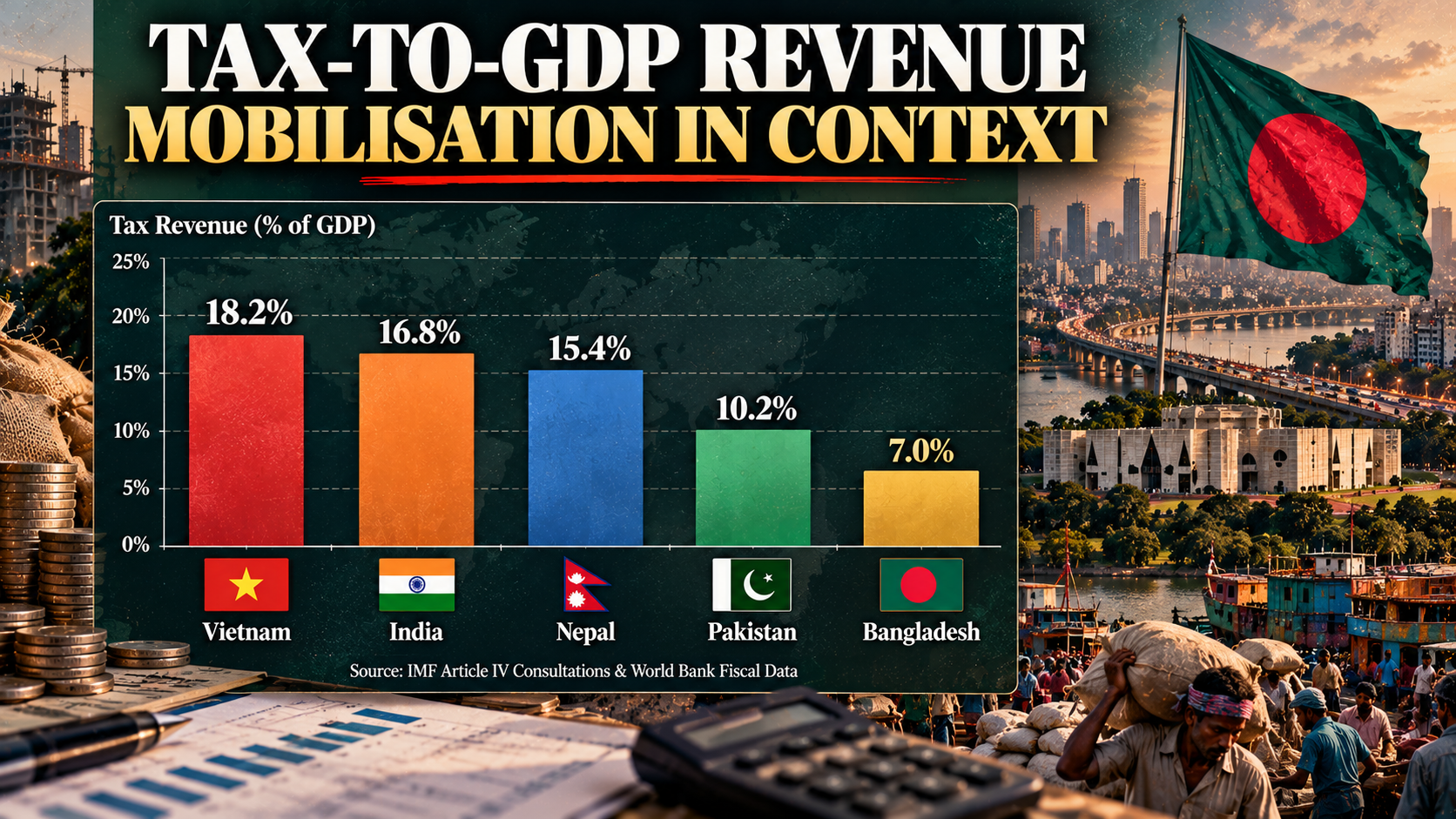
The consequences of this shortfall were underscored in early October 2026. In the national budget for FY2026–27, the National Board of Revenue (NBR) attempted to ease compliance burdens by permitting corporate entities to file value-added tax (VAT) returns quarterly rather than monthly.
The policy backfired:
Large businesses deferred tax deposits, creating acute treasury liquidity deficits.
Value-added tax collections, which account for roughly 38% of total NBR receipts, plummeted 21% year-on-year across July and August.
Administrative chaos over input tax credits and rebate reconciliations stalled supply chain settlements.
The revenue collapse forced President Mirza Fakhrul Islam Alamgir to promulgate the Value Added Tax and Supplementary Duty (Amendment) Ordinance, 2026 on 14 October, abruptly cancelling the quarterly framework and restoring mandatory monthly filings.
The IMF mission visiting Dhaka has placed direct domestic revenue mobilisation at the centre of the new loan negotiations. Without broad-based administrative digitisation, the elimination of widespread corporate tax exemptions, and an enforceable compliance mechanism, the state lacks the resources to service its expanding domestic debt, let alone recapitalise commercial lenders.
The Inflation Dilemma and Monetary Deadlock
For ordinary citizens, the macroeconomic crisis is felt most acutely at the bazaar. Inflation has remained persistently elevated since 2023, driven by recurring currency devaluations, domestic supply disruptions, and imported fuel costs.
Although annual average headline inflation softened from over 10% in mid-2024 to 8.7% by June 2026, the IMF has warned that price pressures are rebounding. In its October 2026 regional assessment, the Fund projected headline inflation to hit 10.9% for FY2026–27—the highest rate witnessed in nearly two decades. Food inflation, which briefly exceeded 14% during the height of the 2024 political crisis, remains volatile.
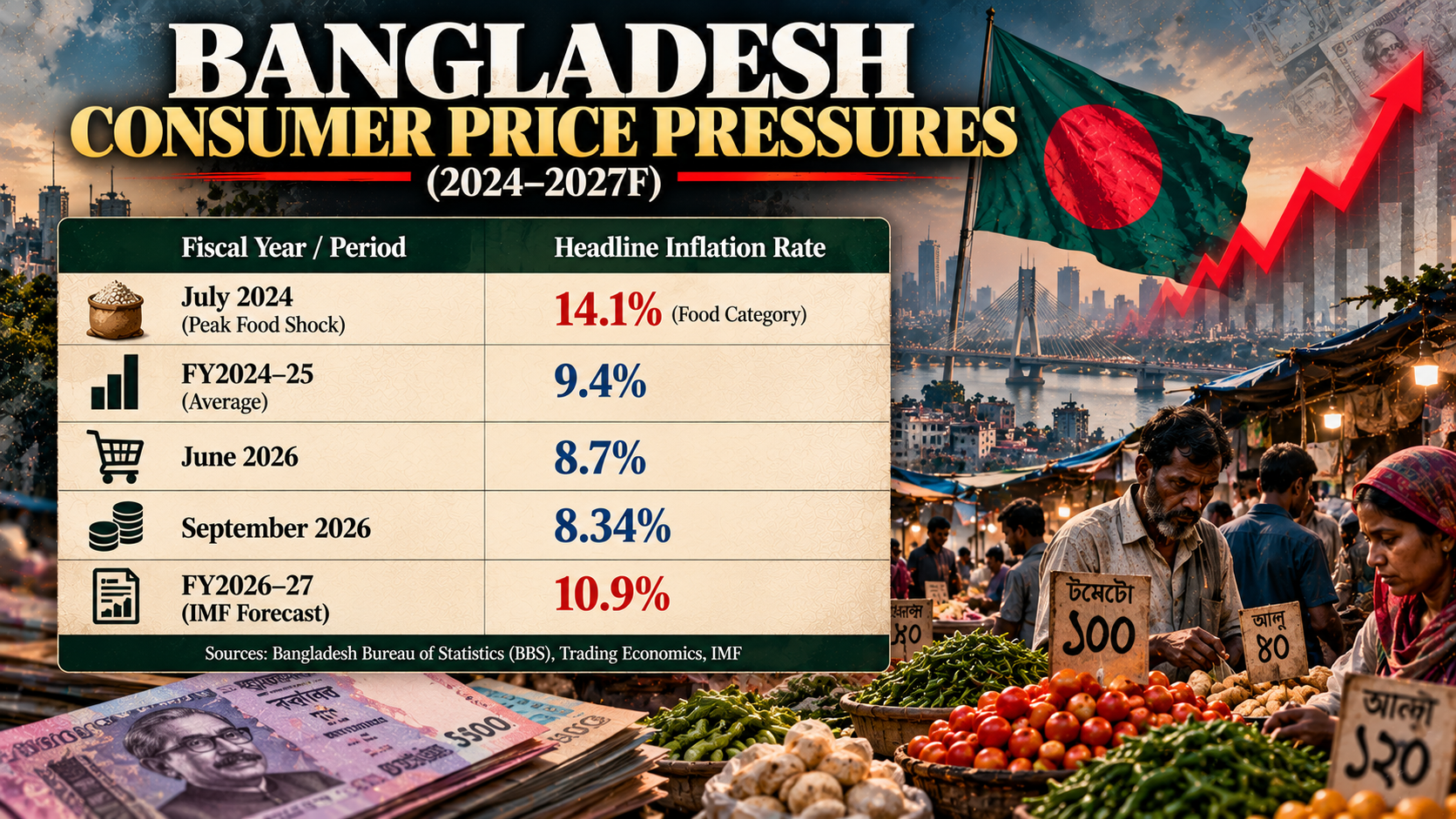
This persistent price pressure has locked Bangladesh Bank into an aggressive monetary posture. In its monetary policy statement on 30 September 2026, the central bank held its policy repo rate at 9.5%, having implemented only a token 50-basis-point trim in August.
Central bank planners face a difficult dilemma:
The Argument for Easing: Domestic manufacturing, heavily dependent on working capital loans, has contracted amid elevated borrowing costs exceeding 14% to 15% in the commercial market. GDP growth slowed to 3.7% in FY25, and broad economic recovery remains tepid.
The Imperative for Tightness: Rapid monetary loosening risks sparking another round of capital flight, undermining the Taka, and reigniting food price spikes.
The IMF has insisted that monetary policy must remain firmly contractionary until real interest rates turn durable and foreign exchange buffers solidify.
External Liquidity and the Global Energy Bill
The external sector presents equally complex challenges. While gross official foreign exchange reserves have partially stabilised from their critical 2024 lows—settling around 4.4 to 4.6 months of import cover—this buffer remains fragile.
External commitments require significant dollar outflows:
Overdue Import Liabilities: The interim and elected administrations have had to settle billions in legacy arrears owed to international oil companies, liquefied natural gas (LNG) suppliers, and cross-border power providers.
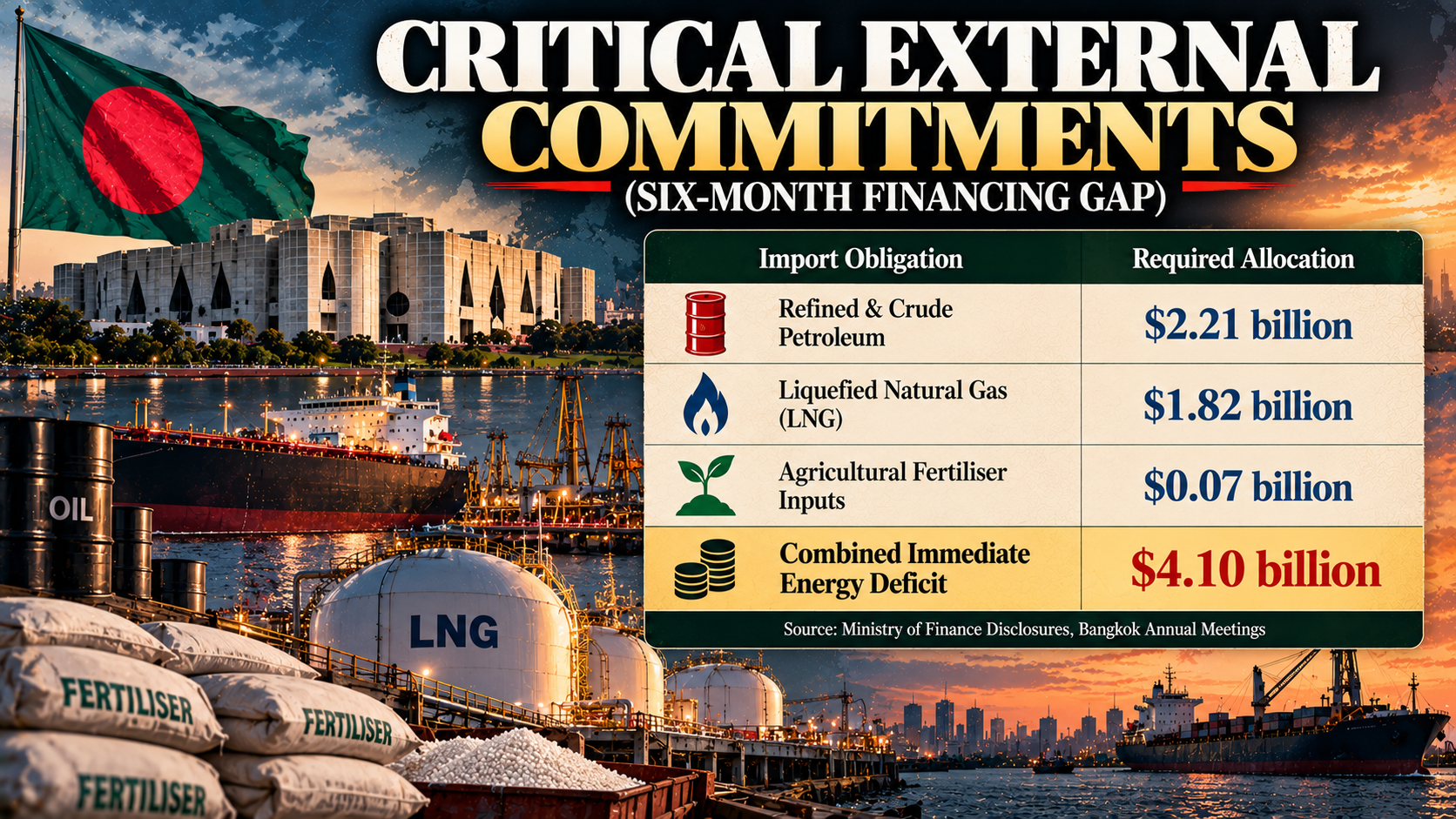
Middle East Shock Spillovers: Rising geopolitical tensions have elevated global energy benchmarks. Prof. Rashed Al Mahmud Titumir, Adviser on Finance and Planning, disclosed in Bangkok that Bangladesh requires an additional $1.82 billion for LNG imports and $2.21 billion for crude and refined oil between March and September 2026 alone, alongside $70 million in fertiliser import differentials.
Export Concentration: Ready-made garment (RMG) shipments to the European Union grew by a modest 3% year-on-year in the first quarter of FY27, reaching $4.9 billion. While markets like Spain recorded double-digit expansion (+14% to $1.14 billion), demand in core destinations such as Germany declined as European consumer budgets remained constrained by domestic living costs.
The Road to December: Conditionality and Political Will
The upcoming negotiations with the IMF mission in Dhaka will centre on conditionality. The Fund is unlikely to disburse unconditional budgetary liquidity. Instead, the draft terms for the proposed $4.5 billion package are expected to require:
Strict Banking Resolution: Establishing enforceable asset recovery timelines, unwinding regulatory forbearance, and initiating recapitalisation frameworks for state-owned lenders.
Structural Subsidy Cuts: Gradually rationalising retail power, natural gas, and fertiliser tariffs to relieve pressure on the central budget, transferring the financial burden directly to commercial consumers.
Institutional Tax Restructuring: Overhauling the NBR by segregating tax policy from tax collection, accelerating e-VAT compliance, and widening the direct tax net.
Finance Minister Amir Khosru has indicated that while Dhaka agrees with the IMF’s diagnostic assessment, the government will demand phased implementation. With parliamentary elections approaching in 2030, executing deep subsidy cuts and resolving insolvent commercial banks poses significant political risk.
Yet, without the discipline and external credibility that an expanded IMF facility provides, Bangladesh risks sliding into an extended period of stagflation, marked by low tax revenues, high inflation, and an incapacitated financial sector. The decision to terminate the 2023 loan was a calculated manoeuvre; the success of the $4.5 billion successor deal will determine whether Bangladesh can restore the economic foundations of its national development model.