In brief
- South Korea's KOSPI stock index fell 40.4 percent from June to October 2026, wiping out 745 billion dollars in value, despite a global AI boom.
- The crash was caused by a combination of extreme chip industry concentration, retail investors using high-margin debt, and structural market weaknesses.
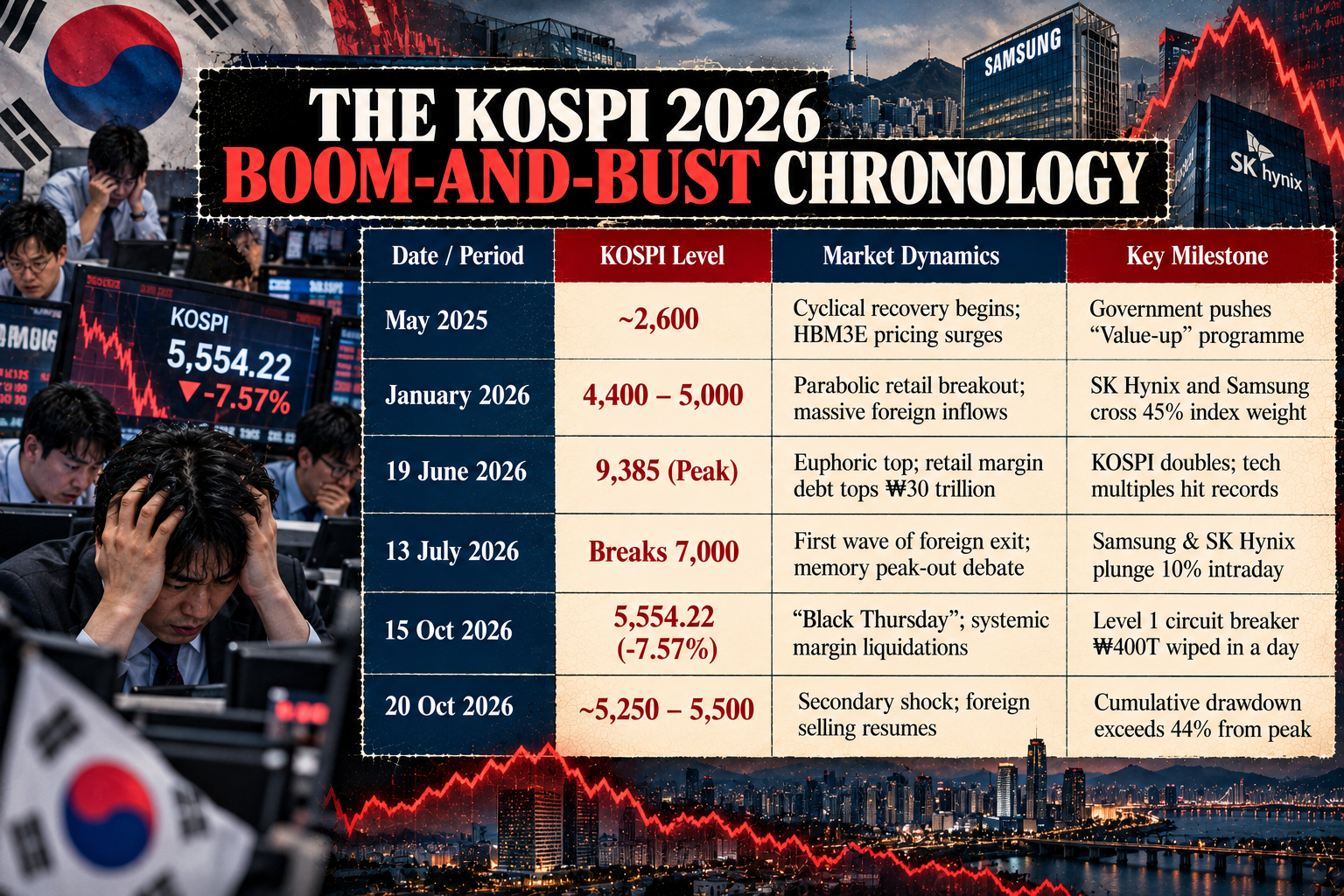
- The index peaked at 9385 points in June 2026 and dropped to 5554.22 points in October 2026, with the decline rivaling major financial crises.
- The collapse highlighted issues in South Korea's market structure, including dominance by two large companies and lack of protections for minority shareholders.
Between November 2025 and June 2026, the Korea Composite Stock Price Index (KOSPI) was celebrated across international financial capitals as the undisputed champion of the global equity bull market. While Silicon Valley hyperscalers poured hundreds of billions of dollars into generative artificial intelligence infrastructure, Seoul held the golden key to the physical bottleneck: High-Bandwidth Memory (HBM).
Propelled by an insatiable global appetite for advanced memory stacks to power Nvidia accelerators, the benchmark KOSPI surged past 5,000 points in January 2026, doubled in less than a year, and touched an eye-watering all-time peak of 9,385 points on 19 June 2026.
Then the trap snapped shut.
Over the subsequent sixteen weeks, the KOSPI suffered one of the swiftest, most destructive capital evaporations in modern Asian market history. By the closing bell of "Black Thursday" on 15 October 2026, the benchmark had plunged 40.4% to 5,554.22 points, triggering emergency circuit breakers and wiping out over ₩1,100 trillion ($745 billion) in equity value across just seven trading sessions.
As noted by Daishin Securities, the velocity of the decline rivalled the darkest chapters of South Korea's financial history, approaching the median drawdowns of the 1997 Asian Financial Crisis and the 2008 Great Financial Crisis.
How did the world's premier semiconductor manufacturing powerhouse endure an equity market collapse of this magnitude while global spending on artificial intelligence was breaking historical records? The answer lies not in a single failure, but in a structural chain reaction where extreme index concentration, cyclical memory panic, retail margin cascades, and corporate governance cynicism collided.
Catalyst 1: The "Single-Stock Index" Concentration Trap
The fundamental vulnerability of the KOSPI lay in its internal architecture. In mature equity markets such as the S&P 500, diversification limits ensure that no single company dictates the destiny of the entire benchmark.
In South Korea, the AI boom turned the national index into a leveraged duopoly.
By early 2026, the meteoric ascent of Samsung Electronics and SK Hynix had inflated their combined weighting on the KOSPI to between 45% and 55% of the entire market. For global asset allocators, buying the KOSPI was no longer an investment in the South Korean macro economy—it was a concentrated bet on memory semiconductor operating margins.
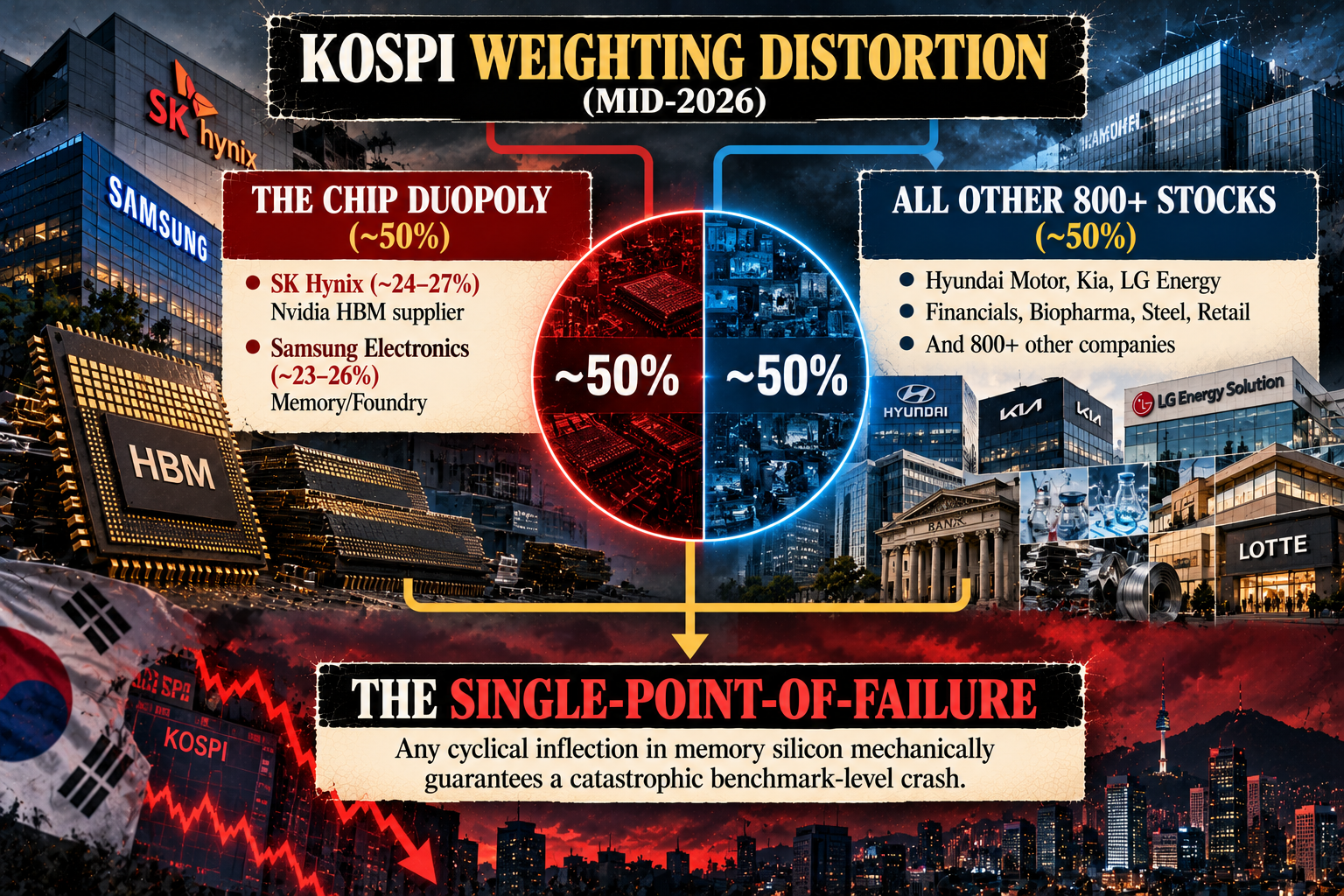
When institutional investors began paring back exposure to global semiconductor hardware in mid-2026, they did not merely sell individual technology equities; they liquidated index futures and broad-market exchange-traded funds. Because Samsung and SK Hynix represented half of the entire capitalisation, any downward pressure on the memory giants exerted an unavoidable mathematical drag on the entire benchmark.
Catalyst 2: Memory "Peak-Out" Fears and the Algorithmic Shift
The second shock was cyclical. Semiconductor markets are notoriously feast-or-famine industries. During late 2024 and 2025, HBM commanded gross profit margins exceeding 60%, generating record operating profits across corporate Seoul.
However, by mid-2026, three structural developments forced Wall Street analysts to declare that the memory supercycle had "peaked out":
Supply Normalisation and Capex Flooding: Spurred by windfall profits, Samsung, SK Hynix, and US-based Micron executed massive capital expenditure programmes to expand HBM3E and next-generation HBM4 packaging capacity. Simultaneously, Chinese DRAM manufacturers (spearheaded by ChangXin Memory Technologies, or CXMT) flooded the low-to-mid-tier commodity DRAM and NAND flash markets, triggering price erosion across legacy memory lines that historically subsidised advanced R&D.
Algorithmic Efficiency Gains: In the software layer, AI model developers began breaking the industry's reliance on raw brute-force parameter scaling. The release of highly compressed, inference-optimised architectures—exemplified by models like DeepSeek V4.1-Flash and advanced post-training quantization—proved that enterprise AI systems could deliver superior reasoning performance while consuming significantly less memory bandwidth per token.
Samsung’s Dual-Front Crisis: South Korea’s corporate crown jewel, Samsung Electronics, faced acute internal execution problems. While SK Hynix consolidated its position as Nvidia's primary HBM supplier, Samsung suffered prolonged qualification delays for leading-edge Blackwell accelerators. Concurrently, Samsung’s contract chipmaking (foundry) division continued to bleed trillions of won in operating losses, failing to close the yield and performance gap with Taiwan Semiconductor Manufacturing Company (TSMC).
When institutional investors realised that peak memory pricing would not persist indefinitely, valuation multiples contracted violently. Forward price-to-earnings (P/E) ratios for South Korean chipmakers collapsed to 26-year lows, yet institutional buyers refused to step in.
Catalyst 3: The Retail Margin Cascade and Leveraged ETF Doom Loop
While institutional investors initiated the sell-off, South Korea’s hyper-financialised retail investor base converted an orderly correction into an uncontrolled rout.
South Korea possesses one of the world's most aggressive retail investing cultures, famously known as the "Donghak Ant Movement." During the index's climb toward 9,000 points, domestic retail traders borrowed record sums to purchase equities. Outstanding retail margin debt on the Korea Exchange climbed past ₩30 trillion ($22 billion) in early summer 2026.
Crucially, retail capital concentrated heavily in leveraged semiconductor ETFs (offering 2x and 3x daily returns linked to domestic chipmakers and KOSPI 200 futures).
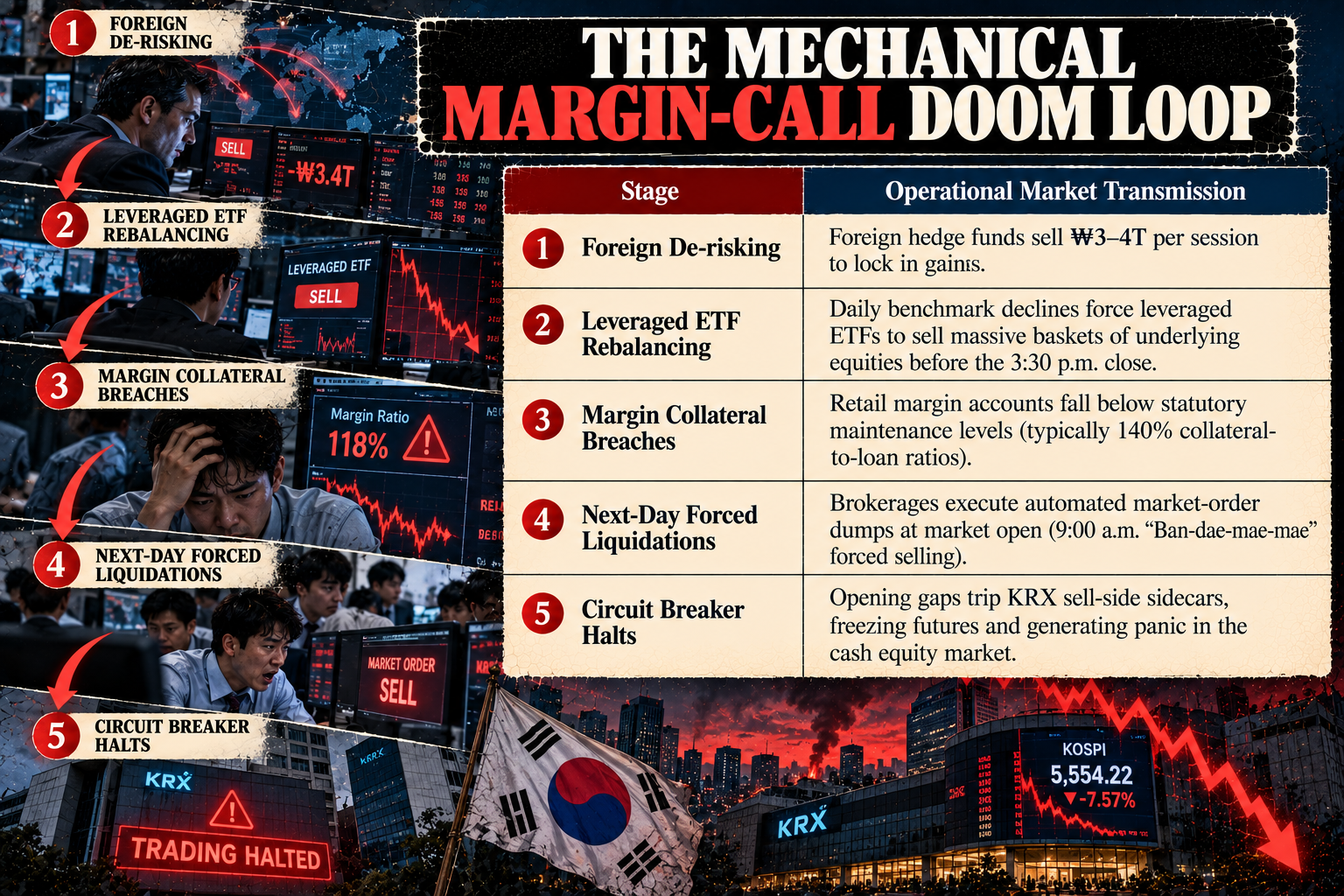
This structural leverage created a fatal mathematical feedback loop. When the KOSPI slid by 3% to 4% in a single day, leveraged ETF providers were forced by their mandates to sell massive quantities of underlying Samsung and SK Hynix shares into the market close to maintain their daily leverage ratios.
The resulting closing-auction sell-offs triggered widespread collateral deficits in retail brokerage accounts. Under South Korean securities regulations, if an investor fails to restore their account collateral above 140% within twenty-four hours, the brokerage executes automated forced liquidations (bandaemaemae) at the opening bell of the following session.
On Black Thursday (15 October 2026), this loop reached peak intensity:
At 9:07 a.m., an opening avalanche of forced margin selling triggered a sell-side sidecar, halting KOSPI 200 futures trading for five minutes.
At 12:38 p.m., as losses widened, the Korea Exchange halted all cash equity trading for twenty minutes by triggering a Level 1 Circuit Breaker after the benchmark index crashed 8% intraday.
Samsung Electronics ended the session down 9.48% (falling to 210,000 won), while SK Hynix plummeted 11.06% (to 1.262 million won), wiping out ₩398 trillion in equity value in a single day.
Catalyst 4: Foreign Capital Flight and the Global ATM
South Korea's equity market has long functioned as what domestic traders call an "international ATM."
Because South Korea maintains deep market liquidity, zero foreign capital controls, and sophisticated derivatives markets, international hedge funds and global mutual funds routinely use the KOSPI to adjust macro risk. When unexpected volatility struck Wall Street—driven by hotter-than-expected US consumer inflation data and 10-year US Treasury yields climbing above 5.3%—foreign institutions did not liquidate illiquid private assets; they sold Korean blue chips.
Between July and mid-October 2026, foreign institutional investors engaged in an unrelenting exit, recording net sales exceeding ₩176 trillion ($130 billion) in Samsung and SK Hynix alone. On Black Thursday alone, foreign funds dumped ₩3.6 trillion in cash equities, marking their eighth consecutive session of net selling.
Compounding the foreign exodus was the sharp depreciation of the South Korean Won (KRW) against the US dollar. As foreign capital fled, the won slid toward multi-year lows, eroding dollar-denominated returns for international fund managers and triggering secondary stop-loss liquidations across passive global emerging-market index funds.
Catalyst 5: The Resurgence of the "Korea Discount"
For decades, South Korean equities have traded at structurally lower price-to-book (P/B) and price-to-earnings multiples than their Japanese, Taiwanese, or American counterparts—a chronic valuation gap known as the "Korea Discount."
The discount stems from the corporate governance architecture of the family-controlled conglomerates (chaebols):
Minority Shareholder Disenfranchisement: Founding families typically control vast corporate empires through labyrinthine networks of circular cross-shareholdings, holding tiny direct equity stakes while exercising absolute board control.
The "Carve-Out" Curse: When a chaebol develops a highly profitable new business division (such as battery manufacturing or specialized AI packaging), rather than letting parent-company shareholders capture the value, the conglomerate routinely executes a physical corporate split (mulsan bungwang), listing the subsidiary separately on the stock exchange. This dilutes parent-company minority shareholders and triggers holding-company discounts exceeding 50%.
Meagre Dividend Payouts: South Korean corporate payout ratios historically languished near 20% to 25%, well below the global average of 40% to 50%.
In early 2025 and 2026, the South Korean financial supervisory authorities attempted to eliminate this gap by launching the "Corporate Value-up Program," self-consciously modelled on the Tokyo Stock Exchange’s successful market reforms. Investors initially believed that mandatory disclosures, tax incentives, and shareholder-return indices would force the chaebols to reform.
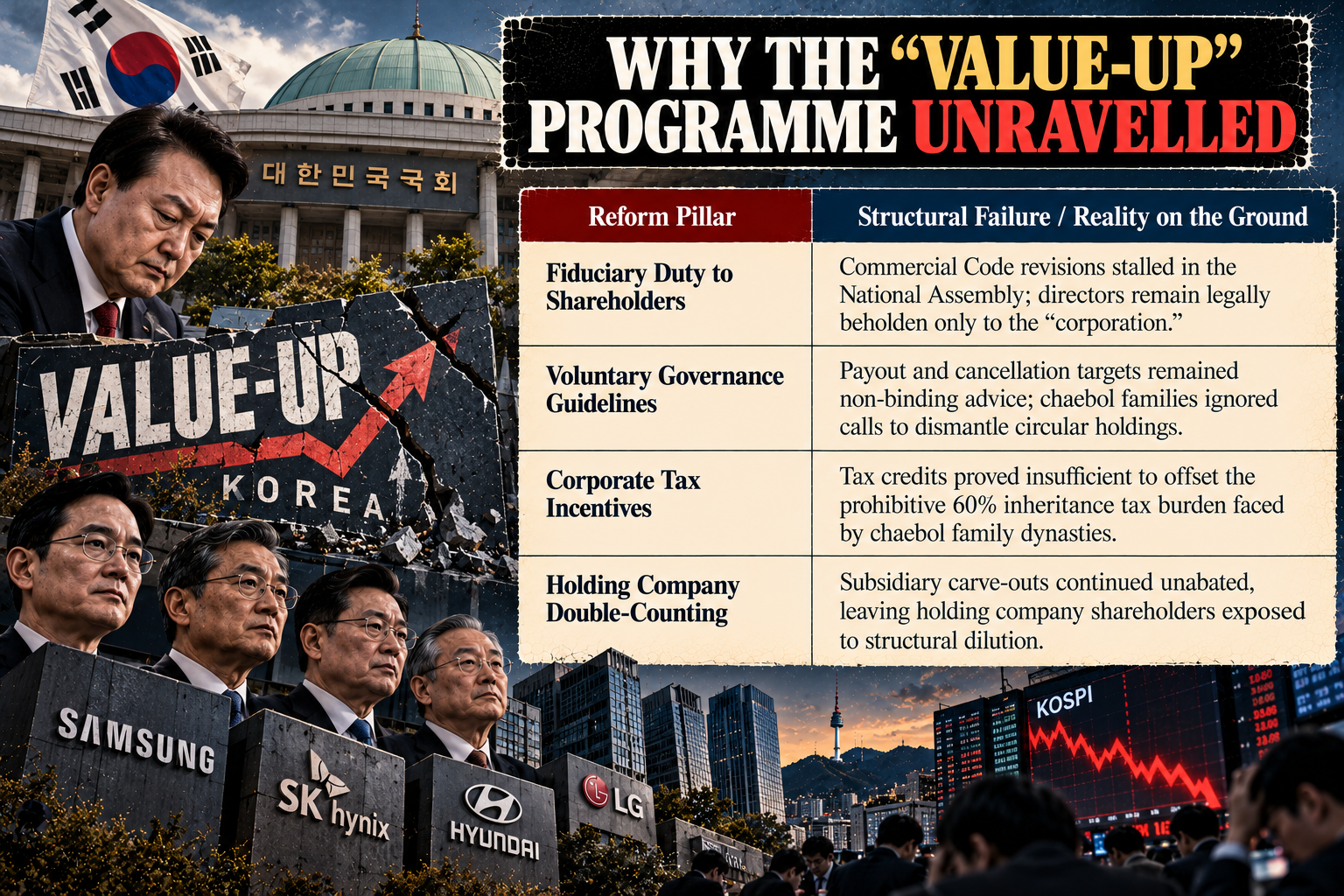
When market conditions tightened in late 2026, international investors discovered that the "Value-up" programme was largely toothless. Unlike Japan, where the Tokyo Stock Exchange actively pressured and threatened to delist capital-inefficient firms, South Korea's financial regulators lacked the statutory authority to force chaebol compliance.
The disillusionment was publicly ratified on 19 October 2026, when President Lee Jae-myung conceded that domestic equities remain "very undervalued," pointing to lingering distrust over market transparency and corporate governance. Rather than vanishing, the "Korea Discount" reasserted itself as an inescapable trap.
Catalyst 6: The Domestic Liquidity Vacuum
Why could domestic capital not absorb the foreign selling?
In normal market corrections, domestic institutional allocators—principally the National Pension Service (NPS), private insurance pools, and commercial asset managers—step in to stabilise blue-chip shares.
In late 2026, South Korea’s domestic liquidity engine was completely stalled:
The NPS Asset-Allocation Ceiling: The National Pension Service operates under strict, pre-determined strategic asset allocation bands. Following the massive rally in H1 2026, domestic equities had expanded to hit the upper threshold of the fund’s statutory domestic portfolio limit. By law, the pension fund could not execute large-scale emergency buying; in fact, its rebalancing algorithms required it to trim domestic holdings.
The Household Debt Straitjacket: South Korean households remain among the most indebted in the developed world, with household-debt-to-GDP ratios exceeding 100%. With high domestic interest rates eating into disposable income, and real estate project-financing (PF) defaults threatening secondary commercial lenders, retail households had fully exhausted their liquid savings.
When foreign institutional funds dumped hundreds of trillions of won into the Korea Exchange, there was no one left to buy the dip. The bid-ask spread widened into a chasm, converting standard profit-taking into a vertical collapse.
Conclusion: The Lessons of the Seoul Rout
The 40.4% crash of the KOSPI serves as an enduring lesson in the perils of synthetic market construction.
South Korea did not crash because artificial intelligence is a mirage. The underlying industrial competitiveness of its champions remains undeniable: SK Hynix remains an engineering marvel at the frontier of memory stacking, and Samsung Electronics commands manufacturing scale that few nations can ever hope to replicate.
Instead, the KOSPI crashed because its market structure was hollow.
When a nation permits two cyclical corporate giants to dominate half of its national equity benchmark, encourages retail investors to amplify that exposure through high-margin debt, and fails to enact binding corporate governance protections for minority shareholders, it constructs an equity market that cannot withstand macroeconomic turbulence.
The global AI infrastructure buildout will continue, but for South Korea's battered investing public, the summer of 2026 provided an unforgiving reminder: no technological revolution is powerful enough to outrun the laws of market plumbing, balance-sheet leverage, and fundamental corporate governance.