In brief
- Headline profits at HDFC, ICICI, and Axis Bank mask four structural risks for the economy, including a household deposit drought and unsecured consumer fatigue.
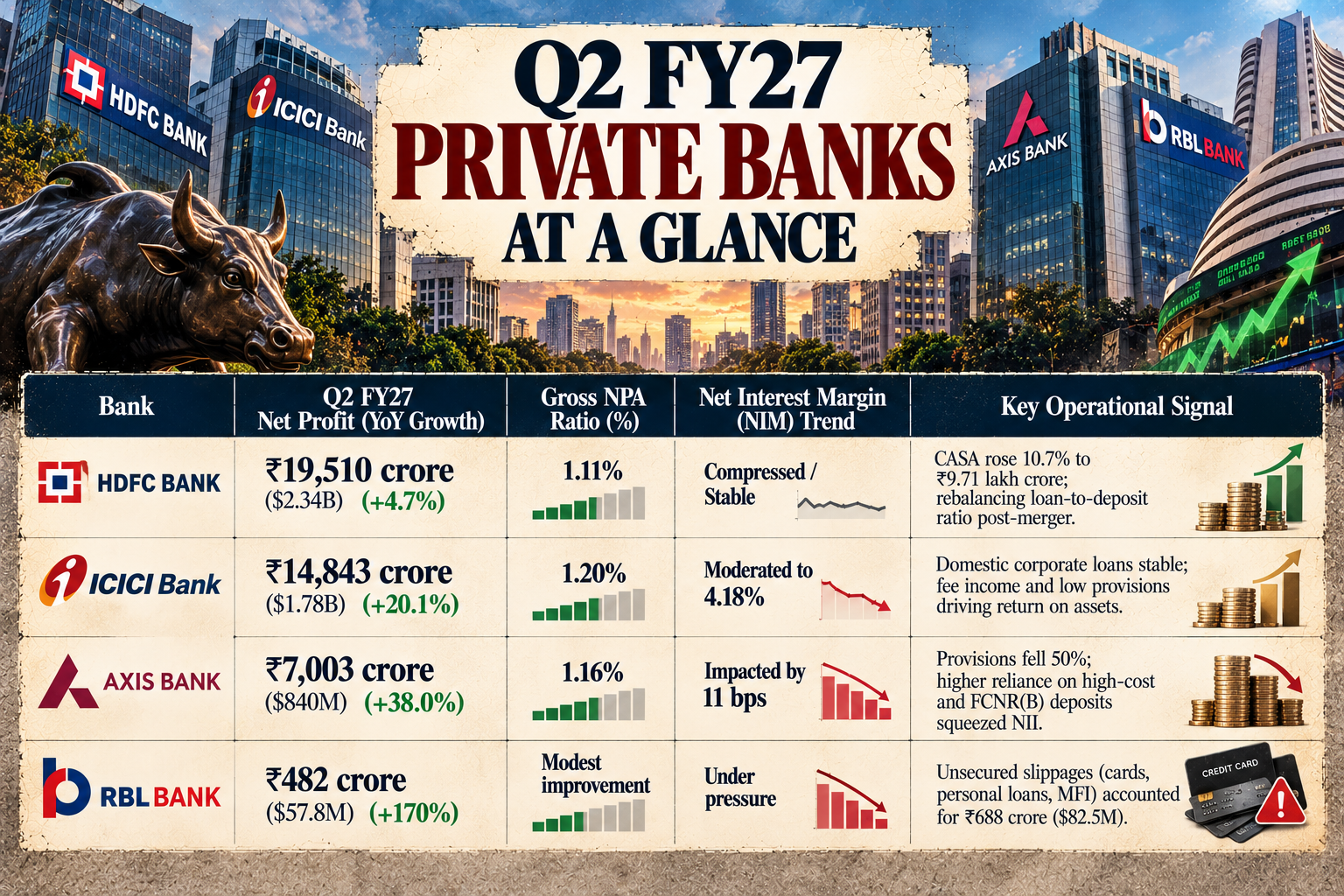
- Q2 FY27 results show HDFC Bank net profit of ₹19,510 crore, ICICI Bank net profit of ₹14,843 crore, and Axis Bank profit after tax of ₹7,003 crore, with provisions falling by 50%.
- There is a shift in household savings away from bank deposits toward capital markets, altering how banks fund themselves.
- Corporate India remains solvent but awaits broader consumption demand before a transformative capital expenditure cycle, signalling a rebalancing rather than debt‑fuelled expansion.
Commercial banks are the central nervous system of any market economy. Their profit and loss statements do not merely record corporate transactions; their balance sheets capture the financial reality of households, businesses, and capital allocators in real time.
In mid-October 2026, India’s premier private sector lenders released their financial results for the second quarter of the fiscal year (Q2 FY27, ended 30 September 2026). At first glance, the headline figures convey uninterrupted strength. HDFC Bank, the country’s largest private lender, reported a quarterly net profit of ₹19,510 crore ($2.34 billion), expanding 4.7% year-on-year. ICICI Bank delivered a 20.1% surge in consolidated net profit to ₹14,843 crore ($1.78 billion). Axis Bank posted a 38% increase in profit after tax to ₹7,003 crore ($840 million), aided by a 50% plunge in provisions.
Yet looking past the headline profits reveals an economy navigating structural transitions. Embedded within the loan books, liability schedules, and asset-quality disclosures are four distinct economic realities: a structural migration of Indian household savings, an emerging strain in unsecured consumer borrowing, an asymmetry between corporate health and private capital expenditure, and a consumer market splitting along income lines.
1. The Deposit Drought: The Financialisation of Household Savings
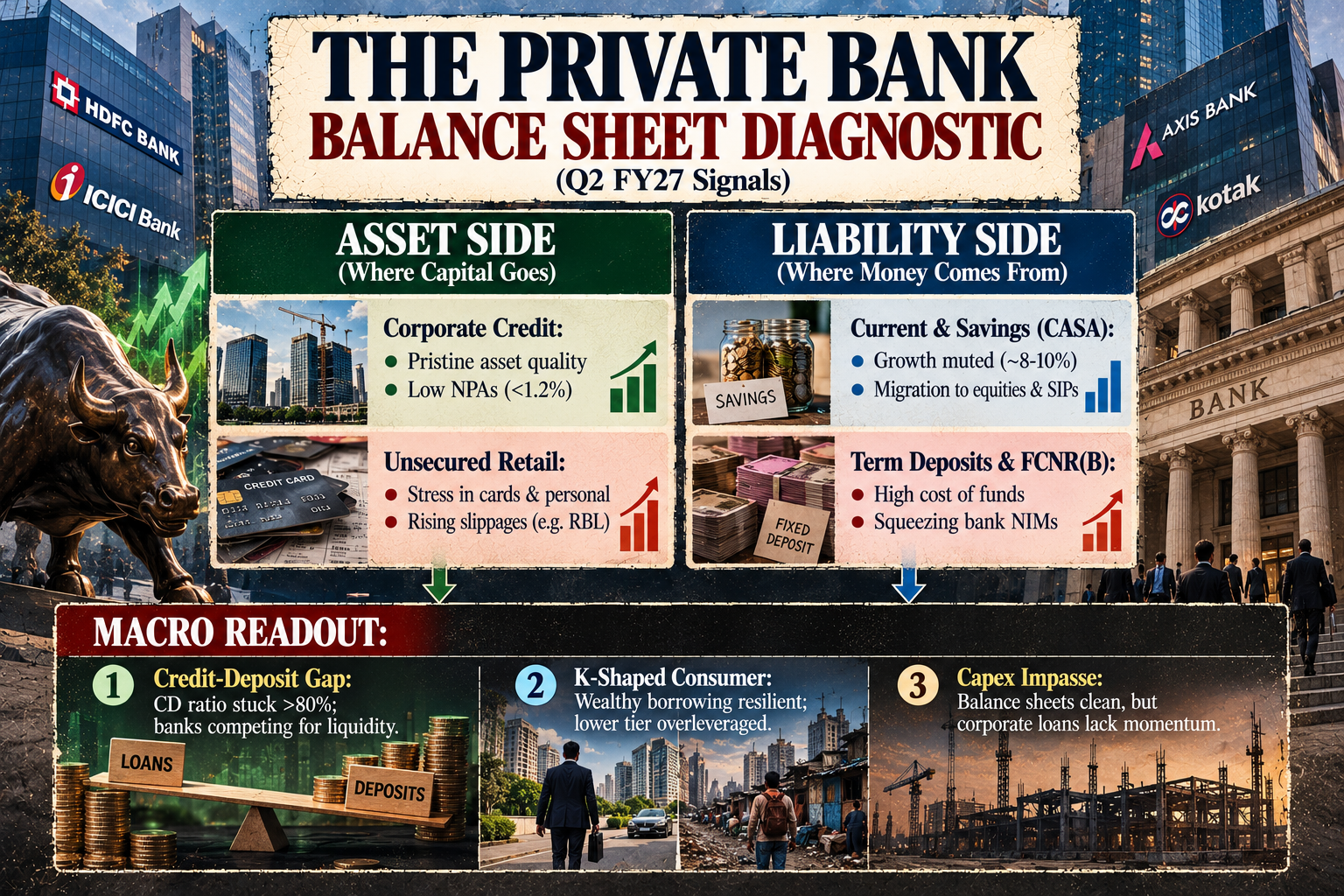
For two years, the Reserve Bank of India (RBI) has highlighted an operational divergence in the banking sector: credit expansion has consistently outpaced deposit mobilisation. In Q2 FY27, that structural tension remained front and centre.
Across the scheduled commercial banking sector, credit growth hovered at roughly 13% to 14% year-on-year, while domestic deposit growth lagged at 11% to 12%. This discrepancy has kept the systemic Credit-Deposit (CD) ratio pinned near historic highs of around 80%.
The cause of this deposit lag is not a decline in overall household thrift, but a structural shift in how Indian households allocate capital.
For generations, the default vehicle for Indian household savings was the bank fixed deposit (FD) or the liquid current-and-savings account (CASA). Over the past three years, retail participation in Indian capital markets has reached scale. With domestic mutual fund Systematic Investment Plans (SIPs) regularly channeling over ₹23,000 crore ($2.76 billion) per month into equities, households are actively bypassing commercial bank balance sheets in search of post-tax real returns.
This creates a paradox for lenders. To fund loan commitments, private banks have been forced to compete aggressively for term deposits, offering higher interest rates and tapping foreign-currency non-resident deposits (FCNR(B) deposits).
The direct economic consequence is margin compression. As high-cost term deposits reprice across bank books, funding costs rise while loan yields remain capped by competitive pressure. Net Interest Margins, which exceeded 4.4% for premier private banks during the peak of the rate-hiking cycle, have steadily moderated—ICICI Bank’s domestic NIM dipped to 4.18% in Q2, while Axis Bank reported an 11-basis-point compression.
The banking system has reached the limits of low-cost liability expansion. If bank deposits do not accelerate, credit supply must eventually moderate to match sustainable funding.
2. The Unsecured Hangover: A K-Shaped Retail Reality
The most critical micro-signal in the Q2 disclosures is the bifurcation in retail credit quality.
Over the last four years, Indian retail banking experienced an unprecedented boom in unsecured lending—small-ticket personal loans, buy-now-pay-later (BNPL) facilities, and credit cards. Algorithms and rapid digital KYC enabled banks and non-banking financial companies (NBFCs) to disburse instant credit to young and lower-salaried urban demographics.
In Q2 FY27, the costs of that rapid credit expansion became visible.
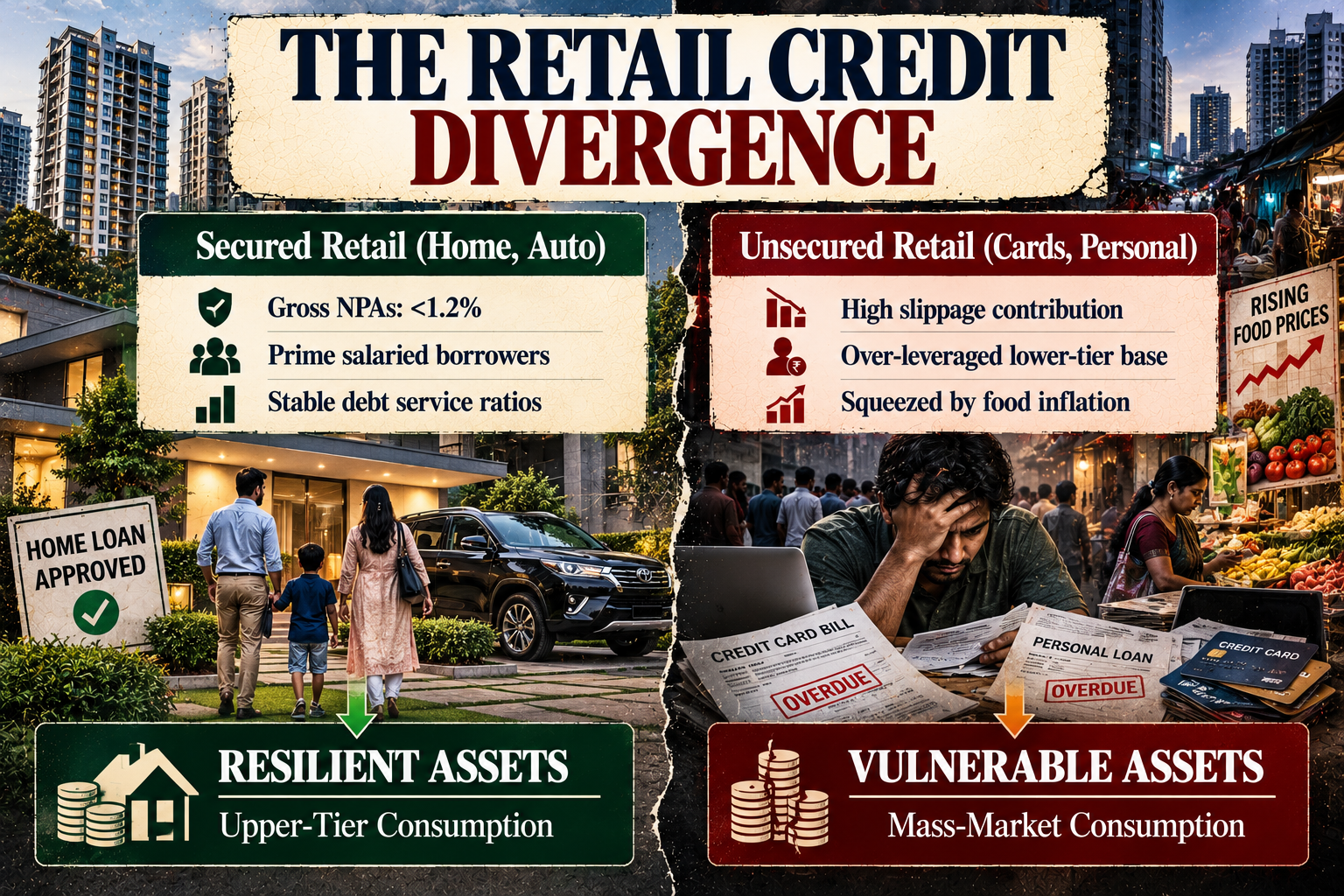
While secured retail loans (prime residential mortgages and auto loans) remain exceptionally healthy, unsecured lending portfolios are showing clear strain. Mid-sized private lenders provide the clearest indicator: at RBL Bank, credit cards, personal loans, and microfinance accounted for ₹688 crore ($82.5 million) of total fresh slippages during the quarter. Even top-tier lenders noted that credit card write-offs and delinquency roll-forwards in personal loans required higher provisioning.
This deterioration vindicates the Reserve Bank of India's preemptive intervention in late 2023, when the central bank raised regulatory risk weights on unsecured consumer loans and credit card receivables by 25 percentage points. That regulatory brake prevented runaway compounding.
Nonetheless, current slippages highlight a strained segment of the consumer base. Salaried individuals earning under ₹35,000 per month, heavily targeted during the peak fintech and retail lending push, have absorbed several years of cumulative food and services inflation. Confronted with static real entry-level wage growth, their debt-service burdens have reached saturation, forcing banks to curtail limits and slow unsecured portfolio growth.
3. Corporate Balance Sheets: Clean, Solvent, but Cautious
If retail credit is experiencing targeted friction, India's corporate credit profile represents the polar opposite: unprecedented solvency coupled with cautious borrowing.
Historically, Indian banking crises were triggered by corporate defaults. A decade ago, during the "Twin Balance Sheet" crisis of 2014–2018, Indian public and private banks were burdened with double-digit bad loans in power, steel, infrastructure, and real estate.
In Q2 FY27, corporate asset quality is exceptionally clean:
Gross NPA ratios at HDFC Bank (1.11%), ICICI Bank (1.20%), and Axis Bank (1.16%) sit near historic lows.
Corporate credit provisions are minimal; large Indian conglomerates have spent the post-pandemic era deleveraging, repairing balance sheets, and raising profitability.
Corporate slippages are near zero across major private lenders.
Yet this pristine health reveals an underlying economic dilemma: the broad-based private capital expenditure (capex) cycle has not fully materialised.
Commercial loan growth in Q2 was driven primarily by short-term working capital financing, trade credit, real estate developers, and infrastructure projects tied to public procurement (highways, renewables, energy transmission).
Large-scale, greenfield private industrial capex—companies borrowing thousands of crores to construct new manufacturing factories from scratch—remains selective. Corporate boardrooms remain financially conservative, funding brownfield expansions through robust internal cash flows rather than major bank syndications. While corporate India is financially resilient, it is not yet taking aggressive debt-fuelled investment bets on future domestic demand.
4. What Bank Data Says About Indian Consumption
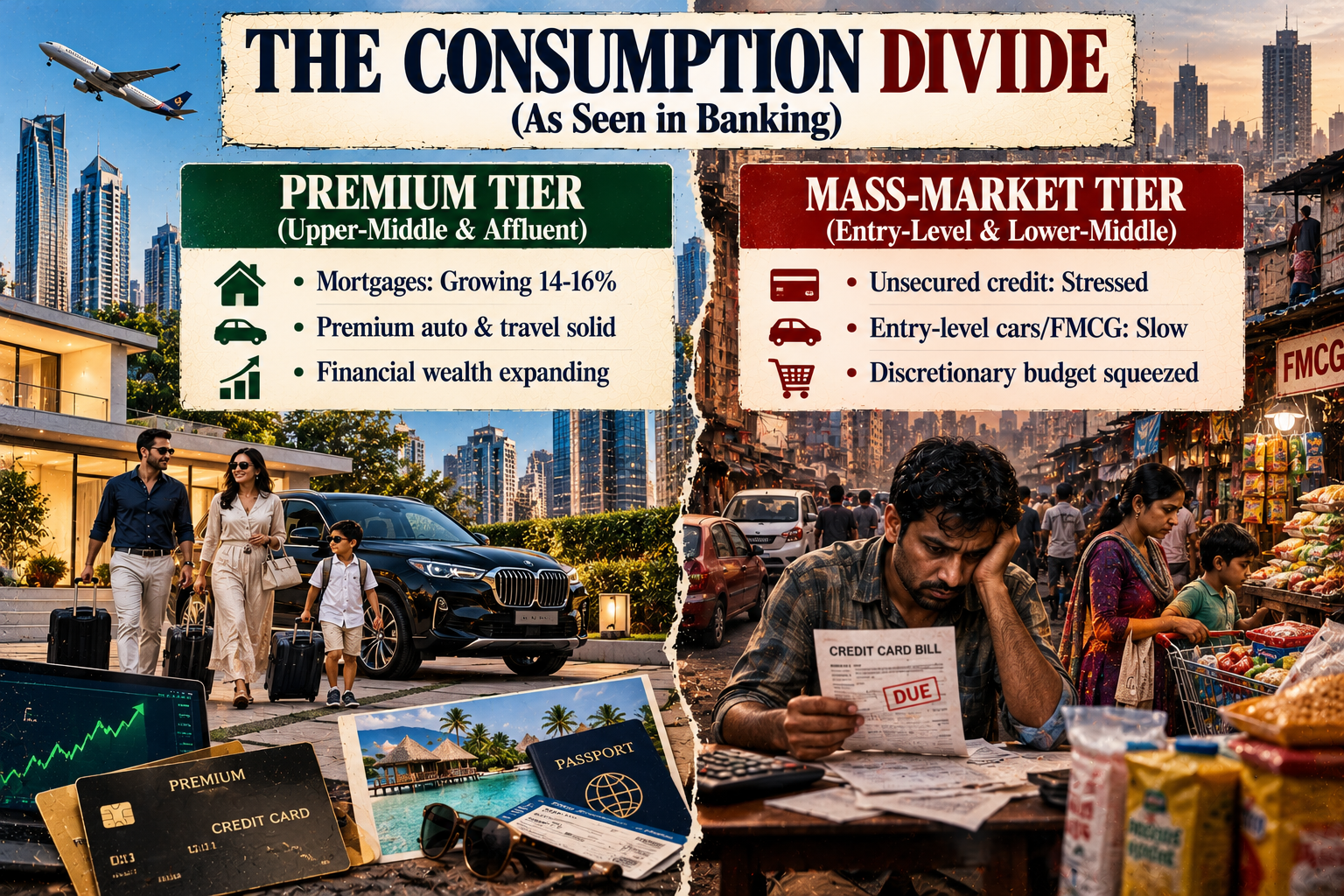
The divergence across loan products offers a clear diagnosis of Indian consumer demand, pointing to a distinct consumption divide:
Upper-Income Resilience
Wealthier urban households continue to borrow with confidence. Demand for residential mortgages (particularly in premium and luxury housing above ₹1.5 crore) expanded at a steady 14% to 16% year-on-year across private lenders. Affluent households, benefiting from real estate appreciation, equity portfolio gains, and stable corporate salaries, continue to drive credit growth in premium vehicles and high-end discretionary spending.
Mass Urban Softness
Conversely, the sharp drop in small-ticket consumer durable loans and rising card defaults reflect a cooling among mass urban consumers. This directly mirrors reports from fast-moving consumer goods (FMCG) manufacturers and automakers, who have documented a persistent slowdown in entry-level passenger vehicle sales and modest rural-urban volume growth. Urban living costs—housing rents, education, and stubborn food price components—have absorbed disposable incomes among middle-to-lower income households.
The Rural Anchor
Positively, bank disclosures from semi-urban and rural branches (particularly at HDFC Bank and Kotak Mahindra Bank) indicate stabilising tractor financing, steady agricultural credit, and lower stress in rural trade books. Following an adequate 2026 monsoon distribution and healthy kharif crop arrivals, rural demand is acting as a baseline floor for the economy, preventing the urban consumption slowdown from developing into a broader economic drag.
The Policy Implications: Caught Between Liquidity and Neutral Stance
These private banking dynamics present a specific challenge for the Reserve Bank of India’s Monetary Policy Committee (MPC).
In its recent policy deliberations, the RBI shifted its monetary stance to "neutral" while holding the benchmark repo rate at 6.50%. The Q2 bank results illustrate the fine balancing act ahead:
The Rate Cut Transmission Challenge: When the RBI eventually begins easing interest rates, monetary transmission will be asymmetric. Because banks are operating with an elevated credit-deposit ratio (around 80%), they cannot easily cut deposit rates without worsening their liquidity squeeze. Conversely, external benchmark-linked loans (EBLR), which comprise over half of private bank advances, will reprice downward immediately, threatening a sharper contraction in Net Interest Margins.
Regulatory Vigilance on Non-Bank Lending: With private banks tightening underwriting standards on personal loans and credit cards, risk is migrating toward unregulated or lightly regulated non-banking channels and informal borrowing. The central bank's focus will increasingly centre on tracking systemic contagion between NBFCs, fintech balance sheets, and core banking liquidity.
The Bottom Line
India's private banking sector enters the second half of the fiscal year in a position of institutional strength. Capital adequacy ratios across HDFC Bank, ICICI Bank, and Axis Bank stand well above 16%, asset quality is at historical highs, and balance sheets are insulated from systemic industrial distress.
Yet the Q2 results deliver a clear message about the broader economy. India is not in an indiscriminate, debt-fuelled expansion. It is experiencing a rebalancing:
Household savings are migrating away from bank deposits toward capital markets, permanently altering how banks fund themselves.
The easy-money boom in unsecured consumer credit has concluded, leaving behind a targeted debt-service hangover among lower-tier urban borrowers.
Corporate India is solvent and financially sound, but remains disciplined, awaiting broader consumption demand before unleashing a transformative capital expenditure cycle.
Far from signaling structural fragility, the Q2 earnings paint a picture of an economy growing at a sustainable, if uneven, pace. The engine is running reliably—but its fuel supply is becoming more expensive, and the terrain ahead requires careful navigation.