In brief
- Online marketplaces opened with a strong start, generating an estimated ₹24,000 crore in gross merchandise value during the opening 48 hours of flagship sales, a run-rate six times higher than normal days, highlighting an e commerce surge this festive season.
- Despite the online rush, urban household budgets tighten as a nationwide LocalCircles survey shows total urban festive spending falling to ₹1.97 lakh crore, down from ₹2.10 lakh crore in 2025.
- Shoppers transact but spend selectively, favouring accessible fashion and quick commerce and funding purchases mostly from accumulated savings rather than consumer credit.
- The funding shift is evident as 83 per cent of urban households plan to use personal savings, with 34 per cent intending to fund a significant portion from past savings, aligning with RBI data on cautious consumption.
India’s 2026 festive shopping season has opened with a sharp contrast between online marketplaces and broader urban household budgets.
E-commerce marketplaces generated an estimated ₹24,000 crore (approximately $2.88 billion) in gross merchandise value (GMV) during the opening 48 hours of flagship sales, according to early estimates from Redseer Strategy Consultants. That represents a run-rate six times higher than typical business-as-usual days.
Yet outside the headline numbers, household balance sheets reflect caution. A nationwide survey of more than 67,000 urban consumers across 307 districts by LocalCircles estimates total urban household festive spending will decline by 6% this year to ₹1.97 lakh crore ($23.6 billion), down from ₹2.10 lakh crore in 2025.
Shoppers are actively transacting, but they are spending selectively, turning to accessible fashion and quick commerce while funding their purchases primarily out of accumulated personal savings rather than consumer credit.
Opening 48 Hours: What Drove the E-Commerce Numbers?
The initial 48 hours of sales—anchored by Amazon’s Great Indian Festival and Flipkart’s Big Billion Days—saw 8 crore to 9 crore (80 million to 90 million) orders placed nationwide.
Between 6 crore and 6.5 crore (60 million to 65 million) unique shoppers participated across the first two days alone. That figure represents more than a third of India's total monthly transacting online shopper base of roughly 15 crore to 16 crore.
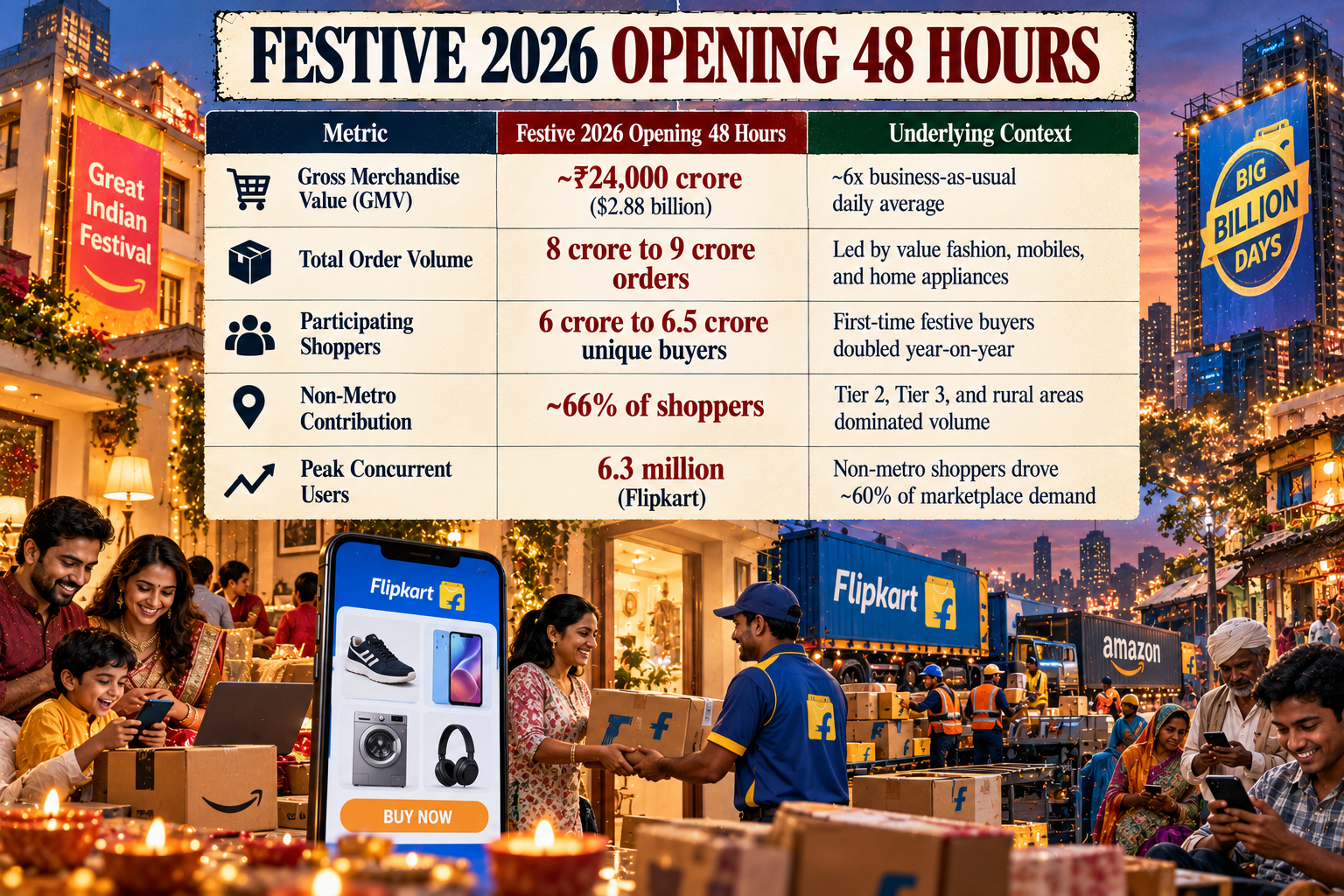
Non-metro consumers drove the expansion in order volumes. Tier 2, Tier 3, and rural towns accounted for roughly two-thirds of all opening-day shoppers. Platforms catering specifically to price-sensitive regional demand recorded substantial volume gains; Meesho, for instance, saw Day 1 orders climb 75% year-on-year, led by festive ethnic wear, home furnishings, and beauty products.
Category Performance: Mobiles Lead, Fashion Expands, TVs Supersize
Product categories are showing divergent trends in price and volume:
Smartphones (38% to 40% of sales value): Handsets remained the largest single category by gross value, generating between ₹9,100 crore and ₹9,600 crore ($1.09 billion to $1.15 billion). However, unit volume growth slowed. Data from Counterpoint Research indicates festive smartphone shipments are projected to contract by 12% in unit terms due to rising memory chip costs pushing up average selling prices, even as total category value grows by 5%.
Consumer Electronics and Appliances (25% to 27% of sales value): Generating ₹6,000 crore to ₹6,500 crore ($720 million to $780 million), large appliances outpaced broader market growth. Television sales were dominated by screen upgrades: models measuring 55 inches and above represented more than 75% of top-selling television stock-keeping units (SKUs) across brands such as Samsung, LG, TCL, and Xiaomi.
Fashion and Apparel (15% to 18% of sales value): Fashion GMV expanded by 22% to 25% year-on-year, contributing between ₹3,630 crore and ₹4,350 crore ($435 million to $522 million). Accessible price points in ethnic and festive apparel resonated strongly with Gen Z buyers, who comprised roughly one-third of opening-day shoppers.
Quick Commerce Emergence: Dark-store operators including Blinkit, Swiggy Instamart, and Zepto expanded beyond grocery delivery into decorative lighting, pooja essentials, beauty, and small electronics. Their daily GMV reached four to five times ordinary levels over the opening festival weekends, accounting for an estimated 20% to 22% of online impulse purchases.
Why Urban Household Budgets Are Tightening
Despite healthy e-commerce volume, the broader retail environment is navigating tighter macro conditions than in 2025.
In 2025, the festive season coincided directly with the implementation of the GST 2.0 rate rationalisation on 22 September 2025, which lowered retail prices across consumer durables and gave an immediate boost to sales. The 2026 festive season has no equivalent fiscal stimulus.
Instead, households face three distinct financial pressures:
Persistent Food Inflation: Retail Consumer Price Index (CPI) inflation rose to 5.54% in September 2026, marking eleven consecutive monthly increases, according to the Ministry of Statistics and Programme Implementation. Food inflation jumped to 7.74%, with staple vegetable prices rising substantially and raising the cost of basic household sustenance.
Rising Borrowing Costs: On 7 October 2026, the Reserve Bank of India’s Monetary Policy Committee raised the repo rate by 25 basis points to 5.50%—its first rate increase in over three and a half years—shifting its policy stance to calibrated tightening. With the RBI projecting CPI inflation to peak at 6.0% in the October–December quarter, rate cuts have been ruled out for the near term, making discretionary personal loans and consumer credit card EMIs costlier.
Elevated Bullion Prices: Domestic gold prices rose above ₹1.50 lakh per 10 grams, while silver crossed ₹2.20 lakh per kilogram. These historic highs have suppressed traditional festive jewellery demand. In the LocalCircles survey, only 6% of urban households indicated plans to buy jewellery this season, shifting festive bullion purchases toward lightweight gifting items and investment coins rather than heavy ornaments.
These factors explain why 31% of surveyed urban households report zero planned discretionary festive purchases this year, while 18% intend to spend less than ₹10,000 ($120).
The Funding Shift: Savings Over Debt
A notable pattern in the 2026 festive season is how consumers are paying for their shopping.
According to LocalCircles survey data, 83% of urban households planning festive purchases will draw on personal savings to some degree. Furthermore, 34% intend to fund a significant portion—25% or more of their total seasonal budget—entirely from past savings, including 16% who will rely on savings for all of their festive purchases.
This shift matches findings from the Reserve Bank of India's July 2026 Urban Consumer Confidence Survey. While the net response on current non-essential spending was subdued at +3.3, consumers chose to tap accumulated deposits rather than take on higher-interest credit following the central bank's October rate hike.
Offline Retail and Automotive Signals
Offline retail and vehicle dealerships present a mixed picture:
Automobile Dealerships: The Federation of Automobile Dealers Associations (FADA) reported vehicle retail registrations of 25.37 lakh units (2.537 million units) in September 2026, a 31.8% year-on-year increase. However, FADA clarified that this spike reflected early dealer stocking ahead of Navratri and an artificially low base from September 2025, when buyers delayed purchases ahead of tax revisions. FADA has cautioned dealers about post-festive inventory buildup, projecting full-year retail auto growth to moderate to 8%–12%.
Physical High Streets: Offline retail associations report steady footfall in suburban neighbourhood stores, but urban high-street shopping has experienced sporadic disruptions and cautious basket sizes. Traditional retailers note that while footfall remains stable, average transaction values are lower as consumers compare prices against quick-commerce and marketplace promotions.
Summary of Performance
India’s 2026 festive season is neither a runaway boom nor a broad consumption collapse. Instead, it is a bifurcated retail season defined by:
Robust digital order volumes driven by Tier 2 and Tier 3 shoppers buying accessible fashion and home goods.
Selective big-ticket spending, where consumers upgrade essentials like 55-inch smart televisions but push back against higher handset prices.
Prudent personal financing, as urban households navigate 5.54% retail inflation and higher interest rates by relying on savings rather than borrowing.
While marketplace delivery networks are operating at peak capacity, total consumer spending reflects deliberate restraint, with households prioritising value and preserving their buffers for the months ahead.