In brief
- China is preparing new export controls that target frontier artificial intelligence technologies, including models above 2 trillion parameters and 14nm chip designs, signalling a shift to software sovereignty and tighter outbound limits.
- On 16 October 2026 MOFCOM and MOST published a draft update to the Catalogue of Technologies Prohibited or Restricted from Export, placing 23 AI technologies under formal restrictions.
- The draft is open for public commentary until 15 November 2026, while a temporary registration rule requires domestic firms to register cross border licensing deals, offshore server migrations and foreign ownership transfers.
- Exemptions include API and cloud consumption, open source code, and internal cloud deployments, designed to protect cross border revenue and diplomatic soft power while retaining access to international markets.
On 16 October 2026, China’s Ministry of Commerce (MOFCOM) and the Ministry of Science and Technology (MOST) jointly published a draft update to the country’s Catalogue of Technologies Prohibited or Restricted from Export.
The proposed revision places 23 artificial intelligence technologies under formal export restrictions, spanning frontier large language models, autonomous agents, advanced semiconductor design, and distributed supercomputing clusters.
While the draft is open for public commentary until 15 November 2026, Chinese authorities simultaneously enacted a temporary registration rule that took effect on the day of publication. Under this interim measure, domestic technology companies must formally register any ongoing or pending cross-border licensing deals, offshore server migrations, and foreign ownership transfers.
The draft represents an evolution in Beijing’s technology strategy. After years of responding defensively to US semiconductor export controls, China is constructing an outbound regulatory perimeter designed to retain domestic intellectual property, assert ideological control over algorithmic outputs, and prevent foreign entities from absorbing China’s frontier software advancements.
The Technical Thresholds: What Is Being Restricted?
Rather than issuing broad, vague prohibitions, the joint ministry draft establishes quantifiable technical benchmarks to separate routine commercial software from national security-grade assets.
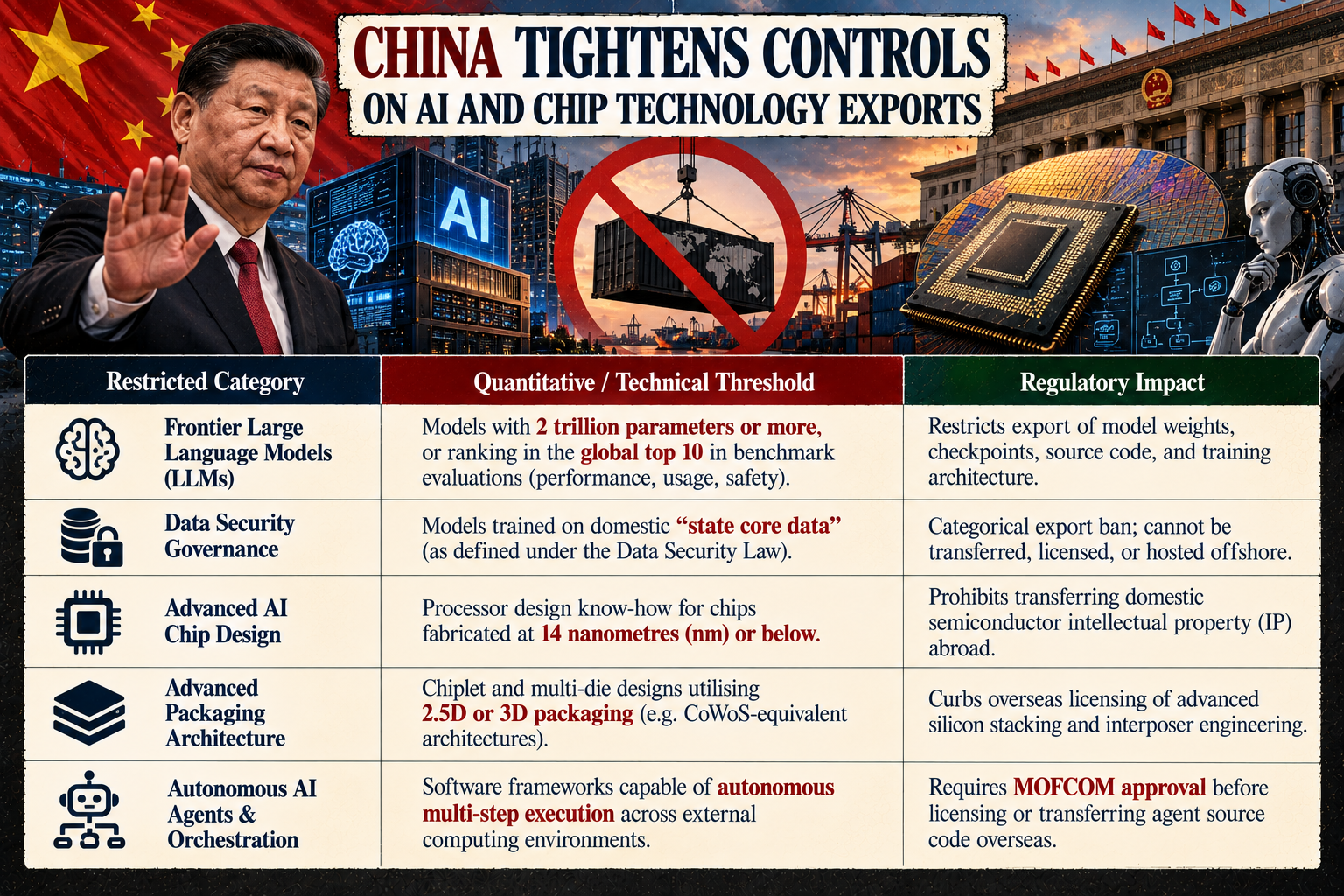
The draft text does not name individual companies, but industry benchmarks indicate that frontier systems—such as Moonshot AI’s Kimi K3, Alibaba’s Qwen3.8-Max, and DeepSeek’s latest high-parameter releases—fall within the 2-trillion-parameter tier or the global performance top-10 threshold.
What Remains Allowed: The Cloud and Open-Source Carve-Outs
Significantly, the draft rules do not shut China’s AI industry off from international commercial markets. Beijing has introduced specific exemptions to protect cross-border revenue and diplomatic soft power:
API and Cloud Consumption Is Protected: Foreign businesses, software developers, and consumers can continue using Chinese AI models via cloud application programming interfaces (APIs), mobile applications, and web interfaces. Serving an overseas user through a server physically based in China is not treated as an export of technology.
Open-Source Code Is Formally Exempt: Technologies and research papers that are already in the public domain, as well as code released under recognized open-source licences, are excluded from the restrictions. MOFCOM announced that it would establish streamlined, automated licensing procedures for open-source collaborations to avoid disrupting global academic research.
Internal Cloud Deployments: If a Chinese enterprise deploys its own proprietary model on its wholly owned data-centre infrastructure located abroad to support its own services, it can apply for expedited, automatic licensing.
The restriction specifically targets the transfer of underlying structural assets: downloading raw model weights, exporting proprietary training datasets, transferring chip design register-transfer level (RTL) code, or entering cross-border joint ventures that grant foreign partners operational control over Chinese algorithms.
Why Now? The Drivers Behind Beijing’s Move
Three distinct pressures explain why Chinese regulators are moving to check the outbound spread of domestic AI:
1. Preventing "Technology Flight" and Foreign Absorption
Over the past eighteen months, Chinese AI developers narrowed the performance gap with leading American research labs, achieving high reasoning benchmarks while operating at a fraction of Western training costs. Consequently, Western technology conglomerates and venture capital funds have actively sought commercial licensing deals, model-weights acquisitions, and overseas talent migration from Chinese startups.
By classifying frontier weights as dual-use export-controlled items, Beijing prevents domestic founders from selling their core intellectual property abroad or relocating their primary corporate entity overseas to circumvent domestic regulations.
2. The Geopolitical Counterweight
Since October 2022, the United States has expanded export controls to starve China of advanced AI accelerators (such as Nvidia’s H100 and B200 systems) and cutting-edge electronic design automation (EDA) software.
Beijing’s new rules establish an asymmetric response. While Washington controls the physical hardware inputs, China is claiming legal control over its frontier algorithmic outputs and domestic silicon packaging know-how. If global developers become increasingly reliant on Chinese open-weight architectures, Beijing retains the statutory power to decide which global industries receive access to subsequent generations of models.
3. Dual-Use and National Security Governance
In an official statement accompanying the draft, MOFCOM stated that the regulations are intended to:
"solidify the security baseline, prevent misuse and abuse, ensure that AI remains under human control, and promote international governance of AI."
Chinese security planners are concerned that exporting raw model weights to third-party states or non-state actors could allow advanced models to be repurposed for autonomous offensive cyber operations, critical infrastructure sabotage, or biological weapons synthesis without the safety guardrails and censorship filters mandated by the Cyberspace Administration of China (CAC).
Ramifications for the Global Tech Sector
The proposed controls introduce substantial friction into the international artificial intelligence ecosystem:
The Global Open-Source Dilemma: The worldwide developer community has relied heavily on open-weight releases from Alibaba (the Qwen series) and DeepSeek as high-performance, cost-effective alternatives to closed American proprietary systems from OpenAI and Google. While existing open releases remain safe under the exemption, future Chinese models exceeding 2 trillion parameters may be forced to remain closed or undergo protracted MOFCOM security reviews before weights can be posted to public repositories like Hugging Face.
Cross-Border Cloud Friction: Chinese AI startups expanding into Europe, Southeast Asia, and the Middle East—such as Zhipu AI deploying instances on global cloud providers—now face regulatory oversight from both sides. They must prove to Western regulators that their systems are free of state-directed security risks, while simultaneously proving to MOFCOM that their overseas instances do not leak domestic "core data" or structural weights.
Domestic Chip Design Isolation: Restricting the export of 14nm and below processor designs, alongside 2.5D/3D packaging know-how, codifies a policy of semiconductor self-reliance. It ensures that any architectural breakthroughs achieved by domestic design firms (such as Huawei’s HiSilicon or emerging domestic GPU makers) remain exclusive to China's domestic supply chain rather than being licensed to international foundries or design houses.
Summary of the Policy Shift
China’s proposed export controls demonstrate that Beijing no longer views its artificial intelligence sector as an underdog playing catch-up, but as a sovereign strategic asset requiring legal borders.
By drawing a firm line at 2 trillion parameters and 14nm architectures, China is establishing a domestic technology perimeter: open to international API commerce and developer adoption, but tightly guarded against structural technology transfer, foreign acquisition, and unregulated deployment abroad.