In brief
- On 5 October 2026 Dated Brent rose to $154 per barrel, the highest level since 1991, while Brent futures stayed near $103, creating a physical to paper spread over $50.
- Severe disruption in the Strait of Hormuz cut Gulf supplies, refiners turned to North Sea and Atlantic barrels, tanker scarcity lengthened voyages and low pre winter stocks left no buffer, forcing spot purchases at premium.
- The $50 spread shows extreme backwardation, signalling that physical crude is scarce while futures price expected normalisation, which alarms central bankers, refiners and finance ministries because it raises inflation, demand destruction and hedging breakdown risks.
- For India, importing over 85% of crude, each $10 rise adds about ₹1.15 lakh crore to the import bill and widens the current account deficit by roughly 0.5% of GDP; watch Hormuz transit safety, inventory draws and SPR releases.
On 5 October 2026, the world’s benchmark for physical crude oil, Dated Brent, crossed $154 per barrel. According to historical pricing records maintained by the London Stock Exchange Group (LSEG), this is the highest level recorded since data collation began in 1991, eclipsing the previous peak of $147.50 set in July 2008 and the April 2026 geopolitical spike.
Yet on the trading screens of London’s Intercontinental Exchange, generic front-month Brent futures hovered near $103 per barrel.
That divergence—an astonishing spread of more than $50 between a physical cargo of crude and a paper futures contract—represents the widest physical-to-paper premium in modern oil market history. To understand why this has happened and why central bankers, refiners, and finance ministries view it with alarm requires looking past headline screen tickers into the mechanics of physical maritime trade.
What Is Dated Brent?
Most retail investors and headline readers assume "Brent crude" refers to a single financial price quote. In reality, the oil market operates across two distinct tiers: the financial derivatives market (paper futures) and the physical cargo trade.
Dated Brent is the price assessment of physical, light sweet crude oil that has been assigned specific loading dates at terminals in the North Sea, typically 10 to 30 days ahead of delivery.
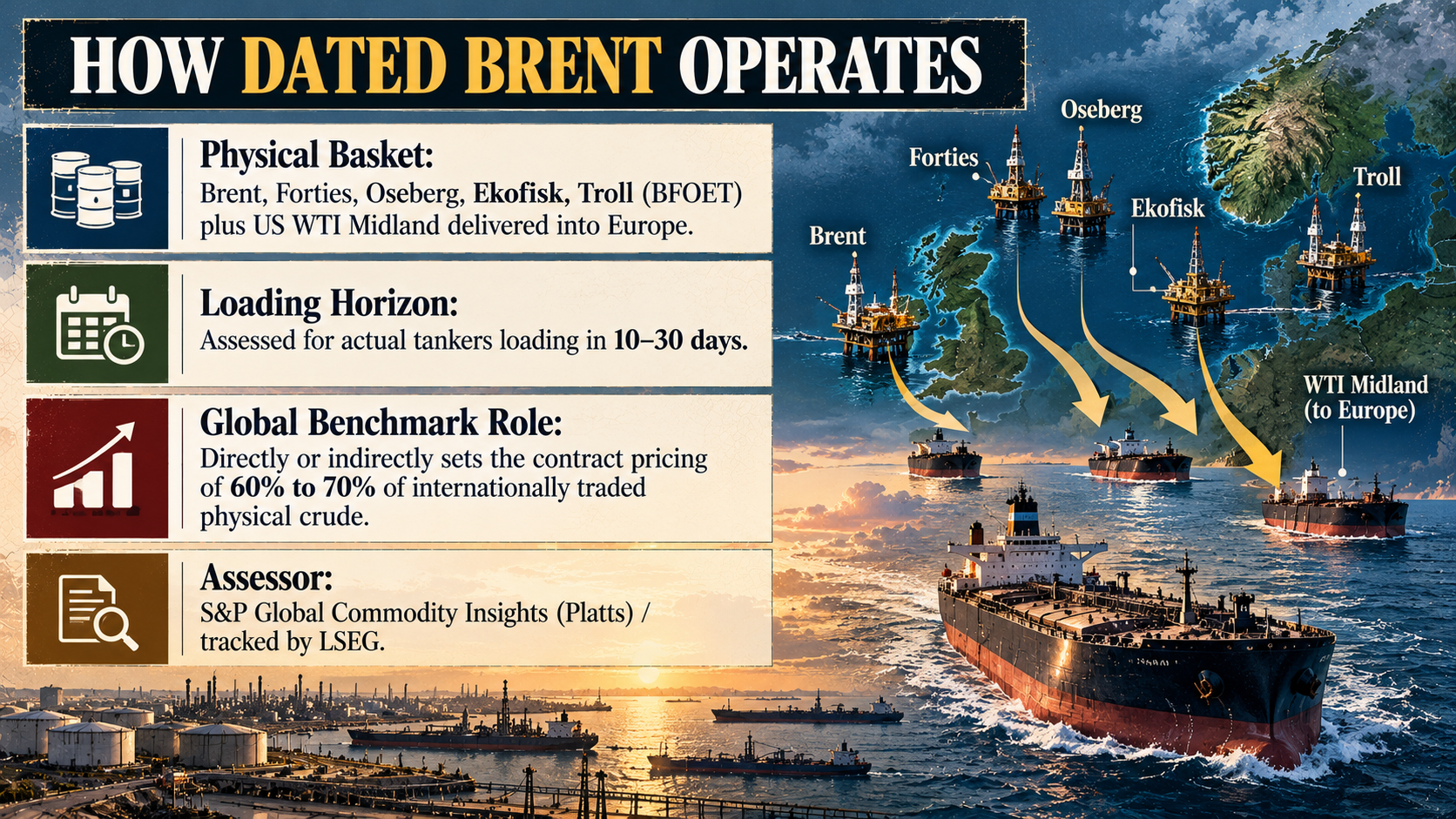
When an oil refiner in Rotterdam, Jamnagar, or Ulsan buys a seaborne cargo of crude from West Africa, the Mediterranean, or the Middle East, the sales contract is rarely priced in fixed dollars. Instead, it is indexed as a differential to Dated Brent. Because of this linkage, Dated Brent governs the real-world settlement of roughly two-thirds of the world's physical waterborne crude trade.
Futures contracts, by contrast, represent standardized financial commitments that settle against an index or roll forward into subsequent months. While speculators and financial institutions trade billions of barrels of paper futures daily, only a small fraction ever results in physical crude delivery. Dated Brent is where wet barrels actually change hands.
Why Has Dated Brent Climbed to $154?
The surge to $154 is not the result of financial speculation. It is the direct consequence of a frantic scramble by commercial refiners to secure wet, deliverable oil that can be unloaded at terminal berths immediately. Four compounding factors explain this surge.
1. Severe Chokepoint Bottlenecks and Tanker Peril in Hormuz
The primary catalyst is the disruption of maritime traffic through the Strait of Hormuz, an arterial waterway through which roughly 20 million barrels per day—one-fifth of global petroleum consumption—normally transits.
Escalating hostilities in the Gulf, missile and drone attacks targeting regional transport hubs, and incidents involving commercial tankers off Oman have turned the strait into an active hazard zone. With commercial shipping lines facing astronomical war-risk insurance surcharges, or resorting to dangerous transshipments with Automatic Identification Systems (AIS) disabled, prompt seaborne flows from Persian Gulf terminals have fallen sharply.
2. The Flight to Safe, Prompt Atlantic Basin Barrels
Refineries cannot simply pause operations while diplomats negotiate shipping safety protocols. Running an oil refinery below minimum technical operating rates risks severe catalytic damage and coking, while an unplanned shutdown costs millions of pounds to restart.
Faced with delayed or missing Middle Eastern shipments, refiners in Northwest Europe, the Mediterranean, and parts of Asia have pivoted aggressively towards alternative sources: North Sea grades, Mediterranean supplies, and West African crudes. Because North Sea crude is waterborne and loaded outside the conflict zone with predictable 10-to-30-day delivery schedules, buyers have been willing to pay whatever premium is demanded to lock in immediate cargoes.
As Naohiro Niimura, partner at Tokyo-based Market Risk Advisory, noted following the price surge, buyers have crowded into Brent because physical volumes can be secured and loaded without catastrophic transit delay.
3. Tanker Scarcity and Inefficient Logistics
The crisis has dislocated shipping efficiency. Tankers that previously completed predictable direct voyages are now forced into prolonged ship-to-ship transfers outside the Persian Gulf, rerouting around the Cape of Good Hope, or waiting for naval convoys. This displacement has absorbed global tanker capacity since September, driving up spot charter rates and stranding crude away from destination refineries.
4. Pre-Winter Commercial Stock Depletion
The timing of the supply shock coincides with the seasonal ramp-up in demand for middle distillates—specifically heating oil, diesel, and kerosene—ahead of the Northern Hemisphere winter. With commercial petroleum inventories across OECD nations already running near five-year seasonal lows, refiners have had virtually no buffer stock to draw down, forcing the entire adjustment onto the spot market.
The Meaning of the $50 Spread: Extreme Backwardation
Under normal market conditions, deferred oil futures trade at a modest premium to prompt spot prices to cover the cost of storage, insurance, and financing—a market structure known as contango.
When prompt supplies are tight, the curve flips into backwardation, where immediate delivery commands a premium over future delivery.
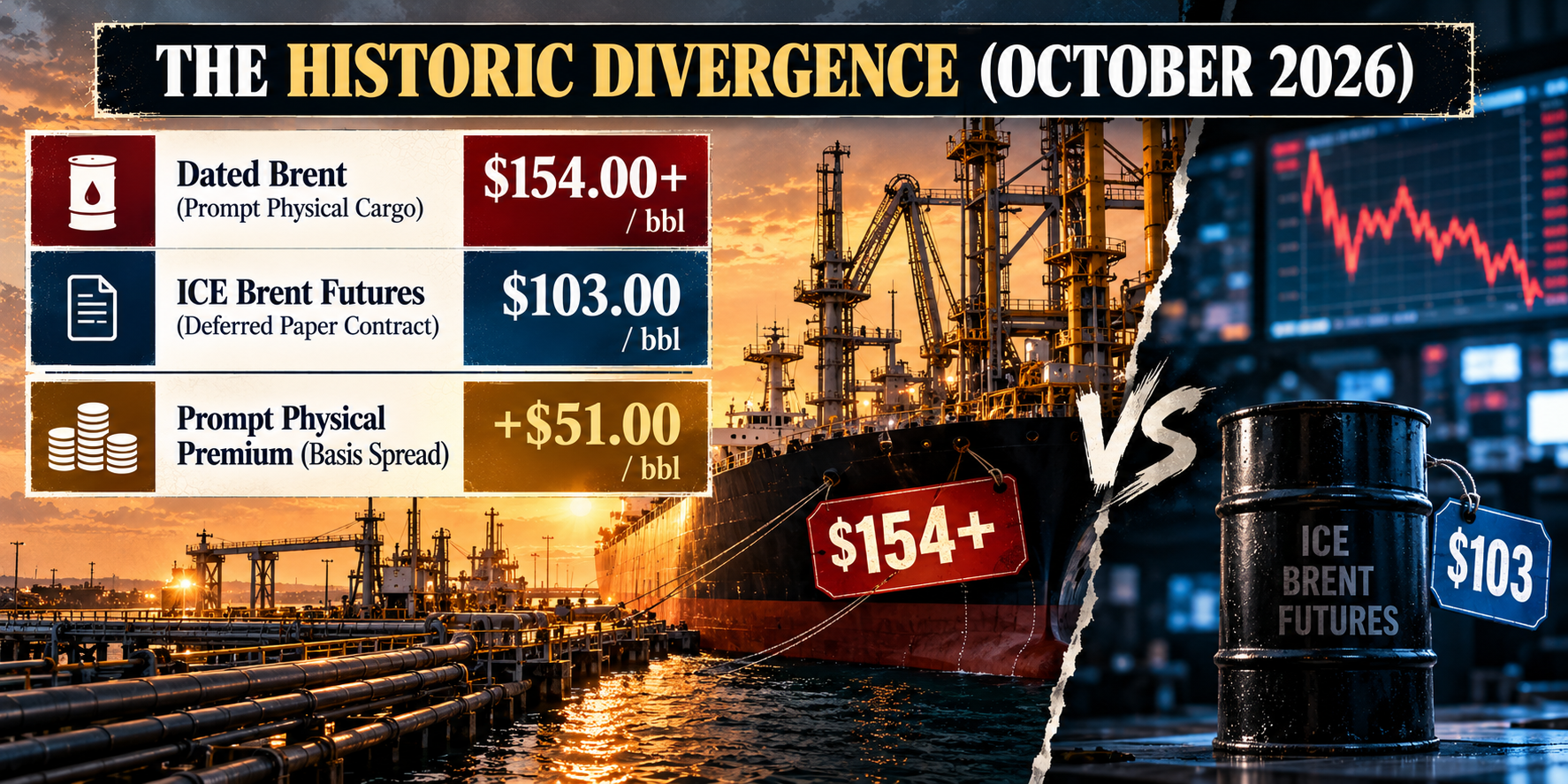
A backwardation of $1 or $2 per barrel signals healthy demand. A backwardation of $51 per barrel indicates systemic stress.
It reveals that the paper derivatives market is pricing in eventual geopolitical normalization or prospective supply deals, while the physical economy is starving for crude today. A refiner whose storage tanks will run dry in three weeks cannot run their distillation towers on a December paper contract priced at $103; they must pay $154 for Dated Brent now.
Why Dated Brent at $154 Is Not a Good Sign
A price spike of this scale is not a sign of economic vigour; it is a disruptive tax on global commerce that carries serious macroeconomic and financial risks.
1. Paper Prices Mask Real-World Consumer Inflation
When casual observers look at market indices showing Brent futures around $103, they receive a false signal of stability. But industrial consumers, airlines, hauliers, and petrol stations do not purchase screen futures; they buy refined products made from physical crude priced against Dated Brent.
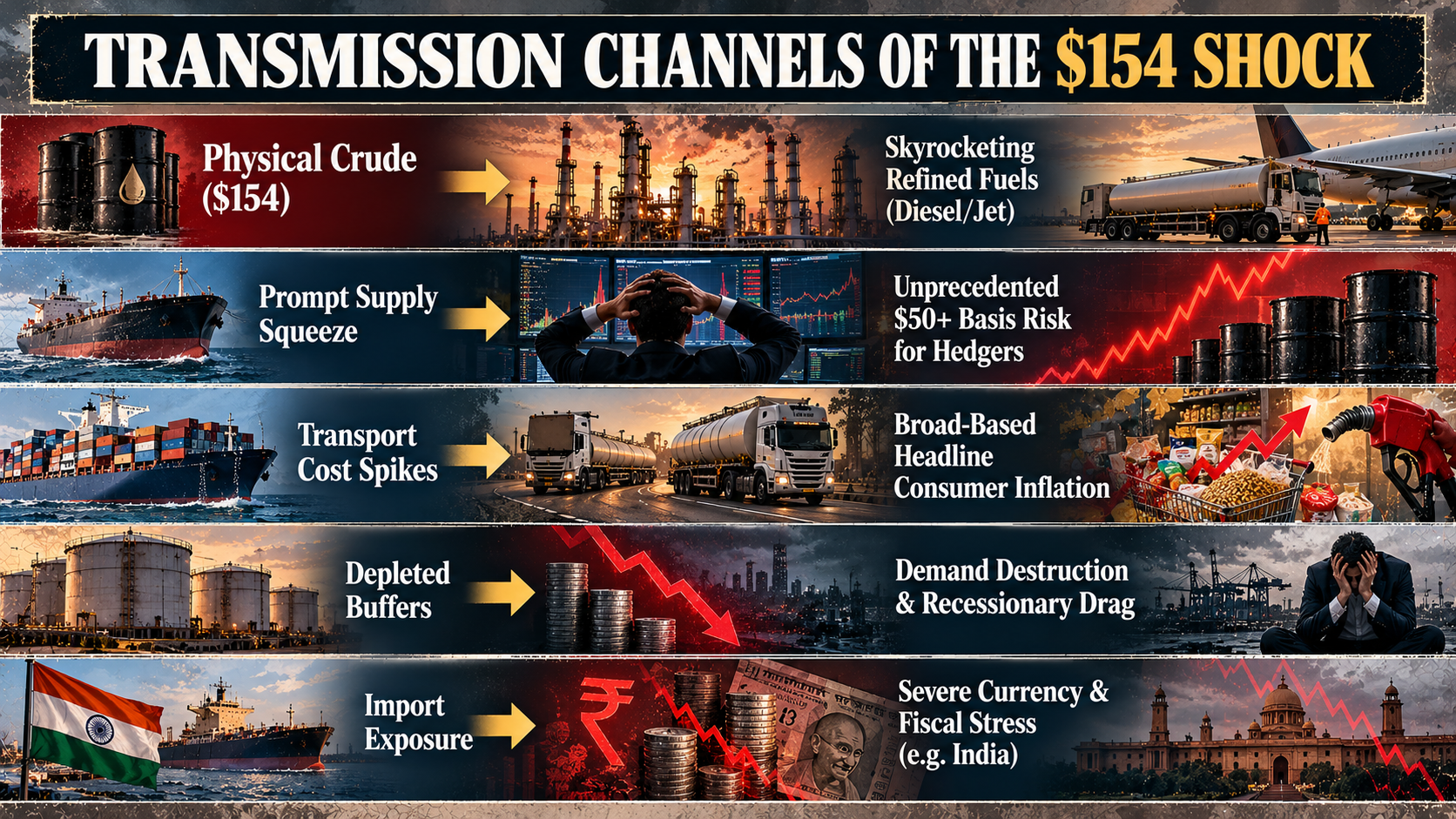
When physical crude costs $154 a barrel, refining margins for essential transport fuels—particularly diesel and aviation turbine fuel—spike dramatically. Wholesale diesel prices in international trading hubs have approached historic records, feeding directly into road haulage costs, maritime freight tariffs, agricultural harvesting machinery, and domestic retail energy bills.
2. The Inevitable Wave of Demand Destruction
Energy economists at consultancy FGE NexantECA have warned that protracted disruption pushing Dated Brent above $154 triggers severe demand destruction.
High energy prices act as a regressive levy on households and businesses. Capital that would otherwise support productive investment or consumer spending is diverted into paying for transport fuels and utility bills. Historically, sustained crude spikes above $140 a barrel—such as those seen prior to the 2008 financial crisis—have served as catalysts for macroeconomic contraction, curbing manufacturing output and pushing major economies into recession.
3. Breakdown of Hedging Mechanisms and Trading House Solvency
An unheralded danger of a $50 basis spread lies in commodity trade finance.
Under standard commercial practice, when a physical trading desk or refiner purchases a tanker of physical crude, it hedges the inventory against price drops by selling an equivalent volume of Brent futures contracts on the exchange. This assumes that physical and paper prices move in tandem.
When the basis spread blows out by $50, the correlation breaks down completely. A trading firm holding physical crude bought at $154 that hedged with short paper futures at $103 faces massive basis risk. If paper prices fall while physical premiums remain elevated, or vice-versa, traders encounter severe margin calls from clearing houses. As seen during the European natural gas crisis of 2022, extreme basis volatility strains bank credit lines, curtails liquidity, and forces smaller traders to withdraw from the market, deepening supply paralysis.
4. Disproportionate Fallout for Emerging Importers: The Indian Case
For major oil-importing developing nations, a sustained physical crude shock is economically destabilizing. India, which imports more than 85% of its crude oil requirements, is exceptionally exposed.
Current Account Deficit (CAD) Expansion: As a rule of thumb, every sustained $10-per-barrel increase in global crude prices adds roughly ₹1.15 lakh crore ($13.8 billion) to India's annual oil import bill and widens the current account deficit by approximately 0.5% of GDP.
Currency Pressure: Surging dollar requirements to pay for seaborne crude shipments place immediate downward pressure on the Indian Rupee, making all other imported industrial inputs—from electronics to edible oils—more expensive.
Fiscal Subsidies and Price Pressures: While public sector oil marketing companies (IOCL, BPCL, HPCL) often buffer retail consumers from immediate pump price shocks, doing so erodes their marketing margins and forces the Union Government to increase fiscal allocations for fertiliser and cooking gas (LPG) subsidies, diverting funds from planned infrastructure capital expenditures.
What to Watch Next
The $154 Dated Brent print is a direct warning from the physical economy: paper futures prices and diplomatic communiqués cannot substitute for actual seaborne barrels.
Whether this spike eases or deepens into an extended energy crisis depends on three critical developments:
The Re-establishment of Verified Safe Transit in Hormuz: Until commercial vessels can navigate the strait under conventional insurance terms and verifiable safety standards, Atlantic Basin prompt crude will retain an exorbitant scarcity premium.
Global Inventory Depletion Rates: If refinery runs are curtailed due to unworkable physical feedstock margins, fuel stock draws will accelerate, shifting the crisis from crude scarcity to refined product rationing.
Coordinated Strategic Petroleum Reserve (SPR) Releases: While previous releases provided short-term relief, commercial refiners need prompt, deliverable light sweet grades. If governments release sour or inland crude that cannot easily reach distressed coastal refineries, the physical prompt premium will remain unanchored.
Until physical supply lines reconnect with refinery demand, Dated Brent at $154 stands as an unambiguous signal that global energy markets remain in a state of acute physical distress.