In brief
- On 9 October 2026 Deepinder Goyal shared that 31 lakh Indians earned money via Zomato and Blinkit in FY26 a 57% rise year on year and claimed Eternal supports the livelihoods of over 1% of India's population
- Using the 4.4 household size on 31 lakh delivery partners yields about 1.36 crore people adding 1.5 lakh warehouse workers and their families gives roughly 1.44 crore to 1.46 crore matching the 1% threshold
- Labour experts note the figure mixes yearly unique partners with sustained livelihoods as many workers use the platform temporarily or for extra income
- To reach 5% of India by 2030 Eternal would need to support about 7.3 crore people requiring roughly 1.62 crore workers which is nearly 69% of the projected national gig workforce of 2.35 crore
When Deepinder Goyal, founder and Group Chief Executive of Eternal Limited (the umbrella entity housing Zomato, Blinkit, Hyperpure, and Feeding India), posted operational employment metrics on 9 October 2026, he set off an immediate debate across India’s business and policy circles.
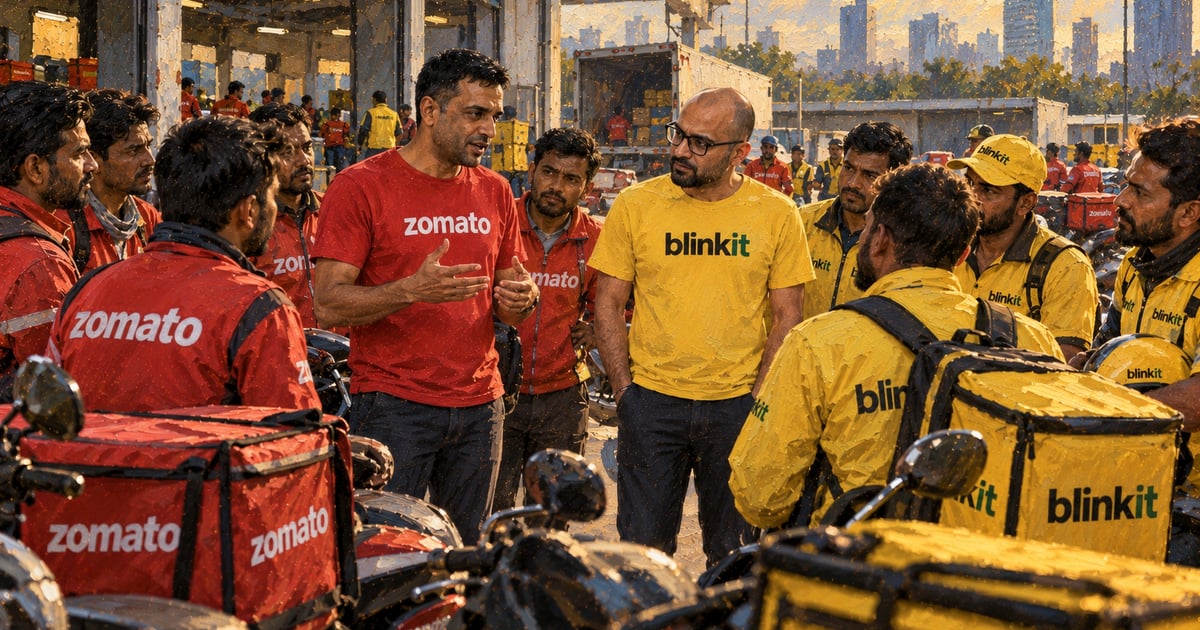
Goyal reported that during the 2025–26 financial year (FY26), 31 lakh Indians (3.1 million) earned money through Zomato and Blinkit as delivery partners—a 57% increase compared with the previous financial year, as reported by Business Today and StartupPedia. Accompanying the announcement was a corporate tribute song co-created with composer Amit Trivedi celebrating the personal aspirations of riders.
The conversation shifted into broader macroeconomic territory when Goyal responded to an online inquiry regarding total dependents:
"If you add our employees, warehouse workers, and all their families, Eternal directly supports the livelihoods of well over 1% Indians 💁♂️.. getting this to 5% by 2030 would be damn cool."
The statement captured attention because 1% of India’s estimated 2026 population of 144.5 crore (1.445 billion) represents approximately 1.45 crore individuals (14.5 million people). Claiming that a single corporate group directly sustains the livelihoods of more people than the entire population of Belgium or Zimbabwe is a bold pronouncement.
Evaluating this assertion requires separating headline corporate arithmetic from the economic realities of India's platform economy.
Deconstructing the 1% Calculation
How does an organisation with approximately 31 lakh delivery partners claim to sustain the lives of more than 1.45 crore citizens? The calculation relies on a standard demographic multiplier: average Indian household size.
According to data from the National Family Health Survey (NFHS-5) and Census projections, the average Indian household comprises roughly 4.4 to 4.5 members. When that multiplier is applied to Eternal’s primary labour pools, the arithmetic emerges clearly:
Delivery Partners: 31 lakh individuals multiplied by 4.4 household members yields approximately 1.36 crore people (13.6 million).
Warehouse and Dark Store Operatives: Blinkit’s expanding network of urban dark stores and Hyperpure’s procurement hubs employ tens of thousands of pickers, sorters, loaders, and hub managers. Assuming a conservative base of 1.5 lakh workers (150,000) across contract logistics, their households account for roughly 6.6 lakh people (660,000).
Corporate and Operational Employees: Across core technology, city operations, merchant relations, customer support, and administrative functions, Eternal employs thousands of full-time personnel.
Adding these components produces a total dependent base of roughly 1.44 crore to 1.46 crore individuals (14.4–14.6 million). On paper, this crosses the threshold of 1% of India’s population.
Cumulative Onboarding Versus Sustained Livelihoods
While the arithmetic holds mathematically, labour economists point out that the metric conflates two distinct concepts: cumulative annual platform participants and sustained, primary livelihoods.
In platform logistics, "chose to earn through the platform during the financial year" refers to the gross count of unique partners who logged in and completed paid deliveries at least once across 365 days. It does not mean Eternal had 31 lakh active delivery workers at any single moment.
Platform delivery in urban India exhibits annual worker turnover rates frequently exceeding 100%. Gig workers often use platforms transiently:
College students working for three months between university terms.
Seasonal agricultural migrants supplementing income during dry seasons.
Salaried workers delivering for two hours in the evening as a secondary income stream.
Workers who test delivery work for a fortnight, find net fuel-adjusted margins unviable, and log off permanently.
Counting every worker who completed a delivery during the year as someone whose household livelihood was "directly supported" by Eternal assumes the platform provides primary household sustenance. For a substantial portion of the 31 lakh cohort, platform earnings represent supplementary, temporary, or intermittent cash flow rather than a dependable primary livelihood.
How Blinkit’s Quick Commerce Boom Reshaped the Workforce
The 57% surge in delivery partners between FY25 and FY26 highlights the structural transformation within Eternal itself.
While Zomato’s core restaurant food delivery remains a steady, mature business, quick commerce has become the group's primary growth driver. According to disclosures in the Eternal Limited Annual Report, Blinkit’s footprint expanded aggressively across Tier-1 and Tier-2 cities, opening hundreds of new dark stores.
Quick commerce demands far higher delivery partner density than food delivery:
Hyper-Local Radii: Dark stores operate within tight 2–3 kilometre radiuses to meet 10-minute delivery promises, requiring dedicated pools of riders clustered around specific neighbourhoods.
Order Volume and Frequency: Grocery and household items generate regular, repeat orders throughout the morning and afternoon, smoothing out the lunch-and-dinner demand peaks typical of restaurant delivery.
Internal Warehouse Labour: Beyond riders, quick commerce relies on physical dark stores staffed by pickers and packers who assemble baskets in under three minutes, drawing thousands of semi-skilled workers into the urban retail logistics chain.
Blinkit’s expansion explains why Eternal's partner count climbed to 31 lakh, outpacing traditional delivery growth rates.
The 2030 Ambition: What Supporting 5% of India Actually Means
Goyal’s forward-looking target—"getting this to 5% by 2030 would be damn cool"—deserves rigorous macroeconomic scrutiny.
By 2030, India’s population is projected to reach approximately 146 crore (1.46 billion). Supporting 5% of that population would mean sustaining the lives of 7.3 crore people (73 million).
To understand the sheer magnitude of this figure, it helps to place it in national context:
The Entire Indian Gig Workforce: In its landmark policy report, India's Booming Gig and Platform Economy, the government think-tank NITI Aayog projected that India’s entire gig and platform workforce across all sectors (ride-hailing, e-commerce, home services, logistics, and delivery combined) would expand to 2.35 crore workers (23.5 million) by 2029–30.
Eternal's Implied Share: For Eternal alone to employ 1.62 crore workers by 2030, it would have to account for nearly 69% of the nation's total projected gig workforce.
Comparison with Formal Employers: India’s largest formal institutional employer, the Indian Railways, employs approximately 12 lakh people (1.2 million). The Indian Armed Forces employ roughly 14 lakh active personnel (1.4 million). A private enterprise engaging 1.62 crore individuals would represent an operational concentration unprecedented in global commercial history.
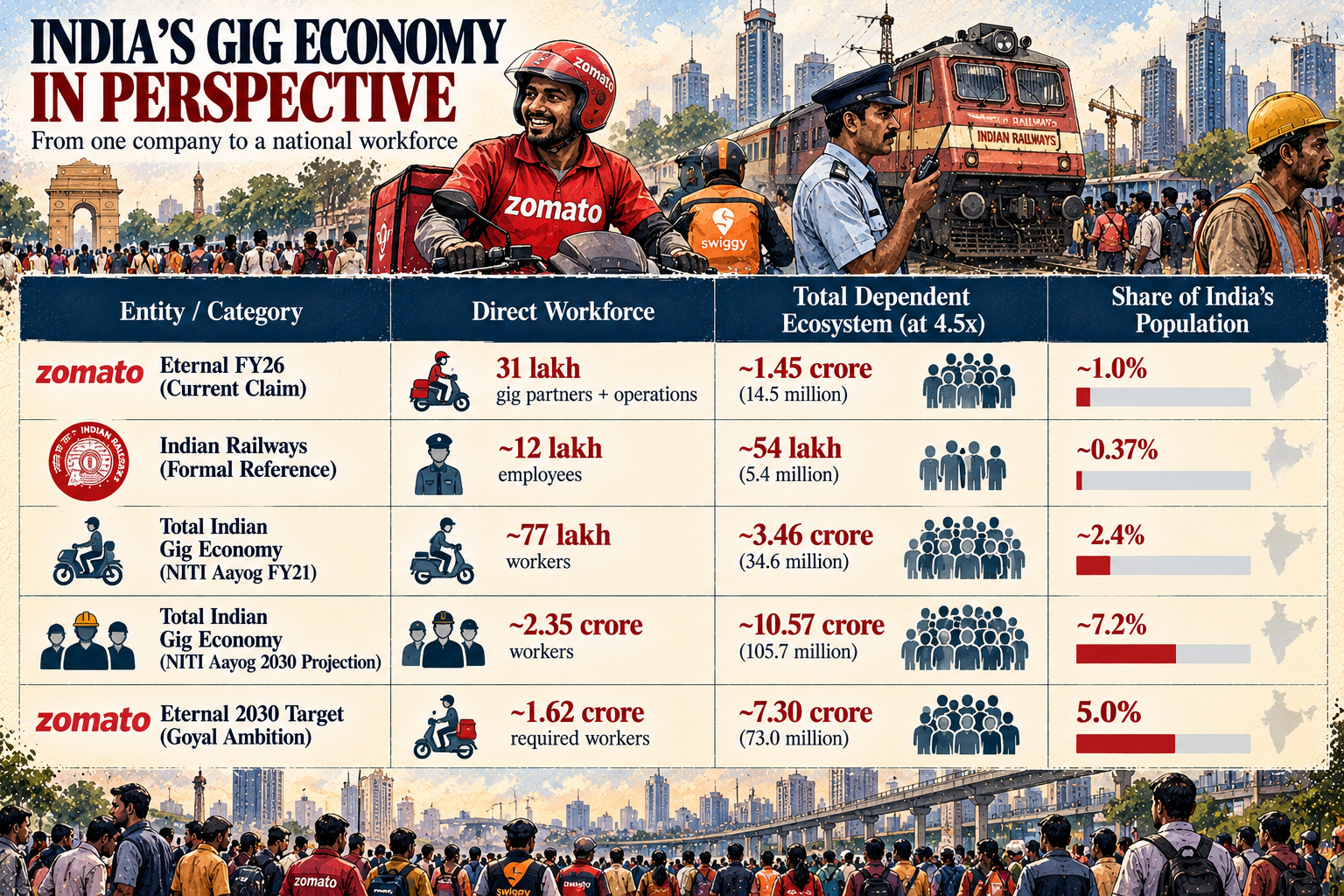
Unless Eternal expands heavily into vast new industrial sectors—such as large-scale contract manufacturing, nationwide agriculture distribution, or healthcare operations—reaching a 5% livelihood share purely through food delivery, quick commerce, and entertainment ticketing is mathematically improbable.
The Unresolved Policy Question: Flexibility Versus Social Security
The wider public reaction to Goyal’s post reflected the central unresolved policy dilemma of modern Indian labour: does the rapid growth of platform work represent productive formalisation, or does it institutionalise precarious informal work?
Platform advocates argue that Zomato and Blinkit have democratised access to immediate, barrier-free earning opportunities. For individuals lacking formal credentials or capital, a smartphone and a two-wheeler provide an instant bridge to income. Furthermore, platforms have introduced accident insurance, maternity benefits for women partners, emergency support funds, and mobile health clinics.
Critics, trade unions, and labour researchers point to structural vulnerabilities:
Absence of Statutory Benefits: Delivery workers are classified as independent contractors rather than statutory employees. They do not receive statutory provident fund (EPF), state healthcare (ESIC), gratuity, paid leave, or minimum wage guarantees.
Asset and Operational Costs: Gig workers absorb the costs of capital depreciation, including vehicle maintenance, tyre wear, smartphone data, and fluctuating fuel prices.
Algorithmic Pressure: Ten-minute delivery promises and algorithmic dispatch systems place intense physical stress on riders navigating congested city traffic.
Regulatory Gridlock: While the central government’s Code on Social Security, 2020 formally recognised platform workers for the first time, comprehensive national implementation has faced delays. Several states, including Rajasthan and Karnataka, have stepped in with standalone platform-worker welfare legislations funded through transaction-level welfare cess.
Evaluating the Milestone
Deepinder Goyal’s disclosure confirms that Eternal has become one of the most powerful job-creation engines in modern corporate India. Onboarding 31 lakh delivery partners in a single year demonstrates remarkable logistical scale and consumer demand.
However, describing this network as "directly supporting the livelihoods" of 1% of the country requires two important caveats: it relies on multiplying gross, high-churn annual registrations by average family sizes, and it counts precarious, part-time gig assignments alongside full, secure livelihoods.
As India's quick-commerce sector matures, the measure of success will not simply be how many millions of riders log in during a 12-month period, but whether the platforms can offer them sustainable earnings, physical safety, and long-term financial security.