In brief
- Ethiopia's landlocked status since 1993 fuels tension; Prime Minister Abiy Ahmed declared Red Sea access an existential matter in October 2023, alarming neighbours.
- A 2024 memorandum with Somaliland for a 20-kilometre coastal lease triggered a diplomatic crisis, drawing Egypt, Eritrea, Somalia and Sudan into a containment coalition.
- In early October 2026 Ethiopia and Eritrea severed diplomatic ties, Eritrean troops entered northern Tigray, and Ethiopian drones struck Eritrean positions near Adigrat.
- Ethiopia lacks the capacity for a full invasion due to internal insurgencies and economic crisis, but warns border clashes could spark a wider regional war.
Over the past three years, few geopolitical questions in the Horn of Africa have provoked as much alarm as whether Ethiopia intends to break its landlocked status by force. Prime Minister Abiy Ahmed placed the issue at the centre of regional politics in October 2023 when he delivered a televised address to parliament, declaring that sovereign access to the Red Sea was an "existential matter" for Ethiopia and warning that a nation of more than 120 million people—projected to reach 150 million within a generation—could not remain confined to a "geographic prison".
To neighbours with coastlines, particularly Eritrea, the implication was unmistakable: Ethiopia was laying the ideological groundwork to seize an outlet to the sea, with the historic port of Assab as the primary target.
Yet in October 2026, the prospect of an Ethiopian conventional invasion of Eritrea looks very different from the rhetoric that sparked the panic. While bellicose posturing continues in Addis Ababa, the military reality on the ground has shifted dramatically. Ethiopia is not poised on the brink of a victorious foreign conquest; instead, it is militarily overstretched, economically strapped, and diplomatically isolated.
Rather than Ethiopian columns marching north, early October 2026 has witnessed the total collapse of bilateral diplomatic ties, the formation of a four-nation regional coalition designed to contain Ethiopia, and the cross-border movement of Eritrean troops into northern Tigray, met by Ethiopian drone strikes.
To understand how the Horn arrived at this precipice, one must examine the bitter history of separation, the brief and deceptive peace of 2018, the fallout from the Tigray war, and the combustible balance of forces today.
1. The Roots of Separation: How Ethiopia Became Landlocked
Ethiopia’s maritime grievance is rooted in modern colonial and post-colonial cartography. For centuries, the Ethiopian highland empires traded through coastal ports along the Red Sea, though control over the littoral was contested by local sultanates, the Ottoman Empire, and European powers.
In the late nineteenth century, Italy established the colony of Eritrea along the Red Sea coast. Following Italy’s defeat in the Second World War, the United Nations federated Eritrea with Ethiopia in 1952 under Emperor Haile Selassie. A decade later, in 1962, Selassie dissolved the federation and formally annexed Eritrea as Ethiopia's fourteenth province.
That annexation ignited a thirty-year armed struggle for independence, spearheaded primarily by the Eritrean People's Liberation Front (EPLF), led by Isaias Afwerki. In the 1970s and 1980s, the EPLF formed a battlefield alliance with the Tigray People's Liberation Front (TPLF), led by Meles Zenawi, which was fighting to overthrow the Marxist military dictatorship (the Derg) in Addis Ababa.
In May 1991, the two rebel movements triumphed: the EPLF liberated Asmara, while the TPLF-led coalition captured Addis Ababa.
Two years later, in April 1993, Eritreans voted overwhelmingly—99.8% in favour—for independence in a UN-monitored referendum. Eritrea formally declared independence on 24 May 1993.
The decision left Ethiopia as the most populous landlocked country on earth. At the time, relations between Meles and Isaias were fraternal. Ethiopia retained duty-free access to the Eritrean ports of Massawa and Assab, the Ethiopian Birr remained the common currency, and the border was left loosely administered.
The arrangement unravelled quickly. Economic frictions emerged in 1997 when Eritrea introduced its own currency, the Nakfa, prompting Ethiopia to demand that cross-border trade be settled in hard foreign currency. Minor, ill-defined territorial claims—most notably around the dusty border town of Badme—metastasized into full-scale confrontation.
2. From the Badme Bloodbath to 'No War, No Peace' (1998–2018)
In May 1998, skirmishes around Badme escalated into the Ethiopian–Eritrean War. Between 1998 and 2000, two of the world's poorest nations fought a First World War-style conflict featuring trench warfare, human-wave infantry charges, and intense artillery barrages. An estimated 70,000 to 100,000 soldiers were killed, and hundreds of thousands of civilians were displaced.
Ethiopia immediately ceased using Assab and Massawa, rerouting virtually all its maritime import and export traffic through the port of neighbouring Djibouti—an arrangement that continues to cost Addis Ababa between $1.5 billion and $2 billion annually in port fees.
The war ended in December 2000 with the signing of the Algiers Agreement. The accord established the Eritrea-Ethiopia Boundary Commission (EEBC), hosted at the Permanent Court of Arbitration in The Hague, whose decisions both sides agreed in advance would be "final and binding".
In April 2002, the EEBC delivered its ruling: it awarded the symbolic epicentre of the war, Badme, to Eritrea.
Citing local political survival and Tigrayan outrage, the TPLF-dominated Ethiopian government refused to withdraw its military from Badme without prior conditions and negotiations. Asmara refused any compromise on a binding international ruling.
The result was a sixteen-year frozen conflict known as "no war, no peace". Isaias Afwerki used the Ethiopian refusal to vacate sovereign territory as justification to turn Eritrea into a heavily militarised, closed garrison state, instituting mandatory, indefinite national service for all young citizens. Both capitals waged proxy wars against each other, financing and hosting armed rebel groups across Somalia, Sudan, and regional borderlands.
3. The 2018 Rapprochement: A Peace Built on Shared Enmity
The deadlock broke unexpectedly in April 2018, when widespread popular protests propelled Abiy Ahmed to the premiership in Addis Ababa, sidelining the TPLF from federal power.
Three months later, in July 2018, Abiy flew to Asmara. In scenes of jubilation, Abiy and Isaias embraced, re-established telecommunications and flights, and declared an end to the state of war. Crucially, Abiy announced that Ethiopia accepted the EEBC’s Algiers ruling without preconditions. The diplomatic breakthrough earned Abiy the 2019 Nobel Peace Prize.
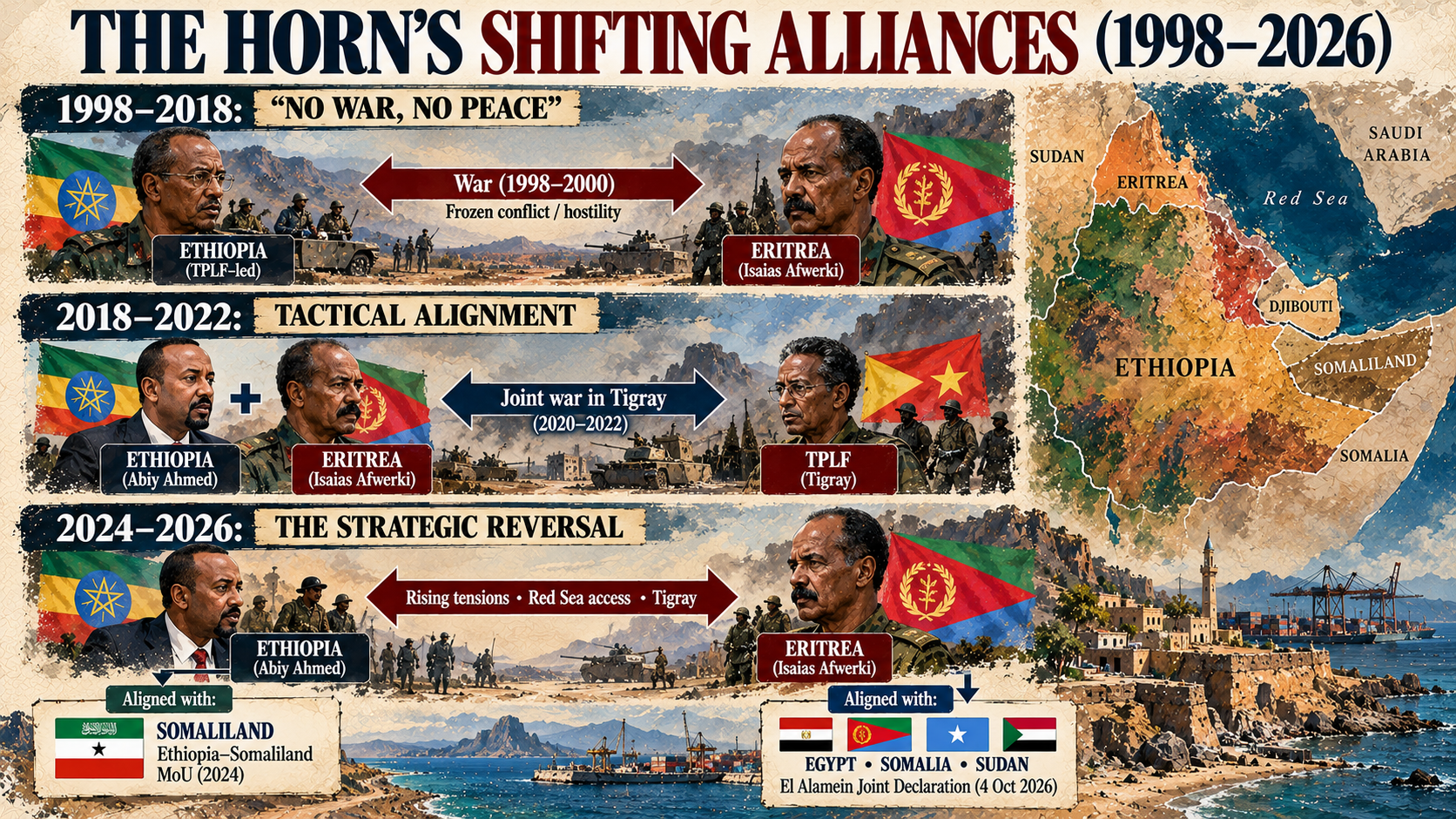
However, international observers soon recognized that the peace pact was less an embrace of institutional integration than a tactical military alliance between two strongmen united against a common adversary: the TPLF, which had retreated to its home region of Tigray.
When civil war erupted in Tigray in November 2020 between the federal government and the TPLF, the Eritrean Defence Forces (EDF) crossed the border in force. Operating alongside the ENDF and Amhara regional forces, Eritrean troops engaged in brutal counter-insurgency operations throughout Tigray, committing documented atrocities against civilians in places like Axum.
The alliance collapsed with the signing of the Pretoria Agreement on 2 November 2022. Brokered by the African Union, the Permanent Cessation of Hostilities Agreement brought an end to the active fighting between the Ethiopian federal government and the TPLF.
Eritrea was neither invited to the negotiations nor a signatory to the text. President Isaias viewed the survival of the TPLF as a political entity—and Abiy’s willingness to make peace with their mutual foe—as a strategic betrayal. The EDF refused to fully withdraw from several border pockets in northern and western Tigray, leaving relations between Addis Ababa and Asmara deeply embittered.
4. The Red Sea Obsession and the Somaliland Gambit (2023–2024)
Deprived of an external war to unify a fracturing nation, Abiy pivoted to maritime irredentism. In October 2023, he initiated a public campaign claiming that Ethiopia's landlocked status was an artificial historical injustice that endangered national survival. Ethiopian state television broadcast lectures arguing that access to the sea was a natural right, explicitly citing the historical links between the ancient Aksumite Empire and the Red Sea, as well as the proximity of Assab.
The reaction from the region was immediate and hostile. Eritrea, Djibouti, and Somalia condemned the rhetoric as a violation of territorial sovereignty. Analysts warned that attempting to take Assab by force would violate the core tenets of the African Union’s Constitutive Act regarding the sanctity of inherited colonial borders.
Blocked on the Eritrean front, Abiy sought a dramatic flank. On 1 January 2024, Ethiopia signed a Memorandum of Understanding (MoU) with the self-declared Republic of Somaliland. Under the deal, Somaliland agreed to lease 20 kilometres (12 miles) of coastline around the Gulf of Aden for 50 years to host a commercial port and an Ethiopian naval base. In return, Ethiopia agreed to conduct an "in-depth evaluation" toward formally recognizing Somaliland's independence—a move that would make Ethiopia the first UN member state to do so.
The Somaliland MoU set off a diplomatic firestorm. The Federal Government of Somalia viewed the deal as an annexationist assault on its territorial integrity. Seeking counterweights, Mogadishu immediately allied with Cairo, which has been locked in a bitter decade-long dispute with Addis Ababa over the filling and operation of the Grand Ethiopian Renaissance Dam (GERD) on the Blue Nile.
Egypt rapidly deepened defence cooperation with Somalia, airlifting military hardware and offering thousands of troops to replace Ethiopian peacekeepers in Somalia. Eritrea, seeing an opportunity to encircle Abiy, threw its full weight behind the Somali–Egyptian axis.
5. Can Ethiopia Actually Invade Eritrea? The Military Balance
When assessing whether Ethiopia is "preparing to invade Eritrea", one must distinguish between political rhetoric and operational capability. A conventional Ethiopian assault aimed at annexing Assab or forcing regime change in Asmara faces near-insurmountable obstacles.
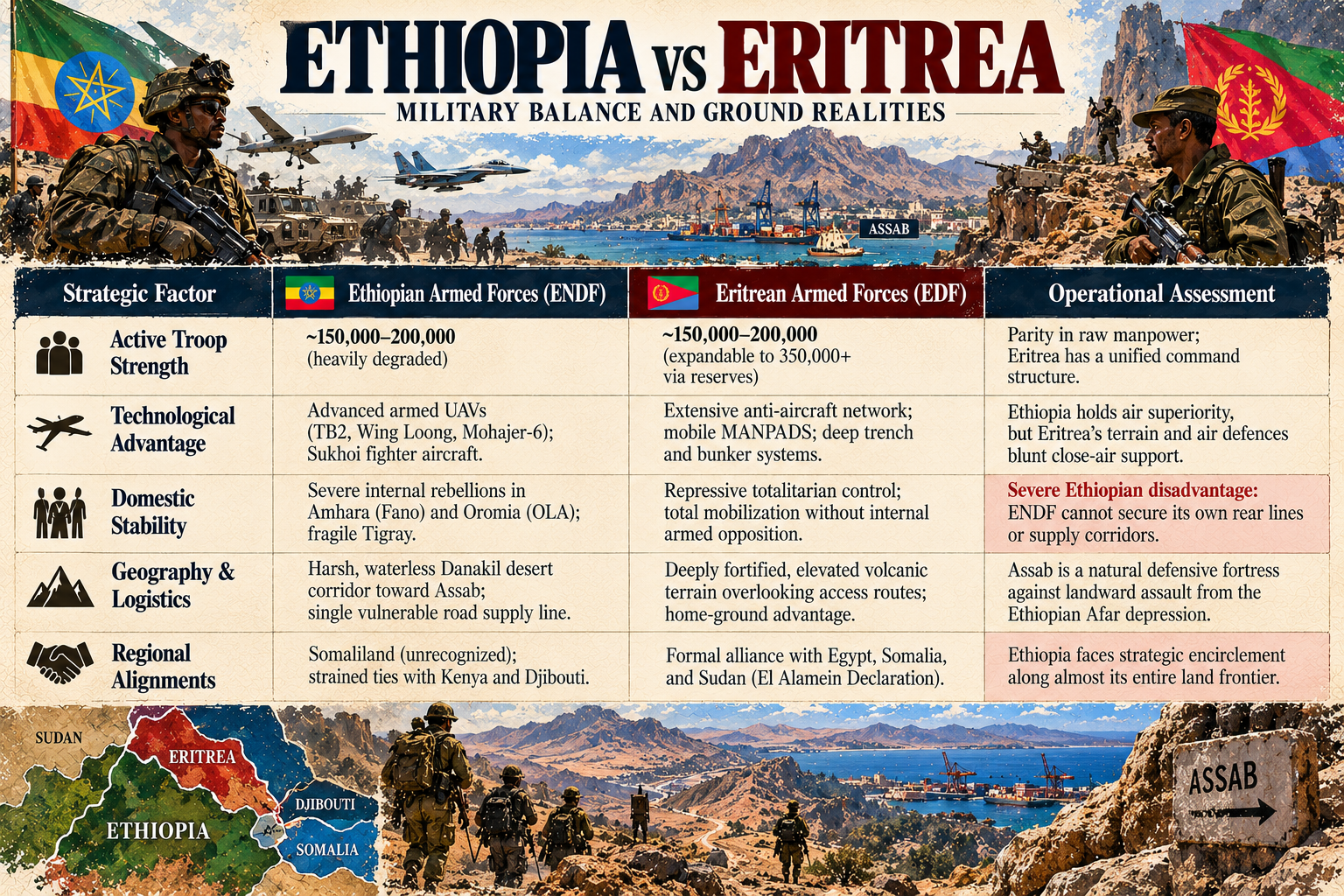
Operational Bottlenecks for Addis Ababa
The Danakil Chokepoint: To seize the port of Assab, the ENDF would have to advance through the Afar depression and the Danakil desert—one of the hottest and most desolate places on Earth. The terrain provides no natural cover, offers virtually no local water or supply infrastructure, and funnels advancing armor through narrow volcanic passes easily defended by entrenched Eritrean artillery.
Internal Insurgencies: The ENDF is currently fighting for control of its own territory. In the Amhara region, the Fano militia continues to ambush federal convoys and contest urban centres. In Oromia, the Oromo Liberation Army (OLA) operates within dozens of kilometres of Addis Ababa. An army unable to secure its primary domestic highways cannot support an expeditionary invasion across international borders.
The Tigray Corridor: The logical invasion route into the Eritrean heartland lies through Tigray. However, the Tigrayan population and the remnants of the Tigray Defence Forces (TDF) harbour deep grievances against both Abiy and Isaias. While Abiy would need Tigray as a staging ground, Tigrayan leaders have zero incentive to serve as cannon fodder in an Ethiopian federal invasion of Eritrea.
Economic Ruin: Ethiopia is grappling with external debt restructuring, soaring inflation, and severe shortages of foreign currency. A high-intensity conventional war would trigger immediate international sanctions, halt multilateral financial lifelines, and collapse the federal budget.
6. Where Do We Stand Today? The Crisis of October 2026
If Ethiopia is ill-prepared to invade, why does the risk of war feel more immediate than at any point since 2000?
The answer lies in how quickly the crisis has shifted from strategic deterrence to active border clashes and proxy confrontation in the opening days of October 2026.
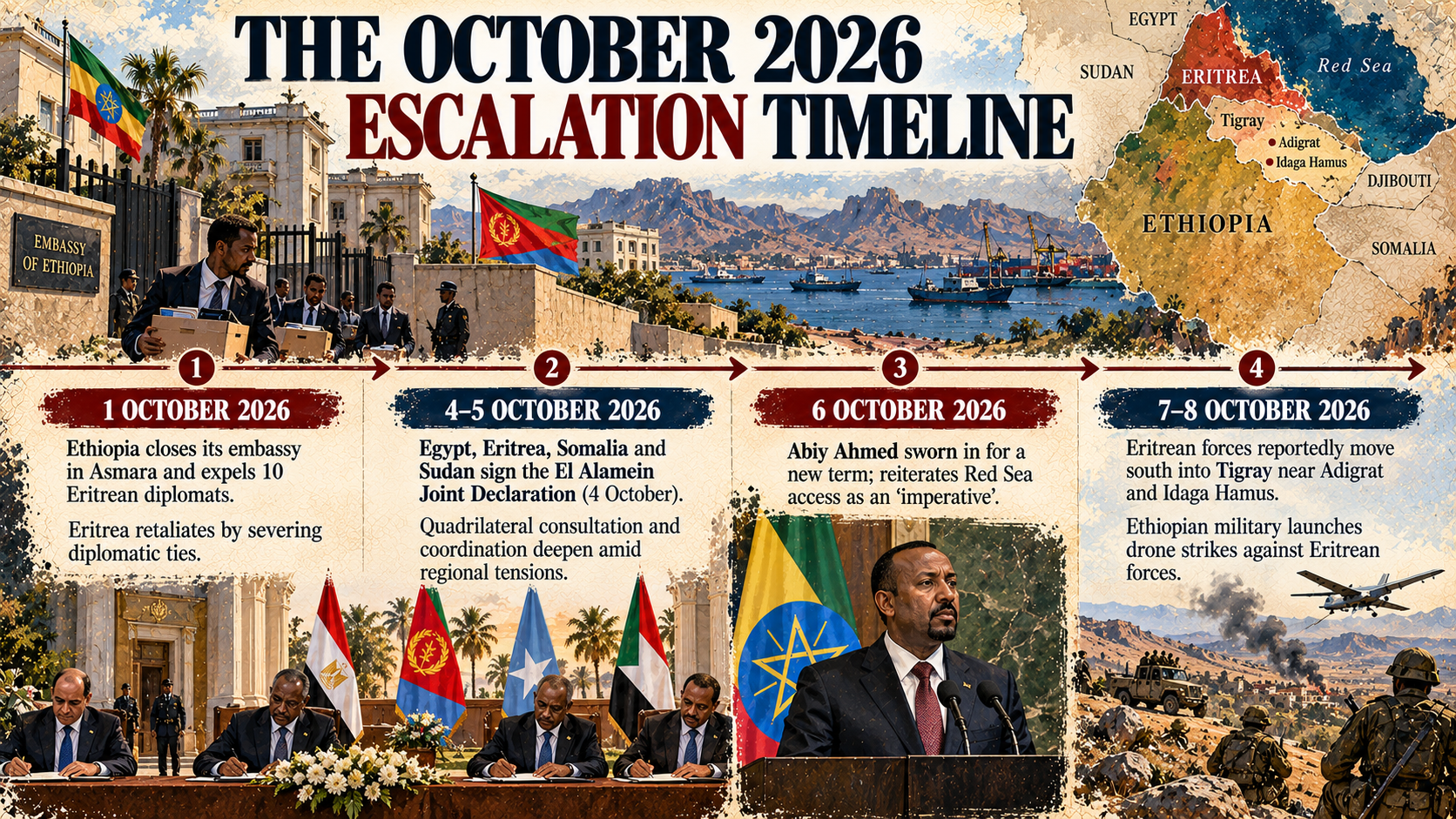
1. Diplomatic Rupture (1 October 2026)
On 1 October 2026, the Ethiopian Ministry of Foreign Affairs announced the immediate closure of its embassy in Asmara, ordering ten Eritrean diplomats to leave the country within 48 hours and citing activities that threatened Ethiopian national security. Eritrea responded within hours by announcing the formal severance of all diplomatic relations, dismantling the diplomatic architecture established during the 2018 peace deal.
2. The El Alamein Quadrilateral Summit (4–5 October 2026)
Three days later, on 4 October, Egyptian President Abdel Fattah el-Sisi hosted Eritrean President Isaias Afwerki, Somali President Hassan Sheikh Mohamud, and Sudanese Sovereign Council leader Abdel Fattah al-Burhan in the coastal city of El Alamein.
The leaders signed the El Alamein Joint Declaration, creating a formal diplomatic and security coordination bloc. The declaration explicitly asserted that governance and security of the Red Sea belong strictly to coastal states—a direct rebuttal to Abiy's maritime claims. The pact unified Ethiopia's primary regional rivals: Egypt (the Nile), Somalia (territorial integrity and Somaliland), Sudan (border tensions at al-Fashaga and regional stability), and Eritrea.
3. Defiance in Addis Ababa (6 October 2026)
Taking the oath of office in Addis Ababa on 6 October 2026 for a renewed five-year term, Abiy Ahmed refused to back down. In his inaugural speech, he insisted that landlocked Ethiopia's right to sea access could not be vetoed by its neighbours, declaring that regional stability was impossible if Ethiopia was denied a sovereign maritime presence.
4. Frontline Clashes and Drone Strikes (7–8 October 2026)
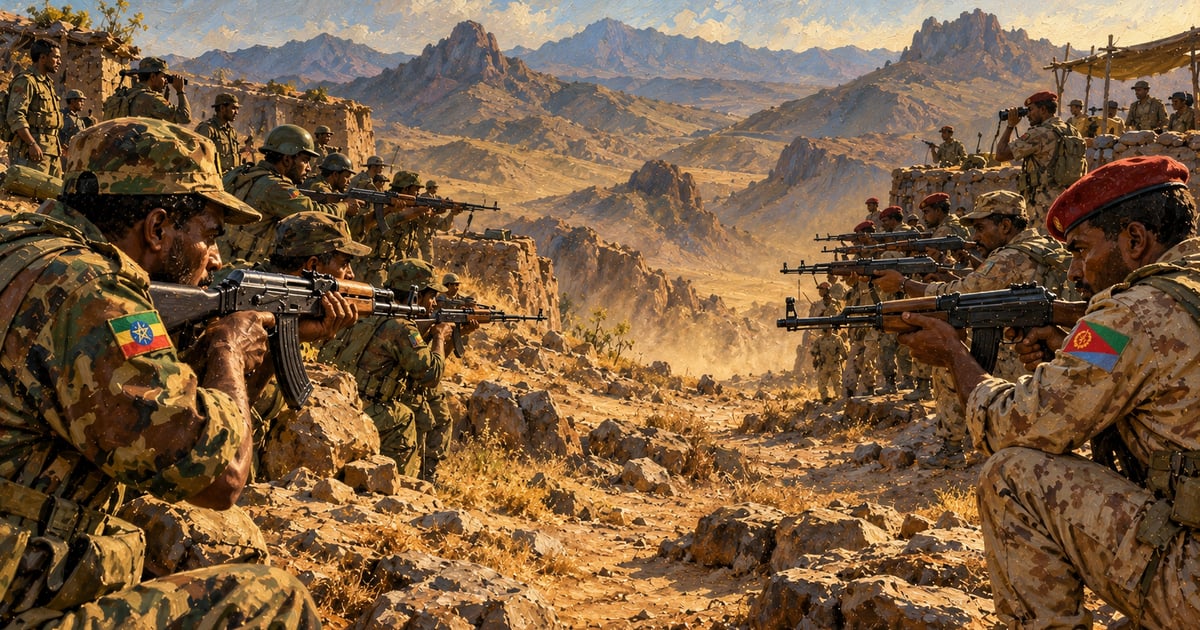
The political confrontation spilled into direct military violence within 24 hours. On 7 October, residents, local officials, and conflict monitors (including ACLED) reported that Eritrean troops and mechanized units had advanced across the northern border into Tigray, moving past historical border lines toward the towns of Adigrat and Idaga Hamus, roughly 40 kilometres (25 miles) south of the frontier.
On 8 October, the Ethiopian military responded by deploying armed combat drones, carrying out precision strikes against Eritrean troop concentrations and supply vehicles outside Adigrat.
7. The Outlook: Not an Invasion, But a Tinderbox
Is Ethiopia preparing to invade Eritrea? The balance of evidence indicates no.
A deliberate, planned invasion to conquer Assab or subjugate Eritrea exceeds Ethiopia's military capabilities, domestic stability, and economic endurance. The narrative of an imminent Ethiopian invasion has functioned primarily as domestic political theatre—a populist rallying cry designed to foster nationalist unity amidst severe internal fracturing.
However, the absence of an invasion plan does not mean peace will prevail. The danger facing the Horn of Africa is not an engineered invasion, but a catastrophic miscalculation.
Eritrea has recognized Ethiopia’s internal vulnerabilities and is actively exploiting them. By coordinating with Egypt and Somalia, hosting Ethiopian dissident factions, and probing southward into Tigray to test federal resolve, Asmara is attempting to weaken Abiy's government from within. Addis Ababa, relying on its drone fleet to police the border, risks striking targets that could draw the full Eritrean army into a retaliatory counter-offensive.
If the localized skirmishes near Adigrat expand into a wider war, it will not be contained between two capitals. With Egyptian forces stationed across the border in Somalia, Sudan fractured by its own civil war, and the Red Sea corridor already disrupted by global maritime friction, an all-out confrontation between Ethiopia and Eritrea would engulf the entire Horn of Africa in a regional conflagration.