In brief
- Federal commandos arrested former BND chief August Hanning, 80, on 6 October 2026 on charges of treasonous espionage, marking the first detention of a former Western foreign intelligence chief for allegedly selling state secrets.
- Prosecutors allege Hanning received roughly 2,000 classified executive summaries from former BND chief of staff Manfred D. between 2010 and 2022 in exchange for regular cash payments, material described as the BND's crown jewels.
- Investigators uncovered the operation accidentally during a probe into a 2024 child abduction case where Hanning was paid over €100,000; financial records show he faced up to €4 million in liabilities from a failed Latvian bank.
- The case follows a 2022 BND division head's arrest for passing secrets to Russia, prompting cross-party demands for bans on private consulting by retired intelligence chiefs and warnings of allied intelligence sharing erosion.
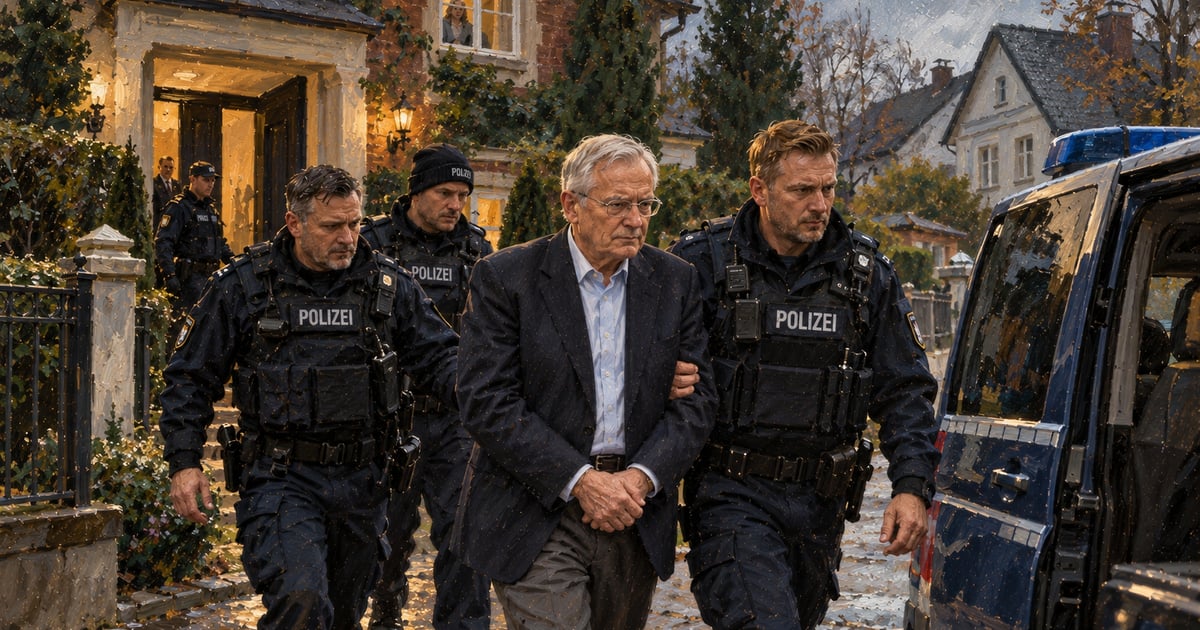
On the morning of Tuesday, 6 October 2026, federal commandos arrived at a red-brick residence in the Westphalian town of Nordwalde to take 80-year-old August Hanning into custody. For seven years, between 1998 and 2005, Hanning directed the Bundesnachrichtendienst (BND), Germany’s foreign intelligence service. Between 2005 and 2009, he served as State Secretary in the Federal Ministry of the Interior, overseeing the country’s entire civilian federal security apparatus under Wolfgang Schäuble.
Hanning is now held in pre-trial detention on warrants issued by the Federal Court of Justice (Bundesgerichtshof) in Karlsruhe, facing charges of treasonous espionage (landesverräterische Ausspähung), the unlawful procurement of state secrets, and attempted treason (versuchter Landesverrat).
The arrest marks the first time in modern Western history that a former foreign intelligence chief has been detained on suspicion of selling state secrets. Observers across Berlin and allied capitals have compared the political shockwave to the 1974 Günter Guillaume affair, in which an East German Stasi operative inside the Federal Chancellery forced the resignation of West German Chancellor Willy Brandt.
The Karlsruhe Indictment: A 12-Year Pipeline of Executive Briefings
According to formal statements released by the Office of the Federal Prosecutor (Generalbundesanwalt), Hanning’s alleged espionage was made possible by an inside source who operated undetected for over a decade.
Simultaneously with Hanning’s detention, federal police arrested his former BND chief of staff, identified under German privacy laws as Manfred D. (64), at his home in Bavaria. Manfred D. is charged with aiding and abetting attempted treason and treasonous espionage.
Prosecutors allege that in the spring of 2010—months after Hanning retired from public service—the two men agreed to establish a continuous pipeline of classified material. Manfred D. remained inside the BND across multiple administrative successions, retaining high-level clearance until his retirement in March 2026.
Between 2010 and June 2022, Manfred D. allegedly spirited roughly 2,000 documents out of the agency and handed them to Hanning in exchange for regular cash payments. The material did not consist of raw field notes; rather, prosecutors state that many files were executive intelligence summaries prepared exclusively for ministerial briefings and the Federal Chancellor.
Former BND Vice-President Arndt Freytag von Loringhoven described this class of material to Der Spiegel as the "crown jewels of the BND"—condensed strategic assessments synthesising human intelligence networks, diplomatic signals, and allied foreign intercepts. Investigative reporting by the Süddeutsche Zeitung revealed that the cache contained assessments of Iran’s nuclear programme, operational deployments of the Russian armed forces, and allied Western intelligence data.
The Accidental Discovery: From Child Custody to Counter-Espionage
Germany’s counter-intelligence units did not uncover the alleged leak through routine internal audits. Instead, investigators stumbled upon the operation during a separate criminal inquiry in Hamburg.
Hamburg prosecutors had been investigating the January 2024 cross-border abduction of two children belonging to steakhouse chain heiress Christina Block and her estranged husband in Denmark. In 2025, investigators established that Block had hired private security contractors—including Hanning and a retired state police investigator—for sums exceeding €100,000 to orchestrate the retrieval, reportedly relying on Hanning’s longstanding operational contacts with Israeli private intelligence figures.
When federal and state police executed search warrants against Hanning’s business premises and digital storage devices in connection with the Block case, they uncovered thousands of internal BND documents that had no connection to child custody disputes. Recognising the sensitivity of the material, Hamburg authorities transferred the files to the Federal Prosecutor’s Office in Karlsruhe, triggering an 18-month counter-espionage probe.
Commercial Pressures and Financial Liabilities
Following his retirement from government in 2009, Hanning established Hanning Consult alongside his wife, Ruth, and took up advisory roles with corporate risk firm System 360. In Berlin policy circles, his credentials opened doors to multinational corporate boards and diplomatic mediation initiatives.
However, financial filings point to substantial personal liabilities in the years preceding his arrest. Hanning held a seat on the supervisory board of Latvian lender PNB Banka alongside former NATO Secretary-General Anders Fogh Rasmussen. In 2019, the European Central Bank declared PNB Banka failing or likely to fail, and Latvian banking regulators closed the institution following extensive money-laundering allegations.
Latvian courts subsequently held the bank's supervisory board members personally liable for unrecovered assets, with claims against Hanning and Rasmussen reaching up to €4 million. As reported by the Austrian daily Kurier, Latvian judicial authorities successfully applied to garnish two-thirds of Hanning’s German civil service retirement pension to satisfy outstanding debts. Prosecutors contend that Hanning sought to offset these mounting financial losses by exploiting his continuous access to state secrets, packaging classified BND reporting into bespoke strategic briefings for high-paying foreign clients.
Who Were the Alleged Clients?
Federal prosecutors have so far declined to identify the overseas intelligence agencies named in the indictment, stating only that Hanning used internal documents to "draft an analysis for an officer of a foreign intelligence service" and maintained contacts with another foreign service over several years.
Reporting by Der Spiegel indicates that investigators are examining connections to the foreign intelligence apparatus of Azerbaijan, where Hanning served on the board of the German-Azerbaijani Forum, as well as business contacts in China. Authorities in Baku issued a formal statement dismissing the allegations as a disinformation campaign intended to damage bilateral relations.
Initial inquiries suggest that Moscow was not the direct client in this instance, despite Hanning’s previous consulting work with Russian industrial entities, including ties to figures connected to oligarch Oleg Deripaska.
The Defence: Admission of Possession, Denial of Treason
Following a preliminary detention hearing at the Federal Court of Justice in Karlsruhe on 7 October 2026, the presiding judge ordered Hanning remanded to pre-trial custody.
Hanning’s defence counsel provided a detailed public response to the German daily Die Welt:
"While it is true that he was in possession of confidential documents, the allegation that he passed on information contained therein to the detriment of Germany, let alone for payment, is incorrect."
The legal strategy rests on distinguishing between the unlawful retention of classified administrative records and the statutory definition of high treason under Section 94 of the German Criminal Code (Strafgesetzbuch). Under German law, high treason requires proof that state secrets were communicated to an external power, resulting in a demonstrable risk of grave harm to the foreign security or defence interests of the Federal Republic. If convicted of treasonous espionage, Hanning faces a custodial sentence ranging from one to ten years, with life imprisonment reserved for exceptionally severe cases.
Systemic Ramifications for German and Allied Intelligence
The arrest compounds a series of security crises for the BND. In December 2022, federal authorities arrested BND division head Carsten Linke on charges of high treason for passing classified signals intelligence regarding the war in Ukraine to Russia’s Federal Security Service (FSB).
Coming on the heels of the Linke case, Hanning’s arrest strikes at the leadership level. Luca Manns, managing director of the Intelligence Services Research Unit at the University of Cologne, described the incident to The Guardian as a "stab to the heart" of Germany’s foreign intelligence credibility, warning of an erosion of information sharing among Five Eyes and NATO partners. Western officials confirmed to news agencies that the compromised material included shared intelligence originating from allied services, including the United States.
In the Bundestag, the scandal has unified lawmakers across the political spectrum behind urgent regulatory reform:
Marc Henrichmann (CDU), chairman of the parliamentary intelligence oversight committee (Parlamentarisches Kontrollgremium), stated to news agencies that anyone who allies themselves with adversaries would be identified, declaring that Hanning’s alleged actions amounted to "trampling his official duties underfoot."
Konstantin von Notz (Greens), deputy head of the oversight committee, warned of a collapse in international partner trust, demanding an immediate ban on private lobbying and commercial security consulting for retired intelligence chiefs.
Martin Jäger, the current President of the BND, insisted in comments to the Rheinische Post that the service conducted comprehensive internal investigations prior to the federal arrests, affirming that "there are no compromises when it comes to internal security."
The case exposes a long-standing vulnerability in Germany’s civil service framework: while active intelligence personnel face strict background monitoring, senior executives transitioning to private risk advisory firms have operated under minimal post-retirement oversight. With parliamentary committees preparing inquiries, the trial of August Hanning will test not only the culpability of a former spymaster, but the integrity of Germany's intelligence governance.