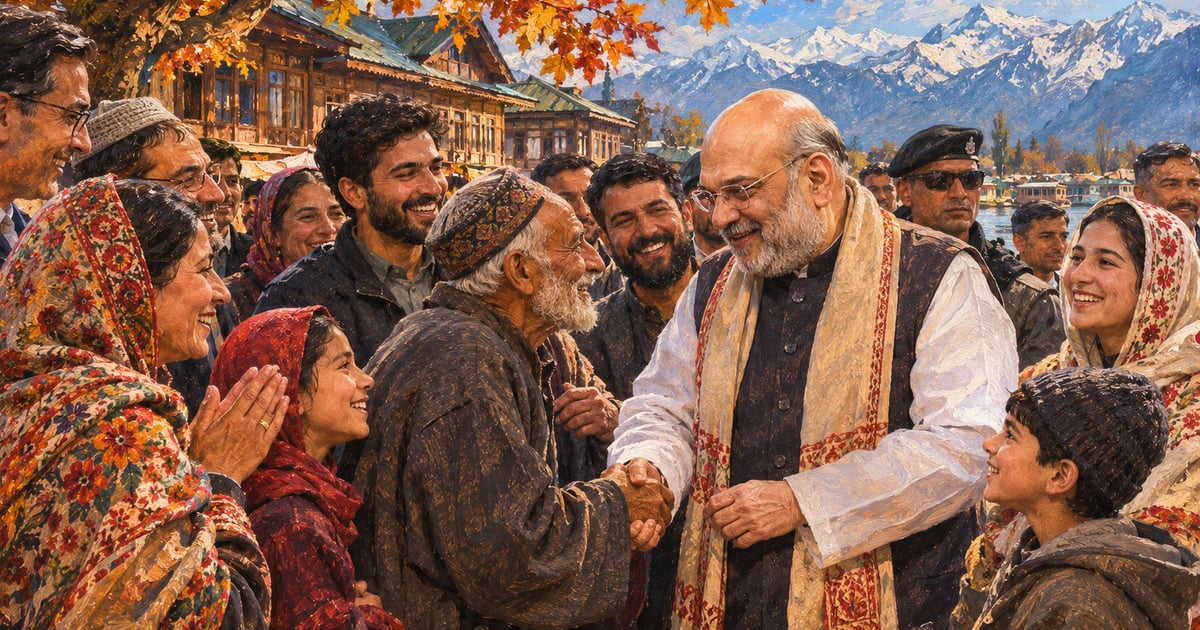
In brief
- Kashmir is reportedly free of locally recruited India-born terrorists for the first time in 35 years after the elimination of Lashkar-e-Taiba operative Mohammad Lateef Bhat in Kulgam, and only two local youths joined LeT during that period.
- Security forces cornered Bhat in South Kashmir’s Kulgam district in the early hours of 18 November 2026, following an attack on CRPF personnel on 11 November.
- Union Home Minister Amit Shah announced on 19 November 2026 at an Anti-Terror Conference in New Delhi that Kashmir is free of locally recruited, India-born terrorists for the first time in 35 years, based on Bhat’s elimination.
- Local recruitment had been a backbone for militant groups in the Kashmir Valley, with numbers rising after 2019 and then shrinking to zero within twenty months, according to security assessments cited in the article.
In the early hours of 18 November 2026, a joint team of the Jammu and Kashmir Police (JKP), Indian Army, Central Reserve Police Force (CRPF), and intelligence agencies cornered Lashkar-e-Taiba (LeT) operative Mohammad Lateef Bhat in South Kashmir’s Kulgam district (DD News). Bhat, a resident of Khrewan in Kulgam carrying a ₹15 lakh cash reward (approximately $17,600 at ₹85 to the US dollar), had been involved in an attack on CRPF personnel on 11 November alongside his associate Umar Nisar Dar, who was neutralised two days earlier on 17 November (The Hindu, DD News).
When Bhat fell outside a Kulgam mosque—security forces having exercised restraint to ensure no structural damage to the religious site—the encounter closed a 35-year chapter in India’s internal security history (DD News). Speaking at the passing-out parade at the Sher-i-Kashmir Police Academy in Udhampur later that day, J&K Director General of Police (DGP) Nalin Prabhat confirmed that local terrorist recruitment across the Union Territory had been brought down to "almost zero" over the preceding two years, with only two local youths joining LeT during that window—Dar and Bhat (DD News).
On 19 November 2026, inaugurating the annual two-day Anti-Terror Conference in New Delhi, Union Home Minister Amit Shah stated that with Bhat’s elimination, Kashmir is free of locally recruited, India-born terrorists for the first time in 35 years (Hindustan Times, Times of India).
The announcement echoed a similar milestone achieved earlier in 2026 on India’s eastern and central internal security front. In August 2024, Amit Shah had set a public deadline of 31 March 2026 to eradicate Left-Wing Extremism (Naxalism)—an armed insurgency that once spanned 126 districts and recorded 1,936 violent incidents in 2010 (PIB). By saturating forest vacuums with 663 fortified police stations and 408 Central Armed Police Force camps, choking Maoist finances through a dedicated National Investigation Agency (NIA) vertical, pairing surrender grants of up to ₹5 lakh with welfare delivery, and executing precision operations, the Ministry of Home Affairs (MHA) met its March 2026 target, reducing LWE-affected districts to zero (PIB).
In Jammu and Kashmir, however, the challenge was fundamentally different. Unlike domestic Maoism, terrorism in the Union Territory has been sustained for over three decades by Pakistan-sponsored cross-border infiltration, proxy outfits, and separatist funding networks. Ending homegrown recruitment there required adapting that ecosystem-dismantling discipline to a hostile border environment.
From 219 Recruits to Zero: Tracking the Collapse in Kashmir
For decades after Pakistan-backed militancy erupted in 1989, local recruitment served as the operational backbone of terrorist groups in the Kashmir Valley. Local operatives provided terrain familiarity, safe houses, reconnaissance, and a domestic propaganda cover for handlers across the Line of Control (LoC). In 2018, before the constitutional reorganisation of Jammu and Kashmir, roughly 219 local youths joined terrorist ranks (Drishti IAS). Following the abrogation of Article 370 in August 2019, Pakistan-based handlers pushed aggressively to sustain local insurgency, and recruitment ticked up briefly from 143 in 2019 to 166 in 2020 (ORF).
From 2021 onwards, the local recruitment pipeline collapsed under sustained multi-agency pressure:
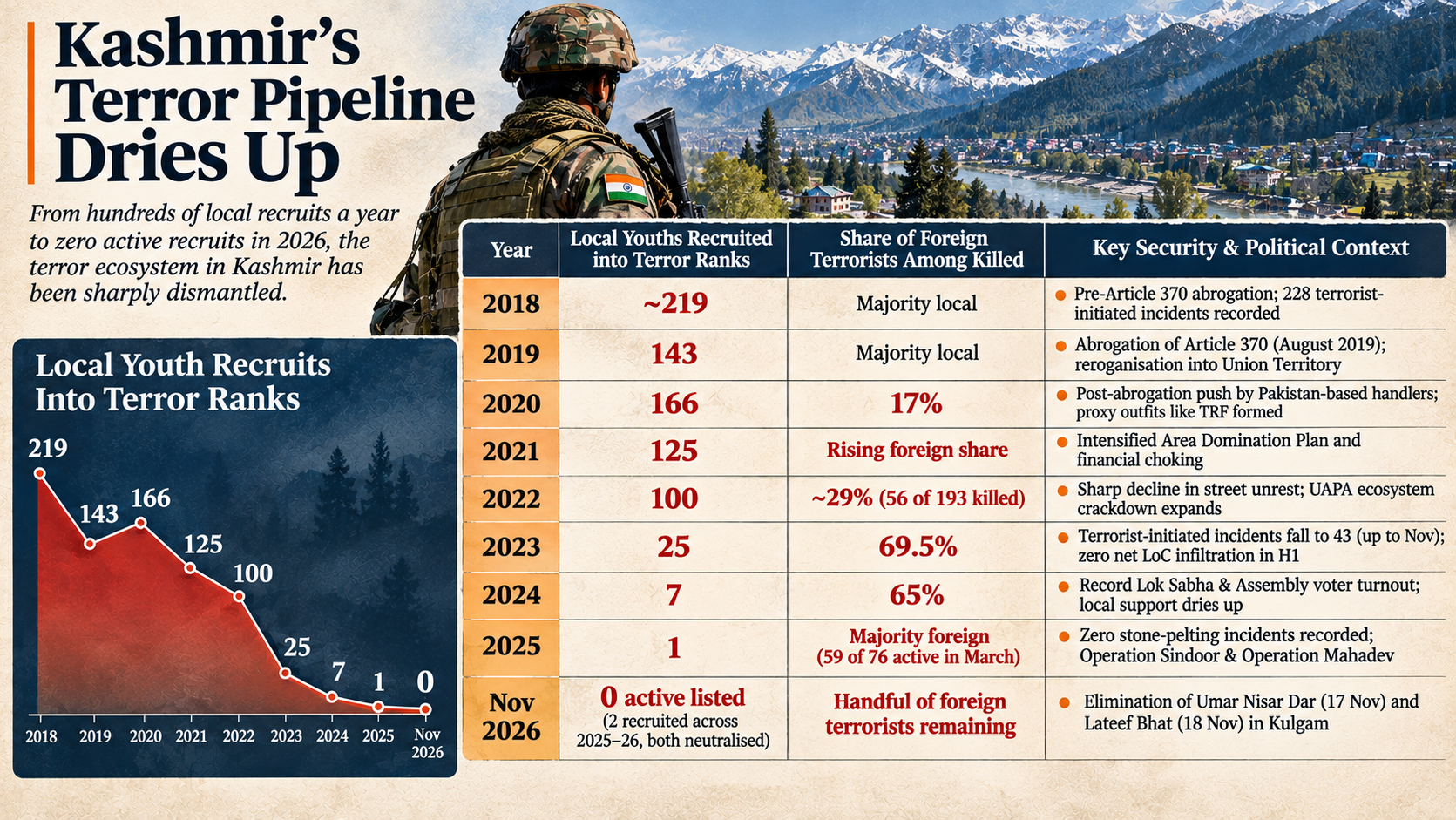
Sources: ORF (October 2026), Drishti IAS, PIB (Dec 2023), Times of India, DD News.
By March 2025, security agencies estimated that out of 76 active terrorists in Jammu and Kashmir, 59 were Pakistani nationals and only 17 were locals (ORF). Within twenty months, that local cohort shrank to zero. Over the broader ten-year arc cited by the MHA, total terrorist attacks in Jammu and Kashmir fell from 7,217 during 2004–2014 to 2,197 during 2014–2024, while combined fatalities among security personnel and civilians dropped from 2,829 to 891 (ECRATS).
Pillar 1: Constitutional Integration and Legal Clarity
The political and legal foundation for dismantling local militancy was laid on 5 August 2019, when Parliament abrogated Article 370 and reorganised the former state into the Union Territory of Jammu and Kashmir. Bringing the Union Territory under uniform central laws removed the legal and administrative insulation that separatist networks had long exploited (Drishti IAS).
Following the constitutional integration, the MHA moved systematically to ban proxy and virtual terrorist fronts—including The Resistance Front (TRF), People’s Anti-Fascist Front (PAFF), Tehreek-ul-Mujahideen, Jammu-Kashmir Ghaznavi Force, and Hizb-ul-Tahrir—closing the loophole whereby Pakistan-backed outfits rebranded themselves under secular-sounding names to evade international scrutiny (PIB).
Equally decisive was a shift in political engagement. As Amit Shah stated in Parliament in July 2025, the Union government formally ruled out talks with separatist conglomerates such as the Hurriyat Conference—characterising them as fronts for terrorist organisations—and instead directed institutional outreach towards elected local representatives and the youth of the Valley (PIB).
Pillar 2: Mission-Mode Synergy Under the "Zero Terror Plan"
Between 2024 and 2026, Amit Shah chaired a series of high-level security review meetings in New Delhi and Srinagar bringing together the Union Home Secretary, Intelligence Bureau Director, Army Chief, CRPF leadership, J&K Lieutenant Governor Manoj Sinha, and J&K Police (PIB, DD News). These reviews mandated the mission-mode execution of two overlapping operational frameworks: the Area Domination Plan and the Zero Terror Plan (PIB).
In practice, this meant eliminating institutional friction between central forces and local policing. Rather than reactive cordon-and-search sweeps after an attack, the JKP, Indian Army, CRPF, and central intelligence agencies operated on real-time shared intelligence grids. The November 2026 Kulgam operations demonstrated how tightly that sensor-to-shooter loop had been compressed: CCTV footage captured Umar Nisar Dar and Lateef Bhat conducting reconnaissance on 10 November across Mir Baar, Akhran, Hablish, and Kilam ahead of their 11 November attack on CRPF personnel (DD News). Within a week, intelligence-led encirclements eliminated Dar on 17 November and Bhat on 18 November.
At the same time, specialised wings such as Counter Intelligence Kashmir (CIK) targeted the digital recruitment pipeline directly, conducting multi-district raids—such as the 10-location sweep in March 2026—to dismantle online radicalisation modules before recruits could ever pick up weapons (The Hindu).
Pillar 3: Choking the Terror Ecosystem Inside and Outside Government
Killing armed operatives alone has rarely ended an insurgency if their logistical and financial support networks remain intact. In Jammu and Kashmir, the MHA and Lieutenant Governor’s administration attacked the Over Ground Worker (OGW) and financing ecosystem across three simultaneous fronts:
UAPA Arrests and Asset Attachments: On 18 November 2026, DGP Nalin Prabhat disclosed that J&K Police arrested 240 accused under the Unlawful Activities (Prevention) Act in 2025, followed by 210 arrests in 2026 (up to mid-November), targeting financial and logistical facilitators (DD News). Over the same period, authorities attached 155 properties linked to terrorists and their handlers in 2025 and 122 properties in 2026, including assets belonging to terrorists operating from Pakistan (DD News).
Terror-Financing Prosecutions: Prior to 2014, formal terror-financing prosecutions in J&K were virtually non-existent. Under the post-2019 crackdown, central and UT agencies registered 32 dedicated terror-financing cases, made 229 arrests, and confiscated assets worth ₹150 crore (approximately $17.6 million) (ECRATS). Disrupting hawala channels and cross-border cash flows cut off the stipends that once funded stone-pelting and local recruitment (ORF).
Purging Sympathisers from the State Payroll: Invoking Article 311(2)(c) of the Constitution—which allows the dismissal of government employees without a departmental inquiry in the interest of national security—Lieutenant Governor Manoj Sinha’s administration terminated around 86 government employees with verified terror links between 2020 and November 2026 (The Hindu). This included police constables, school teachers, health department staff, and medical college personnel—five of whom were dismissed as recently as 17–18 November 2026 for providing arms logistics and intelligence to handlers in Pakistan (Akashvani, Akashvani).
Pillar 4: Cross-Border Deterrence and Economic Mainstreaming
Internal policing was paired with external deterrence and tangible economic stakes for ordinary residents. When Pakistan-backed terrorists attacked tourists in Pahalgam in April 2025, India launched Operation Sindoor to strike terrorist camps and infrastructure across the border, followed by Operation Mahadev, in which joint Army, CRPF, and J&K Police teams neutralised all three Pahalgam attackers—Suleman alias Faizal Jatt, Hamza Afghani, and Zibran (PIB).
Inside the Valley, the restoration of street order fundamentally altered civilian incentives:
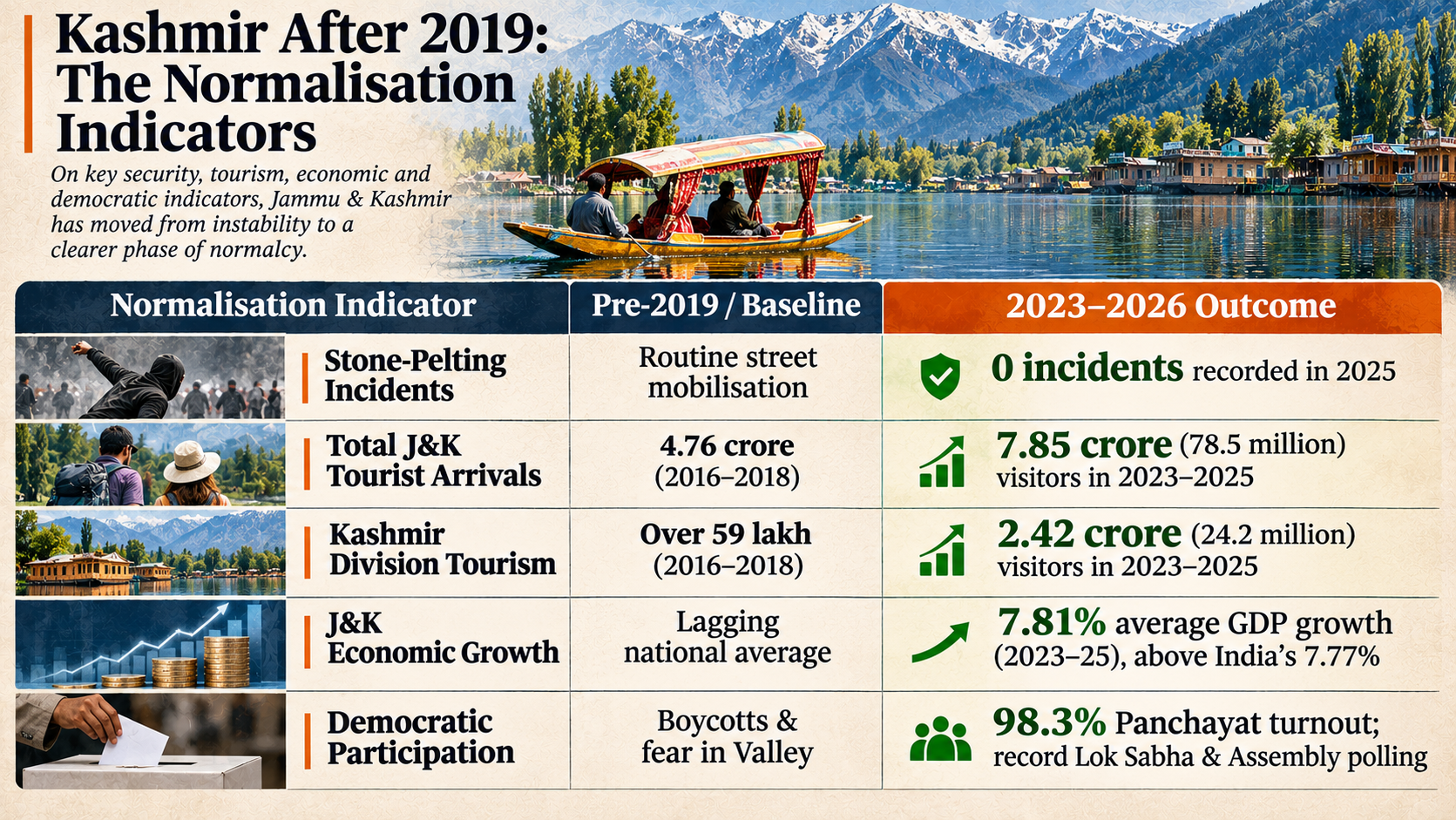
Although the April 2025 Pahalgam attack temporarily depressed Kashmir division footfall from over 98 lakh visitors in 2024 to over 47 lakh in 2025, the broader post-2019 tourism boom—alongside uninterrupted schooling and commercial activity—created a visible economic dividend that eroded the appeal of separatist shutdowns (Akashvani).
What Remains Unfinished: Foreign Terrorists and the Jammu Front
Achieving zero active homegrown terrorists is a structural milestone, not the end of all security threats in Jammu and Kashmir. Both Amit Shah and Lieutenant Governor Manoj Sinha explicitly cautioned in November 2026 that a "handful of foreign terrorists" remain active in the Union Territory (Hindustan Times, State Times).
Security assessments highlight three evolving tactics that India’s security apparatus must now contain:
The Shift South of the Pir Panjal: As dense security grids closed down the Kashmir Valley, Pakistan-based handlers pushed foreign terrorists into the forested, mountainous terrain of the Jammu division—including Rajouri, Poonch, Doda, Kishtwar, and Reasi (ACLED). Between 2021 and 2024, attacks in the Jammu division accounted for 40% of all security personnel killed in the Union Territory, prompting Amit Shah to order the replication of the Valley’s Area Domination Plan across Jammu in June 2024 (Crisis Group, Hindustan Times).
Narcoterrorism Financing: With hawala and formal cash transfers disrupted, Pakistan’s Inter-Services Intelligence (ISI) and terror groups have pivoted towards smuggling heroin and narcotics across land and sea routes to finance residual operations (ORF).
Hybrid and Online Radicalisation: Deprived of local forest-based cadres, handlers across the LoC increasingly attempt to radicalise isolated individuals digitally via encrypted applications for targeted attacks on soft targets, such as migrant workers and tourists (ORF).
This explains why the Anti-Terror Conference in New Delhi on 19–20 November 2026 focused heavily on cross-border terrorism, narcotics-terror linkages, and digital forensics (Jammu Bulletin). By drying up local recruitment in Kashmir and eliminating the last listed homegrown operative, India has stripped Pakistan-sponsored terrorism of its domestic cover and local logistical base—shifting the final phase of the campaign to sealing the border and neutralising the remaining foreign infiltrators.