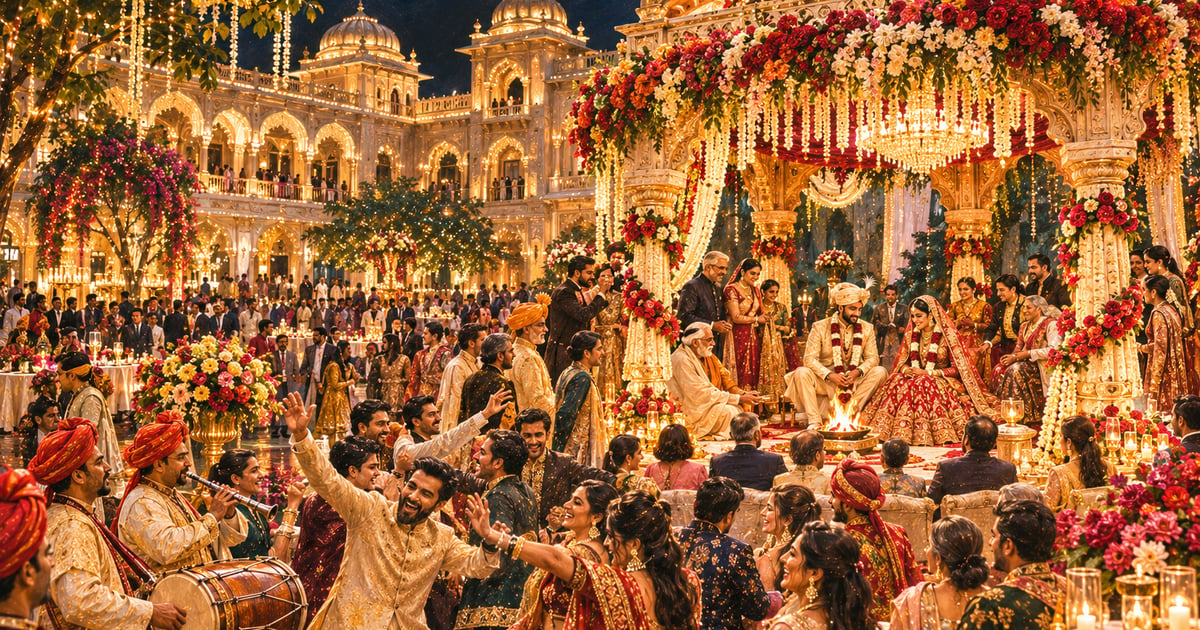
In brief
- India’s wedding economy hits about $130 billion annually (roughly ₹10.7–12.2 lakh crore), making it the second-largest spend after food/groceries and bigger than the US wedding market.
- One season (2025 baseline) saw ~46 lakh weddings across 44 days, spending ~₹6.5 lakh crore and supporting millions of jobs; Delhi drives a large share of the seasonal trade.
- Average wedding cost around ₹12 lakh; a single wedding can equal multiple times GDP per capita and far exceed typical schooling costs.
- Destination weddings rising: ~25% of weddings are destinations (mostly domestic), with ₹2.5 lakh crore domestic destination market growing ~35% annually. Most couples use savings; some borrow (~₹15.5 lakh loan on average).
On Friday, 20 November 2026, Dev Uthani Ekadashi marks the end of the four-month Chaturmas pause for most Indian households (with Vaishnava traditions observing it on 21 November), and the season’s first muhurat opens on Saturday, 21 November 2026 (Devpunya; Drik Panchang). Over the next four months—paused briefly during Kharmas from mid-December to mid-January—India’s most concentrated consumer-spending cycle will swing into motion (TJORI).
No government ministry compiles an official wedding census (Panigrahana). Yet triangulating brokerage models, trader surveys across 75 cities, and platform ledgers reveals an economy of startling scale: US$130 billion (roughly ₹10.7 lakh crore at 2024 exchange rates, or ₹12.2 lakh crore at mid-November 2026 rates) in annual expenditure—second in India only to food and groceries, and nearly twice the size of the United States wedding market (ThePrint; The Hindu).
Annual Scale vs. The Six-Week Winter Surge
Public commentary frequently mixes up India’s full-year wedding market with its six-week November–December retail blitz. Keeping the two ledgers separate clarifies how front-loaded the calendar really is.
Jefferies estimates 80 lakh to 1 crore (8–10 million) weddings take place across India each year, while the World Gold Council puts the annual range at 1.1 crore to 1.3 crore (11–13 million) (ThePrint; Panigrahana). Studio booking records compiled by Panigrahana show 58% of weddings fall between November and February, with December alone accounting for 19% (Panigrahana).
Every autumn, the Confederation of All India Traders (CAIT) surveys trade associations across 75 cities to estimate goods and services turnover during the peak November–December window. Between 2022 and 2025, seasonal trade expanded by 73.3%:
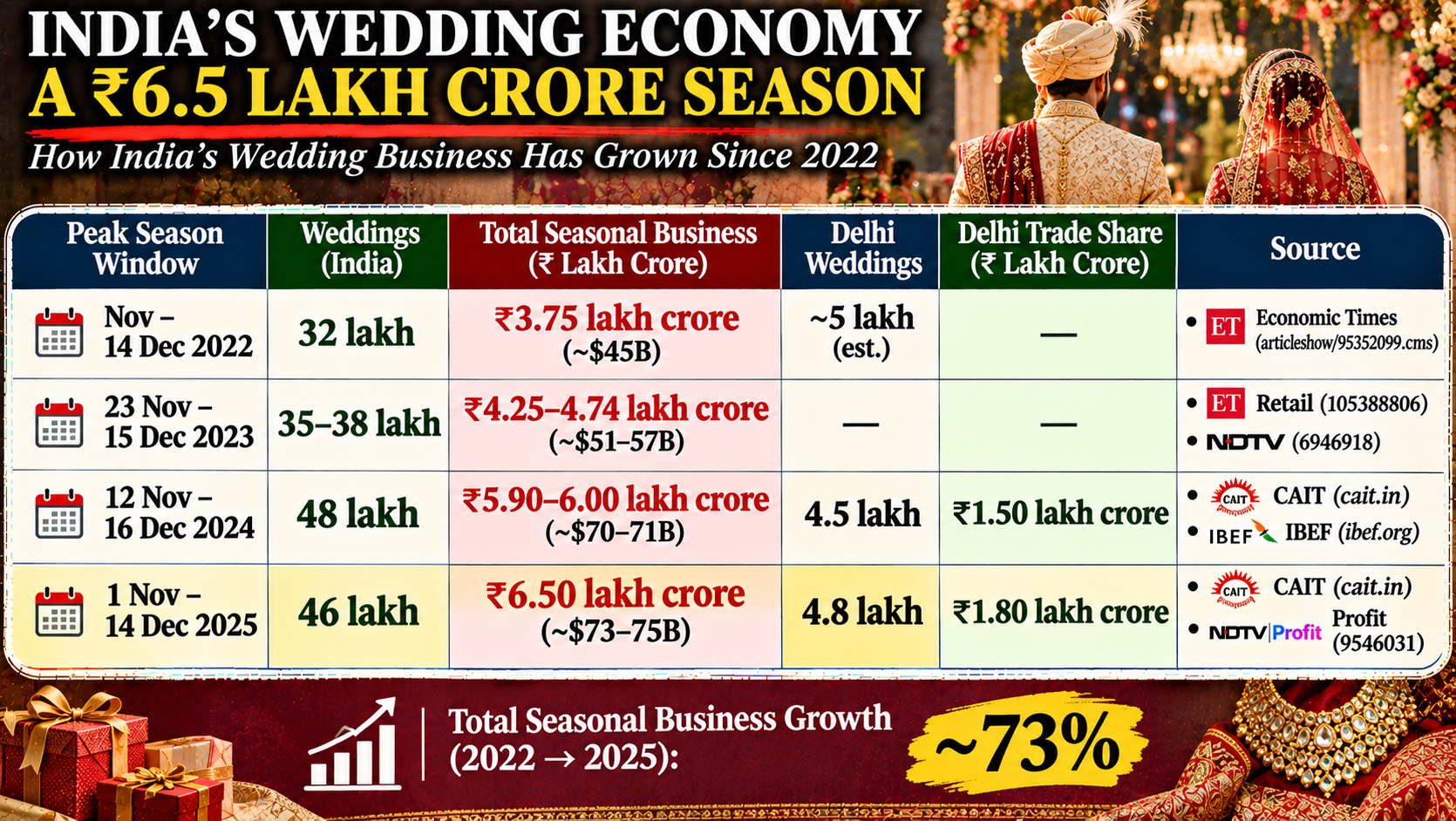
As of mid-November 2026, CAIT has not yet released a fresh figure for the 2026 winter window (Panigrahana). Even without an updated trade-body forecast, the 2025 baseline shows that roughly 46 lakh ceremonies in 44 days generated ₹6.5 lakh crore—equivalent to 1.91% of India’s annual GDP spent in a single seasonal burst—while supporting 50 lakh to 1 crore (5–10 million) jobs (First Resort). Delhi alone accounted for 27.7% of national seasonal trade (₹1.8 lakh crore across 4.8 lakh weddings) (CAIT).
What One Wedding Actually Costs: National Average vs. Urban Reality
The gap between India’s statistical mean and its metropolitan reality explains why the wedding economy feels simultaneously mass-market and hyper-luxury:
National average (Jefferies): ₹12 lakh (US$14,500–15,000) per wedding. That single event equals 5x India’s GDP per capita and over 3x average annual household income of roughly ₹4 lakh (US$4,500) (ThePrint).
Education comparison: Indian households spend an average of US$8,000 (~₹6 lakh) on 18 years of a child’s education from pre-primary through graduation—meaning a wedding costs nearly twice as much as 18 years of schooling. In the United States, by contrast, wedding spend is 0.5x public education and 0.1x private education (ThePrint).
Urban & platform average (WedMeGood 2025–26): Surveying over 2,000 couples and 500+ vendors, WedMeGood recorded an average budget of ₹39.5 lakh (up 8% year-on-year), rising to ₹58 lakh for destination weddings (EVENTFAQS).
City hierarchy: Jaipur tops the country at ₹73 lakh per wedding (pulled upward by palace buyouts), followed by Delhi (₹38 lakh), Bangalore (₹37 lakh), Hyderabad (₹37 lakh), and Mumbai (₹35 lakh) (EVENTFAQS).
CAIT’s granular budget-tier distribution from its 48-lakh-wedding breakdown exposes a sharp Pareto curve. Just 8 lakh upper-tier weddings (16.7% of ceremonies, spending ₹25 lakh to ₹1 crore+) generate ₹2.50 lakh crore—or 42.4% of the ₹5.90 lakh crore base—while the 20 lakh budget ceremonies (41.7% of volume, at ₹3 lakh and ₹6 lakh) account for ₹90,000 crore (15.3%):
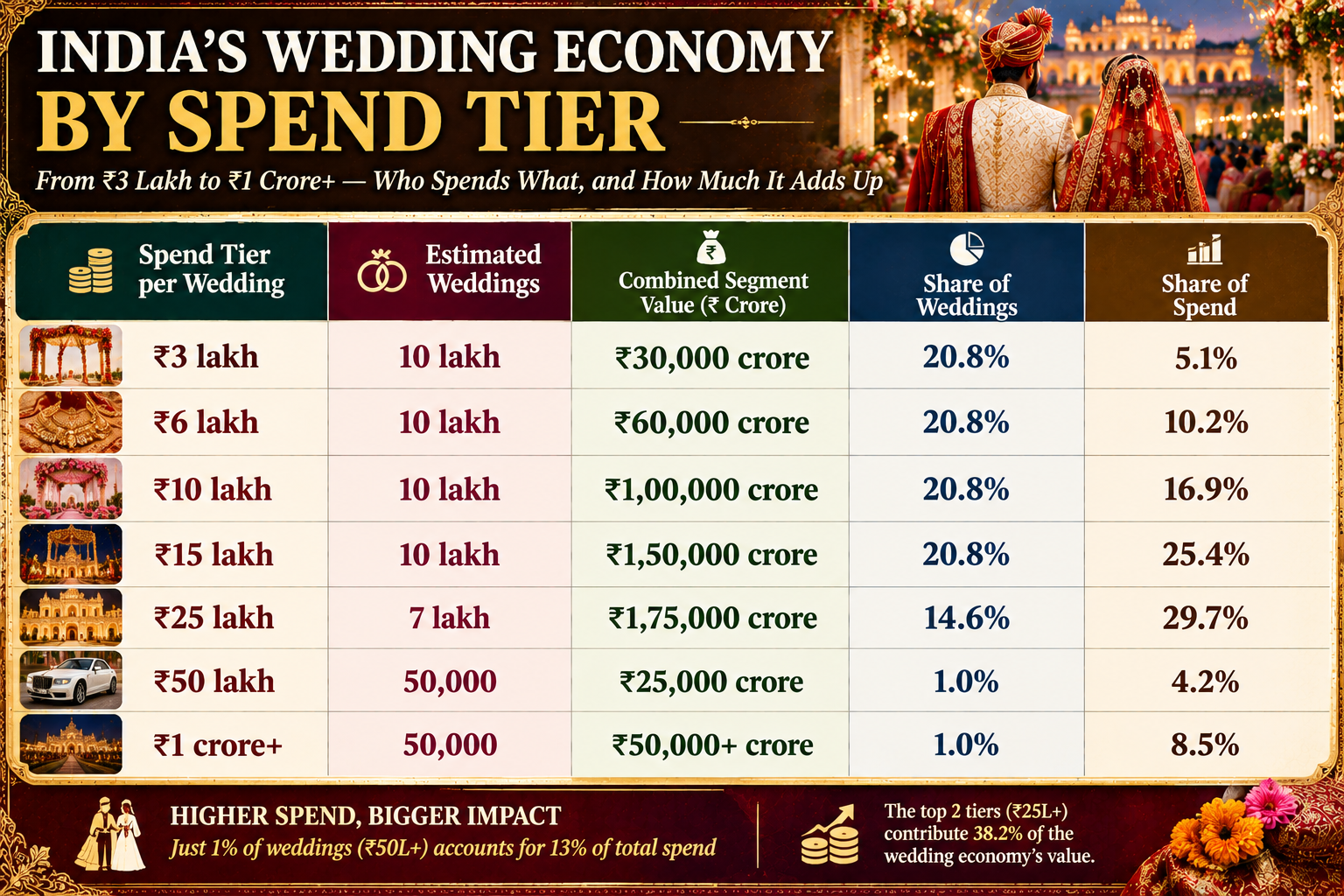
Source: CAIT budget-tier distribution reported by NDTV and Business Today; segment totals and shares calculated directly from CAIT’s 48-lakh-wedding baseline.
Where Every Rupee Goes
Across industry composites (IBEF, Kotak Mahindra MF, Hero FinCorp), a typical Indian wedding hires 14 distinct vendors for 310–330 guests (rising to 420 for local weddings and dipping to 280 for destination events, compared with 115 in the US and 80 in the UK) (First Resort).
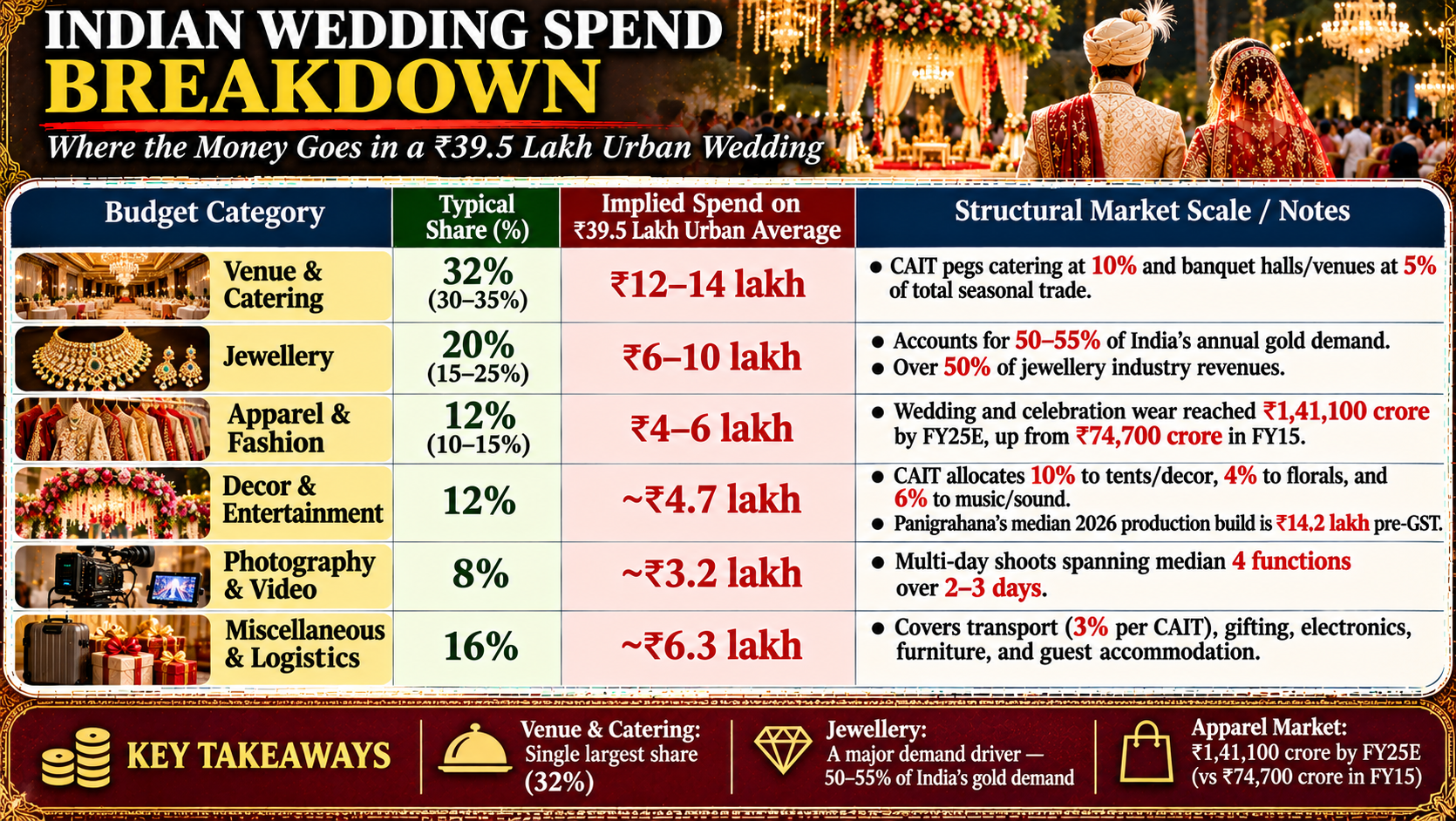
Source: Category shares from First Resort and Kotak Mahindra MF.
Three Structural Shifts Shaping the 2026–27 Season
1. Gold’s 20% Pullback Still Leaves Bullion Expensive
Bullion remains the single biggest swing factor in household budgets. On 30 January 2026, 24-carat gold peaked at a record ₹17,885 per gram (₹1,78,850 per 10g) before correcting nearly 20% to ₹14,315 per gram (IBJA) by 22 October 2026 (Eventic). By 16–17 November 2026, Delhi spot rates hovered at ₹1,36,940–₹1,36,950 per 10 grams for 24K and ₹1,25,530–₹1,25,540 for 22K (Groww).
Because prices remain far above 2024 levels, families are adapting rather than cancelling: jewellers report a shift toward lighter-weight sets (Eventic), 36% of couples rent statement jewellery for pre-wedding events, and 45–46% of brides now opt for lab-grown diamonds for engagement rings (First Resort).
2. Destination Weddings and Diaspora Capital
One in four Indian weddings (25%) is now a destination celebration—89% of them domestic, anchored in Udaipur, Jaipur, Goa, Jaisalmer, and Rishikesh—and 60% of ₹1 crore+ weddings are destination events (First Resort). The domestic destination segment alone is valued at roughly ₹2.5 lakh crore, growing 35% year-on-year (First Resort), while 23.5% of planner enquiries in 2026 studio records originated from the 3.54 crore (35.4 million) Indian diaspora abroad (Panigrahana; First Resort). Listed hospitality players are capturing the spillover directly: Indian Hotels Company (IHCL) reported a 25% year-on-year jump in wedding-related bookings in 2026 (Sahi).
3. Debt, Repo Hikes, and Gold-Loan Mechanics
While 78.65% of couples fund weddings through personal or family savings and 6.25% liquidate assets, 15.2% borrow—taking an average wedding loan of ₹15.5 lakh—and 53% revise budgets upward mid-planning (First Resort).
Financing that overrun became pricier in late 2026. Following the RBI’s 7 October 2026 repo rate hike to 5.50%, unsecured wedding personal loans carry effective annual percentage rates (APR) of 12.5% to 18.5% once processing fees and GST are included (OneMint). That spread has pushed credit-seeking households toward gold-backed loans—now governed by the RBI Lending Against Gold and Silver Collateral Directions, 2025 (effective April 2026), which cap loan-to-value ratios at 85% for loans under ₹2.5 lakh, 80% between ₹2.5 lakh and ₹5 lakh, and 75% above ₹5 lakh (IIFL).
Listed Market Beneficiaries
For equity investors, the winter wedding wave funnels discretionary cash into organised retail: Titan Company, Kalyan Jewellers, and Senco Gold in bullion; Vedant Fashions (Manyavar) and Raymond Lifestyle in celebration apparel; IHCL in luxury banqueting; and Ixigo (Le Travenues) in guest travel (Equitymaster; Financial Express). With muhurat dates opening on 21 November, the next 90 days will test whether high gold prices and 5.50% policy rates trim guest lists—or simply push more of India’s ₹10-lakh-crore-plus celebration machine into organised, credit-backed channels.