In brief
- India will launch its first high-speed railway in 2027 using Japanese-built track, European signalling and Indian-made B28 trains, breaking from the integrated Shinkansen system Japan financed with ¥1.05 trillion in concessional loans.
- New Delhi rejected a closed Shinkansen package because Japanese trains cost 40% more, the E10 would arrive only in the 2030s, and India wanted design control for seven future corridors.
- BEML and ICF will supply 16 eight-car B28 sets (280 km/h design) under a ₹5,400 crore order for 2027 trials, followed by a 350 km/h B35 and indigenous signalling planned for 2030.
- Japanese engineers warn the hybrid architecture is globally unprecedented and demands exhaustive testing, but at a July 2026 summit Japan accepted India's 2027 launch target and both sides kept the E10 as a future option.
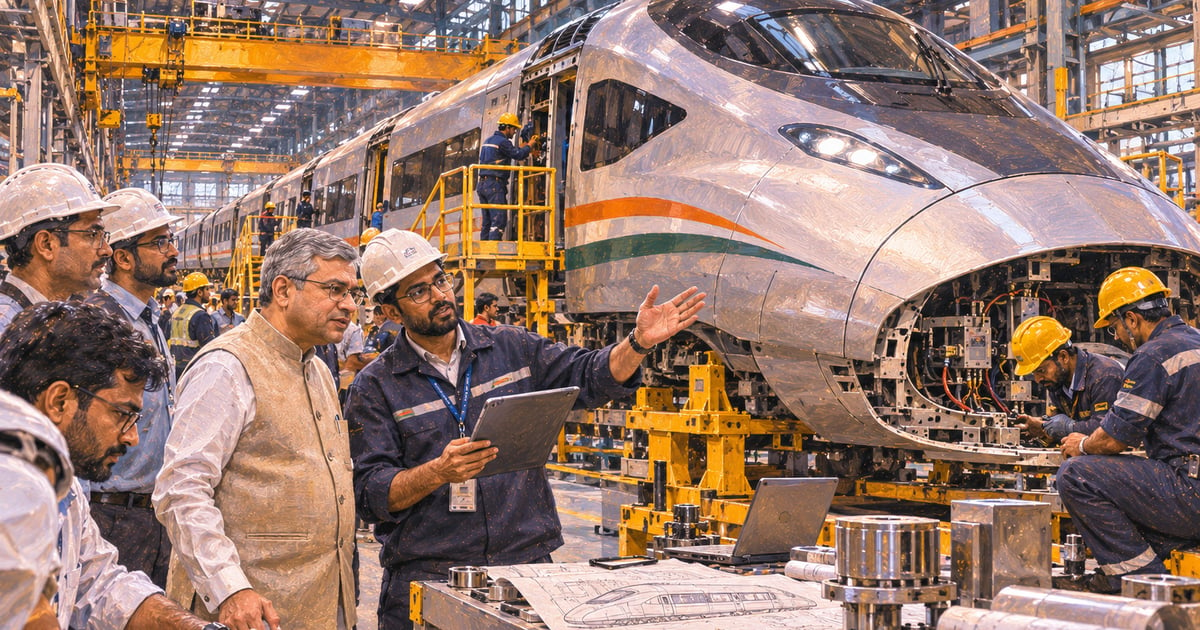
On the completed elevated viaducts between Surat and Vapi in Gujarat, the concrete and slab-track engineering carries clear Japanese DNA, financed by concessional yen loans. Yet when passenger trials begin on India’s first high-speed railway in 2027, the train on the rails will not be a Japanese Shinkansen. It will be the B28, an Indian-designed 280 km/h trainset built by BEML Limited and the Integral Coach Factory (ICF), running under European Train Control System (ETCS) Level 2 signalling installed by a Siemens-led consortium (IndraStra, 7 October 2026).
That hybrid architecture—Japanese-derived track, European signalling, and Indian trains—sits at the heart of a sharp technical and commercial debate in Japan. Japanese railway engineers and commentators have warned that India has broken up a tightly integrated safety system, while Indian officials argue that waiting for Tokyo’s next-generation trains would have left billions of dollars of completed infrastructure sitting idle until the 2030s.
What Japan Wanted—and Why It Matters to Tokyo
When Prime Minister Narendra Modi and then Japanese Prime Minister Shinzo Abe signed the Memorandum of Cooperation on 12 December 2015, the Mumbai–Ahmedabad High-Speed Rail (MAHSR) corridor was framed as an integrated transfer of the Shinkansen ecosystem—not just tracks, but also Japanese rolling stock, Digital Automatic Train Control (DS-ATC) signalling, and an Operation Control Centre (IndraStra; Indian Express, 6 October 2026).
To back that package, Japan offered Japan International Cooperation Agency (JICA) loans at 0.1% annual interest over 50 years with a 15-year grace period, committing ¥1.05 trillion (roughly ₹64,000 crore, or $6.6 billion) across tranches since 2017. In return, Tokyo expected tied procurement for its flagship high-value systems.
From a Japanese engineering standpoint, bundling the train and the signalling is not merely commercial protectionism; it is how Shinkansen safety is proved. Under DS-ATC, onboard computers match stored braking curves against track conditions, meaning the train’s exact mass, braking physics, and control software are co-engineered together (IndraStra).
In October 2026, Masafumi Shukuri, Chairman of both the Japan Transport and Tourism Research Institute (JTTRI) and the International High-Speed Rail Association (IHRA), defended India’s construction pace—noting that even modern Japan could not build a 500-km line in ten years—but cautioned that running two different bullet-train technologies and signalling systems on the same corridor is unprecedented globally and demands exhaustive testing and staff training (Indian Express, 11 October 2026). Delhi-based Japanese railway engineer Isao Tsujimura and former Japanese justice minister Hideki Makihara went further, criticising the split—prompting India’s Ministry of External Affairs (MEA) to reject Makihara’s remarks and note that no Japanese bid was received for the international-spec signalling tender (IndraStra; The Independent, 9 October 2026).
Why India Refused a Closed Combined Deal
Three practical pressures pushed New Delhi away from a bundled Shinkansen contract:
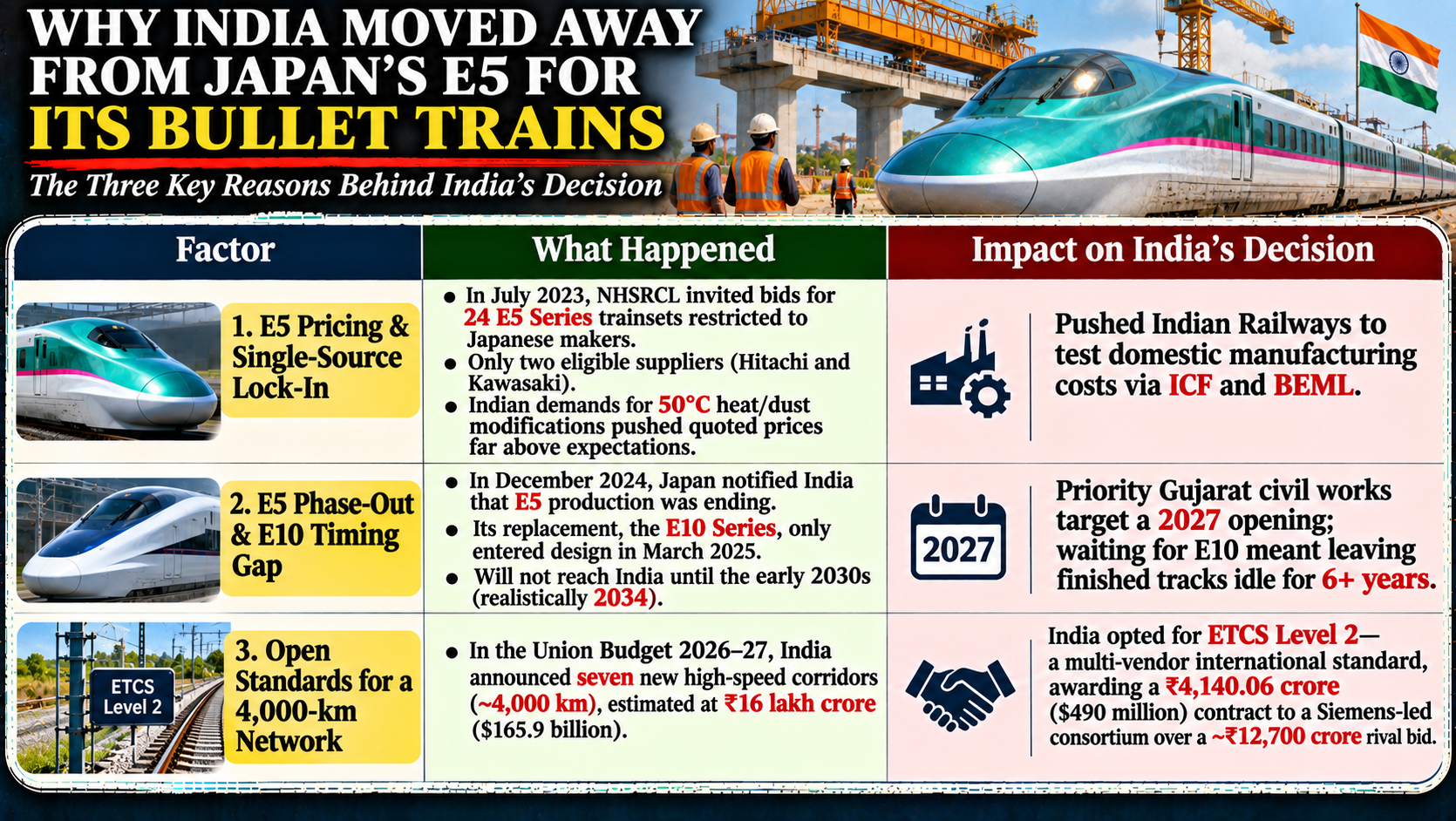
Sources: IndraStra (7 October 2026), B28 Trainset / Wikipedia, and Financial Times (5 October 2026).
B28 First, B35 Next: India’s Two-Step Rolling Stock Plan
Rather than treating domestic trains as a permanent compromise on speed, Indian Railways split its high-speed programme into two sequential platforms:
B28 (250 km/h operational / 280 km/h design): Jointly developed by BEML Limited and ICF in Bengaluru, the eight-car B28 was initially ordered as two prototypes under an ₹866.87 crore ($103 million) contract (₹27.86 crore per coach, including design and tooling for future lines). On 18 September 2026, BEML disclosed a much larger ₹5,400+ crore ($580 million) NHSRCL order for 16 B28 trainsets and maintenance—moving B28 from a stopgap prototype into the corridor’s core fleet (Wikipedia / BEML). On 1 November 2026, Railway Minister Ashwini Vaishnaw inspected B28 car-body squeeze tests at 1,500 kilonewtons in Bengaluru, ahead of mid-2027 trials and an August–December 2027 target launch.
B35 (350 km/h design): Already in planning for 2030, the B35 raises maximum design speed to 350 km/h—matching Japan’s E10 class and exceeding the E5’s 320 km/h—paired with a long-term plan for an indigenous Bharat Train Control System (BTCS) (ET Infra, 23 September 2026; IndraStra).
A Fragile Compromise, Not a Diplomatic Rupture
Despite sharp commentary from retired officials and engineers, neither New Delhi nor Tokyo has walked away from the partnership. At the 2 July 2026 New Delhi summit between Prime Minister Modi and Japanese Prime Minister Sanae Takaichi, Japan formally stated that it "fully understands India's target to commence commercial operations on priority sections in 2027", while both nations "acknowledged the goal of introducing the E10" later—quietly dropping earlier references to Japanese signalling (IndraStra).
The hardest engineering test now sits with India. By unbundling the corridor, New Delhi gained pricing leverage, avoided a six-year delay, and kept design authority for seven future corridors. In exchange, Indian institutions now carry sole responsibility for proving that Japanese-style track, European ETCS signalling, and home-grown B28 and B35 trains can operate together safely at 250–350 km/h.