In brief
- Ramayana: Part 1 released in 2026 has grossed ₹1,384.50 crore worldwide eleven days after release, with 65.7 per cent from India and 34.3 per cent from overseas markets.
- The film’s reported combined duology budget is ₹4,000 crore, making it the costliest Indian and non-English language production ever mounted, and its overseas revenue signals a new soft-power push for India.
- Its soft-power strategy rests on three engines: a Southeast Asian civilisational footprint, state funded cultural and pilgrimage infrastructure, and a Hollywood calibrated entertainment franchise.
- Three structural tensions will decide if Ramayana becomes a lasting global asset or a high-watermark domestic event, especially as Part 1 targets China, Japan, South Korea, and Russia in early 2027.
On 15 November 2026, eleven days after its global theatrical release, Nitesh Tiwari's Ramayana: Part 1 reached ₹1,384.50 crore ($146.9 million at ₹94.25 per US dollar) at the worldwide box office, overtaking RRR's lifetime gross. More telling than the headline number was where the money came from: 65.7% from India, and 34.3% from overseas markets.
For a film built on a reported combined duology budget of ₹4,000 crore ($420 million–$430 million)—the costliest Indian and non-English-language production ever mounted—that overseas share signals why the Ramayana has become India's newest soft-power vehicle. Unlike earlier waves of Indian cultural influence, which spread organically through Cold War-era Raj Kapoor melodramas, yoga, or diaspora nostalgia, the Ramayana push combines three deliberate engines: an existing Southeast Asian civilisational footprint, state-funded cultural and pilgrimage infrastructure, and a Hollywood-calibrated entertainment franchise.
Whether those three engines convert curiosity into durable global cultural influence—the kind Japan built through anime or South Korea through Squid Game—depends on whether the story travels beyond Indian households abroad.
Why the Ramayana Already Had a Built-In Asian Footprint
India did not have to invent the Ramayana's international legibility from scratch. Across Southeast Asia, the epic has functioned for centuries as a living local tradition rather than a foreign import: Thailand's Ramakien, Cambodia's Reamker, Indonesia's Kakawin Ramayana, Laos's Phra Lak Phra Ram, and Myanmar's Yama Zatdaw all adapt the core narrative into royal chronicles, temple reliefs, and classical dance.
In the 1990s, when Harvard political scientist Joseph Nye coined "soft power" to describe a country's ability to attract and persuade without coercion, Indian diplomats largely treated this shared heritage as a polite footnote at ASEAN summits. Over the past decade, New Delhi turned it into active cultural diplomacy. The Indian Council for Cultural Relations (ICCR), which operates 37 Indian Cultural Centres worldwide, has hosted six editions of the International Ramayana Festival and formally designated 2024 as the "Year of Connecting the World through Ramayana".
Its programming stretched well beyond Southeast Asia. Per the ICCR Annual Report 2024–25, Indian missions staged the Sanskrit theatrical production Ramayana – Kala Amrit across Brazilian cities including São Paulo and Rio de Janeiro, convened a Beijing symposium (Ramayana – A Timeless Guide) for 155 scholars, and mounted Adi-Kavya in China with 80 local performers before 994 attendees in January 2025.
The Domestic Infrastructure: Ayodhya and the Ramayana Circuit
Cultural festivals create goodwill among diplomats and scholars; physical infrastructure anchors tourism. Under the Ministry of Tourism's Swadesh Darshan programme, the government identified 15 domestic nodes for a dedicated Ramayana Circuit—spanning Ayodhya, Chitrakoot, Nashik, Hampi, and Rameswaram—while linking Ayodhya with Janakpur in Nepal via cross-border connectivity.
The economic scale of that domestic anchor shifted dramatically after the January 2024 consecration of the Ram Mandir in Ayodhya. According to Invest UP, Ayodhya's annual visitor count jumped from 5.75 crore (57.5 million) in 2023 to more than 16 crore (160 million) in 2024, and crossed 23 crore (230 million) in just the first six months of 2025—surpassing the Taj Mahal and Varanasi. State authorities are backing that footfall with a ₹4,403 crore ($467 million) Ram Van Gaman Path and a ₹2,180 crore ($231 million) eco-friendly township, projecting an ₹18,000 crore ($1.91 billion) tourism economy by 2028.
The 2026 Cinema Gamble: Packaging Myth for IMAX
Tourism and state-sponsored dance troupes rarely reach global mass audiences. That gap is what producer Namit Malhotra—chief executive of London-headquartered, Oscar-winning visual effects house DNEG—and director Nitesh Tiwari set out to close with Ramayana: Part 1.
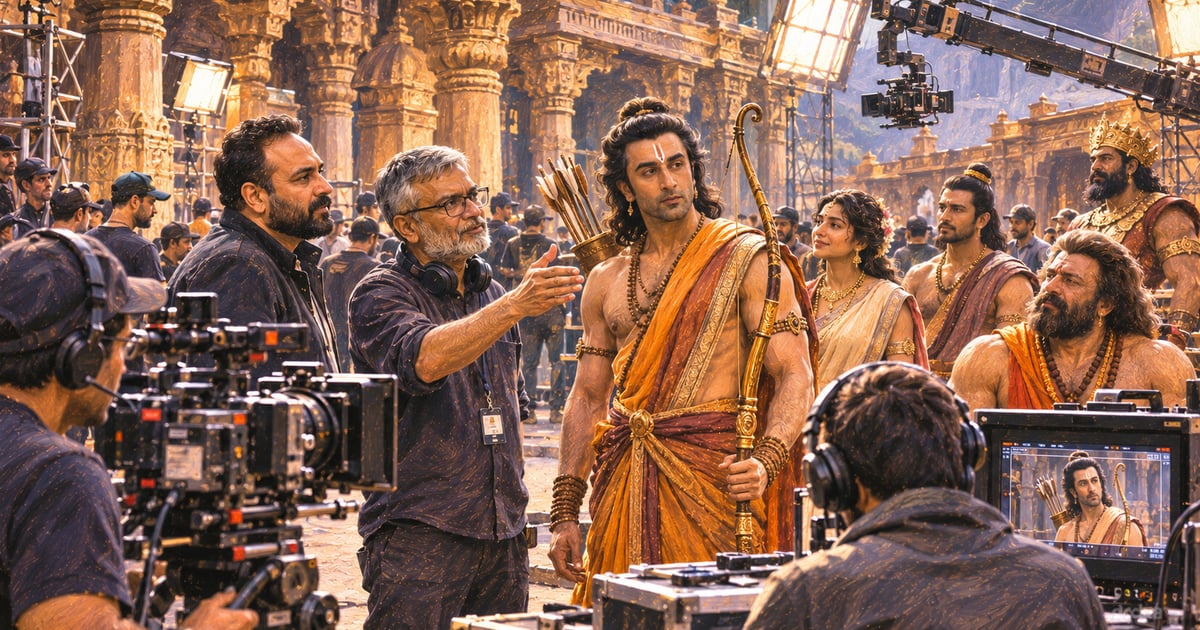
Rather than pitching the film as a traditional Bollywood mythological, the makers assembled a global production pipeline designed to compete with Dune and The Lord of the Rings:
Technical & Musical Scale: Visual effects were led by DNEG and ReDefine for IMAX formats, stunts were coordinated by Terry Notary (Planet of the Apes) and Guy Norris (Mad Max: Fury Road), and the score paired German composer Hans Zimmer—making his Indian film debut—with A. R. Rahman, per CNN.
Global Rollout: Instead of a domestic-first launch, the makers unveiled footage at US Comic-Con 2026, premiered the film at the Academy Museum of Motion Pictures in Los Angeles on 27 October 2026, and dubbed dialogue into English alongside Indian languages.
At the same time, New Delhi launched the World Audio Visual and Entertainment Summit (WAVES) to position India as a global content hub. Together, state backing and private capital have given the Ramayana a distribution apparatus Indian cinema lacked during Baahubali or RRR.
Three Tests That Will Decide If It Works
A ₹1,384.50 crore opening fortnight proves commercial appetite, not permanent soft power. Three structural tensions will determine whether the Ramayana becomes a lasting global cultural asset or a high-watermark domestic event:
First is the diaspora echo-chamber risk. China's animated Ne Zha 2 became the first non-Hollywood film to gross $2 billion worldwide, yet more than 99% of its revenue came from mainland China, analysts at Fair Observer note. Ramayana: Part 1's 34.3% overseas share is far healthier, but North America, the UK, Australia, and the Gulf have large Indian diasporas. The real test begins in early 2027, when Part 1 targets theatrical releases in China, Japan, South Korea, and Russia—markets where tickets must be bought by non-Indian viewers.
Second is the tension between state messaging and organic appeal. As Fair Observer's Muhammad Rauhan Rasheed and Asif Al Hasan argue, India's previous soft-power peaks—from Raj Kapoor in the Soviet Union to Shah Rukh Khan's global following and RRR's Oscar win—succeeded because audiences felt invited into a story, not lectured by a state project. If global viewers perceive mythological blockbusters as instruments of domestic political messaging, non-Indian interest can cool quickly.
Third is regional ownership. Because the Ramayana has dozens of cherished local versions across South and Southeast Asia, asserting singular Indian ownership can provoke friction. In 2020, for example, then-Nepali Prime Minister K. P. Oli sparked a bilateral row by claiming the original Ayodhya lay in Nepal, illustrating how easily shared heritage can turn into nationalist contention, as Diplomatist documented.
Even so, Ramayana: Part 1 has already cleared a hurdle that held Indian cinema back for decades: proving that an Indian studio can mount a $200 million-plus-per-part spectacle, distribute it simultaneously in global IMAX theatres, and generate a third of its revenue outside India. With Part 2 scheduled for 2027, India's oldest story has become its most closely watched cultural export—not because the state declared it soft power, but because global audiences are finally being asked to pay for a ticket.