In brief
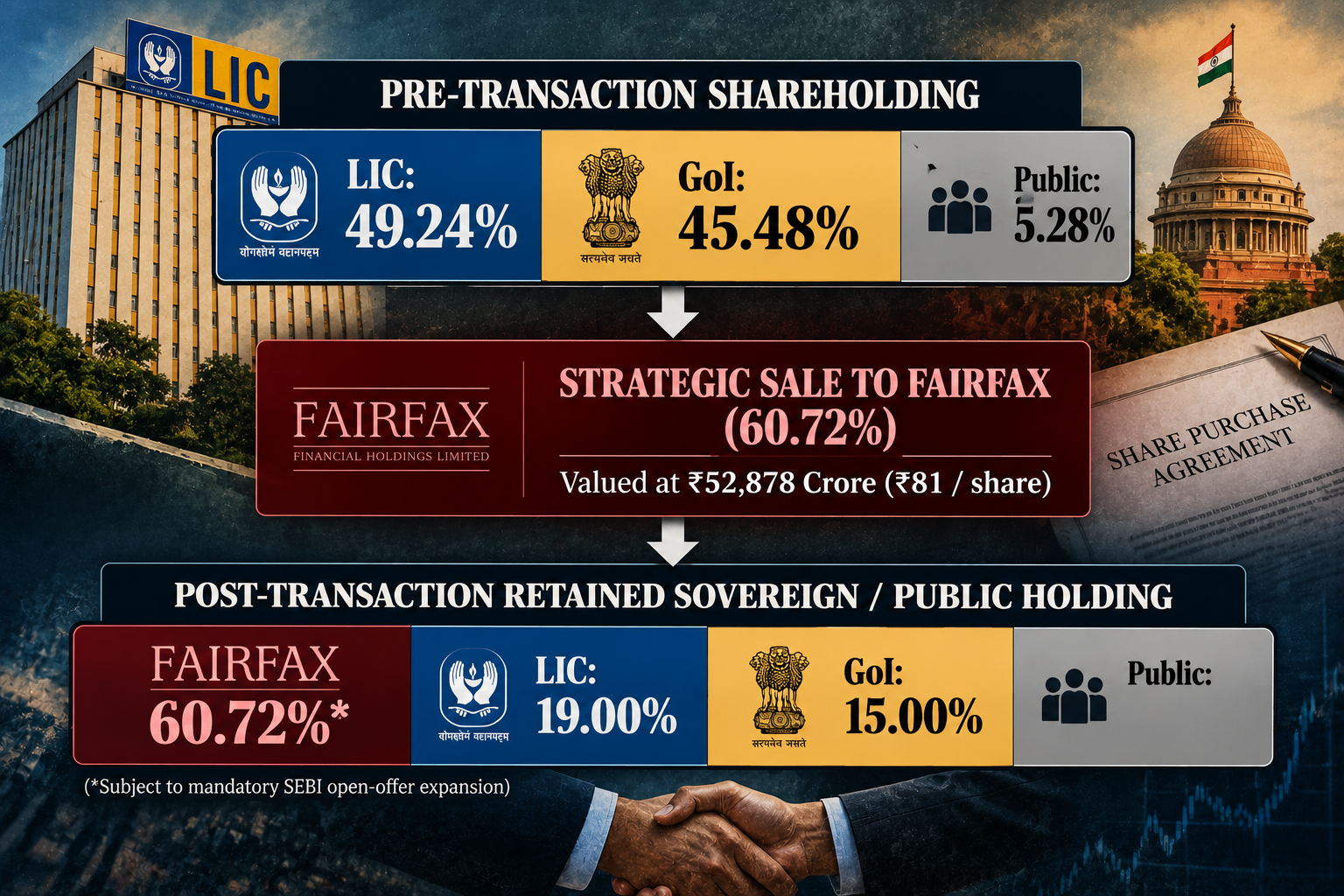
- On 14 October 2026, the Cabinet approved the sale of a 60.72% stake in IDBI Bank to Prem Watsa’s Fairfax for ₹52,878 crore, the biggest foreign investment ever in Indian financial services.
- The government and LIC are selling together, at ₹81 per share. Each gets about ₹26,500 crore.
- RBI gave Fairfax 15 years to cut its stake down to 26%. It also has 2 years to merge CSB Bank (where it owns about 40%) into IDBI or exit one of them.
- IDBI went from a 31.8% bad-loan ratio in 2018 to 2.30% now, and makes over ₹5,000 crore profit a year after LIC’s 2019 rescue.
- Fairfax plans a bigger financial group around it, using Go Digit insurance and IIFL Capital. Staff salaries and pensions are protected in the deal.
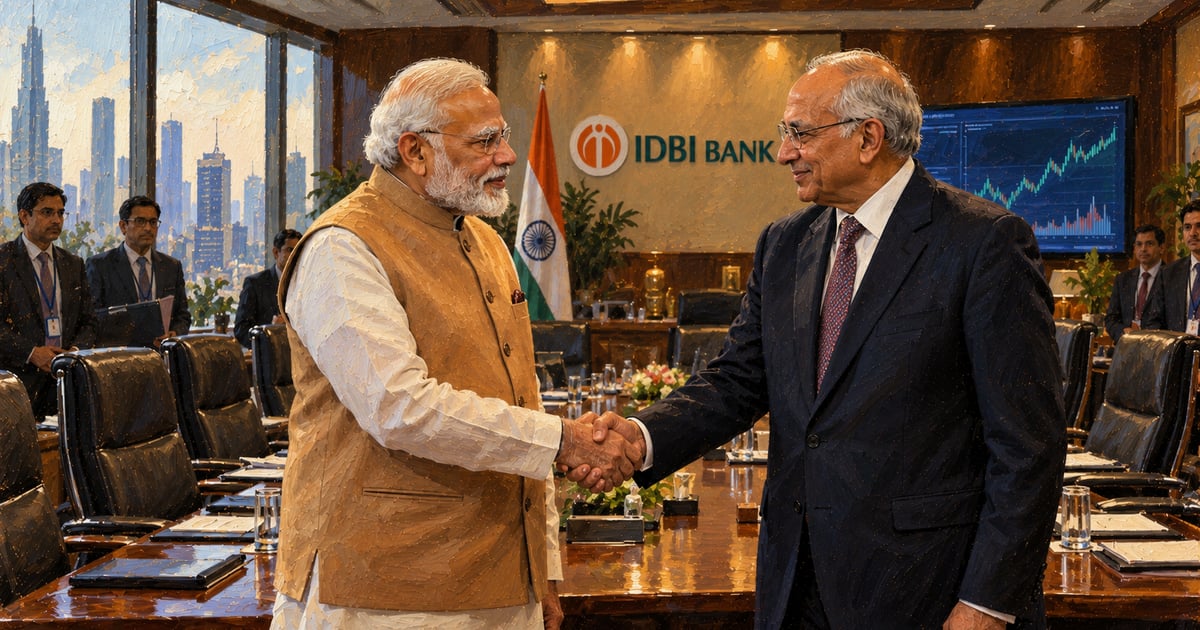
On Wednesday, 14 October 2026, the Cabinet Committee on Economic Affairs (CCEA) approved the sale of a controlling 60.72% stake in IDBI Bank to Prem Watsa’s Fairfax Financial Holdings for ₹52,878 crore (approximately $6.3 billion).
The transaction is a watershed in Indian economic history. It represents the largest-ever Foreign Direct Investment (FDI) inflow into India’s financial services industry and the most consequential transfer of state-held assets into private hands since the re-privatisation of Air India in October 2021.
By sanctioning the transfer of an institution with a balance sheet exceeding ₹4.1 lakh crore ($49 billion) and a network of roughly 1,900 branches to an overseas-headquartered financial group, New Delhi has crossed an ideological Rubicon. The deal closes a tortuous, seven-year effort to privatise the lender and establishes the structural blueprint for future public sector asset sales.
The Deal Mechanics: Who Sells What
The transaction has been executed through a joint offer from the Government of India and the Life Insurance Corporation of India (LIC), which together held 94.71% of the lender prior to the sale.
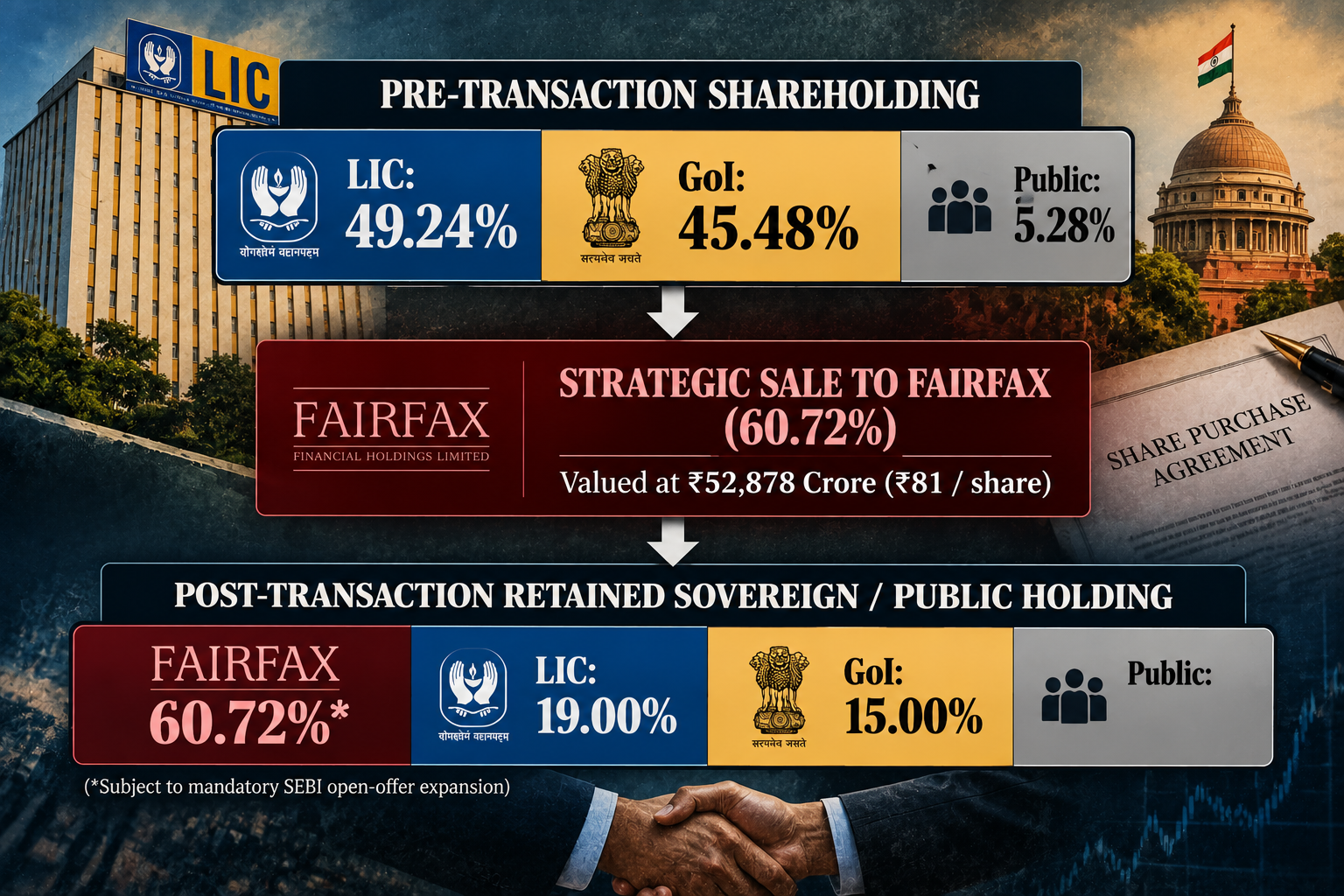
Under the Share Purchase Agreement, Fairfax will pay ₹81 per share. Although the price triggered a short-term 7.5% drop in secondary market trading due to speculative premiums built up prior to the announcement, it secures a massive capital return for the exchequer: the central government will directly realise roughly ₹26,500 crore ($3.15 billion), with LIC pocketing a matching sum to bolster its investment solvency.
The Regulatory Compromise: The 15-Year Glide Path and the CSB Dilemma
The central obstacle that delayed the privatisation of IDBI Bank since preliminary bids were invited in October 2022 was not valuation, but the Reserve Bank of India’s strict bank licensing and ownership architecture.
The central bank enforces two cardinal rules for private commercial banks:
Promoter Ceilings: Bank promoters must gradually reduce their shareholding to a maximum of 26% of paid-up voting equity over the long term to prevent concentrated corporate ownership.
One Promoter, One Bank: A single corporate entity or conglomerate cannot own or promote two competing commercial banks in the Indian market.
To resolve these regulatory bottlenecks, the Ministry of Finance, DIPAM, and the RBI structured a bespoke compliance framework.

Under the Share Purchase Agreement, Fairfax will pay ₹81 per share. Although the price triggered a short-term 7.5% drop in secondary market trading due to speculative premiums built up prior to the announcement, it secures a massive capital return for the exchequer: the central government will directly realise roughly ₹26,500 crore ($3.15 billion), with LIC pocketing a matching sum to bolster its investment solvency.
The Regulatory Compromise: The 15-Year Glide Path and the CSB Dilemma
The central obstacle that delayed the privatisation of IDBI Bank since preliminary bids were invited in October 2022 was not valuation, but the Reserve Bank of India’s strict bank licensing and ownership architecture.
The central bank enforces two cardinal rules for private commercial banks:
Promoter Ceilings: Bank promoters must gradually reduce their shareholding to a maximum of 26% of paid-up voting equity over the long term to prevent concentrated corporate ownership.
One Promoter, One Bank: A single corporate entity or conglomerate cannot own or promote two competing commercial banks in the Indian market.
To resolve these regulatory bottlenecks, the Ministry of Finance, DIPAM, and the RBI structured a bespoke compliance framework.
1. The 15-Year Glide Path
On 16 October 2026, DIPAM Secretary Arunish Chawla confirmed that the RBI has granted Fairfax a 15-year glide path to reduce its 60.72% controlling stake to 26%. This ensures that Fairfax has operational stability to overhaul the bank’s technology, governance, and lending practices without the immediate pressure of diluting equity into the secondary market.
2. The Two-Year CSB Bank Resolution
Fairfax already holds a ~40% promoter stake in CSB Bank (formerly Catholic Syrian Bank), which it rescued and listed in 2018–2019. Under the RBI's "one promoter, one bank" rule, Fairfax cannot operate both IDBI Bank and CSB Bank as separate parallel franchises.
Secretary Chawla clarified that Fairfax has been granted a strict two-year window to either merge CSB Bank into IDBI Bank or execute a complete exit from one of the lenders.
Indications from Toronto and Mumbai suggest Fairfax intends to pursue an eventual merger, combining CSB Bank’s regional strength in southern gold loans and SME lending with IDBI Bank’s nationwide branch footprint and corporate franchise.
The Long Journey: From Industrial DFI to Toxic Ward
To grasp the magnitude of the sale, one must understand how close IDBI Bank came to total collapse.
Founded in 1964 as a wholly owned subsidiary of the Reserve Bank of India under an Act of Parliament, the Industrial Development Bank of India served for four decades as an apex development financial institution (DFI), funding the industrialization of post-independence India—from steel mills and fertiliser plants to thermal power stations.
In 2004, the institution was transformed into a commercial bank to compete directly with modern private lenders such as HDFC Bank and ICICI Bank. However, the cultural and structural transition failed:
By the mid-2010s, IDBI Bank had accumulated massive exposures to troubled infrastructure, power, steel, and aviation projects (including Kingfisher Airlines). When the RBI instituted its landmark Asset Quality Review in 2015, the bank's balance sheet imploded.
By 2018, its Gross NPA ratio reached 31.8%—nearly a third of its entire loan book was non-performing. In May 2017, the central bank placed IDBI Bank under the Prompt Corrective Action (PCA) framework, barring it from opening new branches, extending corporate credit, or issuing bonuses.
Facing outright insolvency that threatened to destabilise the financial sector, the central government orchestrated an emergency rescue in January 2019: the Life Insurance Corporation of India was directed to inject ₹21,624 crore ($2.6 billion) to take a 51% controlling stake.
Under Managing Director and CEO Rakesh Sharma, the bank spent the next four years aggressively provisioning for bad loans, writing off legacy debts, expanding retail mortgage portfolios, and recovering corporate collateral. By March 2021, the lender had met all capital and profitability criteria to successfully exit the PCA framework.
By the first quarter of fiscal 2027, IDBI Bank reported a Gross NPA ratio of just 2.30%, a Net NPA of 0.16%, a Provision Coverage Ratio above 90%, and sustained annual net profits exceeding ₹5,000 crore ($600 million).
Fairfax’s Vision: Building a Financial Megafirm
Prem Watsa, often termed the "Warren Buffett of Canada," is not acquiring IDBI Bank as a passive asset allocator.
In official statements issued alongside the transaction, Fairfax revealed plans to anchor a comprehensive, multi-line financial services group around IDBI Bank. The strategy mirrors the corporate structure of leading private sector lenders:
Bancassurance Integration: Fairfax is a primary backer of Go Digit General Insurance (Digit). By combining Digit’s cloud-native, algorithmic underwriting with IDBI Bank’s branch network and depositor base, Fairfax creates an integrated distribution channel.
Wealth and Capital Markets: Integrating IIFL Capital (in which Fairfax holds substantial historical stakes) will supply IDBI Bank with institutional equity research, wealth management, and investment banking capabilities to rival Kotak Mahindra Capital and Axis Capital.
Low-Cost Deposit Mobilisation: IDBI Bank’s current account and savings account (CASA) ratio, which sits near 50%, provides Fairfax with a low-cost domestic funding engine to finance credit expansion across small and medium-sized enterprises (SMEs) and retail consumers.
The Precedent: What IDBI Bank Means for Future Bank Sales
When Finance Minister Nirmala Sitharaman presented the Union Budget for 2021–22, she announced a policy to privatise two state-owned public sector banks (PSBs) alongside IDBI Bank. For five years, that reform stalled amid fierce union opposition, bureaucratic inertia, and regulatory anxiety over corporate ownership of deposit-taking institutions.
The successful closure of the IDBI Bank transaction changes the landscape:
Proof of Concept: It demonstrates that the Department of Investment and Public Asset Management (DIPAM) can conduct a multi-year, transparent international auction for a complex commercial bank without legal challenges derailing the process.
The Foreign Ownership Paradigm: Prior to this deal, foreign banking presence in India was largely confined to wholly owned subsidiaries (such as Citibank’s legacy consumer operations, standard Chartered, or DBS) or minority stakes. Allowing an overseas investment holding firm to hold 60.72% establishes that foreign capital can own and control systemic Indian banking assets.
Labour Protection Model: To neutralise union backlash, the Share Purchase Agreement strictly protects existing employee salaries, pensions, gratuity entitlements, and service conditions, demonstrating to public sector staff that privatisation does not mandate mass layoffs.
Verdict: The Return on Patience
The privatisation of IDBI Bank is the resolution of a thirty-year institutional identity crisis.
The bank spent the 1990s as a development agency, the 2000s as a reckless corporate lender, the 2010s as a bankrupt ward of the state, and the early 2020s in convalescence under LIC.
At ₹52,878 crore, the sale provides the Indian taxpayer with a fair recovery on capital injected during the dark days of the NPA crisis. More importantly, it brings fresh capital, advanced technology, and professional governance into an institution that was once the poster child of state-directed lending failure.
For the wider Indian economy, the signal is unmistakable: the era of indefinite state ownership of commercial banking has finally begun to yield to market discipline.