In brief
- Portable sensors from IIT Kanpur, IIT Bombay, and ICAR can beam soil reports to mobile apps in minutes, but they do not turn a bare smartphone into a chemical lab.
- The hardware uses an external portable reader or mini-kit paired with a phone app to analyse soil samples.
- Bhu-Parikshak, developed by IIT Kanpur and commercialised with AgroNxt, analyses a 5 gram soil sample with near infrared light and an embedded machine learning model to produce six metrics in 90 seconds.
- The tests face limits such as optical blind spots for phosphorus and potassium, electrochemical drift in phosphate measurements, and the need for proper sampling from multiple field corners.
Clips of Prime Minister Narendra Modi talking about testing soil through a mobile phone drew swift ridicule online after his 12 November 2026 address at the Kisan Tak Bharat Agriculture Conference in New Delhi. Critics treated the remark as a claim that farmers could rub mud directly onto a smartphone screen and read out a fertility report.
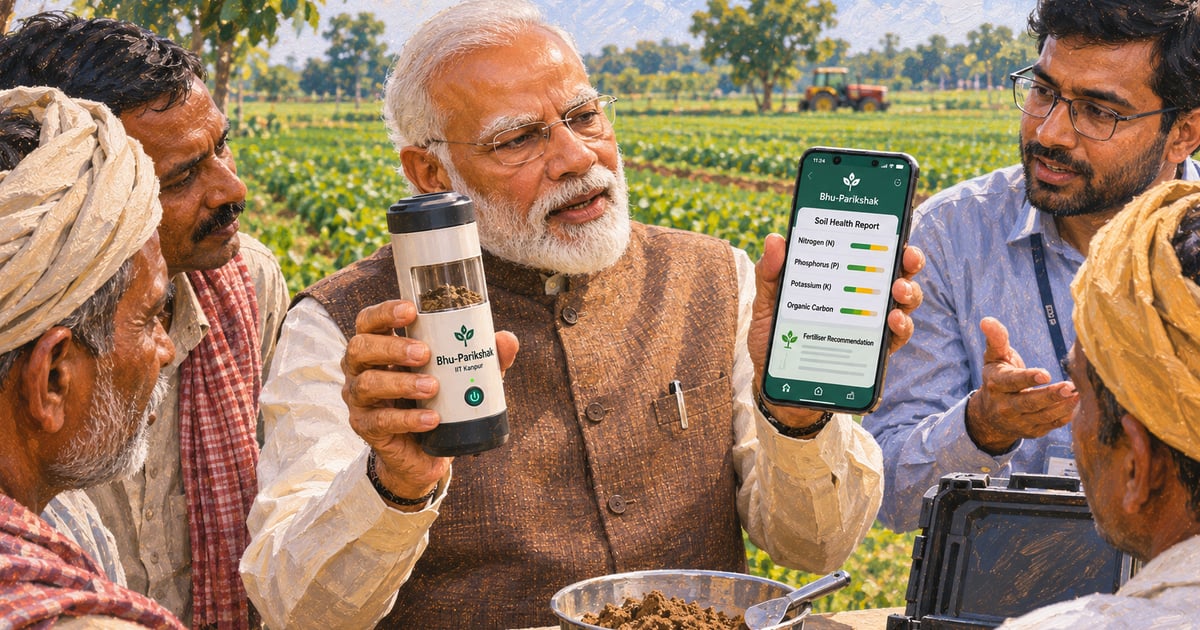
That is not what he said—nor is mobile-linked soil testing science fiction. Speaking at Bharat Mandapam, Modi said "arrangements are now being developed for soil testing through mobile phones", explicitly describing a mobile-based device onto which a farmer places a small soil sample so the paired phone can report which crop suits the field and what fertiliser dose it needs (India Today, 15 November 2026).
The underlying hardware already exists across Indian public laboratories and agri-tech spin-offs. None of these tools turns a bare smartphone into a chemical lab; all of them pair an external portable reader or mini-kit with a phone app.
Four Indian Systems, Three Different Ways to Read Soil
Indian researchers have pursued three distinct engineering routes to get soil data out of regional laboratories—where results can take weeks—and onto a farmer’s phone before sowing begins.
Sources: IIT Kanpur, Office of the Principal Scientific Adviser (June 2024), India Today (15 November 2026), and PIB.
1. Light Instead of Chemicals: IIT Kanpur’s Bhu-Parikshak
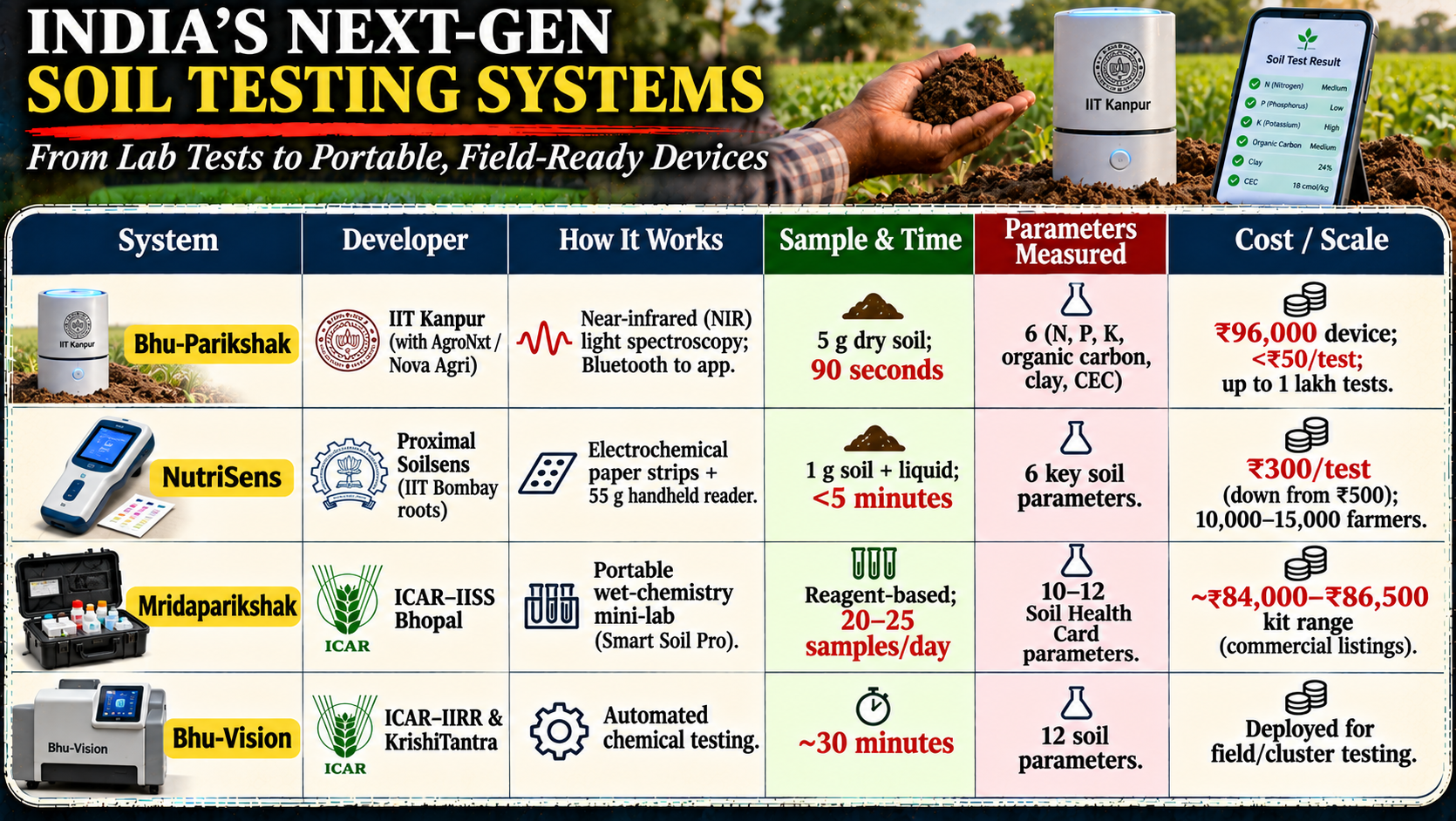
Developed by Prof. Jayant Kumar Singh’s team at IIT Kanpur and commercialised with AgroNxt, Bhu-Parikshak eliminates liquid reagents (IIT Kanpur). A user pours 5 grams of dry soil into the cylindrical handheld unit, which shines near-infrared (NIR) light onto the sample. Because different molecules absorb NIR wavelengths in characteristic patterns, an embedded machine-learning model trained on laboratory-tested samples translates that optical fingerprint into six metrics—nitrogen, phosphorus, potassium, organic carbon, clay content, and cation exchange capacity—and sends a fertiliser recommendation to the Bhu-Parikshak Android app in 90 seconds (India Today).
Its economics are built for rural service providers rather than individual smallholders. According to the Office of the Principal Scientific Adviser’s Agri-Tech Compendium (June 2024), the hardware costs ₹96,000 (about $1,150) with a one-year warranty, can process 100–250 tests a day up to 1 lakh samples (100,000 samples) over its lifetime, and brings per-test operating costs below ₹50.
2. The Soil "Glucometer": NutriSens
If Bhu-Parikshak is a pocket spectrometer, NutriSens—built by Dr Rajul Patkar from research that began at IIT Bombay—works like a diabetic’s blood-sugar meter (India Today). One gram of soil is mixed with an extracting liquid, and a drop of the clear solution is placed onto a disposable paper strip printed with coated electrodes. Chemical reactions generate a faint electrical current that a 55-gram pocket reader converts into six soil readings on a smartphone app in under five minutes. Across eight states, 10,000 to 15,000 farmers already use the system, cutting test prices from ₹500 to ₹300 (India Today).
3. Mini-Labs in a Box: ICAR’s Mridaparikshak and Bhu-Vision
ICAR–Indian Institute of Soil Science (IISS), Bhopal, took an earlier, more conventional route when it unveiled Mridaparikshak in 2015 (PIB). Rather than an optical scanner, Mridaparikshak is a portable wet-chemistry mini-lab—complete with a hot plate, balance, shaker, and Smart Soil Pro meter—that tests 10 to 12 Soil Health Card parameters, including micronutrients, at roughly 20–25 samples a day and sends recommendations straight to farmers’ mobile phones. Bhu-Vision, developed by ICAR–Indian Institute of Rice Research with KrishiTantra, similarly automates wet chemistry to return 12 parameters in about 30 minutes (India Today).
Where the Science Still Falls Short
Portable sensors trade laboratory completeness for speed, and peer-reviewed studies show clear limits:
Optical blind spots: A 2025 review of near-infrared soil studies cited by India Today found that NIR light predicts organic carbon and total nitrogen reliably (with $R^2$ scores above 0.8, where 1.0 is a perfect lab match). However, available phosphorus and potassium leave no direct fingerprint in NIR light, forcing models to infer them indirectly from correlated soil properties—and moisture or unfamiliar regional soil types can skew readings.
Electrochemical drift: A 2024 review in Precision Agriculture found paper-strip electrochemical sensors highly accurate for nitrate and pH, but less reliable for phosphate, sensitive to temperature swings, and dependent on regular calibration (India Today).
Sampling discipline: Testing 1 gram or 5 grams of soil only represents a hectare if a farmer first collects and mixes sub-samples from multiple corners of the field.
Why Speed Matters More Than Perfection
Despite those caveats, the push for rapid mobile-linked testing addresses a massive economic leak on Indian farms. At the same 12 November conference, industry panellists noted that crops absorb only 30% to 45% of applied nitrogen, 15% to 25% of phosphorus, and roughly half of potash; the rest volatilises into the air, locks into soil, or leaches into groundwater (India Today). When farmers follow soil-test advice, the savings are measurable: a 2017 National Productivity Council study of 1,700 farmers across 19 states found that Soil Health Card users cut chemical fertiliser use by 8% to 10% while raising yields by 5% to 6%.
Traditional Soil Testing Laboratories cannot deliver that feedback before sowing windows close. Portable sensors connected to smartphones—and tied into national advisory platforms such as Bharat-VISTAAR, which has handled over 93 lakh queries (9.3 million queries) since its February 2026 launch (India Today)—do not magically turn a handset into a chemistry lab. What they do is put a 90-second or five-minute triage tool in the hands of village entrepreneurs, turning soil testing from a months-long bureaucratic errand into a pre-sowing habit.