In brief
- India now makes more steel than the United States and Japan combined, reaching 164.9 Mt in 2025 and widening the gap in 2026. This shows India’s rising steel output and growing industrial momentum.
- By September 2026, India produced 130.0 Mt in the first nine months, versus 125.2 Mt for the US and Japan together, underscoring India catching up with and surpassing major producers.
- India has long outproduced the European Union, but wider Europe still edged India in 2025 at 170.6 Mt while India moved ahead in the first nine months of 2026.
- Challenges remain for sustaining the pace, including cutting imported coking coal, decarbonising coal based sponge iron, and moving up the value chain into specialised alloys.
In 2025, India poured 164.9 million tonnes (Mt) of crude steel, overtaking the combined annual output of the United States (81.9 Mt) and Japan (80.7 Mt) for the first time, according to the World Steel Association’s World Steel in Figures 2026. By the end of September 2026, that gap had widened: India produced 130.0 Mt in the first nine months of the year, compared with 125.2 Mt for the US and Japan together (worldsteel, October 2026).
The comparison with Europe requires a sharper distinction than most headlines allow. India has long outproduced the European Union (EU-27), whose 2025 output of 126.0 Mt trailed India by nearly 39 Mt. If "Europe" is expanded to include non-EU producers such as Türkiye (38.1 Mt) and the United Kingdom (2.6 Mt)—while excluding Russia, Ukraine, and the CIS—wider Europe still edged out India in 2025 at 170.6 Mt. In the first nine months of 2026, however, India (130.0 Mt) moved ahead of that wider European bloc (127.5 Mt) as well.
Measured against its own history, the ascent is steep. India overtook the US for third place in 2015 and surpassed Japan to become the world’s second-largest producer in 2018. Yet India still accounts for only 8.9% of global crude steel output, while China—even after a 4.4% contraction in 2025—produces 960.8 Mt, or 52.0% of the world’s 1,848.9 Mt total (worldsteel, 2026).
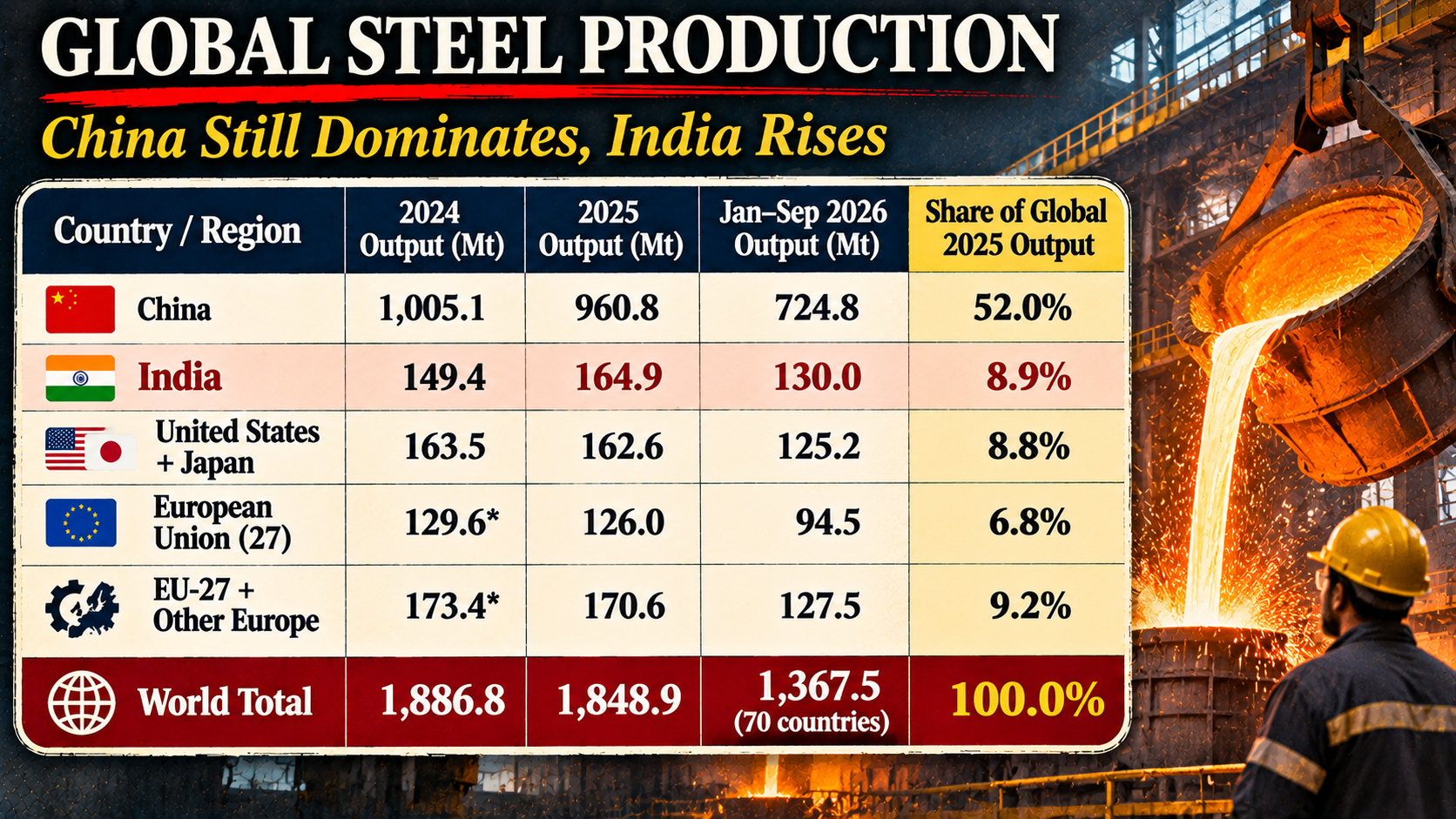
Source: World Steel Association – World Steel in Figures 2026 and September 2026 Crude Steel Production. *2024 EU-27 and wider Europe totals derived from worldsteel 2025 annual percentage-change figures.
Why 165 Million Tonnes Still Leaves India Half-Built
Steel production tracks industrial momentum because virtually no physical asset—from railway tracks and bridges to passenger cars and power pylons—gets built without it. In India’s financial year 2025–26 (April–March), crude steel output rose 10.7% to 168.4 Mt, while domestic finished steel consumption climbed to 163.7 Mt, driven by public infrastructure, railways, and urban construction (Ministry of Steel, April 2026; PIB).
Yet India’s sheer population creates a statistical illusion. In 2025, India became the world’s second-largest steel consumer at 159.8 Mt of apparent finished steel use, even as Chinese demand shrank 7.1% to 796.0 Mt amid its property downturn (worldsteel, 2026). Divide that Indian demand across more than 1.4 billion people, however, and per-capita steel consumption stands at just 109.2 kg—roughly half the 209.0 kg global average, well below the EU-27 (301.2 kg) and US (261.7 kg), and less than a fifth of China (562.1 kg).
That gap explains both the optimism of global mining giants and the scale of India’s policy ambition. India’s National Steel Policy 2017 targets 300 million tonnes per annum (MTPA) of crude steel capacity, 255 Mt of production, and 158 kg of per-capita consumption by 2030–31—with a longer-term 2047 vision of 500 MTPA capacity. Having reached roughly 220 MTPA of capacity in FY 2025–26, private and state producers—led by Tata Steel Group (30.46 Mt in 2025), JSW Steel (30.28 Mt), SAIL (19.44 Mt), Jindal Steel (8.71 Mt), and AM/NS India—are committed to massive brownfield expansions.
The Coking Coal Chokepoint
Building blast furnaces to reach 300 MTPA exposes India’s sharpest raw-material vulnerability. While the country is rich in iron ore—producing 282.4 Mt in 2024—it relies on imports for roughly 85% of its metallurgical (coking) coal (PIB, April 2025; PIB, May 2026).
A November 2024 NITI Aayog report noted that Australia alone supplied 54% of India’s 56 Mt of coking coal imports in FY 2022–23, leaving Indian steelmakers’ margins exposed to Australian weather disruptions, freight spikes, and concentrated global pricing. Paradoxically, India holds billions of tonnes of medium coking coal reserves, yet NITI Aayog attributed the domestic shortfall to chronic underinvestment in coal washing and beneficiation by state miners, alongside the 2014 cancellation of private captive coal blocks.
Through Mission Coking Coal, the government aims to trim coking coal import dependence from 85% to 65% by 2030–31 (PIB, May 2026). Even if that target is met, absolute import volumes will keep climbing: industry analysts at The Coal Hub project India’s coking coal imports will rise from 60.4 Mt in 2025 to 90 Mt by 2030. Meanwhile, to shield domestic coke ovens, India’s Ministry of Finance imposed five-year anti-dumping duties on low-ash metallurgical coke imports from six countries in July 2026—including $128.83 per tonne on Chinese coke and $71.16 per tonne on Australian shipments (GMK Center, July 2026).
Why India’s Electric Furnaces Are Not Like America’s
On paper, India’s production mix looks surprisingly modern. In 2025, 57.7% of India’s crude steel was made via electric furnaces (electric arc and induction furnaces), while 42.3% came from oxygen blast furnaces (worldsteel, 2026). That sits closer to the United States (71.3% electric) than to China (89.4% oxygen).
The similarity is misleading. US electric arc furnaces run overwhelmingly on recycled ferrous scrap, yielding a relatively low carbon footprint. India lacks both abundant domestic scrap and cheap natural gas. Instead, its secondary steel sector—which accounts for 47% of domestic capacity (IBEF, August 2026)—feeds its electric and induction furnaces with coal-based direct reduced iron (DRI), or sponge iron. In 2025, India produced 58.9 Mt of DRI, accounting for 38.5% of the entire world’s 153.0 Mt output (worldsteel, 2026).
Because both its primary blast furnaces and its coal-fired DRI kilns burn fossil carbon, India’s steel sector averages 2.54 to 2.55 tonnes of CO₂ per tonne of crude steel, well above the 1.92 tCO₂ global average (Ministry of Steel / GSI Report, March 2025; worldsteel, 2026).
That emissions gap became a direct commercial liability on 1 January 2026, when the European Union’s Carbon Border Adjustment Mechanism (CBAM) entered its definitive phase, requiring importers to buy certificates tied to embedded carbon emissions. A study by the Indian Council for Research on International Economic Relations (ICRIER) estimates that CBAM could reduce India’s steel exports to the EU by 24%. New Delhi has responded by launching the Green Steel Taxonomy—which restricts "green steel" certification to output below 2.2 tCO₂e per tonne of finished steel—and notifying draft emission-intensity targets for 255 iron and steel units under India’s Carbon Credit Trading Scheme (CCTS) from FY 2026–27.
Chinese Oversupply and the Fragile Trade Balance
India’s capacity build-out is also unfolding under the shadow of China’s property slump. With domestic Chinese demand falling, China exported 133.6 Mt of steel products in 2025 (worldsteel, 2026), flooding Asian markets and squeezing regional prices.
After turning into a net importer of finished steel in FY 2023–24 and FY 2024–25, India’s Ministry of Finance notified a three-year phased safeguard duty on 30 December 2025—levying 12% in year one (April 2025–April 2026), 11.5% in year two, and 11% in year three—on flat steel imports from China, Vietnam, and Nepal (Argus Media; SteelOrbis).
The tariff helped India regain net-exporter status in FY 2025–26, with exports jumping 35.9% to 6.6 Mt against 6.5 Mt of imports (PIB, April 2026). Even so, the balance remains precarious: in the first five months of FY 2026–27 (April–August 2026), India slipped back into net-importer territory, bringing in ₹36,194 crore ($4.3 billion) worth of finished steel as rapid domestic construction outpaced local availability in specialised grades (ET Infra, September 2026). To close that high-value gap, the government’s Production Linked Incentive (PLI) Scheme for Specialty Steel has drawn ₹27,106 crore ($3.2 billion) in committed investments in its first round alongside ₹23,022 crore ($2.7 billion) in broader PLI-backed specialty steel deployment (Ministry of Steel Annual Report 2025–26; PIB, May 2026).
India’s steel milestone is real: no other major economy is adding primary industrial capacity at this pace. Whether that tonnage translates into durable industrial strength over the next decade depends less on outproducing Japan, the US, or Europe than on solving three harder constraints—cutting imported coking coal, decarbonising coal-based sponge iron before carbon tariffs bite, and moving up the value chain into specialised alloys.