In brief
- Between 8 and 16 October 2026, TCS, HCLTech, Wipro and Tech Mahindra reported Q2 results. The Nifty IT index jumped over 12% in six sessions, adding about ₹2.6 lakh crore in value.
- Profits held up, but growth didn’t. Real revenue growth was only 0.2-1.6% from the last quarter, and margins rose through cost cuts like fewer subcontractors and more AI automation.
- Headcount barely grew. The old link between revenue growth and hiring is gone, and campus hiring is still weak.
- Banks and finance clients are spending again, mostly on compliance and cloud. Most other sectors are still flat or falling.
- AI is a pipeline and a price cut at once. TCS says its AI pipeline is $3.1 billion, but clients now demand discounts at renewal, so firms are pushing fixed-price contracts.
The second-quarter earnings season for fiscal year 2026–27 brought an audible sigh of relief across Dalal Street.
Between 8 and 16 October 2026, India’s bellwether software exporters—led by Tata Consultancy Services (TCS), HCLTech, Tech Mahindra, and Wipro—reported quarterly scorecards that triggered a ferocious relief rally. The Nifty IT index surged more than 12% in six trading sessions, adding roughly ₹2.6 lakh crore ($31 billion) in sector value.
The stock market's optimism is understandable: the worst-case scenario that dominated investor sentiment throughout early 2026—that generative AI and macroeconomic stagnation would hollow out Indian IT earnings—did not materialize. Operating margins widened, net profits expanded, and multi-billion-dollar deal pipelines held firm.
Yet a forensic examination of the financial filings reveals that this earnings season is not a return to the post-pandemic boom. Instead, it marks the formal consolidation of a new, defensive economic regime for India’s $250 billion technology export machine: one where profits are sustained through aggressive internal cost compression, where client billable hours are facing structural deflation, and where the historic link between revenue growth and mass white-collar employment has been permanently severed.
The Q2 FY27 Scorecard: Profit Resiliency Across the Tier-1 Pack
The performance across India’s leading software exporters exhibited a uniform pattern: sluggish top-line constant-currency volume expansion accompanied by sharp, disciplined operational margin protection.
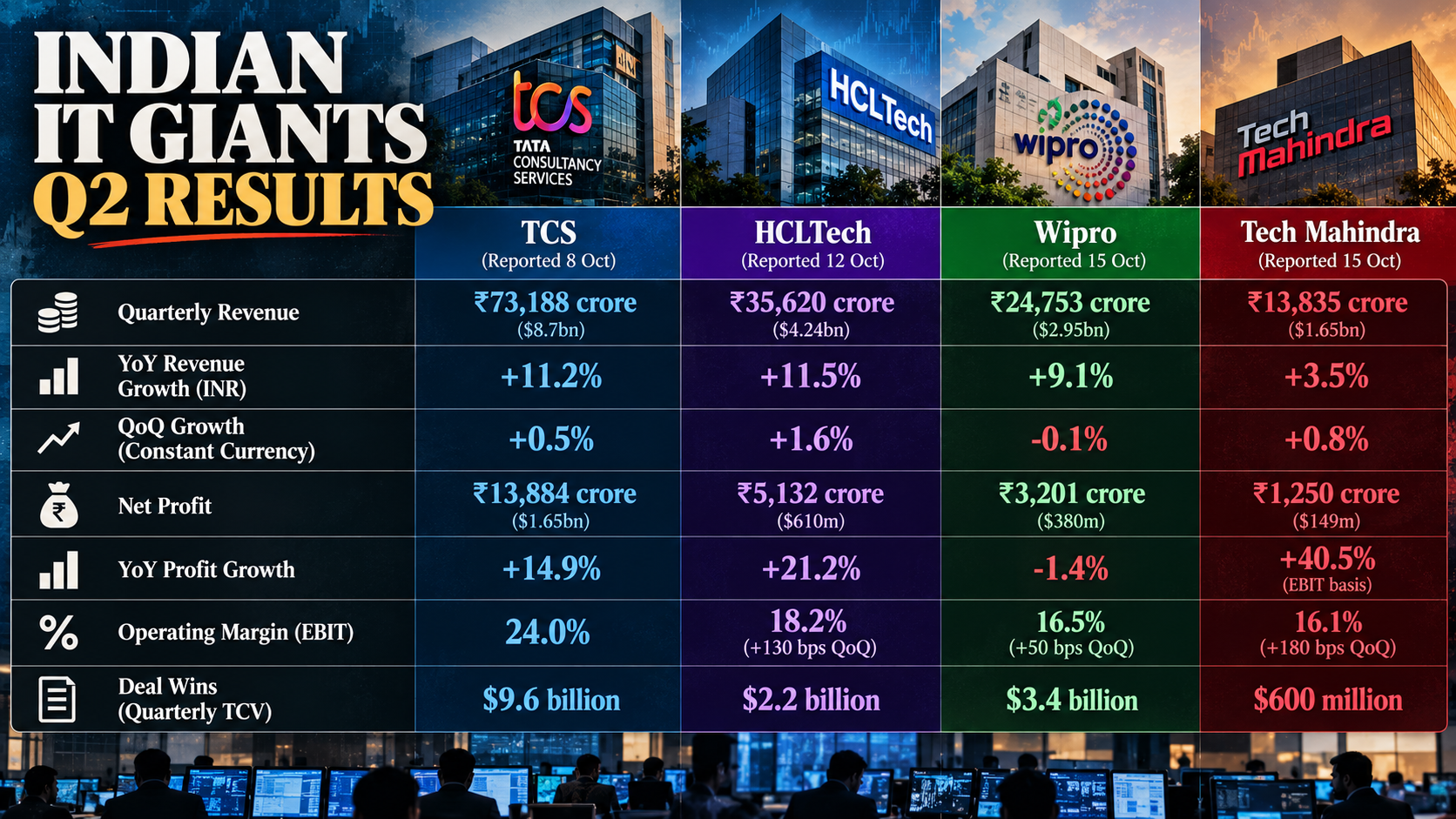
TCS set the tone by pairing an interim dividend of ₹12 per share with an operating margin of 24.0%, while highlighting that its annualized AI-led engagements had crossed $3.1 billion. HCLTech delivered the cleanest operational beat, expanding its operating margin to 18.2% on the back of its engineering services division and raising the floor of its full-year guidance.
Even laggards showed operational stabilization: Wipro managed to widen its IT-services operating margin by 50 basis points to 16.5% despite flat constant-currency volumes, while Tech Mahindra’s turnaround under Mohit Joshi generated a 40.5% YoY surge in operating profit.
Trend 1: The Disconnection of Profit from Volume
The most critical takeaway from Q2 FY27 is that Indian IT has learned how to engineer profit growth without underlying volume expansion.
In constant currency terms—which strips away the tailwind of a depreciating rupee against the US dollar and euro—organic revenue growth across the sector sat between 0.2% and 1.6% sequentially. In historical terms, this is anaemic.
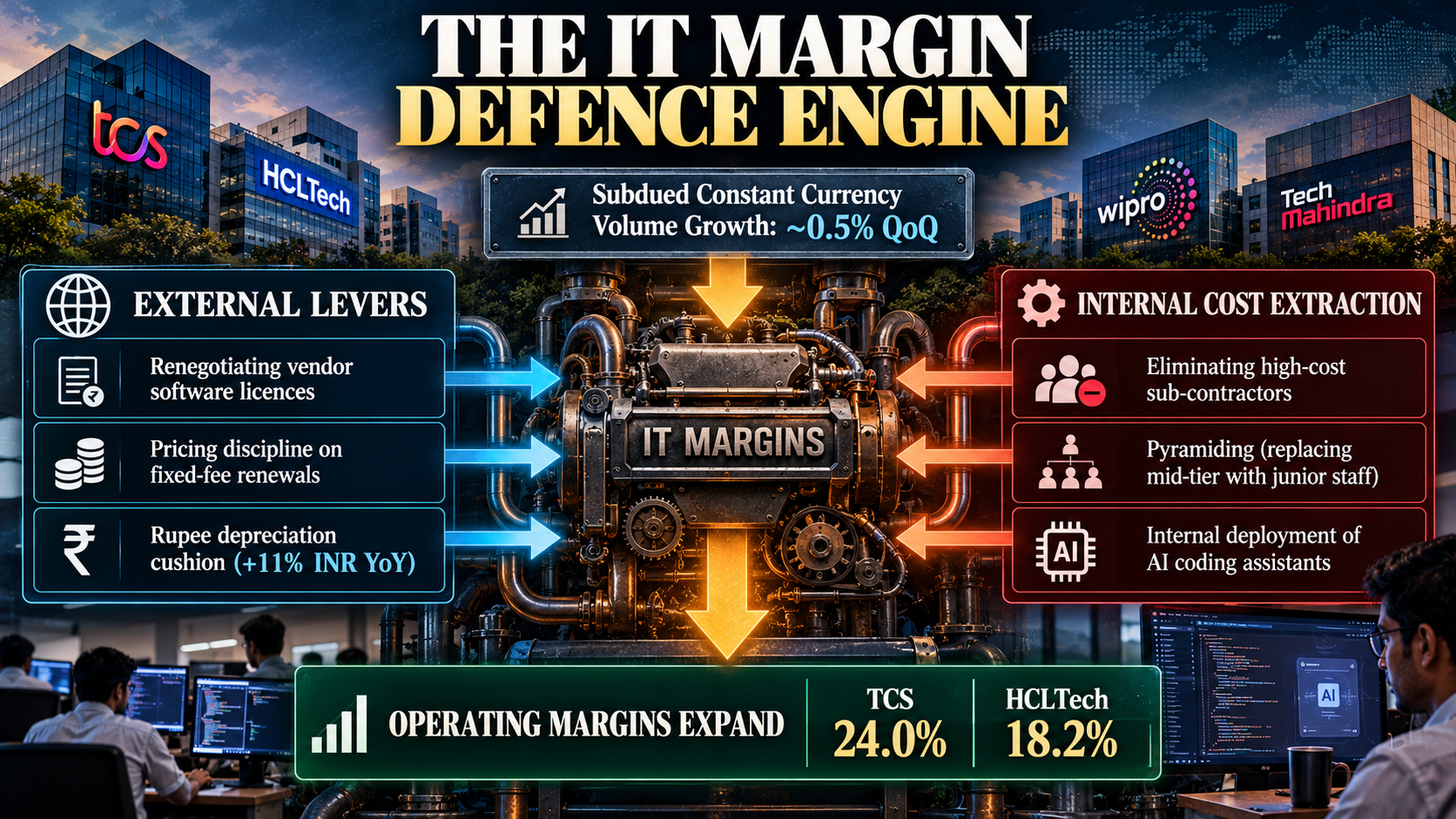
The margin expansion was manufactured through intense internal engineering:
The Purge of Subcontractors: Third-party contractor expenses, which ballooned during the post-COVID talent crunch, were cut by double digits across every major firm.
Internal Automation: IT majors are aggressively dogfooding generative AI and agentic software pipelines within their own delivery centres. Routine tasks in software testing, code refactoring, and IT infrastructure management are now handled by automated tools, allowing companies to deliver existing client contracts with fewer billable human hours.
Pyramid Restructuring: Mid-level management layers have been rationalized, with project workloads distributed downward to cheaper junior engineers supervised by automated project-tracking platforms.
While this protects earnings per share in the short term, cost extraction has mathematical limits. An industry cannot indefinitely expand profit margins by cutting internal overheads if client project volumes do not accelerate.
Trend 2: The End of the Linear Headcount Engine
For thirty years, the health of the Indian IT sector was measured by a single metric: net quarterly headcount additions. The economic model was built on linear labour arbitrage: to grow revenue by 10%, a firm had to recruit roughly 8% more engineers.
Q2 FY27 confirms that this model is finished.
Despite reporting combined annualised revenues approaching ₹2 lakh crore ($23.8 billion) for the quarter, the Tier-1 pack posted negligible net additions to their workforce. Campus recruitment pipelines for the 2026–27 academic year remain subdued, with entry-level onboarding staggered across multiple quarters.
Instead, companies are prioritizing revenue per employee. By embedding AI productivity tooling into engineering workstations, IT firms are absorbing new project requirements using existing bench capacity.
For the Indian macroeconomy, this represents a profound structural pivot. The IT sector can no longer be relied upon to act as an automatic sponge for the country's hundreds of thousands of graduating engineers each spring. It is evolving from a labour-intensive services industry into a capital- and technology-leveraged integration business.
Trend 3: BFSI Stabilises, but Discretionary Spending Remains Frozen
Geographically and vertically, Q2 results reveal a bifurcated enterprise spending environment:
The BFSI Rebound: The Banking, Financial Services, and Insurance (BFSI) vertical—which generates approximately 30% to 33% of sector revenues—recorded its first clear signs of sequential growth (+0.5% to +2.5% CC). American and European regional banks, having deferred digital overhauls during the interest rate hikes of 2023–2025, have resumed spending. However, this spending is narrowly channeled into non-discretionary mandates: regulatory compliance, core banking cloud migrations, and cybersecurity hardening.
The Discretionary Freeze: Outside BFSI, enterprise caution remains severe. Manufacturing, retail, and communications verticals reported flat or negative sequential trajectories. Global clients remain unwilling to fund speculative, greenfield transformation programmes without guaranteed short-term payback.
The nature of deal wins illustrates this caution. While headline Total Contract Value (TCV) numbers were large ($9.6 billion at TCS), the composition of these deals has shifted heavily from innovative digital transformation toward cost-takeout and vendor consolidation. Clients are approaching Indian vendors not to build new digital platforms, but to take over existing sprawling application estates at a 20% to 30% discount.
Trend 4: The AI Paradox — Growing Pipeline, Deflating Contracts
Every major earnings call in October 2026 was dominated by management commentary on artificial intelligence.
TCS disclosed that its active pipeline of generative AI and applied machine learning projects reached $3.1 billion. HCLTech highlighted enterprise deployments of its proprietary cognitive engines, while Wipro pointed to its acquisition of AI orchestration startup FLARRE.AI.
Yet beneath the marketing narrative lies an uncomfortable contractual reality: AI is simultaneously a revenue driver and a billing deflator.
In traditional IT outsourcing, contracts were governed by "time-and-materials" (T&M): the more hours an engineering team took to write, test, and deploy code, the more money the Indian service provider billed the Fortune 500 client.
Generative AI coding assistants have permanently altered this dynamic:
The Enterprise Clawback: Enterprise clients are well aware of AI coding efficiencies. During contract renewals, chief information officers (CIOs) are demanding mandatory productivity discounts. Tasks that previously required 50 software engineers on a multi-year billing schedule are now contracted for 25 engineers, with the client demanding that the 40% efficiency dividend be passed directly into contract pricing.
The Shift to Fixed-Fee: To prevent revenue destruction, Indian IT firms are hastily transitioning clients to fixed-price, outcome-based contracts. If a company can automate the work and deliver it faster, it captures the margin. If it remains trapped in hourly billing, its revenue contracts shrink.
In short, AI is keeping Indian IT companies relevant and protecting their margins, but it is acting as a natural brake on top-line dollar revenue growth.
Verdict: A Transition Quarter, Not a Boom
The Q2 FY27 earnings season demonstrates the remarkable operational discipline of India’s technology leaders. Faced with high interest rates abroad, cautious corporate clients, and structural technological disruption, companies such as TCS, HCLTech, and Wipro have defended their profitability, generated substantial free cash flows, and returned billions of rupees to shareholders in dividends and buybacks.
However, the earnings season also establishes that the nature of the industry has changed forever:
Growth is Cap-Constrained: The era of easy, double-digit constant-currency revenue expansion has been replaced by a grind for market share via vendor consolidation.
The Job Multiplier is Gone: Investors can celebrate expanding operating margins, but job seekers cannot celebrate hiring sprees. The productivity gains of AI are being retained as corporate profit rather than distributed as white-collar hiring.
The Bar Moves to Specialisation: The firms that outperformed in Q2—such as HCLTech with its specialised engineering R&D services—demonstrate that commoditised IT maintenance is vulnerable, while deep engineering expertise and complex system architecture command premium pricing.
Dalal Street’s relief rally was a justified response to an earnings disaster that never happened. But the road ahead will be defined by an uncomfortable truth: Indian IT is no longer a high-growth volume engine; it has matured into a defensive, cash-generative value machine.