In brief
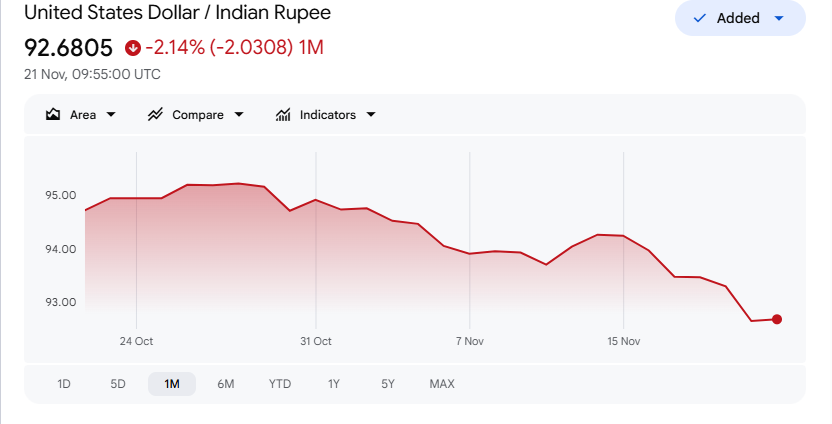
- The Indian rupee closed at ₹92.67 per USD on 20 November 2026, its best level in seven months and a weekly gain, near ₹93 after five straight sessions of gains.
- November sees the rupee leading Asia in monthly gains (roughly 1.7%–2%), with the move partly a mean reversion from a May 2026 low of ₹96.96, though it remains about 3% weaker than the start of 2026.
- The rally occurred despite the US Dollar Index near a 19‑month high, supported by Fed minutes signaling potential further rate hikes, including December.
- Strong foreign inflows into Indian equities (about ₹1.01 trillion in November through 19 November, with a daily record of ₹7,411.41 crore on that day) have allowed the RBI to scale back spot dollar sales, though the RBI’s large forward-dollar exposure limits sustained rupee risks.
The Indian rupee closed at ₹92.67 per US dollar on Friday, 20 November 2026, breaking past the ₹93 mark for the first time since April 2026 and logging its best weekly performance of the year (The Hindu, HDFC Sky). Advancing 65 paise on Friday alone to cap five consecutive winning sessions, the currency has risen roughly 1.7%–2% so far in November—making it Asia’s top-performing currency over the month and putting it on course for its strongest monthly gain in 20 months (Kotak Neo, Upstox, InvestmentGuruIndia).
The rebound has erased nearly all of the rupee’s financial-year 2026–27 (FY27) losses and represents a 4.4% recovery from its all-time low of ₹96.96 per dollar hit in late May 2026 (Economic Times, Kotak Neo). Even so, it remains roughly 3% weaker than its 1 January 2026 opening near ₹89.98—a reminder that November’s surge is a partial mean reversion rather than a full return to early-2026 levels (Upstox).
What Drove the Rupee Past ₹93 While the US Dollar Stayed Near a 19-Month Peak
What makes November’s rally unusual is that it occurred while the US Dollar Index (DXY) hovered near a 19-month high of 103.8, supported by Federal Reserve minutes showing officials open to further interest-rate rises, including a possible half-point move in December (InvestmentGuruIndia). Three domestic and global shifts overpowered that dollar strength:
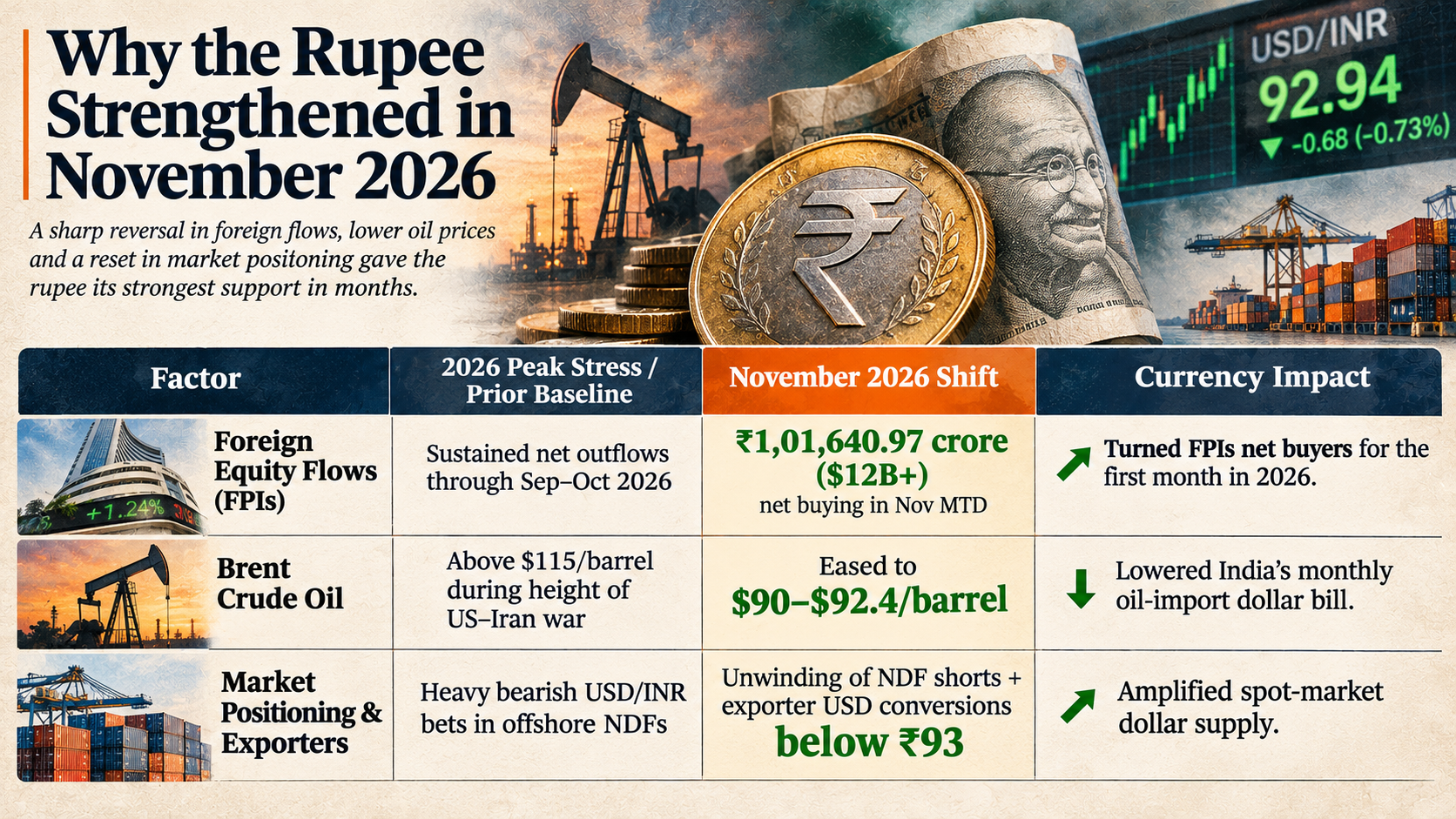
The decisive catalyst has been global equity rotation. Following October’s sell-off in crowded artificial-intelligence stocks across the United States and East Asia, international funds reallocated into Indian equities—considered less exposed to AI hardware-bubble risk—pushing the Nifty 50 up more than 10% in November (TradingView, Economic Times). Foreign investors bought ₹7,411.41 crore ($792.7 million) of Indian shares on 19 November alone, bringing cumulative November purchases to ₹1,01,640.97 crore ($10.87 billion at ₹93.50/USD, and over $12 billion including primary and block flows tracked by Reuters) (Angel One, Kotak Neo).
The RBI’s $239.2 Billion Forward Book: Why Gains May Face a Ceiling
Stronger inflows have allowed the Reserve Bank of India (RBI) to scale back spot dollar sales after months of heavy intervention (TradingView). Yet the central bank’s own balance sheet explains why analysts doubt the rupee can sustain a runaway move below ₹92.
As of September 2026, the RBI’s outstanding net short dollar position in the forward market stood at a record $239.2 billion (₹22.37 lakh crore at ₹93.50/USD)—comprising roughly $40 billion maturing within one year, $56 billion in one to three years, and $143 billion in three to five years (Business Standard, BW CFO World). India’s headline foreign-exchange reserves stood at $705.34 billion in the week ended 13 November 2026, down from a September peak of $785.71 billion built partly through the RBI’s special June 2026 FCNR(B) and external commercial borrowing swap window (Trading Economics, RBI, CapitalVia). Deducting the forward commitments leaves roughly $466 billion to $480 billion in unencumbered reserves—still comfortable at about seven months of import cover, but requiring the RBI to buy dollars whenever capital inflows surge in order to honour maturing contracts (TradingView/Mint, CapitalVia).
Accordingly, Goldman Sachs forecasts USD/INR stabilising around ₹94 over the next three months before edging to ₹95 in six months and ₹96 over 12 months, while IDFC First Bank projects ₹92–₹94 by December 2026, ₹94–₹95 by March 2027, and ₹96 by June 2027 (Economic Times, TradingView).
Winners and Losers: IT Margins Reverse as Imported Costs Ease
The currency’s reversal is already reshaping Indian corporate earnings:
Information Technology Pressure: Kotak Institutional Equities estimates that the rupee’s 2.5% quarter-to-date rise against the US dollar—alongside gains of 6.2% against the euro and 3.4% against the British pound—could trim IT services operating margins by 50–70 basis points and cut FY27 unhedged earnings by 4% to 13% (Economic Times). In Q2FY27, currency depreciation had accounted for roughly 8 to 9 percentage points of reported rupee revenue growth at Tata Consultancy Services (11.2% rupee growth vs 2.8% constant currency on ₹73,188 crore revenue) and Infosys (10.7% rupee growth vs 1.5% constant currency on ₹49,244 crore revenue); the Nifty IT index has dropped over 5.5% in November as that cushion vanishes (Upstox).
Importers and Inflation Relief: Lower crude prices combined with a firmer rupee ease imported input costs for oil-marketing companies, electronics manufacturers, and consumer-durables makers, while reducing urgency for aggressive RBI rate hikes (BW CFO World).
Whether the rupee holds below ₹93 into December now hinges on two variables: whether foreign equity buying sustains once global AI volatility settles, and how aggressively the RBI steps in to buy dollars near ₹92.50 to rebuild its forward book.