
In brief
- India's stock market surged in early November 2026 after months of underperformance, becoming the world's best-performing market as four global and corporate catalysts aligned.
- The rally was driven by an anti-AI rotation away from chip-heavy markets, Brent crude falling to $91 a barrel, a 27.5% year-on-year profit jump across 395 NSE 500 companies, and foreign buying ahead of MSCI index review.
- On 13 November the Sensex fell 318 points after October inflation hit 6.09%, breaching the RBI's 6% ceiling, while four tests loom including further RBI and Fed rate hikes, oil price volatility, and narrow market breadth.
- Structural strengths remain, including above 7% GDP growth, clean corporate balance sheets and a ₹505.70 lakh crore market cap, but the next leg faces sharper rotation and volatility around December central-bank meetings.
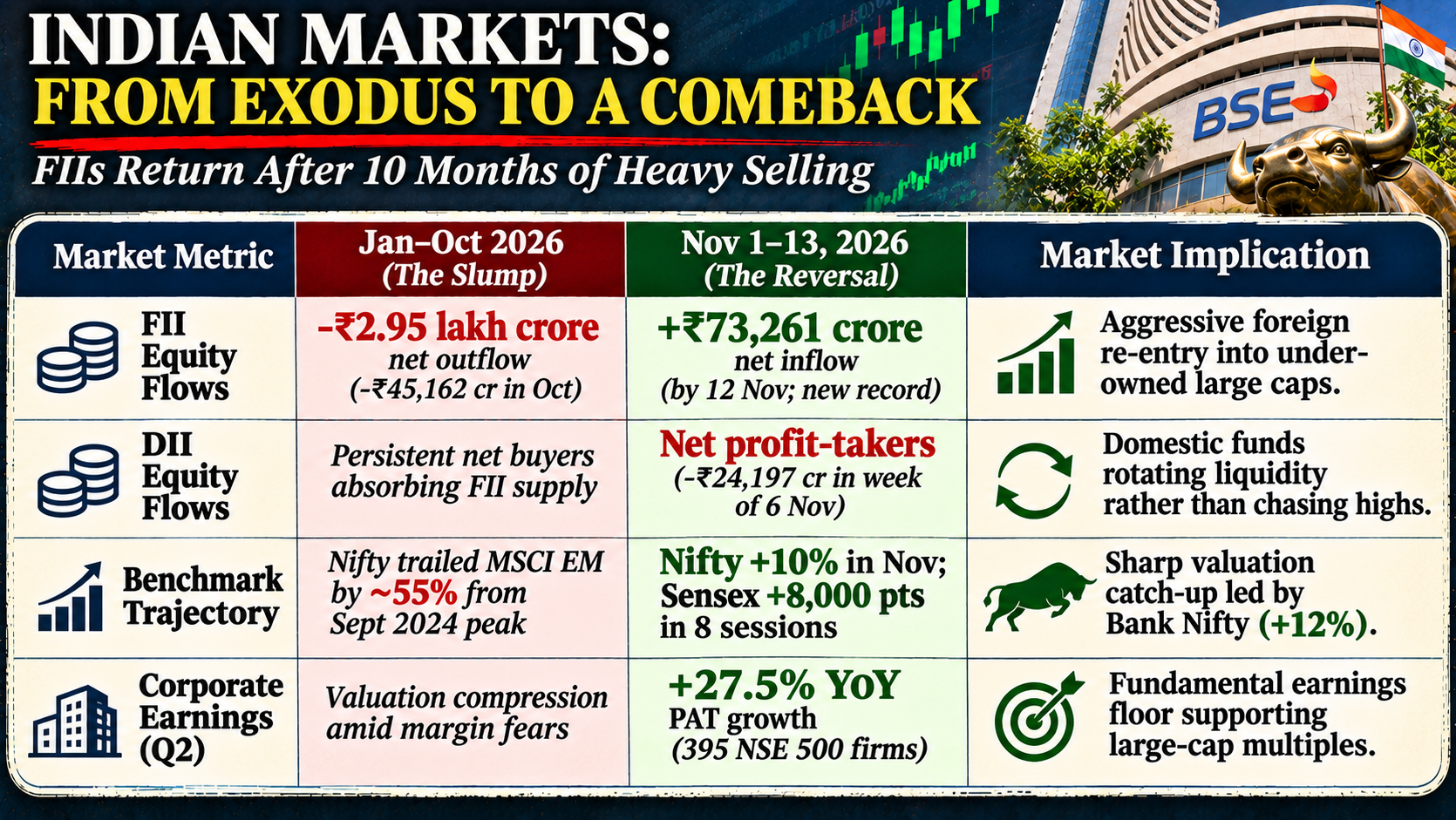
For most of 2025 and 2026, India’s stock market tested investor patience. After peaking in September 2024—and briefly touching a Nifty 50 record of 26,373.20 on 5 January 2026—Indian equities spent months grinding sideways and downward, trailing the MSCI Emerging Markets Index by roughly 55%. Between January and October 2026 alone, Foreign Institutional Investors (FIIs) pulled out ₹2.95 lakh crore from Indian shares.
Then, in the first two weeks of November 2026, the script flipped completely.
During the week ended 6 November, the Nifty 50 surged 8.6% and the BSE Sensex jumped 8.8%—their sharpest weekly advance in nearly six years—propelled by ₹45,960 crore in weekly FII purchases (Kotak Neo). By 12 November, the Sensex had climbed 8,000 points in eight sessions, adding nearly ₹38 lakh crore in BSE market capitalisation, while monthly FII inflows hit a record ₹73,261.33 crore—breaking the all-time monthly record of ₹66,135 crore set in December 2023 even before the month was halfway over.
Yet Friday, 13 November offered an immediate reality check: the Sensex snapped its winning streak, slipping 318.56 points to 81,592.45, and the Nifty 50 fell 155.05 points to 25,144.30 after India’s October inflation breached the Reserve Bank of India’s (RBI) 6% ceiling. To judge whether November’s surge is the opening leg of a durable bull market or a fierce tactical bounce, investors must examine what drove the sudden turnaround—and what now stands in its way.
How India Became the World’s Best-Performing Market: Four Catalysts
India’s November outperformance was not driven by a single domestic policy announcement; it resulted from four global and corporate forces aligning simultaneously:
1. The Global "Anti-AI" Rotation
Throughout 2025 and early 2026, global emerging-market capital crowded aggressively into semiconductor and AI-hardware powerhouses—chiefly Taiwan (TSMC) and South Korea (Samsung and SK Hynix), which together grew to represent nearly one-third of the MSCI Emerging Markets Index. When global investors grew nervous over AI capital-expenditure returns in late October—and as Nvidia’s share price tumbled amid its November leadership crisis—chip-heavy Asian markets suffered sharp drawdowns. As HSBC Asset Management noted in its 2 November tracker, India’s low direct exposure to AI hardware transformed from a liability into a defensive shield, drawing global funds hunting for uncorrelated domestic growth.
2. Oil Relief and West Asia De-escalation Hopes
India’s equity slump through 2026 was heavily tied to West Asia hostilities that pushed Brent crude near $100 a barrel. In early November, Brent retreated toward $91 a barrel—a multi-week low—following signals from Washington that further military strikes on Iran appeared unnecessary and reports of potential US–Iran talks. For an economy that imports over 85% of its crude oil, even a temporary $8–$9 drop in oil immediately eases imported inflation, fiscal subsidy math, and corporate margin anxiety.
3. A 12-Quarter-High Earnings Rebound
Foreign buyers did not return blindly; they returned to improving fundamentals. Across 395 NSE 500 companies that reported second-quarter FY27 results by 12 November, combined profit after tax grew 27.5% year-on-year, with Nifty 50 earnings expanding roughly 24%—a 12-quarter high. Bank Nifty jumped 12% in November to cross 61,000 on resilient credit growth and clean asset quality, while Indian IT services staged a sharp comeback as mid-tier and large-cap firms demonstrated they could win AI-integration contracts rather than be displaced by them.
4. The FII–DII Role Reversal and MSCI Flows
After ten months of relentless foreign selling, FII positioning in India was historically underweight. Once sentiment turned, short-covering combined with active buying ahead of MSCI’s November 2026 index review (projected to draw roughly $2 billion in passive inflows). Remarkably, Domestic Institutional Investors (DIIs)—who had propped up the market all year—took the opposite side, selling ₹24,197 crore in the week ended 6 November and ₹6,331 crore on 12 November to lock in gains.
Will This Bull Run Continue? Four Tests Ahead
Friday’s pullback on 13 November—which pushed NSE market breadth negative (2,179 declining stocks against 1,446 advancing)—underscores that the easy phase of the rebound is likely over. Whether Indian equities can sustain a fresh bull run into 2027 depends on four critical tests:
1. India’s 6.09% Inflation Breach and the RBI
On 12 November, India’s October CPI inflation printed at 6.09%, crossing the RBI’s 6% upper tolerance limit for the first time in two years on the back of an 8.94% food-price surge. Because the RBI had already hiked the repo rate by 25 basis points to 5.50% in October under a "calibrated tightening" stance, markets now face the prospect of a second consecutive hike on 4 December—with domestic brokerage Emkay warning of up to 75 basis points in cumulative tightening if El Niño keeps food prices elevated. Rate-sensitive sectors such as autos, real estate, and NBFCs (which led Friday’s declines) will face valuation headwinds if borrowing costs climb further.
2. US Treasury Yields and a Hawkish Federal Reserve
Hotter-than-expected US consumer price data has pushed the US 10-year Treasury yield back toward 5%, prompting Federal Reserve Governor Christopher Waller to signal support for a 50-basis-point US rate hike in December. Historically, a 5% risk-free US Treasury yield acts as a powerful magnet, capping sustained FII allocations to emerging markets once initial tactical reallocations finish.
3. Crude Oil’s Fragile Floor
Brent crude’s bounce back above $95 a barrel by 13 November served as a reminder that West Asia diplomacy remains volatile. If shipping disruptions or renewed strikes push crude back toward $100, India’s macro trade-off—higher imported inflation alongside a weaker rupee—will return immediately.
4. Large-Cap Breadth vs Mid-Cap Lag
Technical data shows more than 65% of Nifty 100 large-cap stocks now trade above their 200-day moving averages, whereas the Nifty Midcap 100 and Smallcap 100 indices continue to lag. A durable bull market requires broader participation beyond flagship banks and index heavyweights, supported by steady Q3 earnings rather than mere multiple expansion.
The Bottom Line
India became the world’s top-performing equity market in early November because global investors needed an uncrowded, earnings-backed alternative to an overheating global AI trade—and found one in Mumbai’s undervalued large caps just as oil prices cooled.
That structural appeal remains intact: domestic GDP growth is projected above 7%, corporate balance sheets are clean, and NSE’s total market capitalisation now stands at ₹505.70 lakh crore ($5.37 trillion). However, with domestic inflation above 6%, the RBI and US Fed both leaning hawkish ahead of December, and DIIs selling into foreign strength, the next leg of the bull run is unlikely to be a straight vertical climb. Expect sharper sector rotation, heightened volatility around December’s central-bank meetings, and a market that rewards earnings delivery over broad index beta.