In brief
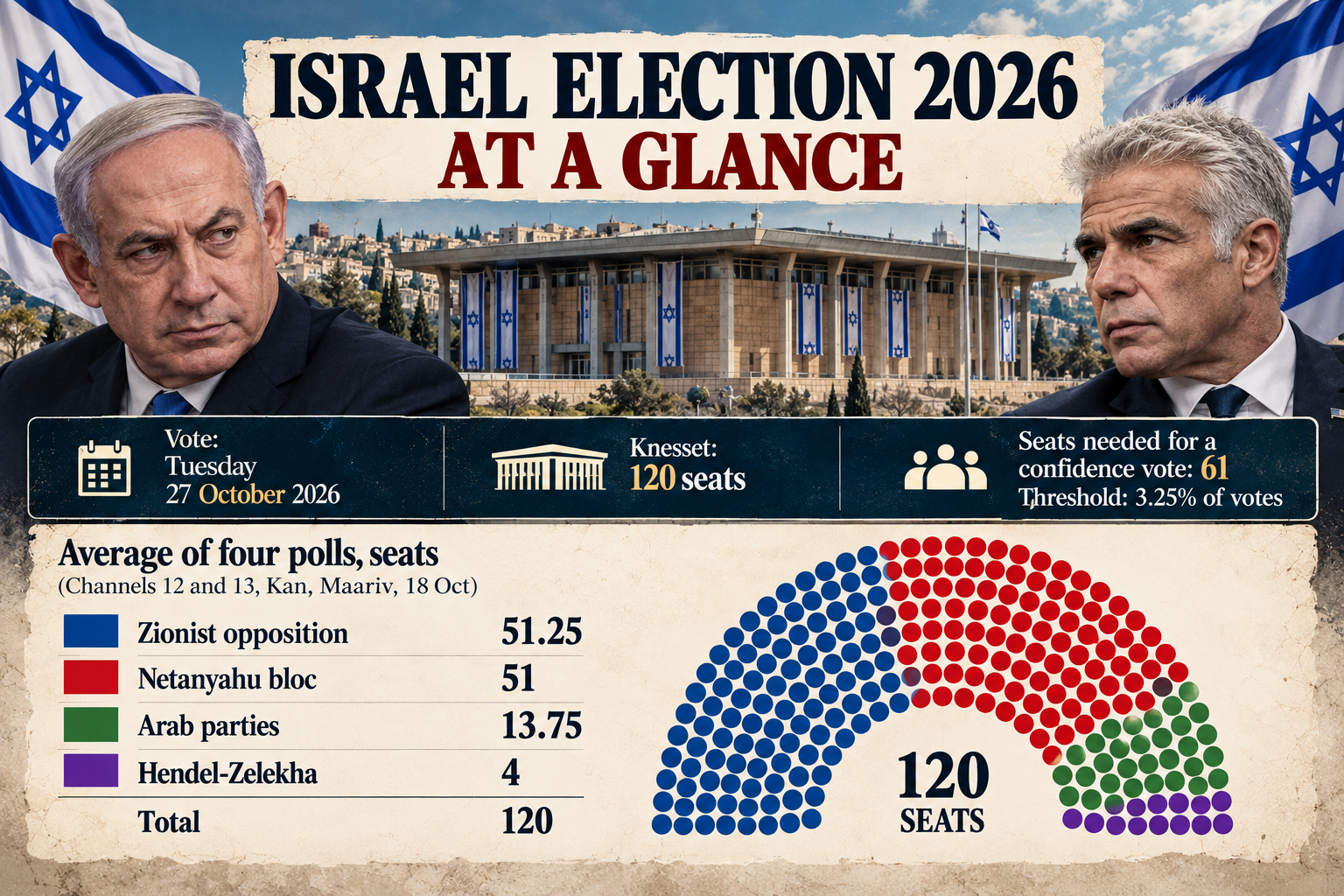
- Four polls published on 18 October put the two main camps almost level, with the Zionist opposition averaging 51.25 seats and Benjamin Netanyahu's bloc 51, making a majority for nobody.
- Israelis vote on Tuesday 27 October for a new 120-seat Knesset, and a government needs at least 61 members to survive a confidence vote.
- The real fight involves small parties, Arab turnout, ultra-Orthodox parties' demands, and weeks of bargaining after the count.
- Official results are due by 4 November, and the president may then try to form a government within 28 days, plus up to 14 more days.
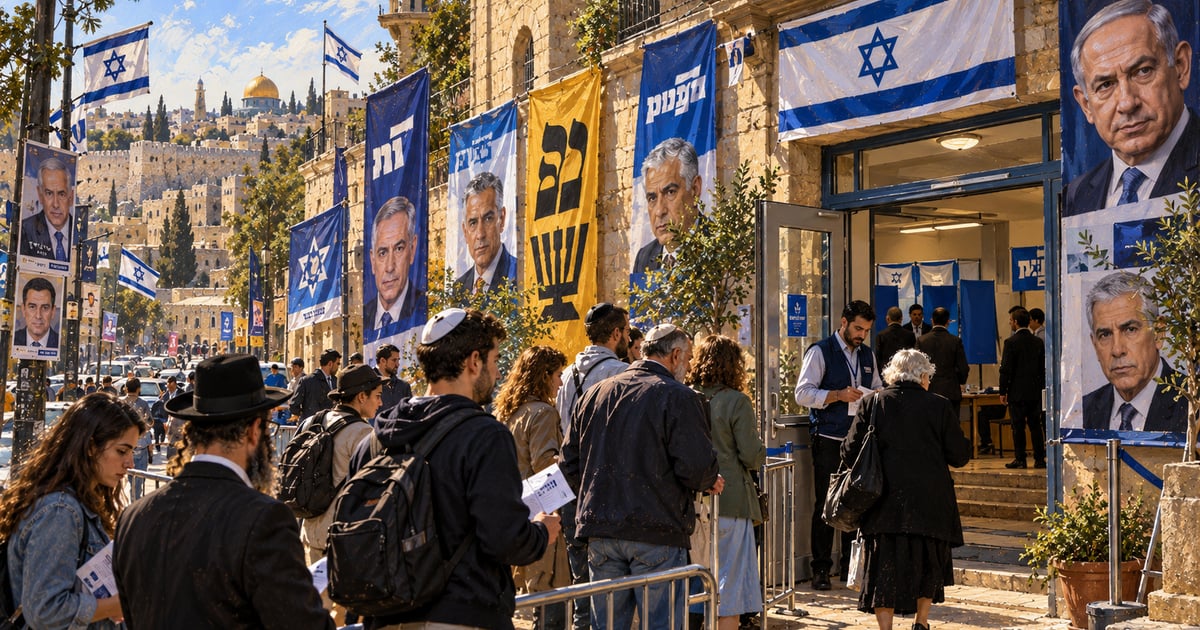
Israelis vote on Tuesday 27 October for a new 120-seat Knesset, the first since 1988 on its scheduled date. A party needs 3.25% of the vote to win any seats. A government needs at least 61 members behind it to survive a confidence vote.
Four polls published on 18 October put the two main camps almost level. The Zionist opposition averages 51.25 seats and Benjamin Netanyahu's bloc 51. That is a majority for nobody. The real fight is over small parties, Arab turnout, the ultra-Orthodox parties' demands and the weeks of bargaining after the count. This guide covers who is running, what voters care about, and how a government could, or could not, form.
1. Both blocs are stuck about ten seats short
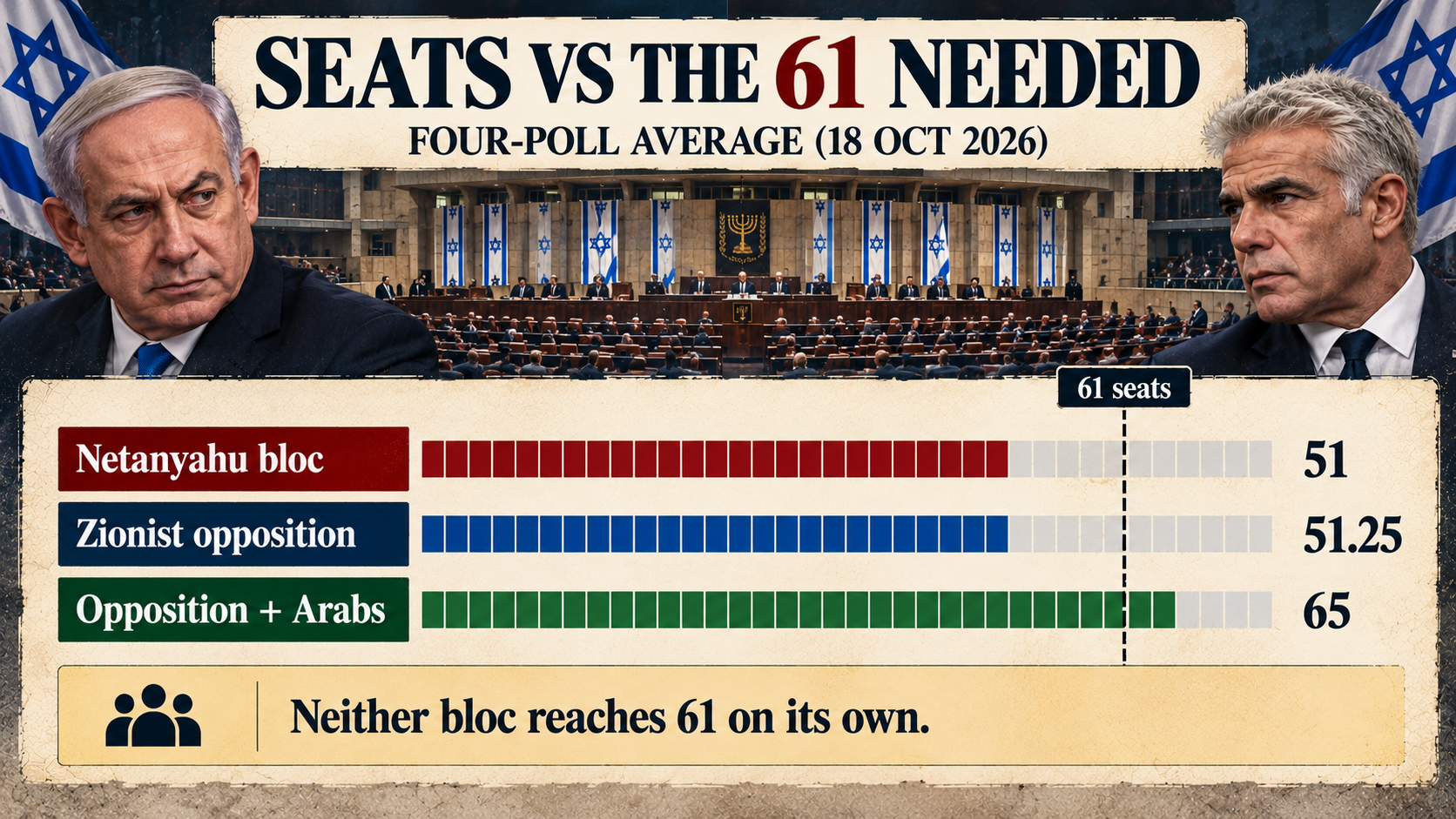
Neither side reaches a majority on today's numbers.
On paper the opposition plus the Arab parties would reach 65. In practice that sum is arithmetic, not a plan. Naftali Bennett rules out Arab and ultra-Orthodox partners. Arab turnout also runs low: 53.2% in 2022, against 70.6% overall.
2. The pollsters disagree more than the blocs do
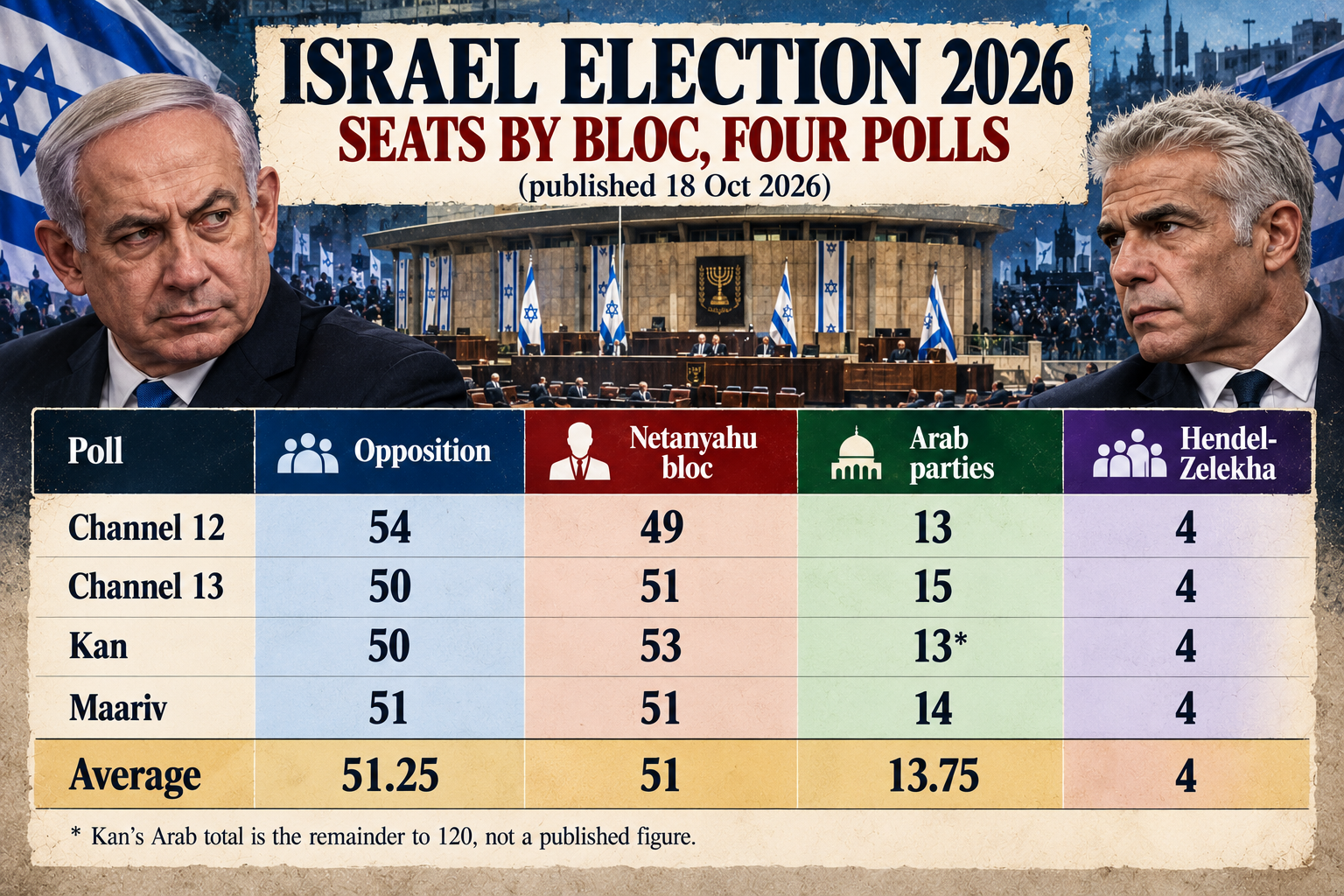
Channel 12 has the opposition ahead 54 to 49. Channel 13 has Netanyahu's bloc ahead 51 to 50, and Kan has it ahead 53 to 50. A single bloc moves by up to 4 seats depending on the pollster, while the gap between the two averages is a quarter of a seat. One poll tells you very little.
The small parties make this harder. Channel 12 put Winter's People of Israel at 1.8%, under the line, and Hendel and Zelekha's joint list at 4 seats. The sums are simple: 3.25% of 120 seats is about 3.9 seats, so any list below it throws its votes away. Maariv's pollster, Menachem Lazar, told the Jerusalem Post that if Winter's party misses, the balance tilts to the opposition, and if Hendel and Zelekha miss, it tilts to the coalition. He put the undecided at 5 to 6%, mostly choosing within one bloc rather than switching, and said the country may end up stuck with no government.
3. Who is running
The biggest list is not Netanyahu's. Gadi Eisenkot's Yashar averages 21.5 seats across the four polls, Likud 19 and the alliance led by Bennett 12.5. Shas and United Torah Judaism each poll about 7 seats in Maariv, and the Joint Arab List 7 with Ra'am on 5.
Candidate polling tells a slightly different story. In Maariv's 7 to 8 October poll, Netanyahu was the top choice for prime minister at 38%, ahead of Eisenkot on 24% and Bennett on 14%. Head to head, Bennett beat Netanyahu 44 to 42 and Eisenkot beat him 46 to 40. Opposition voters sounded keener: 86% said they were certain to vote, against 81% on the coalition side.
Bennett's alliance has Yair Lapid at number two. Avigdor Liberman's Yisrael Beytenu is hawkish, wants religion and state separated and takes a hard line on the draft. Eisenkot is more lenient on it and would sit with Shas, the same explainer says. Itamar Ben-Gvir's Otzma holds six seats now and polls up to nine; he wants the defence ministry and presents himself as a right-wing alternative to Netanyahu.
Netanyahu is on trial in three cases and faces an ICC warrant. The Israel Democracy Institute's Prof. Ofer Kenig says his strategy has shifted to just trying not to lose.
4. What voters say they care about
Security and the economy are almost tied at the top, and the economy is the stranger story. Growth was 3.2% in the first half of 2026 with unemployment at 2.8%, yet food prices are up 8% since the start of 2024, according to the group Lobby 99. The war has cost about NIS 350 billion (USD 114.6 billion) to March 2026, and Netanyahu wants a NIS 183 billion defence budget, about USD 60 billion.
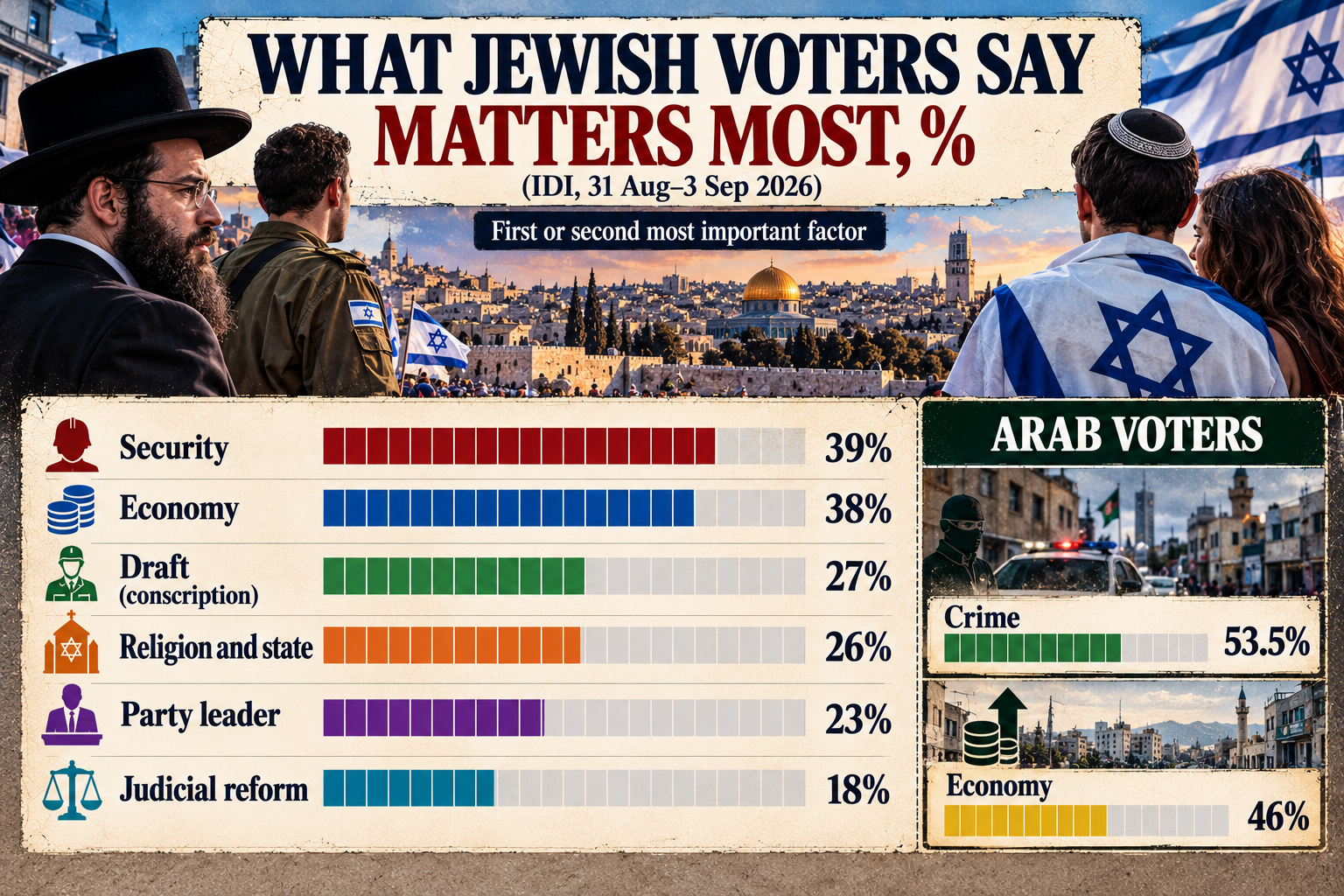
Arab voters rank crime first. The same survey found 68% of Jews and 32% of Arabs call 7 October central to their vote. The inquiry into it is a campaign fight too: the High Court postponed any ruling until after the election, and Netanyahu prefers a panel picked by lawmakers to one appointed by the court. Gaza hangs over everything. Israel says it will not withdraw before Hamas fully disarms, while Hamas ties its heavy weapons to Palestinian statehood, AP reported in July.
5. The draft fight that could break a coalition
The dispute over drafting ultra-Orthodox men has run through three court steps and one law. In July the Knesset passed, 58 to 54, a temporary law freezing arrests of students who do not report. The High Court froze it the next day and struck it down on 3 September. Eight of nine justices also called it unconstitutional in substance, the Jerusalem Post reported. That leaves no draft law on the books.
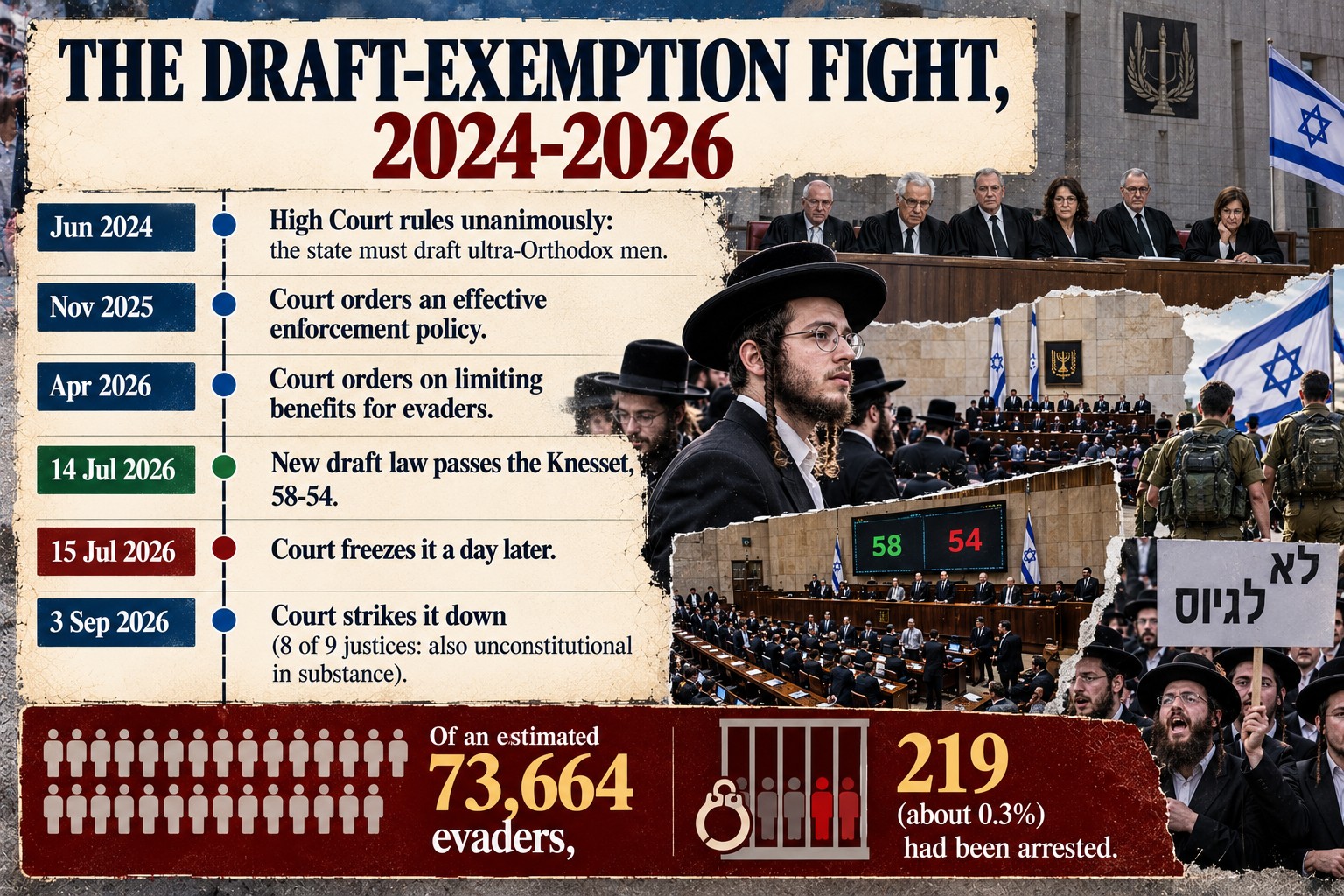
This matters because 67% of respondents in an IDI July poll opposed the freeze, and some ultra-Orthodox factions may prefer opposition until it is settled. Any coalition that needs them has to find a way through.
6. After the vote: the open question
Counting is only the start. Official results are due by 4 November, and the president then picks one member to try forming a government. That person gets 28 days, plus up to 14 more. In 2022 the whole process ran from 1 November to 29 December.
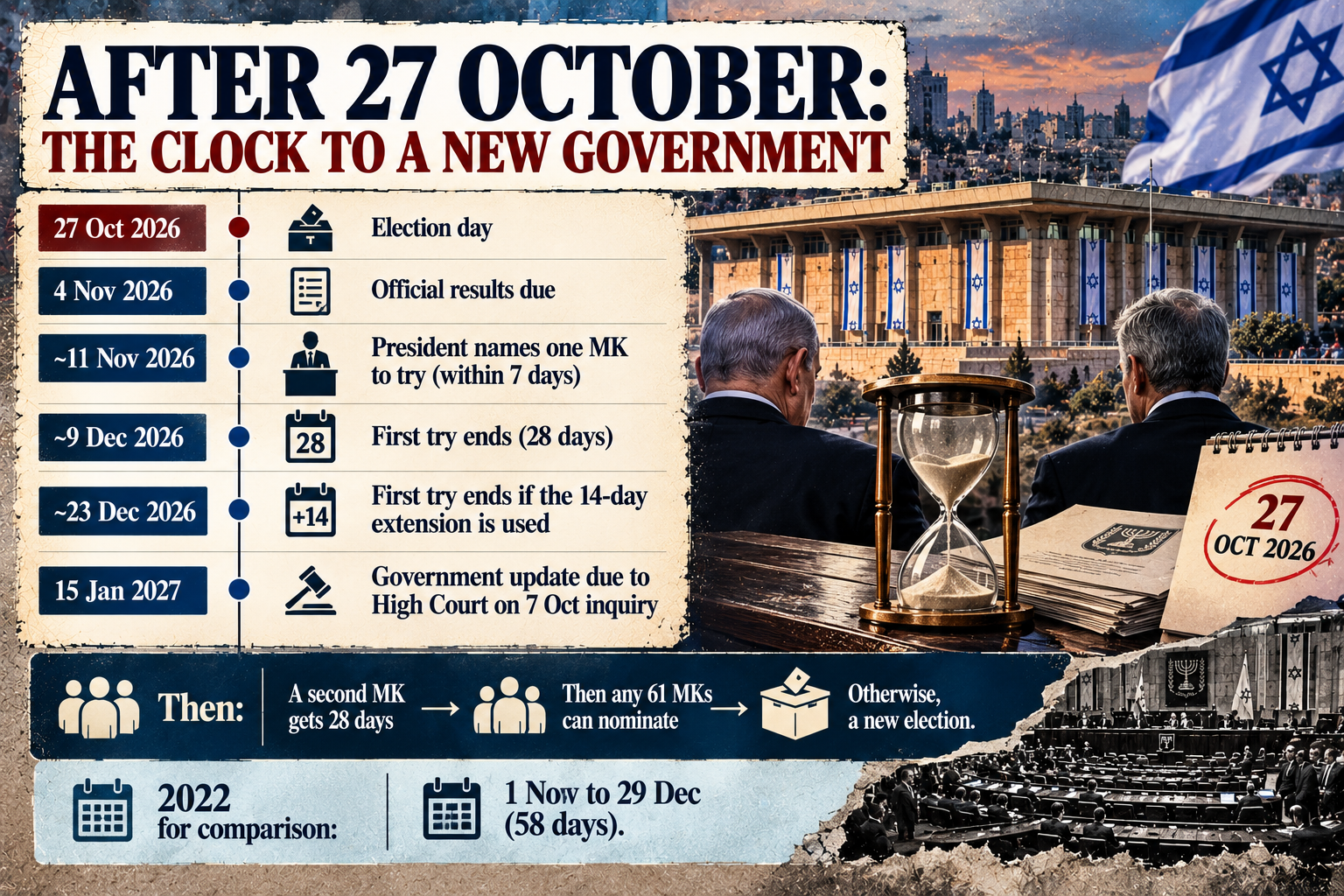
President Isaac Herzog has said he will do everything to avoid repeat elections, and unity or rotation deals could return if neither side reaches 61. Netanyahu asked for a pardon in November 2025; in April Herzog was wanting a plea deal first. Trust is thin. In the IDI survey, 56% saw a high chance the losing side would refuse to accept the result and respond with force. Some 63% of Jews expected interference from inside Israel and 54% from abroad. Claims about the election machinery are already contested: critics say the coalition cut the election committee's budget by NIS 50 million, which we could not confirm independently.
So the question is not who finishes first on 27 October. It is whether anyone can gather 61 seats from a map that currently offers neither side a path, and how long Israel waits to find out.