In brief
- ISRO completed detailed design of a 2,400 kN full-flow staged combustion methalox engine on 16 October 2026, becoming only the third programme ever to pursue this cycle after the Soviet RD-270 and SpaceX Raptor.
- The engine will power a future human-rated heavy-lift vehicle targeting an Indian crewed lunar landing by 2040, requiring 80 to 100 tonnes to low Earth orbit.
- ISRO built the design on earlier work including the 200 kN LM20-TD demonstrator tested in 2019-2020, kerolox staged combustion experience from the SCE-200, and the 1,100 kN LME1100 gas generator engine tested in October 2026.
- Remaining hurdles include developing oxidation-resistant superalloys for the oxidiser-rich preburner, tuning dual-shaft startup transients, and expanding test infrastructure at Mahendragiri for 250 bar chamber pressures.
In the hierarchy of liquid rocket propulsion, the Full-Flow Staged Combustion Cycle (FFSCC) occupies a category of its own. Rocket engineers often refer to it as propulsion's holy grail—a thermodynamic cycle so demanding in its metallurgy and fluid mechanics that across seventy years of the space age, only two operational programmes have ever succeeded in building and hot-firing one: the Soviet Union with the experimental RD-270 in the late 1960s, and SpaceX with the Raptor engine powering Starship today.
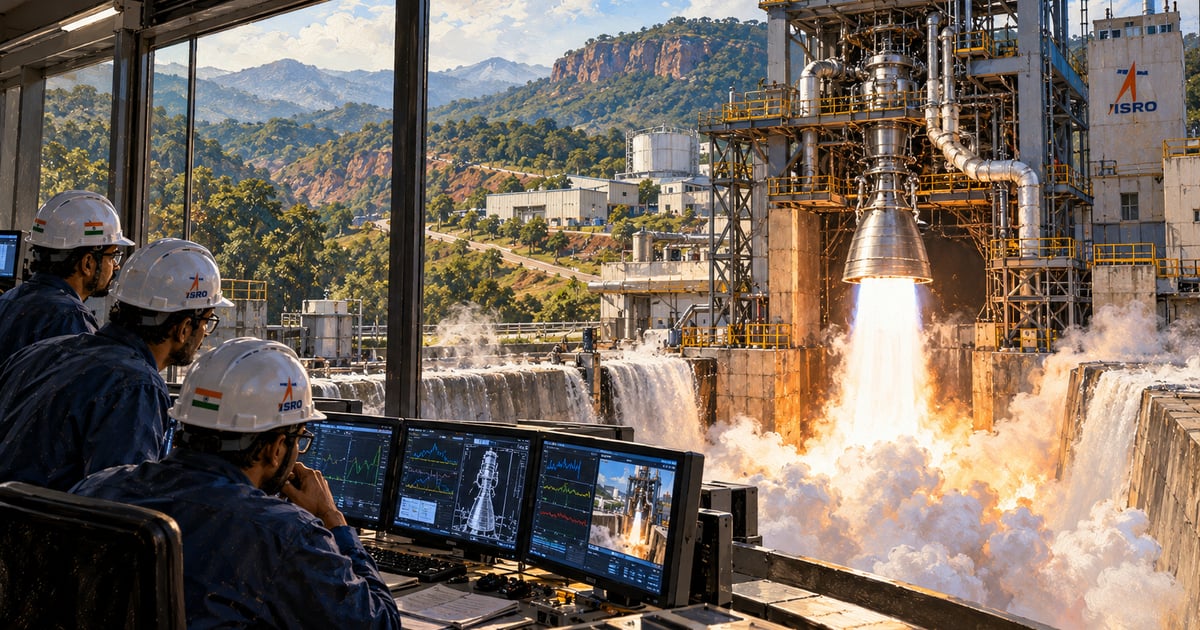
On 16 October 2026, the Indian Space Research Organisation (ISRO) officially announced that it has completed the detailed engineering design of a domestic 2,400 kN Full-Flow Staged Combustion liquid oxygen–liquid methane (LOX–Methane / Methalox) rocket engine.
Engineered at the Liquid Propulsion Systems Centre (LPSC) in Valiamala, Thiruvananthapuram, this 240-tonne-thrust engine is designed for a single purpose: to serve as the high-thrust propulsion core for a future human-rated Heavy-Lift Launch Vehicle capable of sending an Indian crewed landing stack to the lunar surface by 2040.
The announcement marks a fundamental pivot in Indian aerospace architecture. By leapfrogging traditional open-cycle engines, ISRO is staking its long-term deep-space ambitions on high-pressure, gas-gas combustion.
The Propulsion Spectrum: Why Full-Flow Is Superior
To understand why the 2,400 kN design represents such a significant leap, one must examine the fundamental thermodynamic trade-offs of liquid rocket engines.
Liquid engines do not simply pour fuel and oxidiser into a chamber; they require massive mechanical energy to drive turbopumps that force hundreds of kilograms of cryogenic propellants per second into high-pressure combustion zones. How an engine powers those turbopumps determines its efficiency.
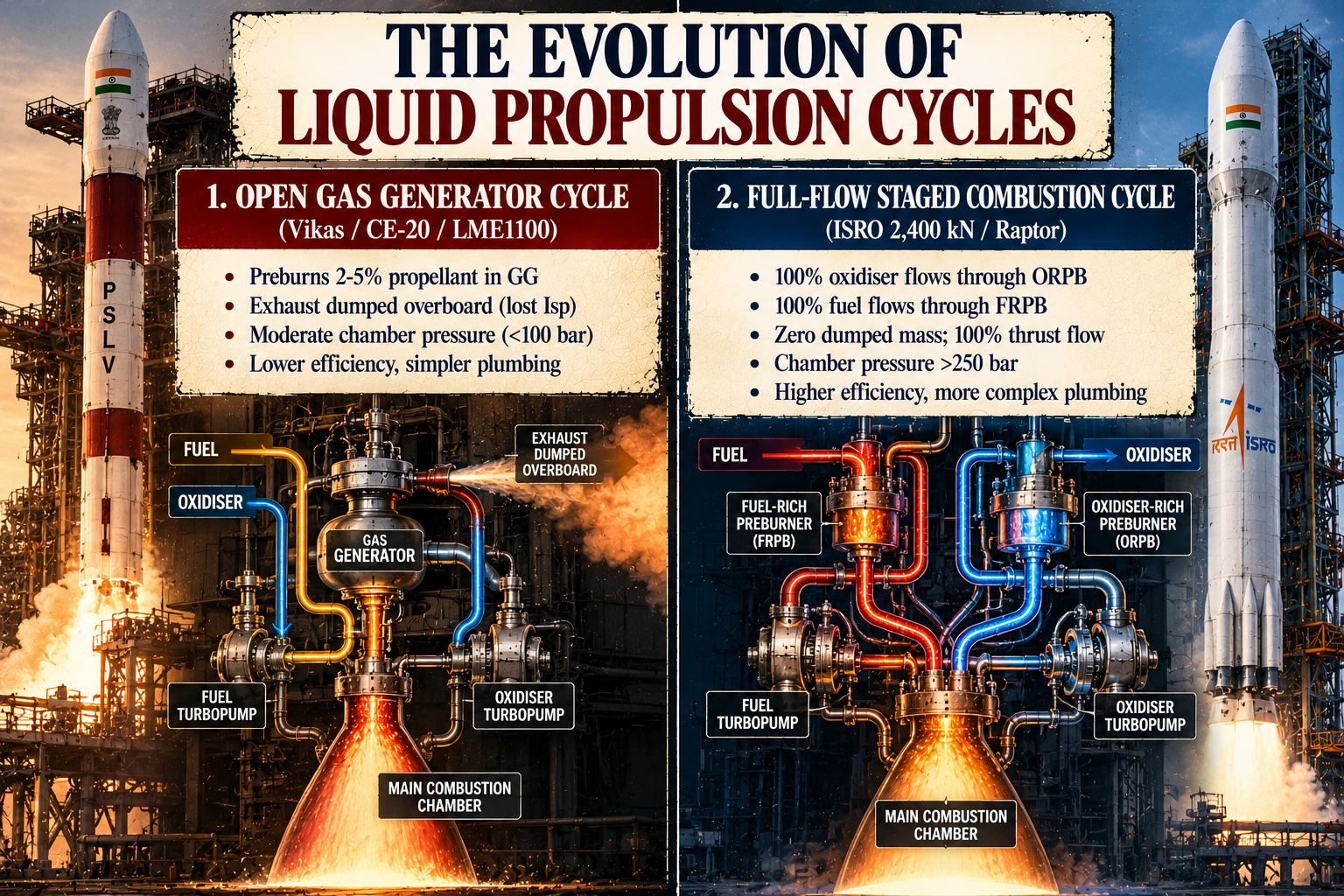
1. The Open Gas Generator Cycle
In engines such as ISRO’s workhorse Vikas (kerolox/hypergolic), the CE-20 cryogenic engine, or the new LME1100, a small fraction (typically 2% to 5%) of the propellants is tapped off, burned in an external gas generator, and used to spin a turbine. That exhaust gas is then dumped overboard through a secondary nozzle.
While mechanically straightforward, it incurs an unavoidable specific impulse ($I_{sp}$) penalty: up to 5% of the onboard propellant mass produces almost no thrust. Furthermore, the turbine must run at scorching temperatures because a small mass of gas has to generate all the pump work.
2. Closed Staged Combustion (Oxidiser-Rich or Fuel-Rich)
In single-shaft staged combustion—such as the Soviet RD-180 or ISRO’s kerolox SCE-200—the exhaust from the preburner is routed back into the main combustion chamber rather than dumped overboard, capturing 100% of the energy.
However, because only one propellant is routed through the preburner (either oxidiser or fuel), the mass flow driving the turbopump is restricted. To extract sufficient work, the preburner must run at exceptionally high temperatures, and the turbopump shaft requires complex dynamic seals to prevent hot, high-pressure oxidiser gas from contacting fuel.
3. Full-Flow Staged Combustion (FFSC)
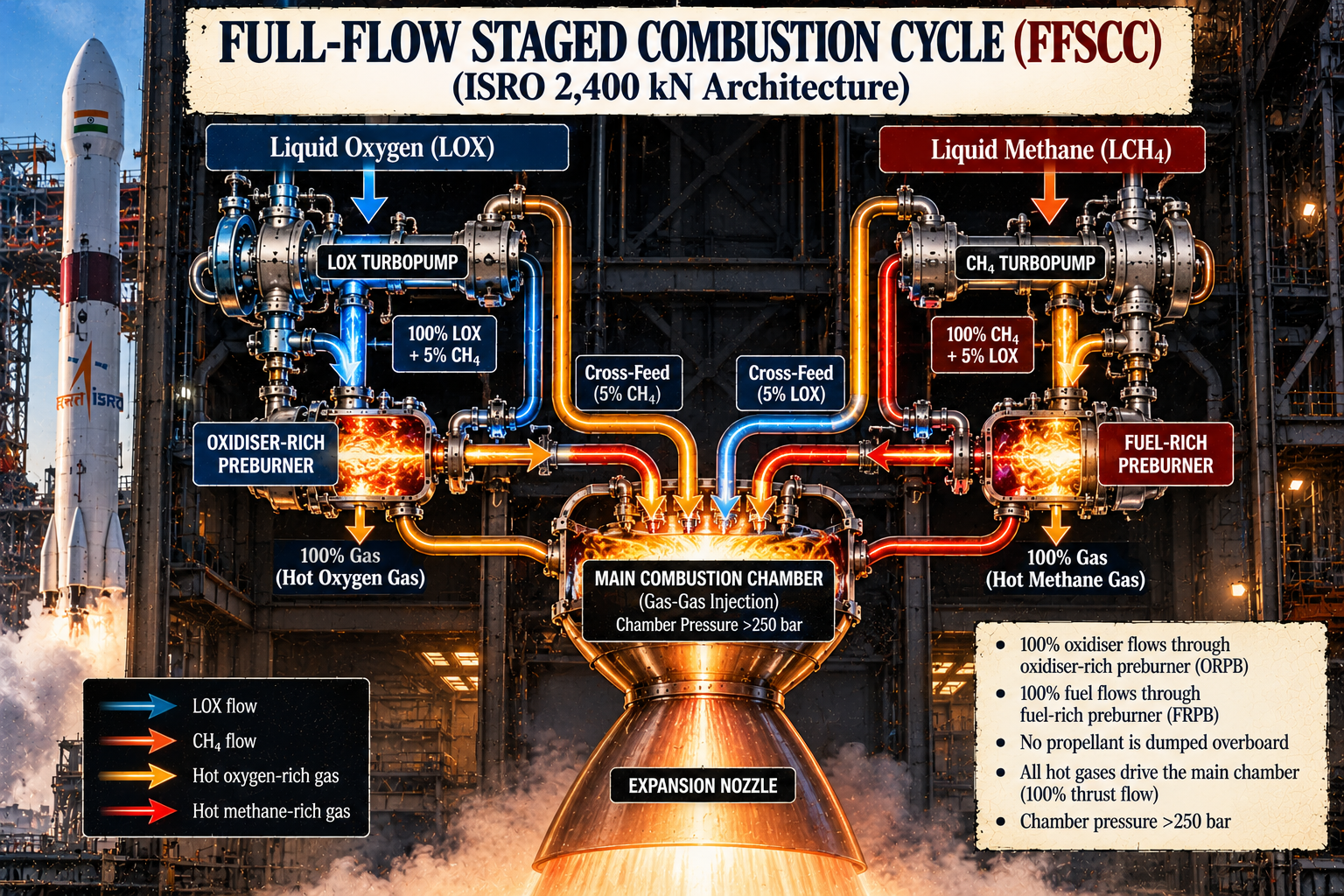
Full-flow staged combustion resolves these thermodynamic constraints by splitting the cycle into two distinct, parallel preburners and two separate turbopumps:
Oxidiser-Rich Preburner (ORPB): All of the incoming liquid oxygen is pumped through this preburner, where it is mixed and ignited with a tiny, tightly metered fraction of methane. This produces a warm, high-pressure oxidiser-rich gas that spins the LOX turbopump.
Fuel-Rich Preburner (FRPB): All of the incoming liquid methane is pumped through a separate preburner and ignited with a small fraction of oxygen, producing a warm, high-pressure fuel-rich gas that spins the methane turbopump.
The Propulsion Spectrum: Why Full-Flow Is Superior
To understand why the 2,400 kN design represents such a significant leap, one must examine the fundamental thermodynamic trade-offs of liquid rocket engines.
Liquid engines do not simply pour fuel and oxidiser into a chamber; they require massive mechanical energy to drive turbopumps that force hundreds of kilograms of cryogenic propellants per second into high-pressure combustion zones. How an engine powers those turbopumps determines its efficiency.
1. The Open Gas Generator Cycle
In engines such as ISRO’s workhorse Vikas (kerolox/hypergolic), the CE-20 cryogenic engine, or the new LME1100, a small fraction (typically 2% to 5%) of the propellants is tapped off, burned in an external gas generator, and used to spin a turbine. That exhaust gas is then dumped overboard through a secondary nozzle.
While mechanically straightforward, it incurs an unavoidable specific impulse ($I_{sp}$) penalty: up to 5% of the onboard propellant mass produces almost no thrust. Furthermore, the turbine must run at scorching temperatures because a small mass of gas has to generate all the pump work.
2. Closed Staged Combustion (Oxidiser-Rich or Fuel-Rich)
In single-shaft staged combustion—such as the Soviet RD-180 or ISRO’s kerolox SCE-200—the exhaust from the preburner is routed back into the main combustion chamber rather than dumped overboard, capturing 100% of the energy.
However, because only one propellant is routed through the preburner (either oxidiser or fuel), the mass flow driving the turbopump is restricted. To extract sufficient work, the preburner must run at exceptionally high temperatures, and the turbopump shaft requires complex dynamic seals to prevent hot, high-pressure oxidiser gas from contacting fuel.
3. Full-Flow Staged Combustion (FFSC)
Full-flow staged combustion resolves these thermodynamic constraints by splitting the cycle into two distinct, parallel preburners and two separate turbopumps:
Oxidiser-Rich Preburner (ORPB): All of the incoming liquid oxygen is pumped through this preburner, where it is mixed and ignited with a tiny, tightly metered fraction of methane. This produces a warm, high-pressure oxidiser-rich gas that spins the LOX turbopump.
Fuel-Rich Preburner (FRPB): All of the incoming liquid methane is pumped through a separate preburner and ignited with a small fraction of oxygen, producing a warm, high-pressure fuel-rich gas that spins the methane turbopump.
This arrangement provides four critical thermodynamic advantages:
Full Mass Flow: Because 100% of the oxidiser flows through one turbine and 100% of the fuel flows through the other, the mass flow available to drive the turbines is maximised.
Lower Turbine Operating Temperatures: Because the working fluid mass is so large, the preburners do not need to operate at extreme temperatures to extract the requisite pump horsepower. Lower turbine temperatures prolong component life, reduce thermal fatigue, and permit dozens of re-ignitions—essential for reusable human-rated rocketry.
Gas-Gas Combustion: Unlike conventional engines where liquid propellants are atomised into droplets inside the main chamber, both the oxidiser and fuel enter the 2,400 kN engine's main combustion chamber entirely in a gaseous state. Gas-gas mixing achieves near-perfect characteristic exhaust velocity efficiency ($C^*$), rapid flame propagation, and complete combustion within a compact chamber volume.
Elimination of Interpropellant Dynamic Seals: In single-shaft systems, an imperfect seal can lead to explosive contact between volatile propellants. In an FFSC engine, the LOX pump is driven strictly by oxygen-rich gas, and the fuel pump is driven strictly by fuel-rich gas. The propellants never meet until they enter the main combustion chamber.
Why Methalox? The Propellant of Deep Space
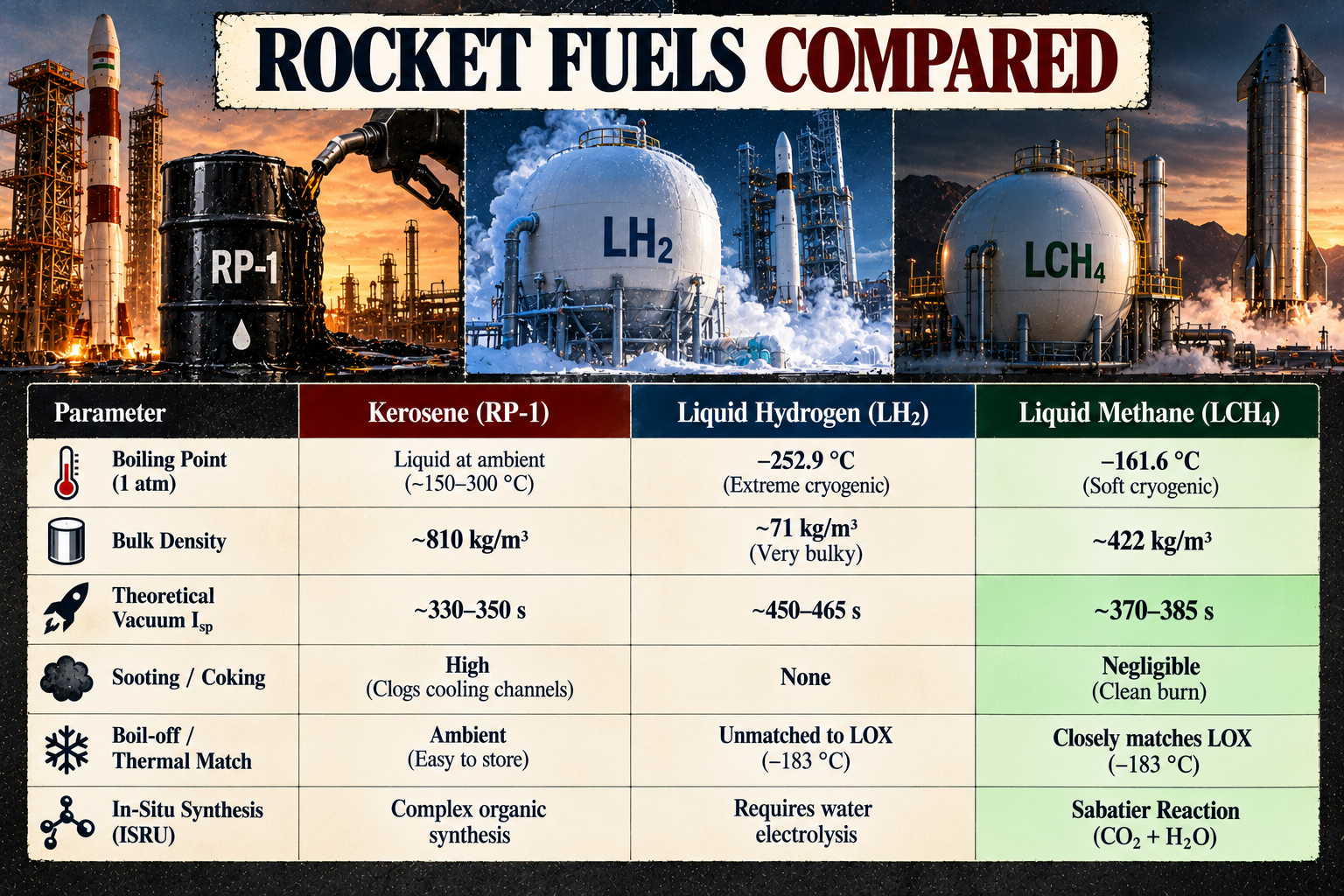
For decades, ISRO’s liquid propulsion roadmap relied on the hypergolic Vikas engine (burning toxic unsymmetrical dimethylhydrazine and dinitrogen tetroxide) and cryogenic upper stages (burning liquid hydrogen and liquid oxygen). The selection of liquid methane ($CH_4$) for the 2,400 kN engine reflects operational lessons from modern orbital mechanics:
Liquid hydrogen offers unmatched efficiency ($I_{sp} > 450\text{ s}$), but its microscopic density requires colossal, heavy fuel tanks that inflate atmospheric drag. Furthermore, hydrogen boils at −253 °C, causing rapid propellant boil-off during multi-day orbital coast phases. Kerosene, while dense, produces heavy carbon soot (coking) inside regenerative cooling jackets, making rapid engine turnaround and reusability notoriously labour-intensive.
Liquid methane occupies the engineering sweet spot. Its storage temperature (−161.6 °C) closely mirrors liquid oxygen (−182.9 °C), allowing common-bulkhead propellant tanks with minimal parasitic insulation. It burns cleanly without coking, enabling rapid reusability.
Crucially for long-term exploration, methane can be manufactured on Mars or lunar polar bases through the Sabatier reaction, combining carbon dioxide and water ice.
The Stepping Stones: How ISRO Built the Foundation
A 2,400 kN full-flow engine cannot be designed in a vacuum. It is the apex of an incremental development programme begun in 2019:
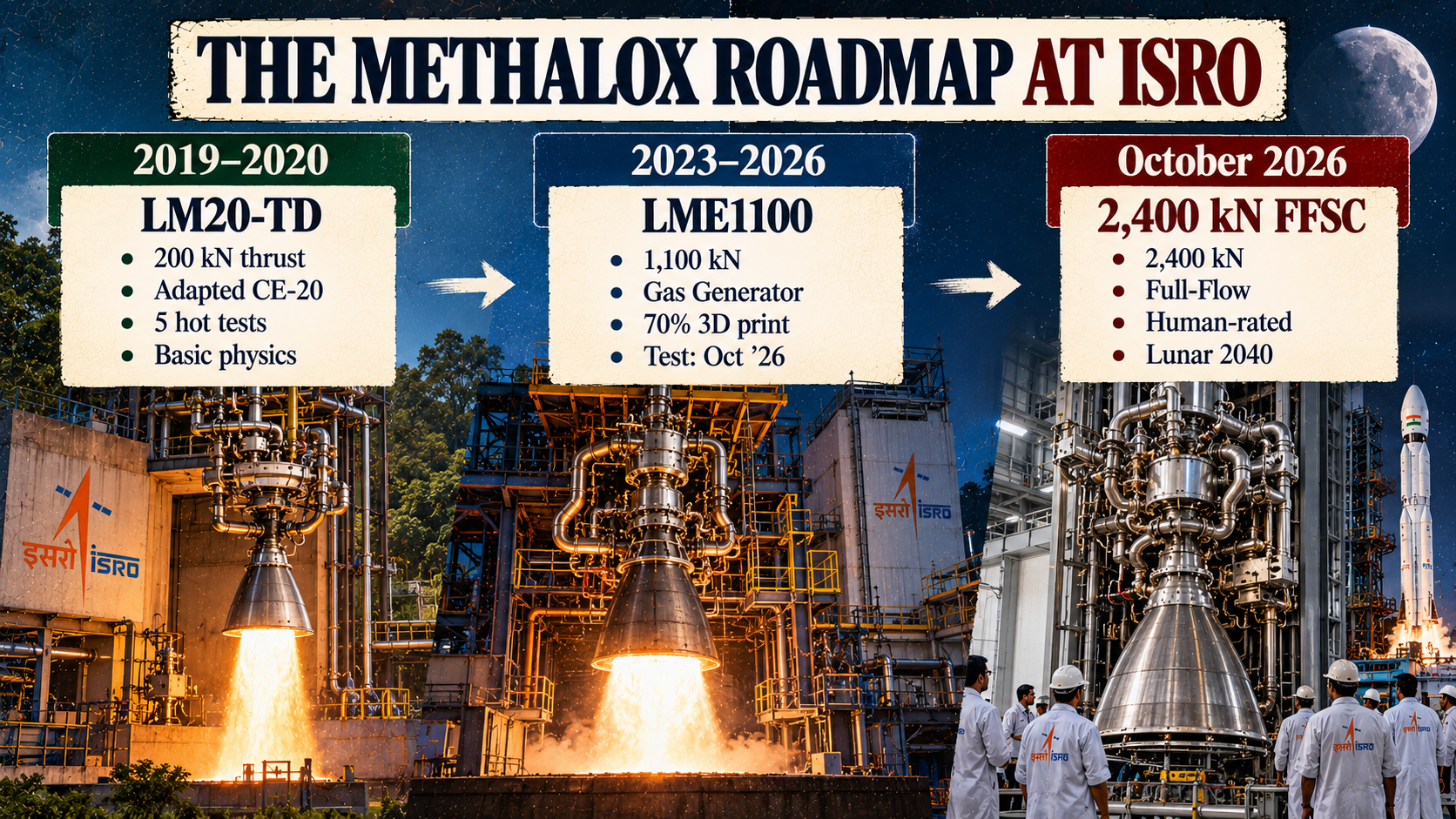
1. The Technology Demonstrator (LM20-TD)
Between 2019 and 2020, LPSC engineers converted components from the indigenous CE-20 hydrogen engine into a 20-tonne (200 kN) technology demonstrator known as the LM20-TD. Tested at the ISRO Propulsion Complex (IPRC) at Mahendragiri, this demonstrator executed one cold-flow test and five hot-fire tests. It validated ignition sequences, chill-down protocols, and rotor-dynamic behaviours for the LOX–methane combination.
2. The Semi-Cryogenic Precedent
Concurrently, ISRO spent years qualifying high-power turbomachinery for its kerolox semi-cryogenic engine (SCE-200). Testing the SCE-200's preburner and power-head systems gave ISRO engineers empirical mastery over staged combustion fluid dynamics and high-pressure metallurgy.
3. The LME1100 Milestone (October 2026)
In 2023, ISRO formally initiated the LME1100—an 1,100 kN Gas Generator cycle methalox engine intended to power the booster stage of the Next Generation Launch Vehicle (NGLV / Soorya).
The LME1100 has served as the industrial manufacturing testbed. Over 70% of its components are produced via metal additive manufacturing (3D printing). On 9 October 2026, ISRO completed the first full-scale ignition test of the LME1100 Gas Generator at Mahendragiri, validating spark-torch ignition and 3D-printed injector configurations. With integrated hot-fire testing of the complete LME1100 engine scheduled for mid-2027, the baseline manufacturing ecosystem is already established.
Mission Profile: The Road to the 2040 Crewed Lunar Landing
Why does India need 2,400 kN of full-flow thrust? The answer lies in the physics of trans-lunar trajectories.
In late 2023, the Indian Government approved a clear deep-space directive:
Construct the indigenous Bharatiya Antariksh Station (BAS) by 2035.
Land an Indian astronaut on the lunar surface and return them safely by 2040.
ISRO’s current most powerful operational vehicle, the LVM3, can place roughly 8 tonnes into Low Earth Orbit (LEO) and send about 2 tonnes toward the Moon via Trans-Lunar Injection (TLI)—sufficient for uncrewed probes like Chandrayaan-3, but orders of magnitude below what is required for human life support, descent engines, and return propellant.
A crewed lunar mission requires an orbital mass of 25 to 35 tonnes injected toward the Moon, translating to a launch vehicle capable of delivering 80 to 100+ tonnes to LEO in a single launch, or through two rendezvous launches.
The baseline NGLV (Soorya), configured with nine 1,100 kN LME1100 engines on its core booster, is designed for 30 tonnes to LEO in its expendable configuration. To build a true Super Heavy-Lift Launch Vehicle (SHLV) for lunar exploration, ISRO requires a booster stage capable of producing between 12,000 and 20,000 kN of sea-level thrust.
A cluster of five to eight 2,400 kN FFSC engines provides that exact thrust architecture, while delivering the higher specific impulse ($I_{sp} > 375\text{ s}$ in vacuum) needed to maximise payload mass.
The Engineering Mountain: What Remains to Be Built
Completing the digital, computational, and mechanical design of an FFSC engine is a necessary first step; translating that design into hot-firing hardware at Mahendragiri represents a formidable engineering challenge.
Materials Science in Oxidiser-Rich Environments: The biggest technical trap of full-flow rocketry lies in the Oxidiser-Rich Preburner. Pumping pure, incandescent oxygen gas at hundreds of atmospheres through turbine blades will cause almost any conventional metal to ignite and burn like firewood. India must domestically synthesise and certify exotic nickel- and cobalt-based superalloys, advanced ceramic matrix coatings, and single-crystal turbine blades capable of surviving oxidising hellfires.
Dual-Shaft Hydrodynamic Balancing: Because the fuel and oxidiser loops are tightly coupled through the main combustion chamber backpressure, any minor pressure fluctuation in the oxidiser turbopump instantly feeds back into the fuel turbopump. Tuning the startup transient—lighting both preburners and spinning twin shafts to tens of thousands of RPM without inducing destructive combustion instability or turbine surge—demands sub-millisecond digital engine control.
Test Stand Augmentation: Testing a 240-tonne engine at chamber pressures above 250 bar requires massive cryogenic storage facilities, high-flow propellant chill systems, and high-pressure water deluge suppression infrastructure far larger than current facilities at IPRC.
A Defining Statement of Aerospace Maturity
For the past three decades, India's space programme built its global reputation on frugal innovation: launching light-to-medium satellites with the PSLV, orchestrating gravity-assist planetary missions, and flying Chandrayaan-3 on a lean budget.
The announcement of the 2,400 kN Full-Flow Methalox engine signals the transition to heavy-lift independence. By committing to full-flow staged combustion, ISRO has bypassed intermediate compromises in favour of the most thermodynamically efficient propulsion cycle known to science.
The road to the 2040 lunar surface will be long and technically unforgiving. But with the design of its 240-tonne methalox powerhouse now complete, India has officially put its engineering stamp on the frontier of deep-space rocketry.