
In brief
- In early 2024 the drifting bulk carrier Rubymar, after being hit by Houthi missiles, dragged its anchor and severed the AAE-1, Seacom/TGN-Eurasia and EIG cables, cutting roughly a quarter of data capacity between Europe and Asia.
- The incident revealed that over 90% of Europe‑Asia data flows through a 16‑17 cable cluster in the Red Sea, and that repairs in an active war zone can take months, exposing a critical lack of resilience.
- In response, hyperscalers, sovereign wealth funds and telecom consortia are advancing Plan B, an overland digital corridor via Iraq, exemplified by the $700 million WorldLink Project, Ooredoo’s dark‑fibre deal with iQ Networks and inclusion in Iraq’s $17 billion Development Road.
- Alternative routes such as the Trans‑Israel Blue‑Raman, Meta’s 2Africa, the Trans‑Caspian Digital Silk Way and the Arctic Far North Fiber are being built, but land‑based cables face risks like backhoe cuts and militia fragmentation while allowing repairs in 4‑12 hours.
More than 90% of all data capacity flowing between Europe and Asia relies on a cluster of 16 to 17 submarine cable systems laid along the floor of the Red Sea. In early 2024, when the commercial bulk carrier Rubymar drifted for days with its anchor dragging along the seabed after being struck by Houthi anti-ship missiles, it severed three critical cables—AAE-1, Seacom/TGN-Eurasia, and the Europe India Gateway (EIG)—cutting roughly a quarter of regional data capacity at a stroke.
The crisis that followed exposed a harsh structural reality for global telecommunications: the physical network that underpins the modern internet is concentrated in a handful of hazardous maritime bottlenecks. The most dangerous point of failure is not deep-sea sabotage by underwater commandos, but the operational impossibility of repairing civilian infrastructure in an active war zone.
In response, Big Tech hyperscalers, regional sovereign wealth funds, and international telecom consortia are accelerating "Plan B": constructing an overland digital corridor across the Middle East, with Iraq emerging as the primary terrestrial land bridge between the Persian Gulf and Europe.
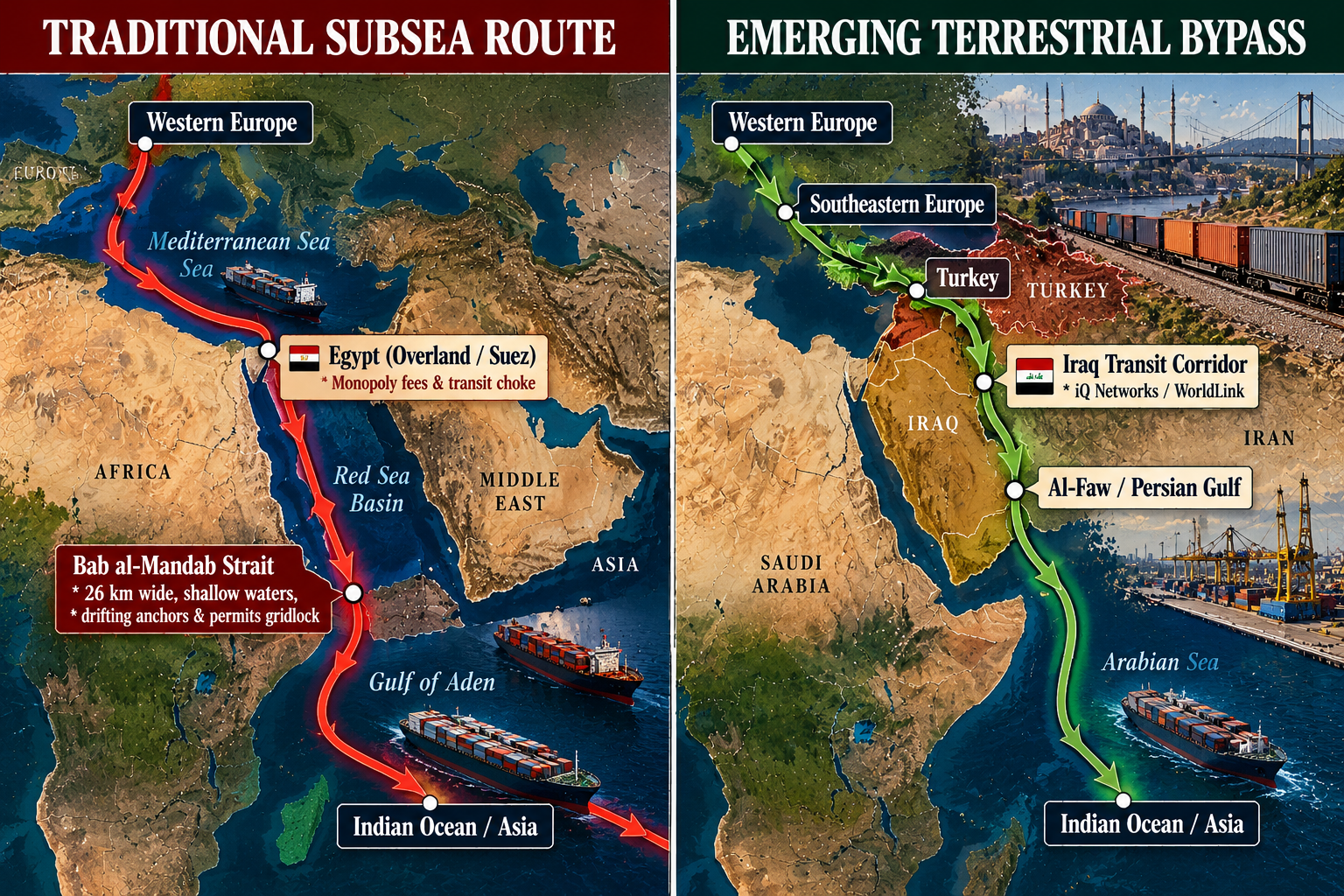
The 26-Kilometre Bottleneck at the Gate of Tears
To understand why the internet is vulnerable in the Red Sea, one must understand its geography. TeleGeography data shows that the Red Sea corridor represents the shortest, lowest-latency maritime path connecting the population centres of Europe with those of South and East Asia.
Yet this massive digital highway funnels directly through the Bab al-Mandab Strait—known historically in Arabic as the Bab-el-Mandeb, or the "Gate of Grief". At its narrowest, the strait spans just 26 kilometres (16 miles) between the coast of Yemen on the Arabian Peninsula and Djibouti and Eritrea in the Horn of Africa.
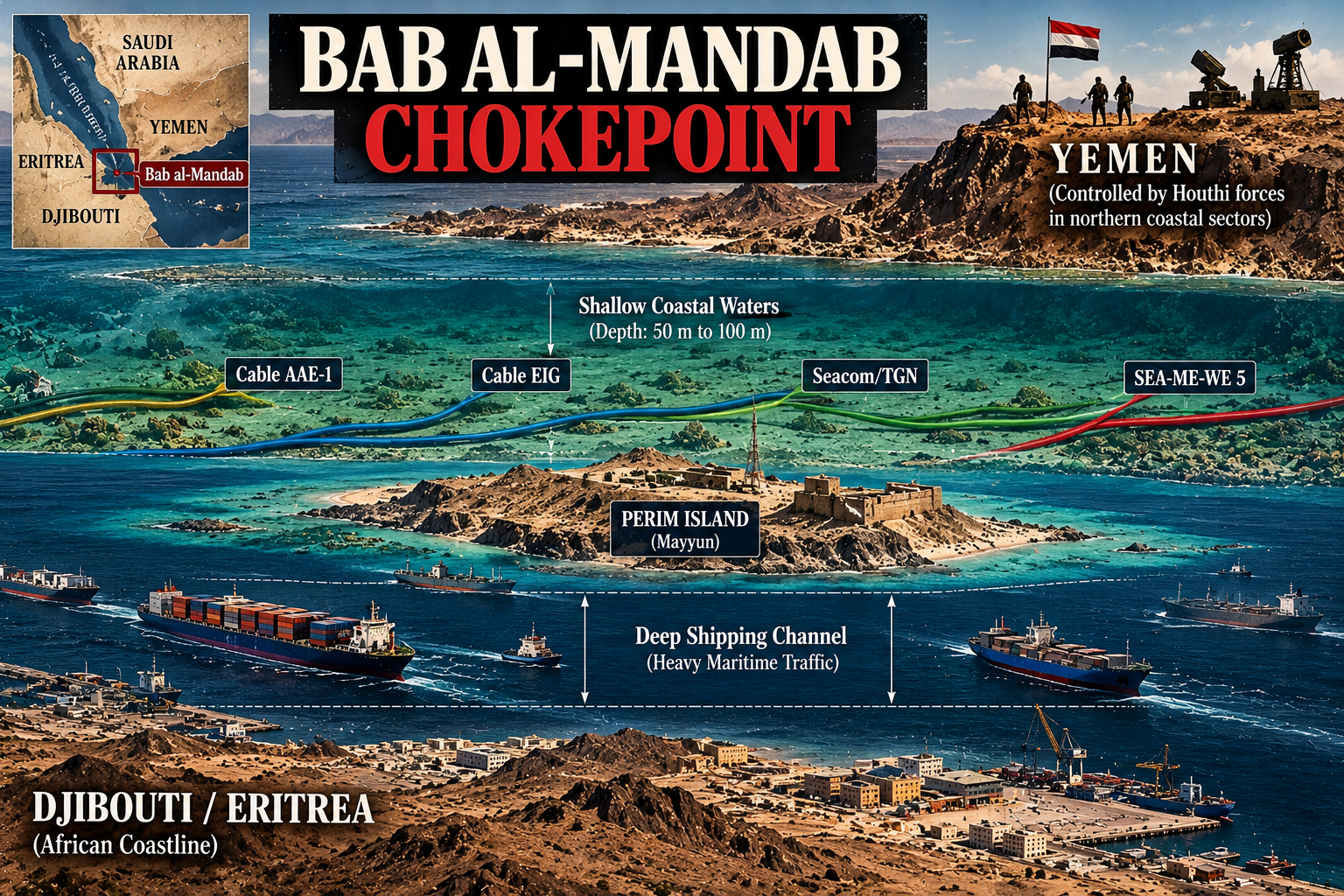
Subsea cables traversing deep ocean trenches—such as those across the Atlantic or Pacific—rest thousands of metres beneath the surface, far beyond the reach of human activity. In the Bab al-Mandab, however, the seabed rises sharply. Cables sit in shallow waters, often between 50 and 100 metres deep.
This shallow bathymetry makes the cables extraordinarily susceptible to maritime accidents. In commercial shipping channels, ships that drop anchor in emergencies or lose engine power drag heavy steel flukes across the seabed. When several high-capacity cables are bundled within a few kilometres of each other to navigate the narrow passage, a single dragging anchor acts like an underwater plough.
Compounding this southern bottleneck is the northern bottleneck in Egypt. Every cable travelling north through the Red Sea must make landfall on Egyptian shores, traverse the Suez isthmus overland to Alexandria or Port Said, and re-enter the Mediterranean. State-owned Telecom Egypt operates an effective monopoly over this transit corridor, levying crossing fees that telecom operators have long criticised as exorbitant, sometimes reaching hundreds of millions of dollars over the lifetime of a cable system.
Collateral Cuts and the Myth of Deep-Sea Sabotage
When cable cuts began occurring off the Yemeni coast in early 2024, speculative reports claimed that Houthi militants were deploying divers or submersibles to deliberately sever digital infrastructure.
Technical investigators and marine salvage experts quickly established a different reality. The Houthi movement possesses neither the specialised submersibles nor the saturation-diving technology required to conduct precision underwater sabotage on subsea cables.
Instead, the mechanism was secondary collateral damage:
Vessel Invalidation: On 18 February 2024, Houthi anti-ship missiles struck the Rubymar, a commercial cargo vessel carrying ammonium phosphate fertiliser.
Uncontrolled Drift: The crew abandoned ship. With its engines dead, the vessel drifted uncontrolled for nearly two weeks in the southern Red Sea.
Seabed Scouring: As the vessel drifted towards its eventual sinking on 2 March 2024, its deployed anchor ploughed the seabed across known cable coordinates.
Simultaneous Severing: The anchor ripped through the AAE-1, Seacom/TGN-Eurasia, and EIG cable systems, disabling an estimated 25% of data transmission passing through the passage.
Recurring Vulnerabilities: Subsequent disruptions, including cable breaks in autumn 2025 affecting systems such as IMEWE and SEA-ME-WE 4, demonstrated that as long as maritime combat persists in the strait, commercial shipping casualties will continue to take down subsea lines.
The Real Crisis: The Repair Trap
In peaceful waters, a severed submarine cable is routine maintenance. Specialised cable-repair vessels equipped with remotely operated vehicles (ROVs) drop grapnels, retrieve both severed ends to the surface, splice the microscopic glass fibres in a sterile onboard cleanroom, and lower the sealed joint back to the seabed. The entire operation typically takes 10 to 14 days.
In the Red Sea, that routine maintenance turned into a multi-month operational nightmare. The repairs for the February 2024 cuts stretched on for nearly half a year because of three interconnected barriers:
The Permitting Deadlock: Repair ships operated by global consortia were caught in a bureaucratic vice. To enter Yemeni territorial waters, operators were required to secure maritime permits from the internationally recognised government based in Aden. However, the coastal waters and coastal firing positions were physically controlled by the Houthi administration in Sana'a, which demanded its own permits and issued veiled threats against unauthorised vessels.
Prohibitive War-Risk Insurance: Marine insurance underwriters refused to insure civilian cable-repair ships entering active missile and drone corridors without exorbitant war-risk surcharges. In several cases, underwriters declined coverage altogether.
Stationary Targets: Splicing a cable requires a ship to remain completely stationary or move at dead-slow speed for days at a time. In waters where anti-ship missiles and unmanned surface vessels operate, a stationary 140-metre cable ship is an indefensible target. Operators refused to dispatch vessels without dedicated naval protection from multinational task forces such as Operation Prosperity Guardian or the European Union’s Operation Aspides.
This repair gridlock proved far more damaging than the physical cuts themselves. It proved to global cloud providers that redundancy within the Red Sea was an illusion: if three or four cables were severed simultaneously and could not be repaired for six months, relying on alternative fibre pairs in the same basin provided zero meaningful resilience.
Rerouting Traffic: Latency Spikes and Financial Tolls
When the Red Sea cables went down, the global internet did not collapse. The Border Gateway Protocol (BGP)—the routing protocol that directs global traffic—automatically shifted data packets along alternative paths.
However, resilience came at a steep technical and financial cost:
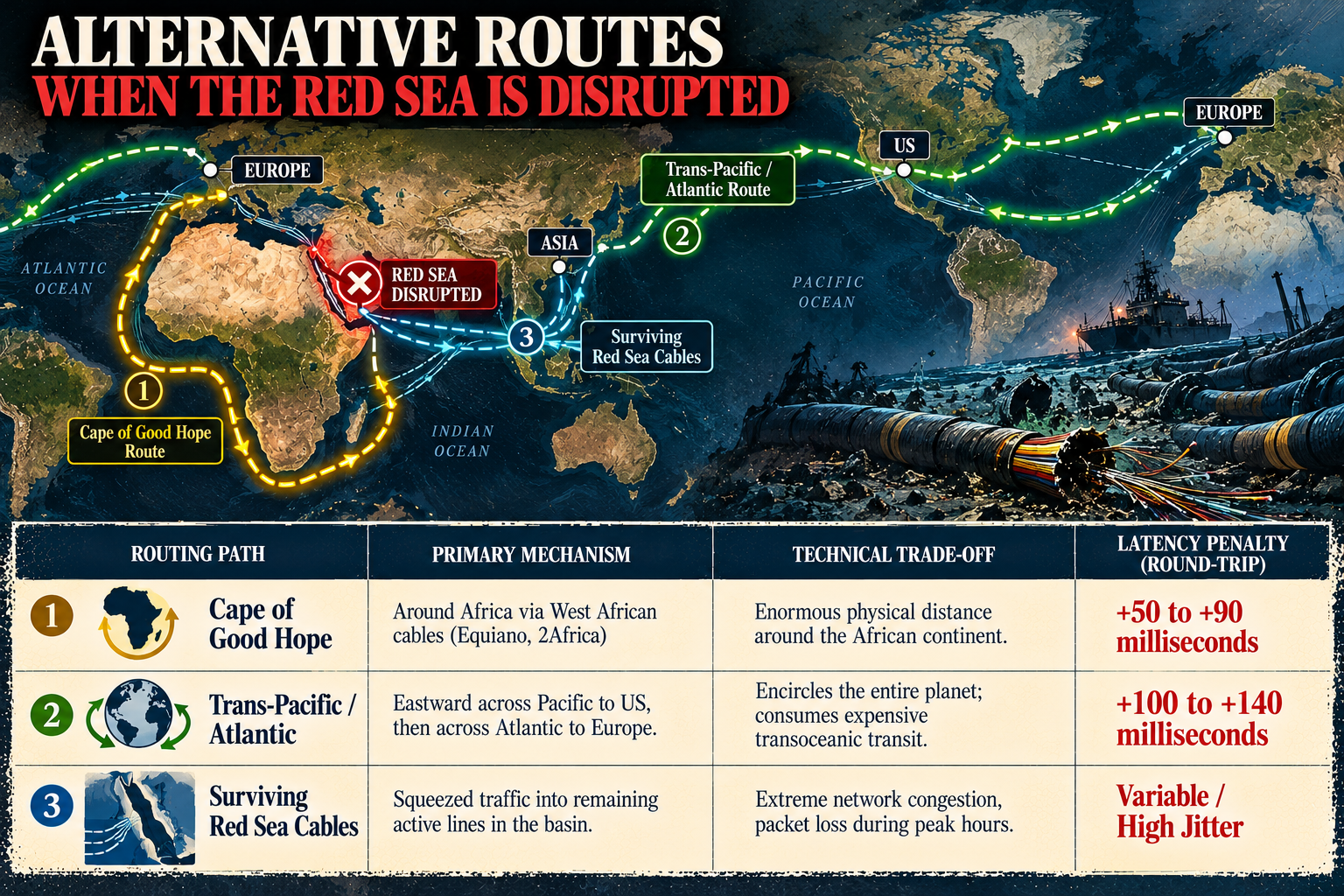
While an additional 80 milliseconds of latency is imperceptible to a consumer streaming a video, it is catastrophic for enterprise operations. High-frequency financial trading between London, Mumbai, and Singapore relies on microsecond advantages. Real-time cloud computing, distributed database synchronisation, and multinational corporate networks experienced severe latency degradation.
Telecom operators and cloud hyperscalers were forced to purchase emergency backup capacity on alternative routes at premium spot rates, costing the industry hundreds of millions of dollars.
The Iraq Alternative: Building a Digital Land Bridge
Faced with permanent geopolitical volatility in the Red Sea and Egyptian transit costs, telecom operators and sovereign infrastructure funds have turned to a route long considered too politically complex: Iraq.
Geographically, Iraq is the natural bridge between the Persian Gulf and Europe. Data landed on the shores of the Gulf can travel north across Iraqi territory, cross into Turkey, and plug directly into the high-speed fibre rings of Central and Southeastern Europe. This completely bypasses the Bab al-Mandab Strait, the Red Sea, and Egypt.
Over the past two years, this theoretical route has transformed into commercial reality through major multi-million-dollar infrastructure investments:
1. The $700 Million WorldLink Project
Unveiled in early 2026, the WorldLink Project is a $700 million (approx. ₹5,800 crore) joint venture between Iraqi and Emirati telecommunications consortia. WorldLink integrates a submarine network in the Gulf with a high-capacity terrestrial fibre spine across federal Iraq and the Kurdistan Region into Turkey. Designed specifically as an alternative Eurasian digital corridor, the project offers a low-latency route directly connecting Gulf data centres to European exchanges.
2. The Ooredoo and iQ Networks Agreement
In October 2026, Ooredoo’s international wholesale arm, Ooredoo Financial Networks (OFN), finalised a landmark dark-fibre agreement with Iraq’s iQ Networks. Under the agreement, Ooredoo secured dedicated dark-fibre pairs across iQ Networks’ terrestrial infrastructure running from the southern Iraqi coast to the Turkish border.
This terrestrial link connects directly with the Fiber to the Gulf (FIG) subsea system and landing facilities operated by Iraq's state-owned Iraqi Telecommunications and Post Company (ITPC) at Al-Faw. By routing traffic through Iraq, Ooredoo can guarantee its enterprise and hyperscale clients an active bypass around Red Sea maritime chokepoints.
3. Integration with the $17 Billion "Development Road"
Baghdad has explicitly integrated digital infrastructure into its broader $17 billion (approx. ₹1.4 lakh crore) Development Road project. Launched to connect the Grand Faw Port in southern Iraq to Turkey via a 1,200-kilometre network of railways and motorways, the project includes dedicated, secure subterranean utility conduits specifically engineered for multi-terabit fibre-optic cables.
Terrestrial Pitfalls: Swapping Maritime Risk for Land Fragility
While the Iraqi digital corridor solves the maritime bottleneck of the Red Sea, telecommunications engineers emphasise that land-based routes introduce an entirely different set of vulnerabilities.
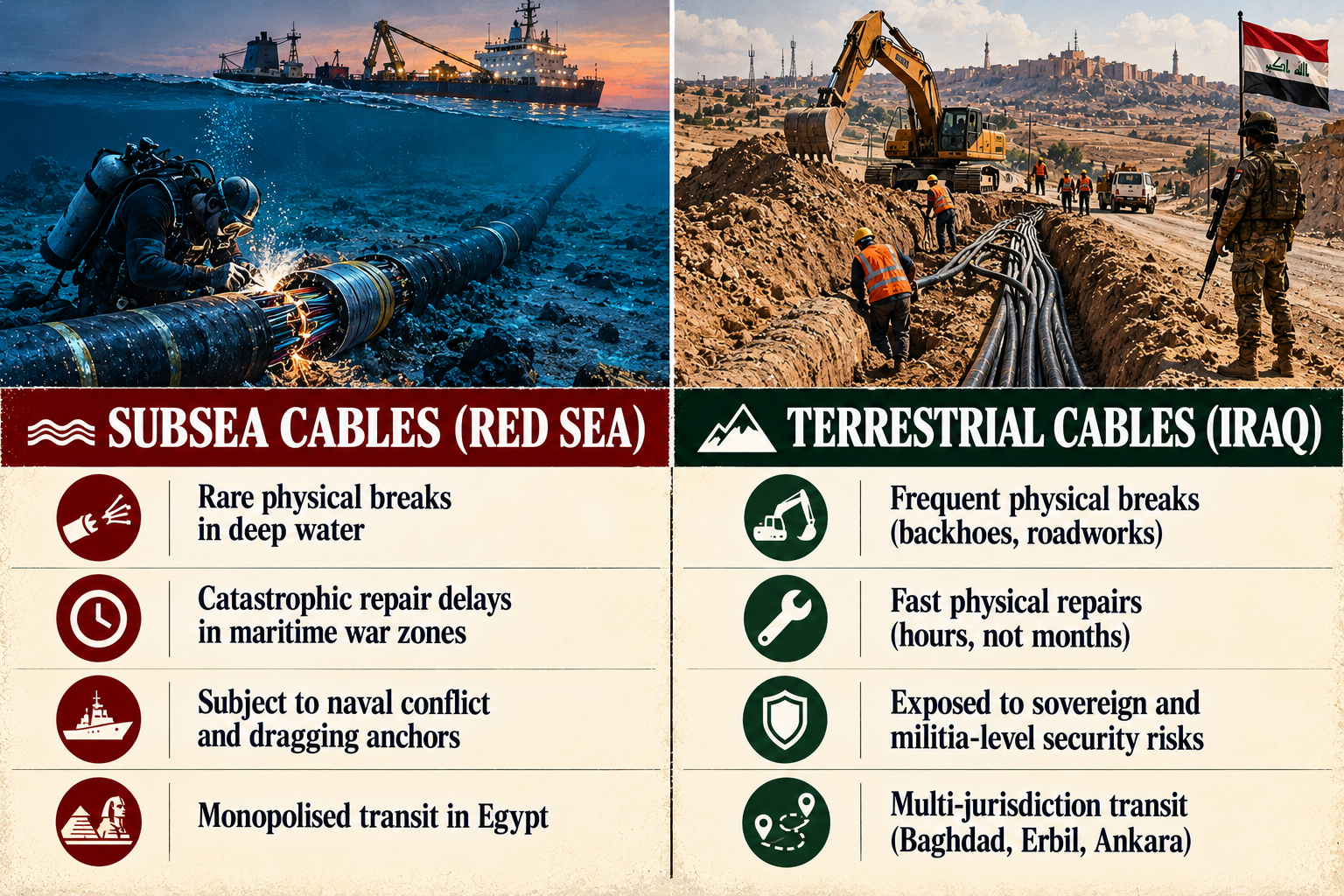
Backhoes and Construction Cuts: Historically, terrestrial fibre systems suffer far more frequent cuts than submarine systems. A road construction crew with a backhoe, agricultural trenching, or sabotage can sever a buried cable in seconds.
Sovereign and Militia Fragmentation: An overland cable through Iraq must traverse territory influenced by various political and security factions. Ensuring physical security along 1,200 kilometres of highway and pipeline requires coordination between federal security forces, regional Peshmerga forces in Iraqi Kurdistan, and local tribal groups.
Regulatory and Transit Alignment: Crossing from federal Iraq through the Kurdistan Regional Government (KRG) and into Turkey requires long-term regulatory stability between Baghdad, Erbil, and Ankara—entities that have historically clashed over oil revenue sharing, airspace, and border security.
The advantage of the terrestrial route, however, lies in repair speed. Even if a backhoe cuts an overland fibre cable in central Iraq, a field maintenance crew can locate the break with optical time-domain reflectometers (OTDR), dig up the conduit, and splice the fibre within four to twelve hours. It does not require a $50 million specialised vessel, war-risk underwriting, or a naval frigate escort.
The Wider Diversification: Big Tech’s Strategic Mosaic
Iraq is not the only corridor being developed. The world’s dominant tech companies—Google (Alphabet), Meta, Microsoft, and Amazon—now own or lease the majority of international subsea cable capacity. To insulate their cloud ecosystems from regional shocks, they are financing a diversified mosaic of bypass routes:
Google’s Trans-Israel Route (Blue-Raman): Developed with Telecom Italia Sparkle and other partners, the Blue-Raman system splits into two distinct segments. The "Blue" cable runs from Italy and Greece to the Israeli port of Tel Aviv. The "Raman" cable runs from Jordan and Saudi Arabia down to Mumbai, India. The two systems meet via an overland terrestrial conduit across Israel and Jordan. This bypasses the Red Sea and Egypt entirely, though it faces its own regional security complexities amid ongoing Middle Eastern geopolitical conflict.
Circumnavigating Africa (2Africa and Equiano): Meta-backed 2Africa (at 45,000 kilometres, one of the longest subsea projects ever built) circles the entire African continent. While it includes a Red Sea branch, its western flank along the Atlantic coast connects Europe directly to South Africa, linking with Indian Ocean networks to provide a pure maritime circumnavigation that completely avoids the Middle East. Google’s Equiano cable similarly connects Western Europe to South Africa.
The Trans-Caspian Digital Silk Way: Spanning from Central Asia across the Caspian Sea, through Azerbaijan and Georgia into the Black Sea, this overland-subsea hybrid aims to link China and Central Asia to Europe, bypassing both Russia to the north and the Red Sea to the south.
The Arctic Frontier (Far North Fiber): Planned across the Northwest Passage through the Arctic Ocean, this proposed route seeks to connect Japan and Scandinavia directly, providing an entirely conflict-free, ultra-low-latency bridge between Asia and Europe.
The Strategic Realignment of Global Data
The crisis in the Red Sea has permanently dismantled the telecommunications industry's assumption that oceanic transit is inherently cheaper, simpler, and safer than overland infrastructure.
The future of intercontinental connectivity will not depend on a single, ultra-dense maritime canal. Instead, the global network is decentralising into a multi-modal mesh. By investing in the Iraq Transit Corridor alongside circum-African and trans-Israel infrastructure, Big Tech and international telecom operators are ensuring that no single militant group, dragging anchor, or maritime bottleneck can ever again sever the digital link between continents.