In brief
- On 15 October 2026 at McGregor, Texas, Elon Musk demonstrated a Tesla Roadster 2 prototype using cold-gas thrusters to perform ballistic hops and achieve 0-60 mph in under one second.
- The vehicle uses compressed-air tanks at 7,000-10,000 psi derived from SpaceX Falcon 9 technology but lacks wings or rotors so it cannot sustain aerodynamic flight.
- The FAA states the vehicle does not meet its aircraft definition while NHTSA warns it must comply with road safety standards; high-pressure tanks and thruster nozzles violate pedestrian and collision regulations.
- Tesla opened reservations at $200,000 standard, $250,000 thrust variant and invitation-only rocket edition not approved for public roads with production targeted for 2028.
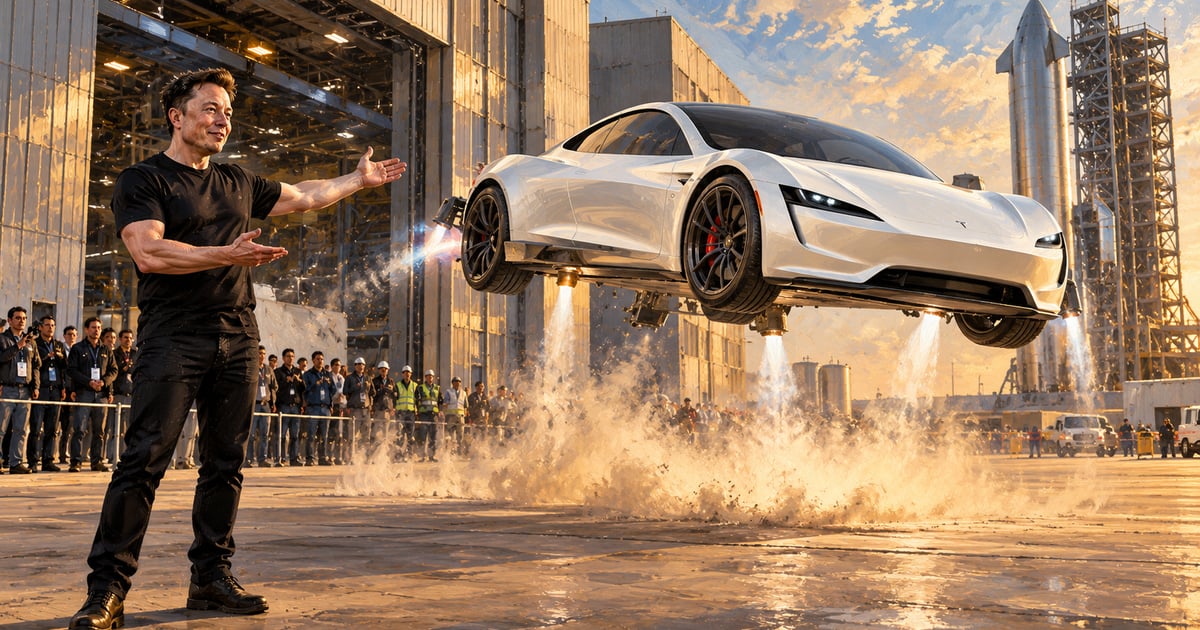
On 15 October 2026, at SpaceX’s rocket testing grounds in McGregor, Texas, Elon Musk unveiled what he declared to be the world’s first "flying car."
During a live demonstration, a redesigned prototype of the Tesla Roadster 2 drove up a curved loop ramp, adhered momentarily upside down, and launched into the air. Firing a cluster of compressed-air rocket thrusters mounted on its body, the vehicle rolled 180 degrees mid-air before landing back on its wheels. In a subsequent run, the car used its thrusters to vault over a stationary line of Tesla vehicles and demonstrated acceleration from 0 to 60 mph in less than one second.
Controlled remotely throughout the demonstration—"to make sure we don't kill anyone," Musk noted from the stage—the prototype represents the culmination of nearly a decade of promises regarding the "SpaceX package" for Tesla’s flagship sports car.
Following the spectacle, Tesla opened reservation tiers on its website, offering a standard road model for $200,000 (around ₹1.66 crore), a "thrust" variant requiring a $250,000 deposit (around ₹2.08 crore), and a single-seat "rocket" edition featuring a "full flight system" available strictly by invitation.
Yet, buried beneath the theatrical acrobatics is a clear engineering reality: Tesla has not built a flying car in any practical sense of the term. What was demonstrated was a high-performance electric vehicle equipped with high-pressure cold-gas reaction thrusters capable of performing brief ballistic hops.
The Mechanism: Cold-Gas Thrusters vs Aerodynamic Flight
To understand what the Roadster did in Texas, it is necessary to distinguish between aerodynamic flight and reaction propulsion.
A genuine flying car—or an electric vertical take-off and landing (eVTOL) aircraft such as those developed by Joby Aviation, Archer, or Alef Aeronautics—relies on wings, rotors, or ducted fans. These vehicles generate aerodynamic lift as air flows over their surfaces, allowing them to remain airborne for tens of minutes or hours to cover intercity distances.
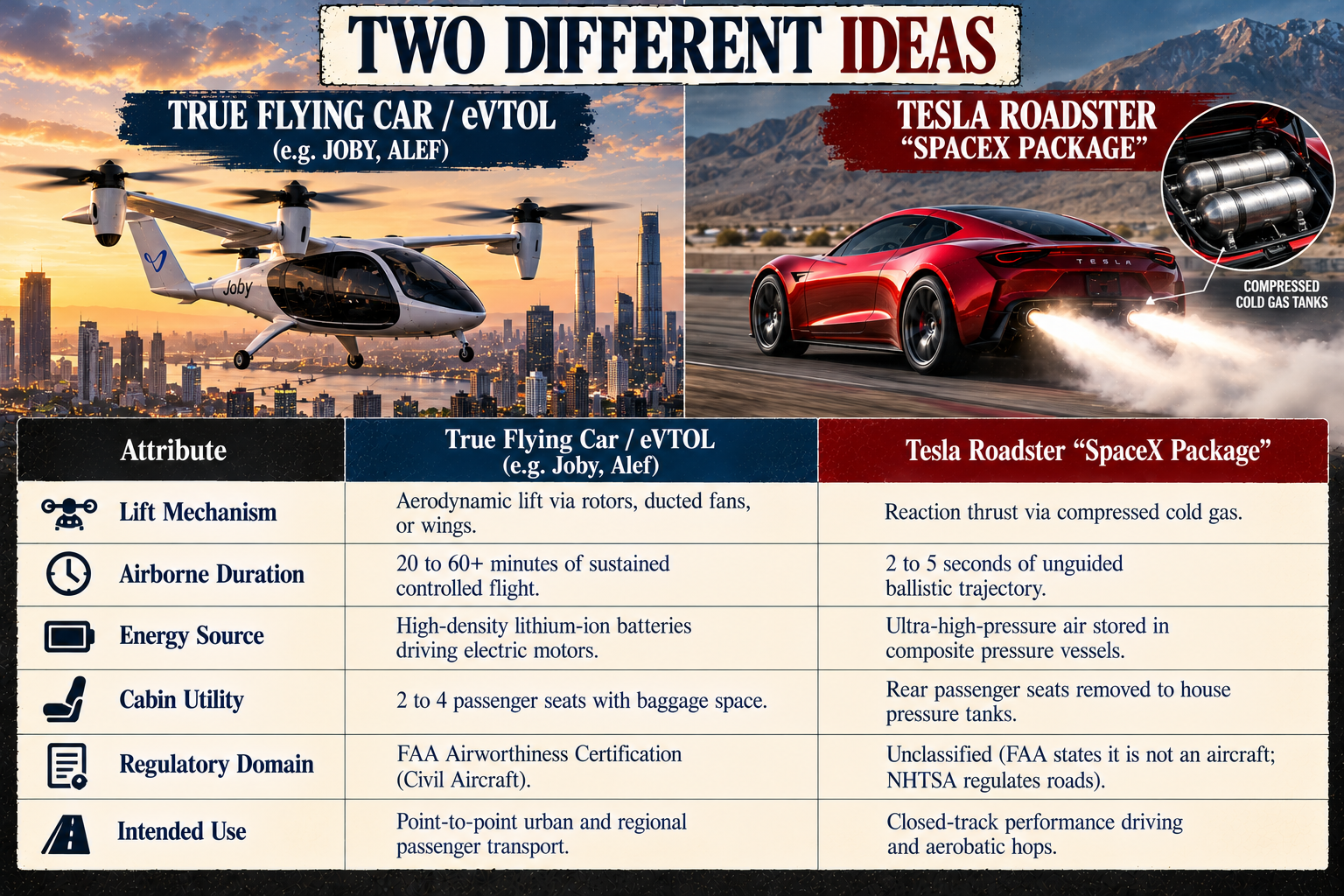
The Tesla Roadster possesses neither wings nor lift-generating rotors. Instead, it adapts technology directly from SpaceX's Falcon 9 orbital rocket: cold-gas thrusters.
In orbital rockets, small reaction control system (RCS) thrusters vent inert, compressed gas into the vacuum of space to orient the spacecraft. On the Roadster, Tesla has replaced the rear passenger seats with Composite Overwrapped Pressure Vessels (COPVs) wrapped in carbon fibre. These tanks store air compressed to extreme pressures—typically between 7,000 and 10,000 pounds per square inch (psi).
When the driver (or, in this case, the remote operator) activates the system, fast-acting valves vent this ultra-high-pressure gas through cold-gas expansion nozzles arrayed behind the licence plate and beneath the chassis:
Downforce and Acceleration: Firing thrusters upward pushes the car into the asphalt, artificially multiplying tyre grip to achieve sub-one-second 0–60 mph acceleration without tyre slip.
The "Hop": Firing the main downward and rearward thrusters off a curved ramp provides a momentary burst of upward momentum, launching the two-tonne car into a brief, unguided parabolic arc.
Attitude Control: Smaller cold-gas nozzles around the vehicle pulse briefly to impart rotational torque, allowing the vehicle to roll 180 degrees before gravity pulls it back down.
Once the compressed air inside the COPVs is expended—which takes only a few seconds of continuous venting—the car has zero ability to sustain altitude. It does not fly from city to city; it jumps, flips, and lands.
The Regulatory Void: Neither a Car nor a Plane
Even if Tesla perfects the mechanical reliability of its thrusters, moving the vehicle from a private test facility to public infrastructure presents unprecedented legal barriers.
When contacted by CBS News regarding who holds oversight of a rocket-equipped car, the Federal Aviation Administration (FAA) gave a definitive answer:
"The Tesla vehicle does not meet the FAA definition of an aircraft."
Because the vehicle does not generate aerodynamic lift and cannot navigate controlled airspace, it cannot be certified under standard Federal Aviation Regulations (FARs) governing experimental or light-sport aircraft.
At the same time, the National Highway Traffic Safety Administration (NHTSA), which oversees road safety in the United States, issued a clear warning:
"While the vehicle may appear to defy the laws of physics, the manufacturer must ensure that it does not defy applicable Federal Motor Vehicle Safety Standards and drivers must obey all local traffic laws."
Under existing Federal Motor Vehicle Safety Standards (FMVSS):
Vehicles are strictly prohibited from emitting high-pressure debris-blasting gas jets that could endanger following motorists, cyclists, or pedestrians.
External rocket nozzles and sharp thruster housings violate pedestrian impact protection mandates in Europe and Asia.
High-pressure 10,000-psi pressure vessels located inside the passenger cabin create catastrophic shrapnel and explosion risks in standard rear-end highway collisions.
Tesla is evidently aware of these limitations. On its official reservation portal, the company added a clear legal caveat: the Rocket edition with the "full flight system" is not approved for public road use.
Musk’s Complete Reversal on Flying Cars
The Texas demonstration marks an ironic turn in Elon Musk’s public commentary. For years, Musk was one of Silicon Valley’s most outspoken critics of flying automobiles.
During a 2014 interview and again at a TED conference in 2017, Musk argued that flying vehicles were fundamentally impractical for urban mobility:
"There is a challenge with flying cars in that they’ll be quite noisy, the wind force generated will be very high... Let’s just say that if something’s flying over your head, a whole bunch of flying cars going all over the place, that is not an anxiety-reducing situation. You’re thinking: ‘Did they service their hubcap? Or is it going to come off and guillotine me as they fly by?’"
It was precisely this critique that led Musk to found The Boring Company, arguing that digging three-dimensional tunnels beneath cities was far superior to filling the sky with flying vehicles.
The shift toward embracing the "flying car" label reflects marketing opportunism rather than an urban transit breakthrough. With Tesla’s core electric car sales experiencing margin compression amid intense competition from Chinese manufacturers like BYD, dramatic demonstrations of exotic technology serve to rekindle the company's reputation as a futuristic innovation leader rather than a conventional automotive manufacturer.
What to Expect by 2028
Tesla has stated that production of the new Roadster is targeted for 2028—eleven years after it was first unveiled in 2017 with an initial delivery target of 2020.
When the vehicle eventually reaches private owners, the commercial version will almost certainly be divided into two distinct realities:
The Road-Legal Production Supercar: A purely electric hypercar utilizing a tri-motor all-wheel-drive powertrain, active aerodynamics (including a patented 700 kg downforce rear wing), and conventional steer-by-wire controls capable of extraordinary track speeds.
The "SpaceX Package" Track Novelty: A track-only, non-road-legal curiosity with sealed COPV tanks, sold to select collectors under strict liability waivers, capable of firing compressed-gas bursts on closed airstrips.
Tesla has demonstrated that an electric sports car can be fitted with rocket thrusters and launched off a ramp. But until a vehicle can sustain controlled, aerodynamic flight without exhausting its energy store in three seconds, the flying car remains where it has always been: firmly on the ground.