In brief
- Jio Platforms filed its Red Herring Prospectus on 14 October 2026 for India's largest IPO, pricing shares at ₹1,065 to 1,119 to raise up to ₹30,213 crore through a 100% fresh issue with no secondary sales.
- The issue aims to prepay ₹27,500 crore of Reliance Jio Infocomm's debt after finance costs surged 41.6% year-on-year to ₹2,980 crore in the June 2026 quarter.
- Telecom subsidiary Reliance Jio Infocomm generates 87 to 94% of consolidated revenue and profit, with 53.33 crore subscribers, and valuation multiples of 33x earnings and 3x book value match Bharti Airtel rather than a tech premium.
- Key risks include holding-company structure, prepaid revenue reliance on Reliance Retail as sole distributor, no segment reporting for AI and cloud ventures, spectrum obligations, and lack of exclusive control over the Jio trademark.
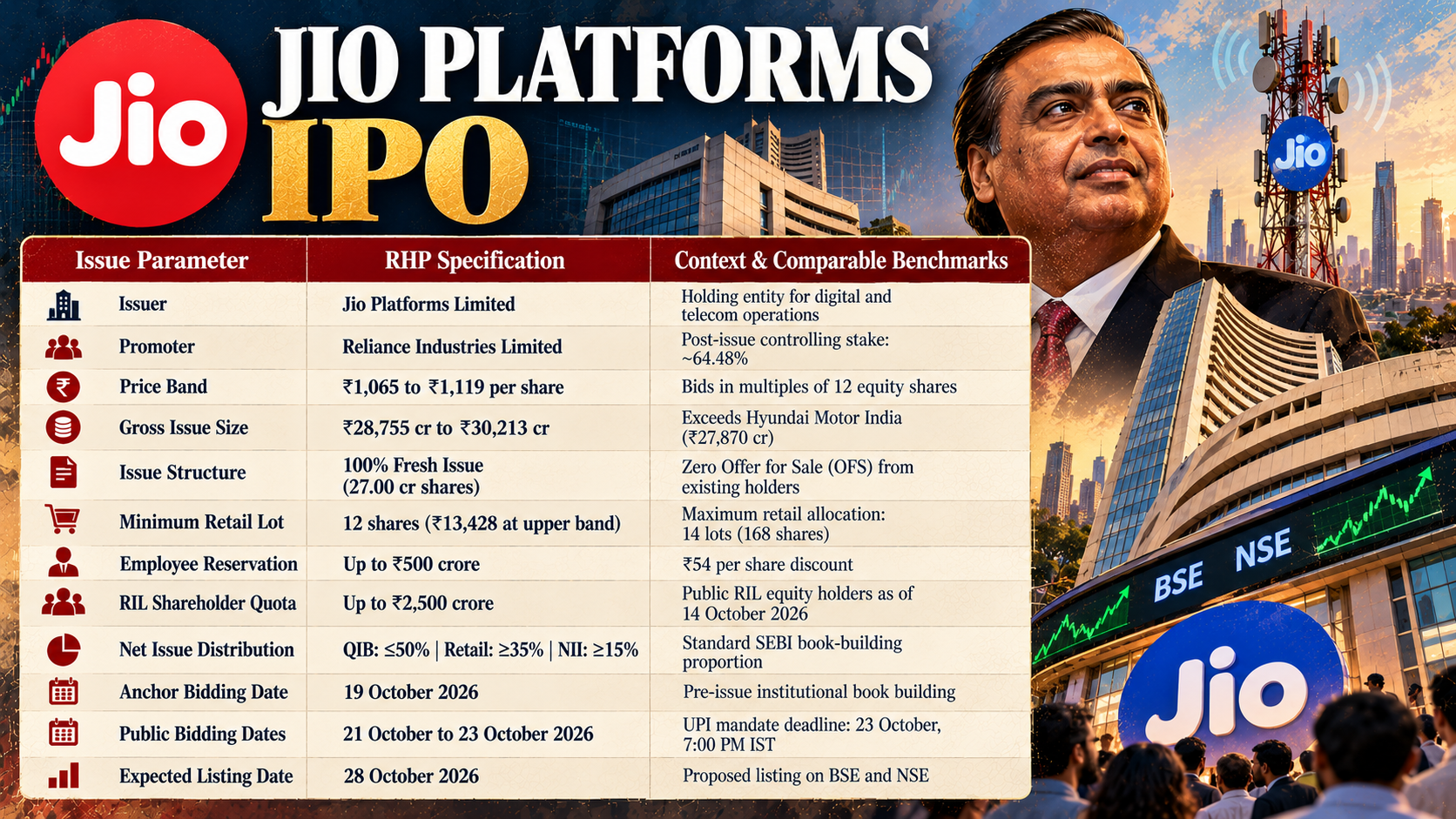
The formal filing of the Red Herring Prospectus (RHP) by Jio Platforms Limited (JPL) on 14 October 2026 marks the arrival of India's largest initial public offering to date. Priced at a band of ₹1,065 to ₹1,119 per equity share, the issue seeks to mobilise up to ₹30,213 crore (approximately $3.62 billion), surpassing the previous benchmark set by Hyundai Motor India in 2024.
Yet the RHP reveals an offering whose financial architecture differs markedly from popular market narratives. Far from serving as a secondary cash-out for prominent strategic investors like Meta, Alphabet, or KKR, the transaction is structured as a 100% fresh equity issue. Moreover, behind the presentation of a diversified artificial intelligence and cloud conglomerate lies a business whose earnings, cash flows, and immediate valuation remain overwhelmingly anchored to India's domestic telecommunications infrastructure.
Issue Structure and Key Parameters
The IPO comprises up to 27,00,00,000 (27 crore) fresh equity shares of face value ₹10 each. At the upper boundary of the price band, the post-issue equity capital expands from 893.90 crore shares to approximately 920.90 crore shares. This prices Jio Platforms at an implied post-issue market capitalisation of ₹10,30,490.55 crore (₹10.30 lakh crore, or roughly $123.5 billion).
Because the issue entails zero secondary share sales (Offer for Sale), promoter Reliance Industries Limited (RIL) will see its controlling equity stake diluted only marginally from 66.43% to 64.48%. Strategic shareholders—including Meta affiliate Jaadhu Holdings (9.98%), Google International (7.73%), Saudi Arabia's Public Investment Fund (2.31%), KKR (2.31%), and Vista Equity Partners (2.31%)—retain their holdings entirely, absorbing the modest 2.93% equity expansion.
Objects of the Issue: The De-leveraging Play
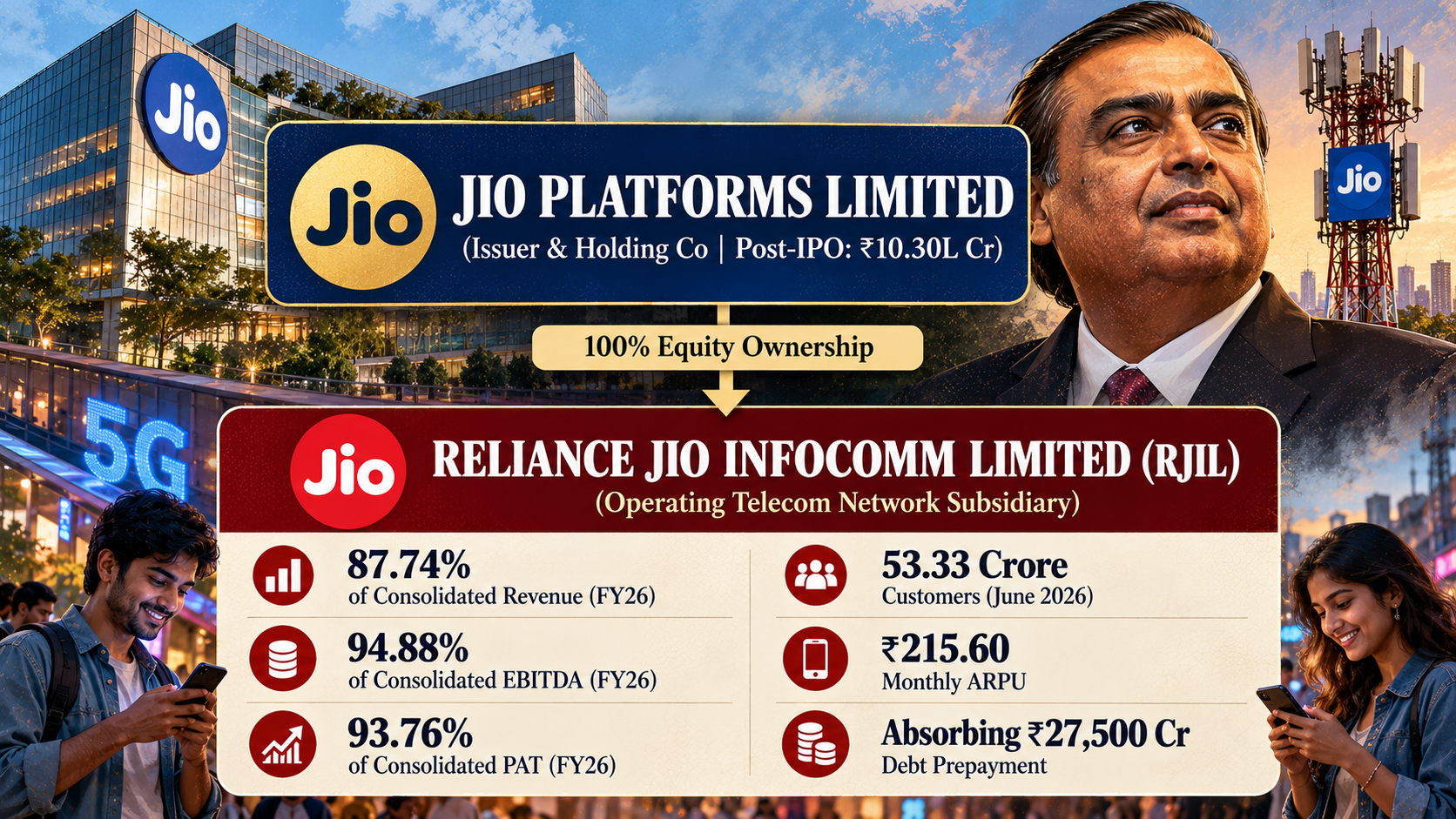
Of the net capital raised, the RHP allocates up to ₹27,500 crore specifically for the full or partial prepayment of outstanding borrowings contracted by its primary operating subsidiary, Reliance Jio Infocomm Limited (RJIL). The residual funds are reserved for general corporate purposes within regulatory thresholds.
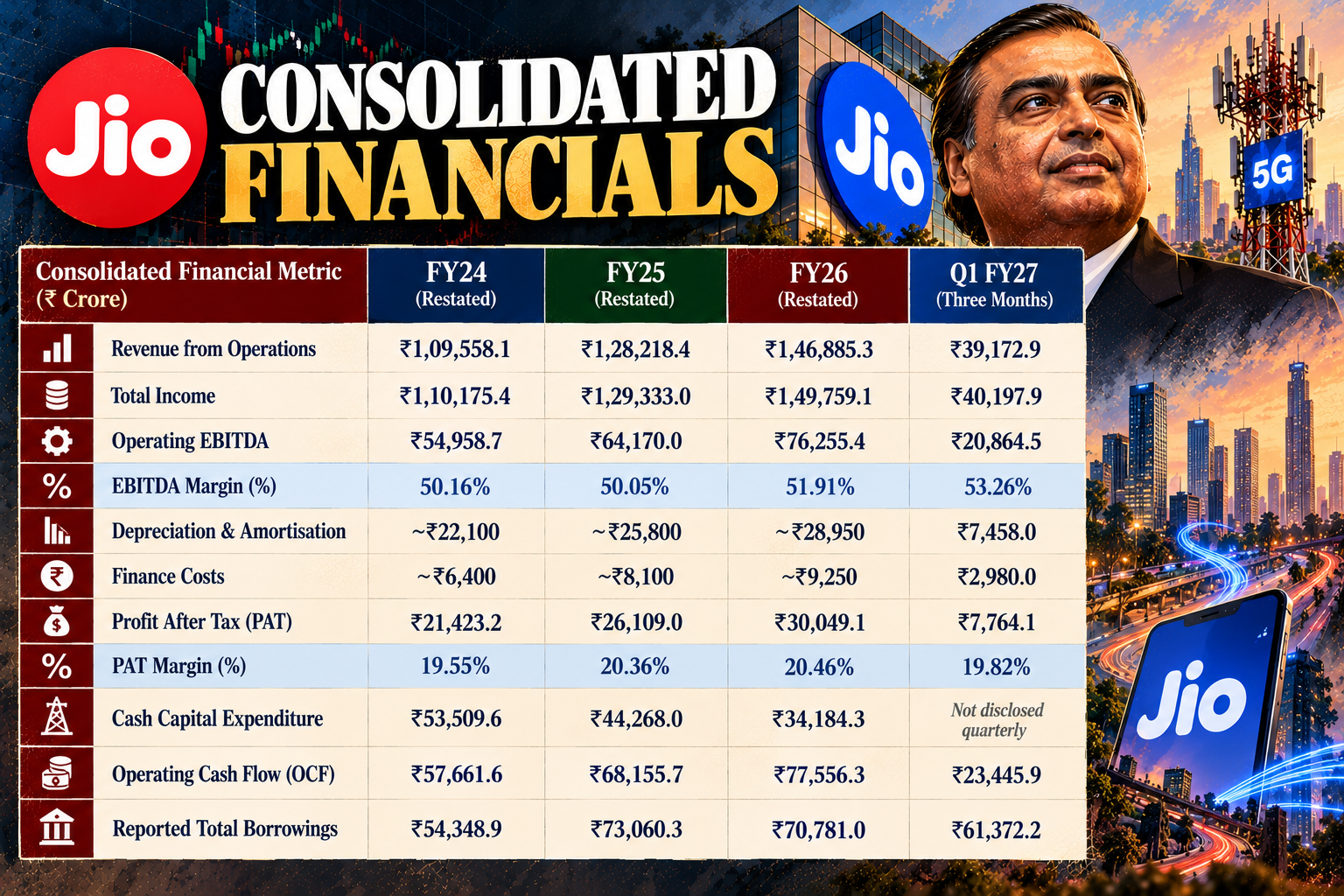
This capital application addresses a specific pressure point on the consolidated income statement. In the quarter ended 30 June 2026 (Q1 FY27), JPL reported a 41.6% year-on-year surge in finance costs to ₹2,980 crore, up from ₹2,105 crore in Q1 FY26. While total borrowings fell from ₹70,781.0 crore on 31 March 2026 to ₹61,372.2 crore by 30 June 2026, the debt service load continued to restrain net income growth.
Applying ₹27,500 crore directly against high-interest bank debt effectively neutralises RJIL's commercial debt liabilities. However, investors must recognise that total indebtedness in the telecom sector extends beyond bank borrowings to include substantial deferred spectrum obligations owed to the Department of Telecommunications (DoT) and capital expenditure creditors.
Operating Engine: Subscriber Scale and Monetisation
JPL’s operational foundation rests on a telecommunications footprint covering over 99% of India's population across 3,60,537 accessible network towers and 26,800.8 MHz of spectrum.
As of 30 June 2026, RJIL served 53.33 crore (533.3 million) customer connections, up from 49.81 crore a year earlier. Operating metrics in the RHP indicate that growth has increasingly pivoted from raw subscriber accumulation toward customer retention and usage monetisation.
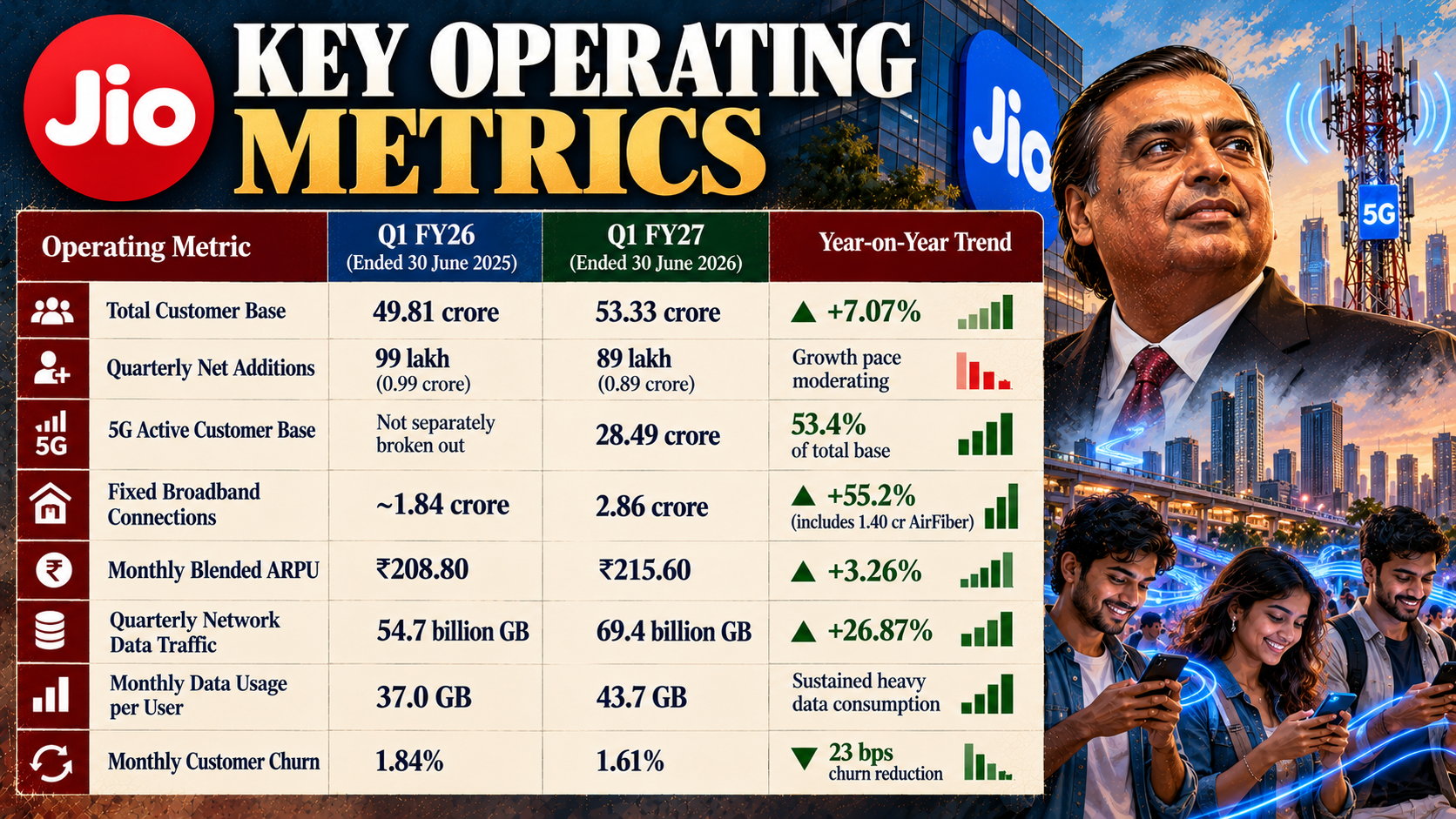
The moderation in quarterly net additions (89 lakh in Q1 FY27 versus 99 lakh in Q1 FY26) highlights the maturity of the domestic mobile subscriber base. Future revenue acceleration hinges on upward tariff revisions and moving users onto higher tiers. Concurrently, the fixed wireless access (FWA) business—operating via JioAirFiber—has expanded to 1.40 crore users, capturing demand in secondary and tertiary markets where optical fibre deployment remains cost-prohibitive.
Financial Track Record: Margin Expansion vs Return on Capital
JPL’s restated consolidated financial statements reflect steady top-line expansion and healthy operating margins over the three-year reporting period.
Between FY24 and FY26, operating revenue expanded from ₹1,09,558.1 crore to ₹1,46,885.3 crore, while earnings before interest, tax, depreciation, and amortisation (EBITDA) rose from ₹54,958.7 crore to ₹76,255.4 crore.
The Return Ratio Paradox
While headline profitability crossed ₹30,000 crore in FY26, the underlying return metrics paint a more nuanced operational picture:
Return on Average Net Worth (RoNW) rose from 8.02% in FY24 to 9.42% in FY26, aided by cumulative earnings retention and a consolidated net worth of ₹3,34,013.4 crore.
Return on Average Capital Employed (ROACE) fell steadily from 12.83% in FY24 to 12.50% in FY25, and further to 10.76% in FY26.
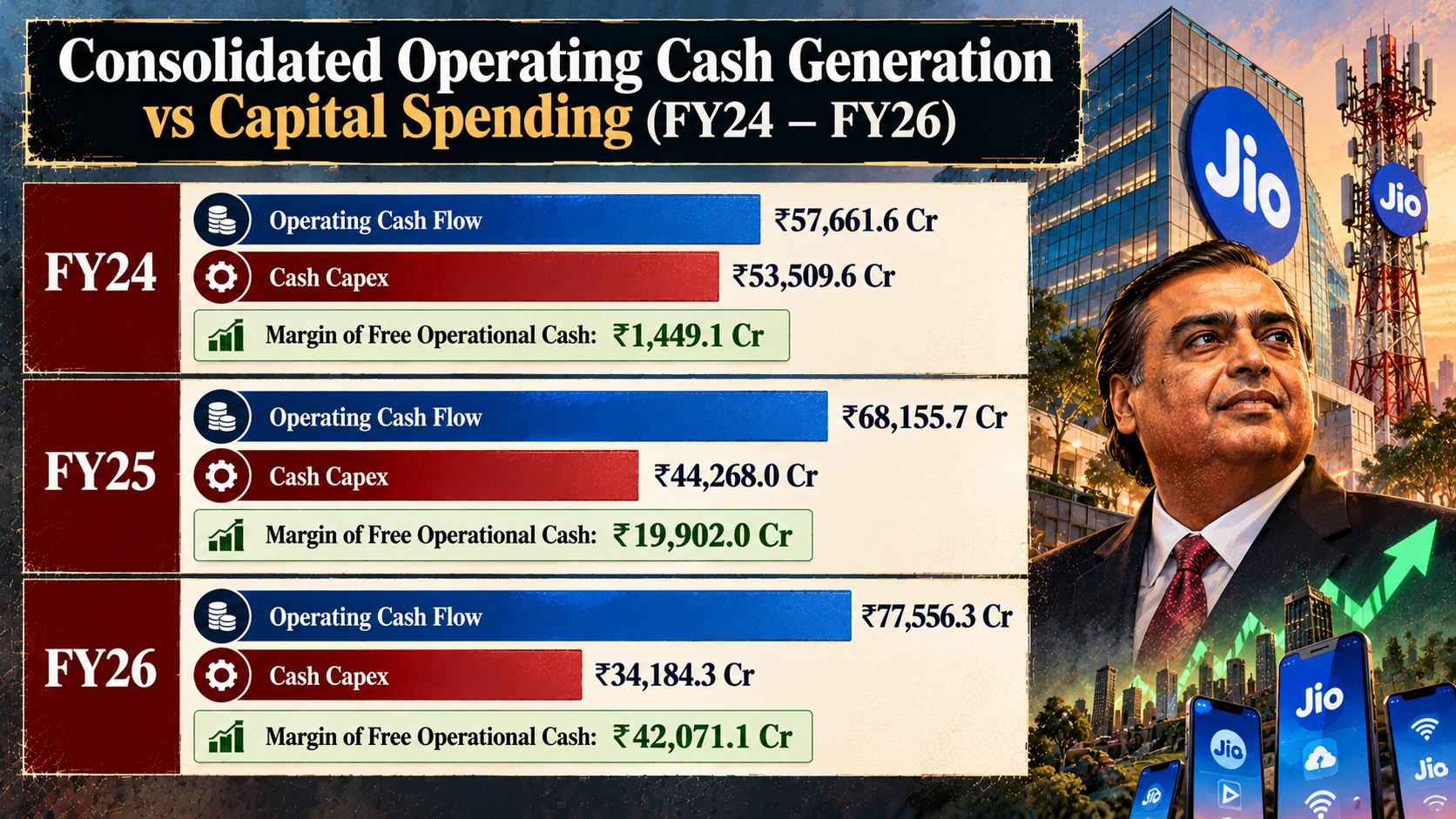
This contraction in ROACE highlights the capital-intensive reality of nationwide standalone 5G deployment. Total assets reached ₹6,22,905.3 crore by June 2026. While annual cash capex has stepped down significantly from ₹53,509.6 crore in FY24 to ₹34,184.3 crore in FY26, the accumulated asset base has yet to generate proportional incremental operating earnings.
Platform Valuation and Peer Reality
At the upper price boundary of ₹1,119 per share, JPL enters the market on the following multiples:
Price-to-Earnings (P/E): 33.28x based on pre-issue FY26 basic EPS of ₹33.62, and 33.19x on post-issue annualised Q1 FY27 run-rate earnings.
Price-to-Book (P/B): 2.99x against its restated net asset value (NAV) of ₹373.66 per share as of 31 March 2026 (and 2.93x against June 2026 NAV of ₹382.34).
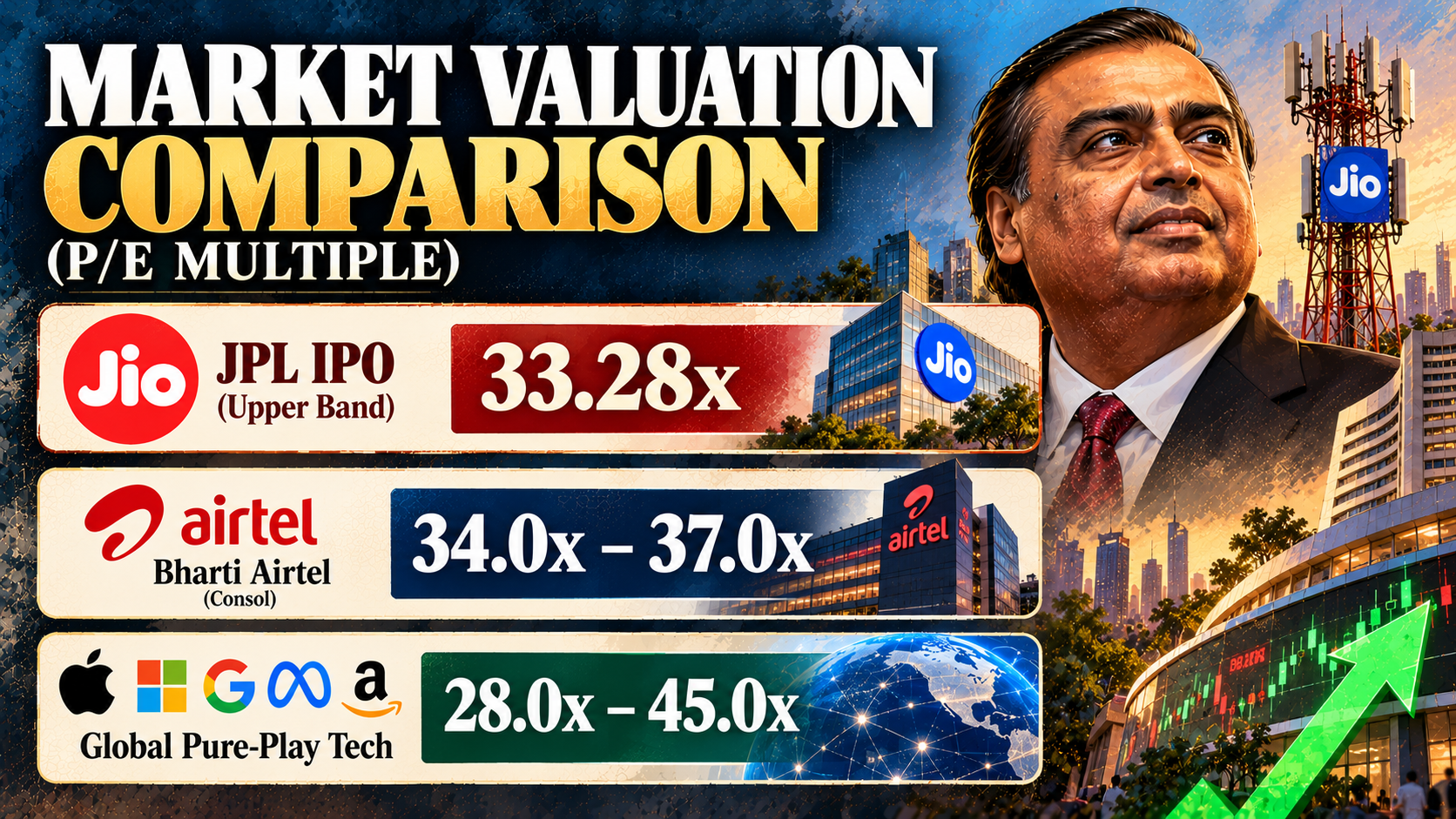
The issue's valuation sits in line with Bharti Airtel’s domestic consolidated trading range (approximately 34x–37x earnings), rather than demanding a speculative tech-platform premium. This pricing acknowledges that JPL's profit engine remains fundamentally tethered to regulated telecommunications tariffs.
Critical Disclosures and Structural Risks
The RHP risk factors outline several material dependencies that institutional and retail investors must weigh:
Operational Subsidiary Concentration: JPL operates purely as a holding entity. RJIL generated 87.74% of consolidated operational revenue, 94.88% of EBITDA, and 93.76% of net profit in FY26. For Q1 FY27, RJIL contributed 87.34% of revenue and 93.89% of EBITDA.
Prepaid Revenue and Channel Dependency: Prepaid mobile plans accounted for 77.08% of FY26 revenue. The company discloses that Reliance Retail Limited serves as the sole distributor for these prepaid connectivity services, introducing an ongoing related-party operational dependency.
Single Segment Reporting Under Ind AS 108: JPL reports under a single operating segment ("Digital Services"). As a result, the RHP provides no independent profit-and-loss statements for individual non-telecom initiatives such as JioBrain (AI), JioAICloud, JioPC, or enterprise software tools, preventing investors from assessing the standalone unit economics of its software portfolio.
Capital Intensity and Spectrum Renewal Obligations: Maintaining quality across 53.33 crore subscribers requires ongoing investments in network hardware and passive infrastructure leasing. Furthermore, statutory dues and spectrum payouts represent fixed long-term commitments regardless of macro tariff environments.
Absence of Trademark Control: JPL does not hold exclusive control over the "Jio" brand. Other Reliance Group entities—including Jio Financial Services Limited—use the trademark independently, creating brand reputation risks beyond JPL's direct operational governance.