In brief
- JR East is retiring the Suica Penguin after 25 years and replacing it with three candidate characters following a global public vote. The penguin will formally graduate on 31 March 2027, marking the end of its quarter‑century tenure.
- Public reaction to the retirement is one of widespread irritation and derision on social media and commuter forums in Japan, with critics calling the replacements uninspired corporate art.
- The change aligns with a digital shift as physical Suica cards decline in Tokyo stations over the past three years, amid broader trends toward digital wallet usage and licensing costs.
- JR East will announce the winning character on 18 November 2026, invite name proposals, and the new character will take over on 1 April 2027, during a year‑long farewell campaign called the Penguin Years.
In Tokyo, few commercial symbols are as universally recognised as the round, black-and-white face of the Suica Penguin.
Since East Japan Railway Company (JR East) launched its contactless IC card in November 2001, the Adélie penguin has peered out from physical commuter passes, station ticket barriers, train carriage advertisements, and convenience store payment terminals.
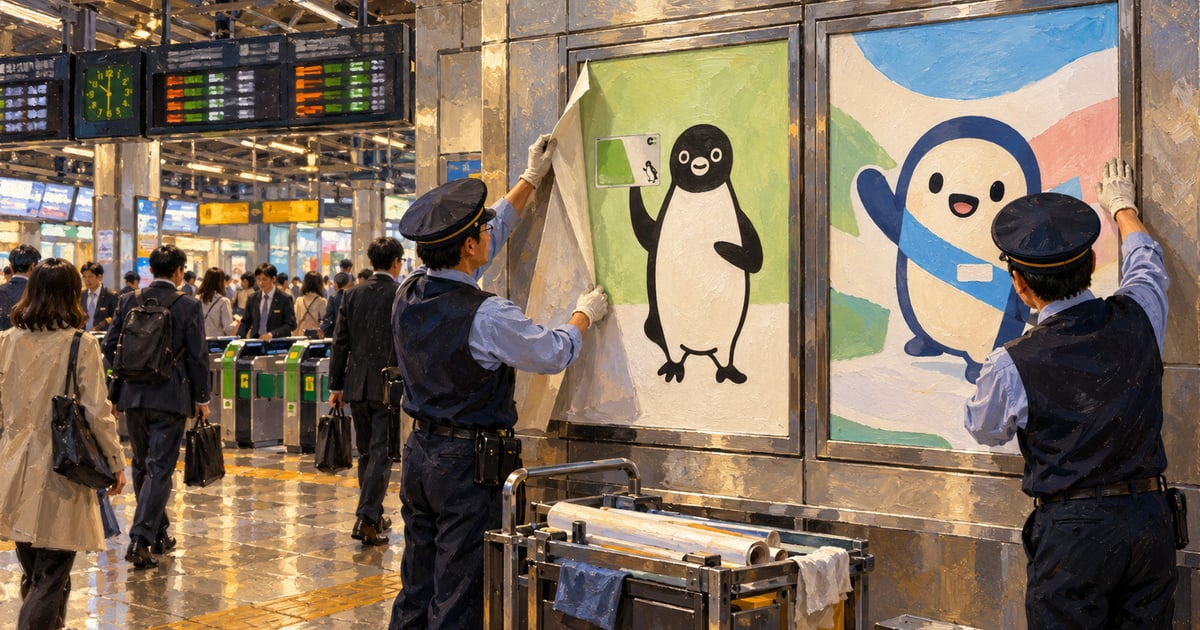
On 8 September 2026, JR East unveiled three candidate characters to replace the penguin, opening a global public vote to determine who will take over the railway's brand identity. The company confirmed that the penguin will formally "graduate" on 31 March 2027, concluding a quarter-century tenure.
The announcement was met not with celebratory nostalgia, but with widespread public irritation. On social media platforms and commuter forums across Japan, commuters reacted with disbelief and derision, criticising the candidate replacements as uninspired corporate art and questioning why JR East would discard one of the most successful corporate mascots in post-war Japan.
Behind the public outrage lies a collision between commuter sentiment, corporate intellectual property licensing costs, and JR East’s effort to turn an everyday transit card into a digital financial super-app.
The Three Contenders: Why the Replacements Provoked Ridicule
To select a successor, JR East convened an internal judging panel that reviewed concepts submitted by young commercial creators. The railway operator stated it wanted a character to represent Suica’s "renaissance"—moving beyond train gates into a broader companion for everyday digital commerce.
The three finalists put to the public vote could hardly look more different from the minimalist elegance of the original penguin:
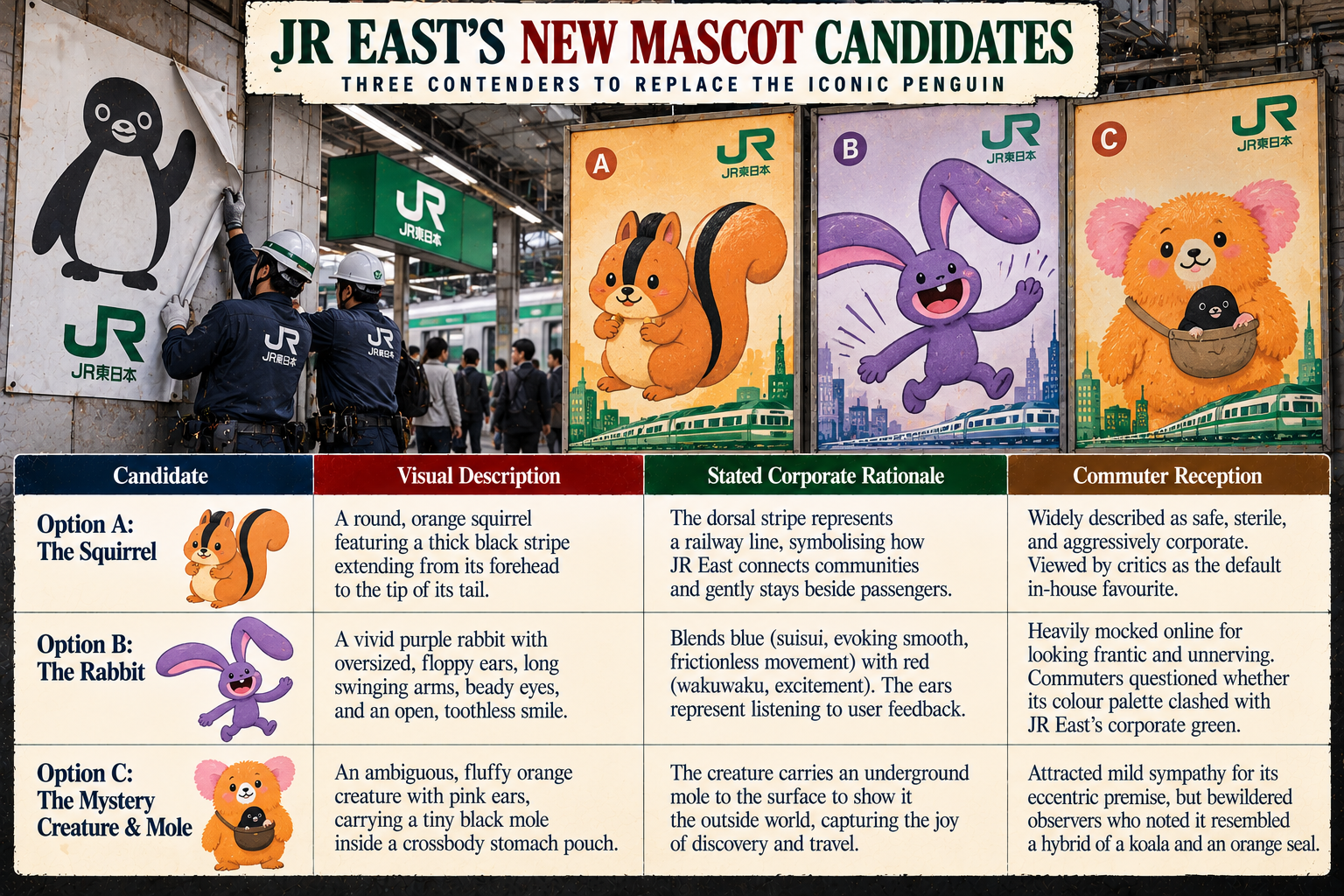
Online commentary in Japan was swift and overwhelmingly critical. Commuters described the trio as looking like low-budget municipal mascots (yuru-kyara) or generic Western corporate tech illustrations.
One widely circulated comment on Japanese forums captured the prevailing mood:
"Even if you hired all three of these characters at the same time, they wouldn't have half the charm of a single penguin."
The Real Rationale: The Intellectual Property Problem
JR East’s official explanation frames the retirement as an editorial evolution: the penguin is "graduating" so that a new character can embody the future of mobile payments.
The underlying legal and financial reality is more pragmatic: JR East does not fully own the Suica Penguin.
The character was not conceived in a corporate design lab. It originated in 1999 as a standalone character in a picture book titled A Day in the Life of a Penguin, written and illustrated by renowned artist Chiharu Sakazaki.
When advertising agency Dentsu was developing the launch campaign for Suica in 2001, art director Tomotomo Tanaka spotted Sakazaki’s book and licensed the penguin for initial station promotional posters. The card was designed to allow passengers to glide smoothly through ticket gates without queues (suisui), and the swimming penguin was chosen as an animal metaphor for effortless gliding.
The posters were an unexpected cultural phenomenon. The penguin proved so popular that JR East moved it onto the card itself, turning it into the permanent face of the system.
However, the legal consequence of that impromptu adoption has persisted for 25 years:
The copyright and licensing rights remain jointly held between Chiharu Sakazaki, Dentsu, and JR East.
Every piece of penguin merchandise—from plush toys and branded pastries sold at Pensta specialty shops to credit card partnerships—requires royalty accounting and approval from the creator.
Expanding the penguin into cross-promotions, corporate software ecosystems, and third-party commercial ventures involves licensing overhead.
By commissioning a new character from scratch through a competitive tender, JR East acquires 100% unencumbered global copyright. The railway operator can trademark, license, alter, and digitise the winning character across apps, financial products, and global partnerships without paying external creator royalties.
The Digital Shift: From Plastic Cards to Smartphone Wallets
The timing of the mascot change also aligns with the decline of the physical smart card.
Over the past three years, physical Suica cards have steadily disappeared from Tokyo stations. In 2023 and 2024, global semiconductor chip shortages forced JR East and regional transit operators to suspend the sale of unregistered physical Suica and Pasmo cards for more than a year.
Although sales eventually resumed, millions of commuters permanently shifted to Mobile Suica on Apple Wallet and Android devices, or to credit-card tap-to-pay systems.
For JR East, Suica is no longer primarily a plastic train ticket; it is an e-money ecosystem that processes retail shopping, vending machine purchases, café transactions, and regional loyalty points. The company wanted a character designed specifically for animated app splash screens, smartphone push notifications, and AI chat interfaces—uses that were never envisioned when Sakazaki drew the original picture book in the late 1990s.
Why Commuters Distrust the Process: The Takanawa Gateway Shadow
The backlash is compounded by a deep-seated scepticism toward JR East's public engagement exercises.
In 2018, JR East held a high-profile public naming contest for a new station on Tokyo’s central Yamanote loop line. The public submitted tens of thousands of votes, overwhelmingly backing traditional names:
"Takanawa" came first with 8,398 votes.
"Shibaura" came second.
"Takanawa Gateway" finished in 130th place, receiving just 36 votes.
Despite the public ballot, JR East executives selected "Takanawa Gateway" anyway, sparking widespread anger and petitions demanding the corporate English suffix be removed.
Because of that precedent, many commuters suspect the current mascot vote is equally theatrical. Commentators have speculated that Option A (the corporate squirrel) was pre-selected internally, and that the public voting portal—which closed on 23 September 2026—serves primarily as a marketing exercise to manufacture buy-in for an unpopular decision.
What Comes Next?
JR East has scheduled the formal announcement of the winning character for 18 November 2026, coinciding with Suica’s 25th anniversary. The company will then invite the public to submit name proposals for the winning animal before the character officially assumes duties on 1 April 2027.
Until then, JR East is running a year-long farewell campaign dubbed the "Penguin Years," featuring commemorative train wraps on the Yamanote Line, retrospective exhibition stands, and limited-edition merchandise runs.
The commercial challenge for JR East, however, will begin the morning after the transition. The Suica Penguin succeeded precisely because it was not designed by a committee to represent a corporate payments app. It was an offbeat, slightly aloof illustration created by an independent artist, whose unforced charm made navigating the world's busiest railway network feel just a little more gentle.
Replacing that emotional equity with an orange squirrel or a purple rabbit may solve JR East's licensing ledger, but it will leave Tokyo commuters mourning an irreplaceable companion of daily life.