In brief
- KFC will replace PepsiCo fountain dispensers with beverages from The Coca-Cola Company in 3,718 domestic restaurants starting January 2027, ending the 41 year partnership that began in 1986.
- The transition aims to support a broader menu overhaul and modernisation at KFC U.S. restaurants.
- The switch is scheduled to conclude across all company owned and franchised American locations by spring 2027.
- Catherine Tan-Gillespie, president of KFC U.S., says the move advances the chain's goal to evolve KFC, strengthen restaurants and create a more relevant experience for today’s customers.
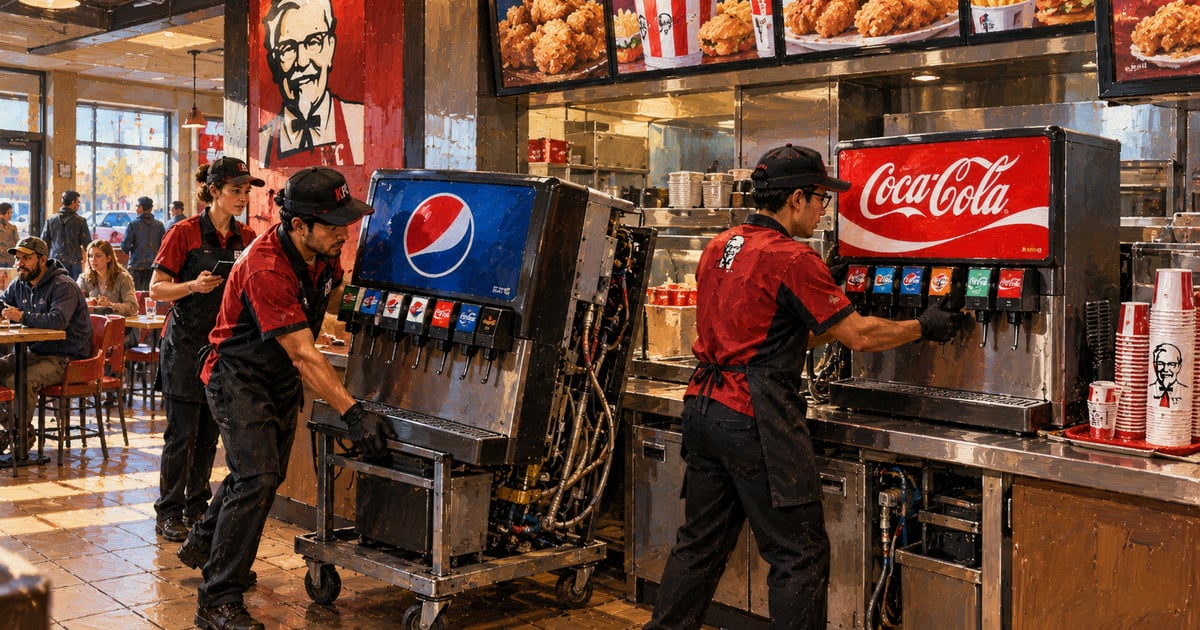
Beginning in January 2027, KFC U.S. will remove PepsiCo fountain dispensers from its 3,718 domestic restaurants and replace them with beverages manufactured by The Coca-Cola Company.
The transition, which is scheduled to conclude across all company-owned and franchised American locations by spring 2027, brings an end to a 41-year commercial partnership that began in 1986, when PepsiCo acquired the fried chicken chain for $840 million.
While financial terms of the multi-year master pouring rights contract were not publicly disclosed, the transaction represents one of the most visible supplier realignments in the quick-service restaurant (QSR) sector in over a decade.
The 1986 Legacy and the 1997 Spinoff
To understand the symbolic weight of the transition, the corporate history between KFC and PepsiCo must be examined:
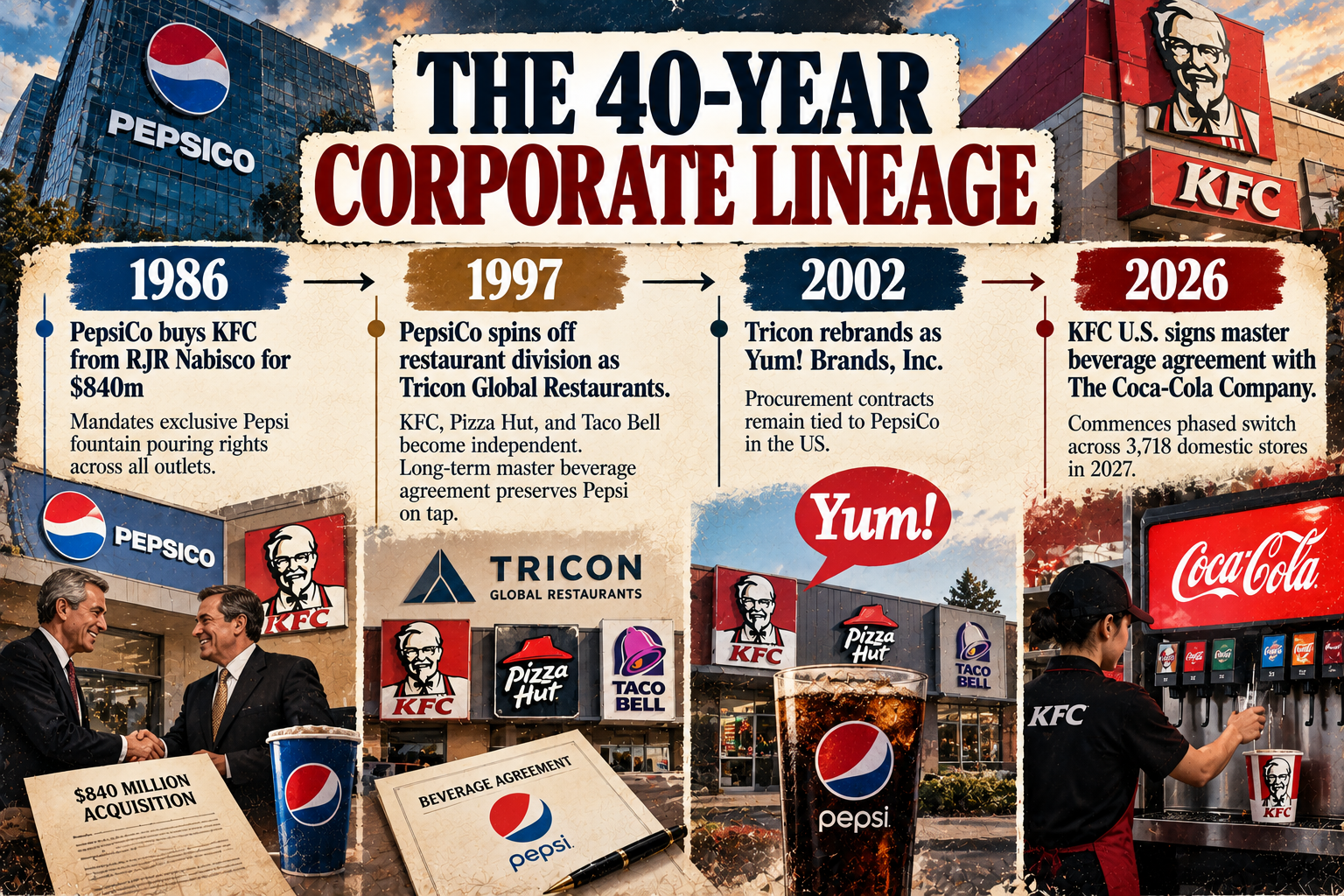
In 1986, under former chief executive Wayne Calloway, PepsiCo purchased Kentucky Fried Chicken from RJR Nabisco to construct a vertically integrated fast-food empire alongside its existing holdings, Pizza Hut and Taco Bell. Operating restaurants provided PepsiCo with guaranteed, captive pouring rights, insulating the beverage maker against Coca-Cola's dominance in commercial dining.
By the mid-1990s, however, rival restaurant chains began refusing to stock Pepsi, unwilling to subsidise a direct competitor in the fast-food space. In 1997, PepsiCo spun off its fast-food arm into Tricon Global Restaurants—which later adopted the name Yum! Brands in 2002.
As part of the separation agreement, Tricon signed long-term, exclusive beverage supply contracts that kept Pepsi in KFC, Taco Bell, and Pizza Hut fountain units. For four decades, that supplier relationship remained undisturbed across American franchises.
Fast-Food Economics: Why Fountain Contracts Matter
In the quick-service restaurant model, fountain beverages represent the single most lucrative item on the menu. While chicken, cooking oils, and labour carry tight margins, bag-in-box fountain syrup generates gross margins between 80% and 90%.
Because the operational cost of fountain syrup amounts to pennies per pour, national beverage contracts are rarely decided on syrup wholesale prices alone. Instead, commercial agreements are secured through a complex package of concessions:
Equipment Subsidies and Maintenance: Dispensing systems, carbonators, ice lines, and drive-through rapid-pour towers cost thousands of pounds per store. Beverage suppliers typically fund or heavily subsidise equipment installation and maintenance.
Cooperative Marketing Funds (Co-op Funds): Syrup manufacturers rebate tens of millions of pounds annually into the fast-food chain's corporate advertising fund, subsidising national television campaigns and digital app promotions.
Menu Innovation Allowances: Suppliers fund specialized dispensing hardware (such as multi-flavour automated dispensers and dedicated cold-foam or iced-tea bars).
Catherine Tan-Gillespie, president of KFC U.S., indicated that the decision was driven by broader menu modernisation under the chain’s internal "Kentucky Fried Comeback" initiative:
"This partnership is about more than what’s in the cup. It is another step in our work to evolve KFC, strengthen our restaurants, menu offerings and create a more relevant experience for today’s customers."
KFC has been under sustained commercial pressure in the United States, ceding market share in the fried chicken segment to competitors like Chick-fil-A (a long-time Coca-Cola client), Popeyes Louisiana Kitchen, and Raising Cane's. To counteract traffic declines, KFC has piloted expanded beverage menus—including boba teas, iced coffees, and craft shakes—at its "Open House" prototype restaurant in McKinney, Texas. The partnership with Coca-Cola is intended to support national rollouts of specialized beverage pairings that encourage higher average order values during afternoon snacking hours.
Yum! Brands’ Divide-and-Conquer Procurement
The KFC transition does not signal a total breach between Yum! Brands and PepsiCo. Rather, Yum! Brands has adopted a fragmented procurement approach that pits the two soft-drink giants against each other:
Taco Bell: A spokesperson for PepsiCo confirmed that Taco Bell recently signed an exclusive 10-year contract extension. The Mexican-style chain remains one of PepsiCo’s most lucrative retail accounts, anchored by the cult popularity of Mountain Dew Baja Blast, a proprietary flavour formulated exclusively for Taco Bell in 2004 that has become an indelible part of the brand’s identity.
Pizza Hut: Continues to pour Pepsi products domestically, maintaining parity with regional delivery dynamics.
International Precedents: Outside North America, KFC is not bound to a single supplier. The chain already serves Coca-Cola across several major global markets, including Indonesia (where KFC switched from Pepsi to Coke in 2019 after local bottling realignments) and Malaysia (which converted to Coca-Cola in 2022).
The Shifting Frontlines of the Soda Wars
KFC's defection marks another high-profile fountain win for Coca-Cola, which has systematically captured institutional foodservice accounts over the past three years:
Costco Wholesale: Converted its iconic warehouse food courts back to Coca-Cola dispensers.
Marriott International: Swapped domestic hotel pouring rights to Coca-Cola.
Culver’s: The Midwest burger chain switched its 900+ restaurants from Pepsi to Coca-Cola in 2023.
However, PepsiCo has delivered significant counter-blows in the dining channel. Most notably, in 2024, PepsiCo secured the master beverage contract for Subway, replacing Coca-Cola across nearly 20,000 sandwich shops starting in 2025. PepsiCo also holds the fountain contract for sandwich chain Jersey Mike’s Subs.
Consultants caution that while switching beverage brands delivers symbolic prestige and significant trade allowances, consumer behaviour rarely changes based on the fountain tap alone. R.J. Hottovy, head of analytical research at retail data firm Placer.ai, observed that restaurant chains that changed soft-drink providers historically experienced a modest lift in foot traffic during the initial marketing blitz, after which foot-traffic patterns normalised to reflect core food menu strength.
For KFC, the arrival of Coca-Cola in early 2027 provides a marketing spark and fresh capital allowances for equipment modernization. For Coca-Cola, securing 3,718 restaurant fountain heads serves as a symbolic victory, reclaiming taps that had been locked behind PepsiCo's corporate firewall since the mid-1980s.