
In brief
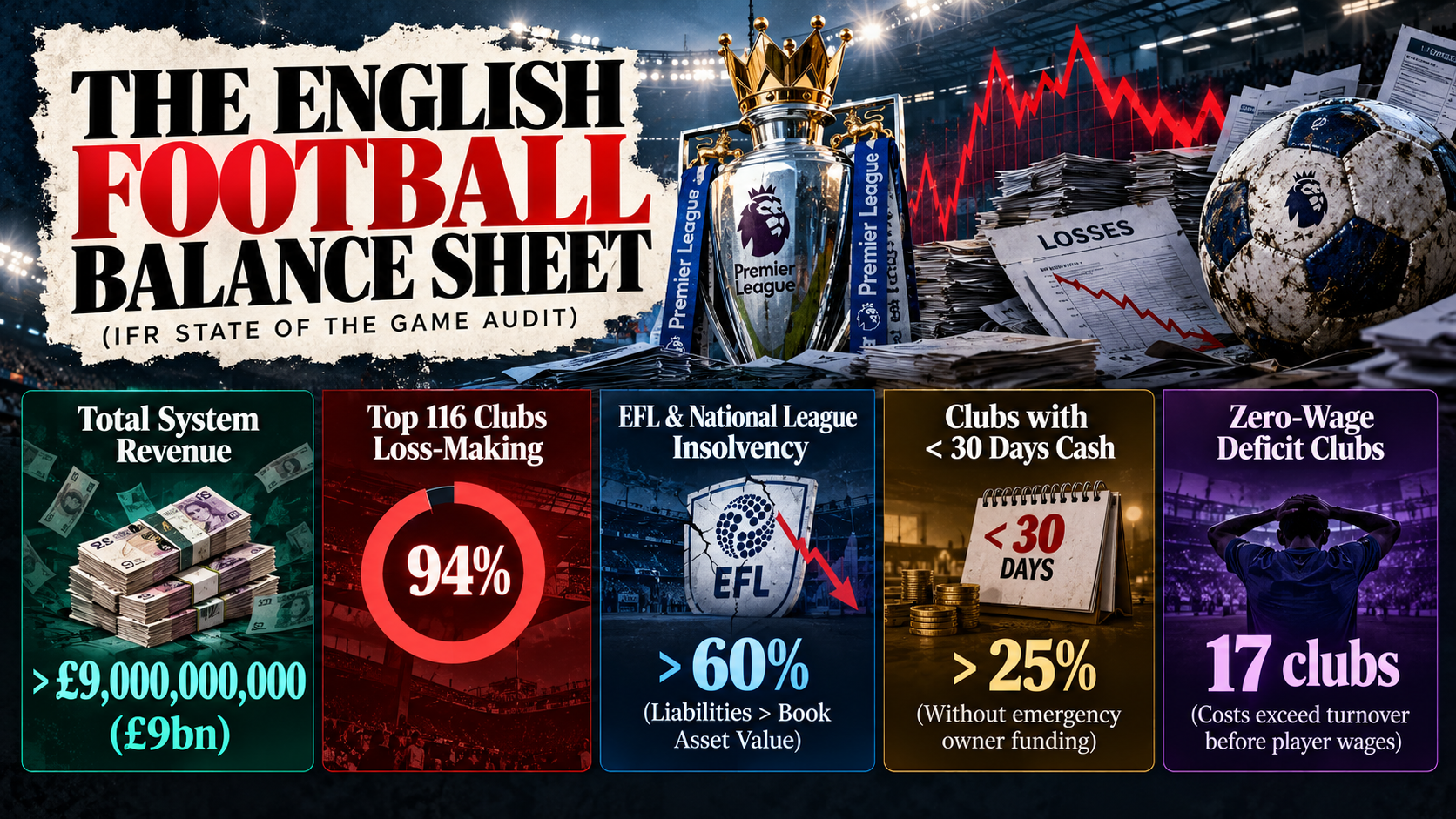
- The Independent Football Regulator published its first State of the Game report on 13 October 2026 finding English football dangerously exposed with systemic deficits and 94 per cent of professional clubs losing money
- Premier League revenue reached £9 billion but clubs posted record losses with Chelsea losing £262.4 million and members selling assets to meet the £105 million profitability threshold
- The average Premier League club earns eight times the average Championship club driving lower teams to spend 100 to 125 per cent of revenue on wages leaving over 60 per cent of EFL clubs technically insolvent
- Domestic broadcast value per match fell 27 per cent to £6.2 million prompting government intervention through the Football Governance Act and new spending caps that top clubs are challenging in court
To the casual observer, the English Premier League remains an unmatched commercial juggernaut. It fills cathedrals of glass and steel each weekend, beams broadcast feeds to a billion living rooms across the globe, and generates annual ecosystem revenues topping £9 billion (approximately ₹99,000 crore / $11.7 billion).
Yet beneath this gilded surface, the economic engine of English football is running on fumes.
On 13 October 2026, the newly established Independent Football Regulator (IFR) published its inaugural State of the Game report—a 250-page forensic audit of the English football pyramid. The report arrived not from campaigning fans or doom-mongering economists, but from a statutory body endowed with parliamentary powers. Its conclusion was unequivocal: English football is "dangerously exposed", operating with systemic deficits, and teetering on the edge of structural financial disaster.
The warning does not mean Manchester United or Arsenal will file for liquidation next Tuesday. Instead, it signals the arrival of a slower, more insidious form of ruin: an economic system where unchecked wage inflation outpaces flatlining broadcast revenues, where 94% of professional clubs lose money, and where top-flight excess systematically threatens the survival of the 138-year-old pyramid below it.
The Audit: Record Revenue, Universal Losses
The central finding of the IFR’s report is an economic paradox: English football has never earned more, yet it has never been poorer.
The scale of the top-flight losses challenges the narrative that financial recklessness is confined to lower-league misfits. Chelsea posted a record Premier League pre-tax loss of £262.4 million (around ₹2,880 crore / $340 million) for the financial year ending 30 June 2025. Across the division, clubs have resorted to balance-sheet gymnastics—selling training grounds, offloading team hotels to sister corporate entities, and orchestrating swap deals of academy prospects prior to the 30 June accounting deadline—merely to comply with the league's £105 million three-year Profitability and Sustainability Rules (PSR) threshold.
When a league generating billions requires its members to sell car parks and hotels to their own owners to avoid sporting penalties, the business model has ceased to function normally.
The 8x Cliff-Edge and the Championship Casino
The Premier League cannot be understood in isolation; it sits atop a four-division professional pyramid bound by promotion and relegation. The financial distance between the penthouse and the floor below has turned into a vertical drop.
According to the IFR, the average Premier League club now earns more than eight times the revenue of the average EFL Championship club.
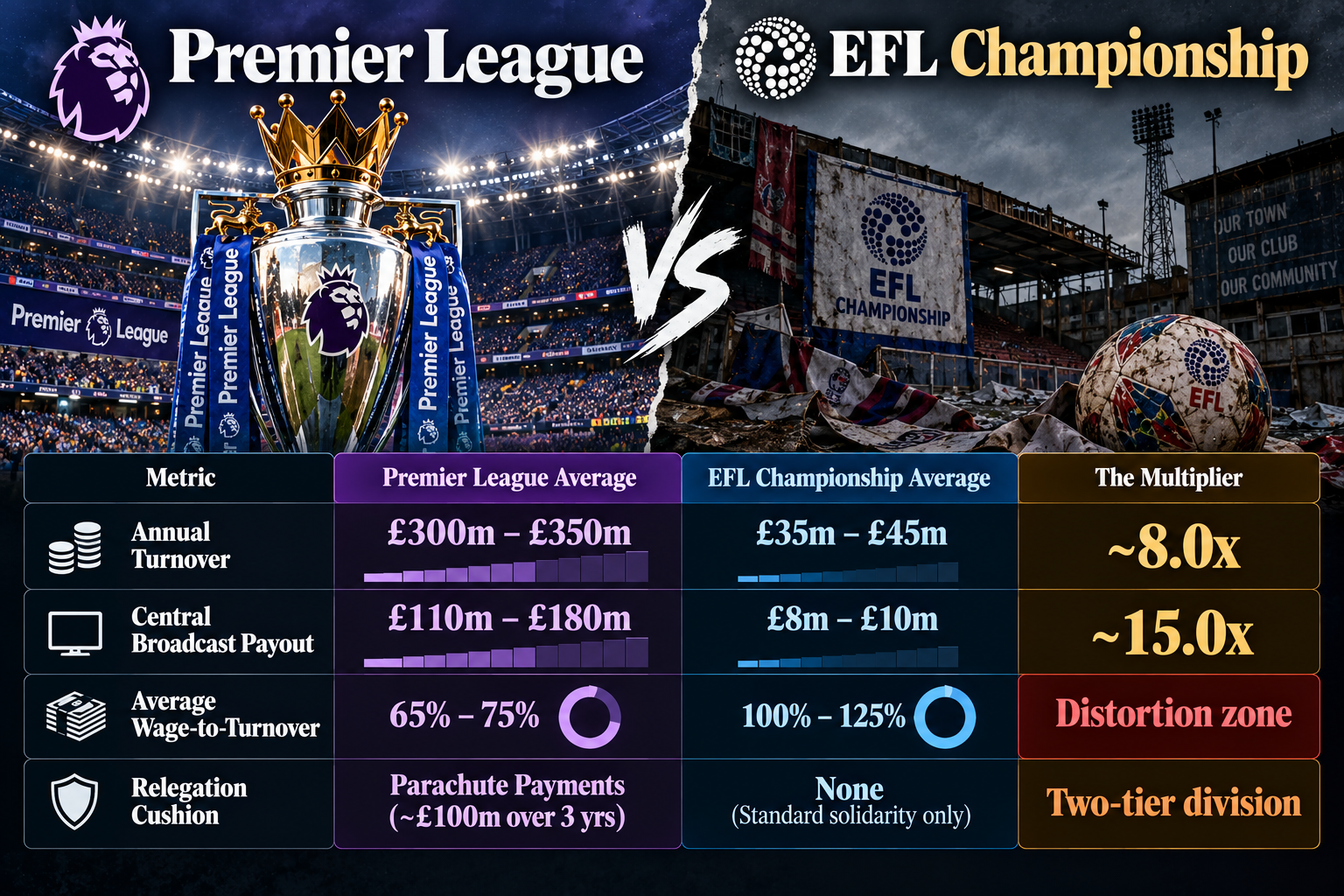
This eightfold disparity creates what economists call a tournament problem. Because reaching the Premier League promises an immediate revenue surge of at least £120 million (₹1,320 crore / $155 million), Championship club owners gamble recklessly.
Championship clubs regularly spend between 100% and 125% of their total annual revenue on player wages alone. They are not investing out of operational cash flow; they are operating at a deliberate loss, subsidised by private equity debt or high-net-worth benefactors, in the hope of landing on the top-flight roulette wheel.
The consequences downstream are catastrophic. Over 60% of clubs in the English Football League (EFL) and the National League are now technically insolvent, with liabilities exceeding the book value of their assets. More than a quarter of all professional clubs in England told the regulator they could not survive for more than one month if their owner decided to stop underwriting monthly losses.
Most alarming of all: 17 clubs across the lower divisions carry operating overheads—stadium maintenance, stewarding, energy, administrative staff—that exceed their total revenue before a single pound is paid to a footballer. They are structurally unviable entities surviving solely on billionaire charity.
The Broadcast Plateau: The Bailout Era Is Over
For thirty years, Premier League excess was forgiven because the revenue tide never stopped rising. Whenever wage bills threatened to overwhelm corporate earnings, the next television rights auction arrived to re-inflate margins.
That era has officially drawn to a close.
The Premier League's domestic rights deal for the 2025–2029 cycle was agreed at £6.7 billion over four years. While trumpeted by executive suites as a headline 4% increase over the previous three-year £5 billion package, the underlying metrics reveal stagnation:
Diluted Per-Match Value: To secure the £6.7 billion figure, the league increased the number of live broadcast matches from 200 to 270 per season—a 35% increase in inventory. On a per-game basis, the domestic value of Premier League rights actually fell from roughly £8.5 million to approximately £6.2 million per match.
Exhausted Domestic Competition: Traditional pay-TV broadcasters (Sky and TNT Sports) are squeezed by cord-cutting and production cost inflation. Free-to-air players are absent, and Silicon Valley streaming platforms have been selective rather than reckless bidders.
International Resistance: Overseas rights, which historically provided explosive double-digit growth in the United States, Asia, and the Middle East, are facing macroeconomic headwinds, currency volatility, and competition from other global entertainment formats.
When top-line growth moves from 15% compound annual expansion to flat or low-single-digit gains, an industry carrying rigid, multi-year fixed player wage commitments enters a margin squeeze. Clubs can no longer outgrow their bad decisions; they must balance their books.
Regulatory Paralysis and Civil War
Faced with this structural crunch, the institutions that govern the sport have retreated into factional warfare and legal conflict.
1. The Death of Consensus
The Premier League is currently consumed by litigation against its own membership. The historic proceedings involving Manchester City—which resulted in an independent commission issuing guilty verdicts on more than 100 charges of financial rule breaches—has pitted the richest club in the world against the league's executive leadership.
Simultaneously, arbitration tribunals over Associated Party Transaction (APT) rules and shareholder loan interest benchmarks have exposed bitter philosophical divides between state-backed powerhouses, American multi-club conglomerates, and historic legacy institutions.
2. The Failed "New Deal for Football"
For nearly three years, the Premier League and the EFL failed to reach a voluntary agreement on wealth redistribution. The Premier League’s offer of £180 million annually over ten years (in addition to existing £150 million solidarity flows) was rebuffed by the EFL, which demanded £207 million, a five-year review clause, and an emergency "lifeboat fund" for distressed clubs.
The impasse forced the British government to intervene with the Football Governance Act, granting the Independent Football Regulator statutory "backstop powers" to legally dictate the financial settlement if the leagues remain deadlocked.
3. The Accounting Merry-Go-Round: PSR to Anchoring
Recognising that PSR in its current form merely incentivised clubs to sell academy players for pure accounting profit, the Premier League voted to transition toward UEFA's Squad Cost Rules (SCR)—capping spending on wages, transfers, and agent fees at 85% of revenue for non-European clubs (70% for those in Europe).
It also initiated trials of Top-to-Bottom Anchoring (TBA), which would cap any single club’s squad spending at a fixed multiple (typically 4.5 to 5 times) of the central broadcast revenue paid to the bottom-placed team. Yet anchoring has already met ferocious resistance from top clubs, who argue that artificial spending caps violate UK competition law and diminish their ability to compete with Real Madrid, Bayern Munich, or the Saudi Pro League.
Verdict: The Nature of the Coming "Ruin"
Is financial ruin coming to the English Premier League?
If "ruin" is defined as the total collapse of the top flight, mass bankruptcies of global brands, or empty stadiums on Saturday afternoons, the answer is no. Global capital remains infatuated with English football. American private equity groups, Gulf sovereign funds, and domestic billionaires will continue to view Premier League assets as irreplaceable, trophy cultural real estate.
However, if ruin is defined as the destruction of sporting integrity, the insolvency of the lower leagues, and the replacement of sporting merit with financial tribunal decrees, then ruin has already arrived.
English football has constructed an economic model that requires permanent, double-digit revenue inflation to subsidise an irrational wage race. Now that the broadcast market has plateaued, the structural rot is showing:
Competitive Sclerosis: A regulatory system that restricts spending to a percentage of turnover inevitably locks in the dominance of the existing highest-earning commercial giants, cementing an anti-competitive caste system.
The Hollowed-Out Pyramid: Without a comprehensive redistribution mechanism that eliminates the distortion of parachute payments, lower-division clubs will continue to lurch toward administrative collapse every time an owner tires of underwriting monthly operating deficits.
The Legalisation of Sport: When championship outcomes, European qualifications, and relegation battles are decided by accounting tribunals and king’s counsel rather than goals scored on the pitch, the sport’s foundational social contract with supporters is broken.
The Independent Football Regulator’s State of the Game report is the final structural warning. The English game does not have a revenue problem; it has an addiction to spending every pound it earns—and several pounds it does not. Unless cost controls are enforced and the revenue chasm narrowed, the Premier League will remain a glittering diamond balanced atop an increasingly fractured mountain of debt.