In brief
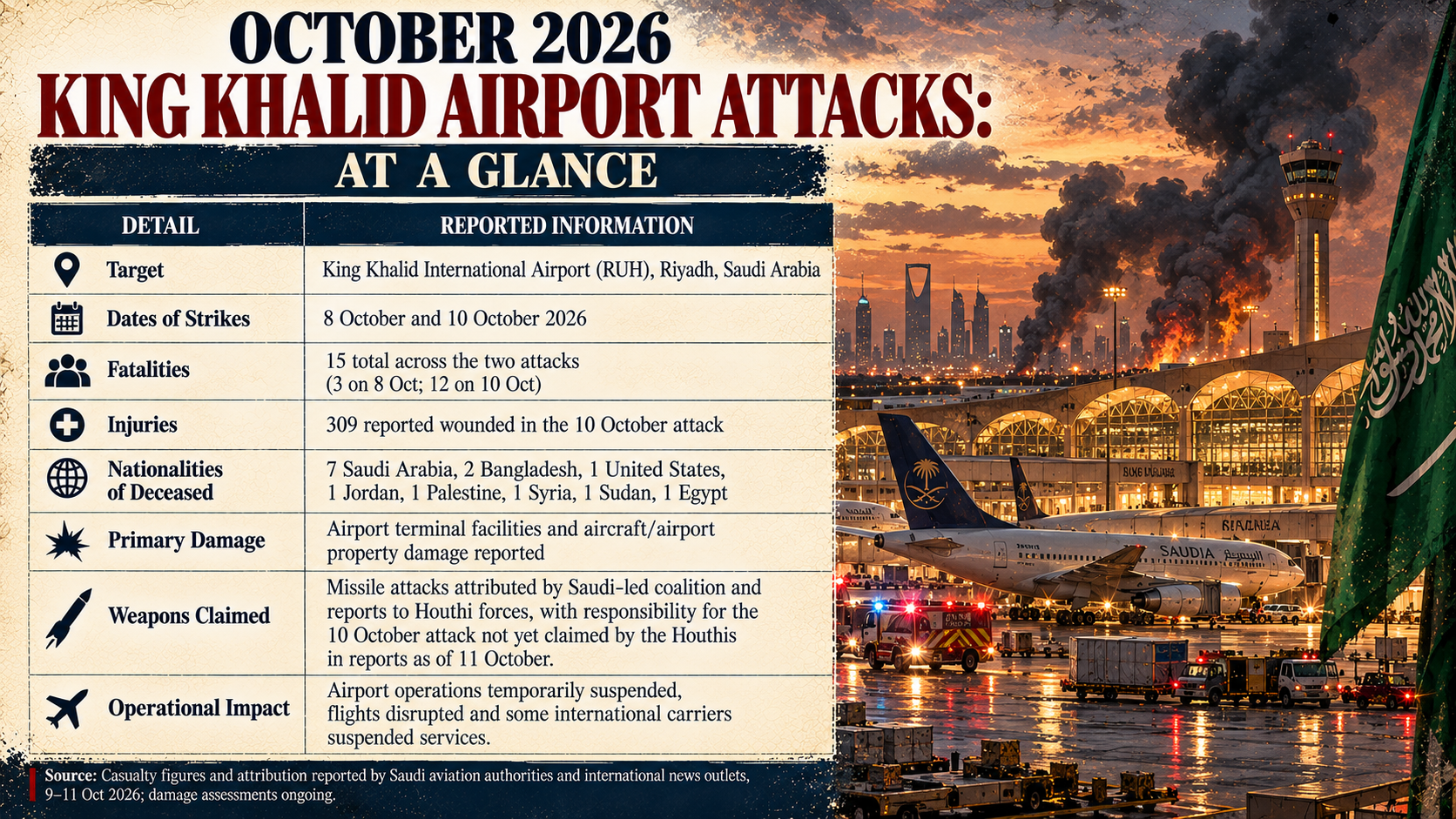
- Houthi forces launched ballistic missile strikes on King Khalid International Airport in Riyadh on 8 and 10 October 2026, killing 15 civilians and wounding over 300, leading to the suspension of flights at Saudi Arabia’s main aviation hub.
- On 8 October two missiles hit airfield facilities and a Saudia aircraft, killing three Saudi nationals including a pilot; on 10 October a missile struck the terminal complex of Terminals 3 and 4, killing 12 and injuring 309.
- The Houthis said the attack was retaliation for a coalition airstrike on Sanaa International Airport in July 2026, with senior official Mohammed al‑Bukhaiti claiming responsibility.
- The strikes forced the cancellation or diversion of flights for the WPC Energy Congress starting 11 October and threatened other Vision 2030 events such as the Future Investment Initiative.
A series of ballistic missile strikes launched by Yemen’s Houthi movement against King Khalid International Airport in Riyadh has killed 15 civilians and wounded more than 300, forcing the suspension of flights at Saudi Arabia’s primary aviation gateway. The strikes, carried out between 8 and 10 October 2026, represent the deadliest cross-border assault inside the kingdom in more than a decade, puncturing years of relative calm along the Saudi–Yemeni frontier and disrupting international gatherings scheduled in the capital.
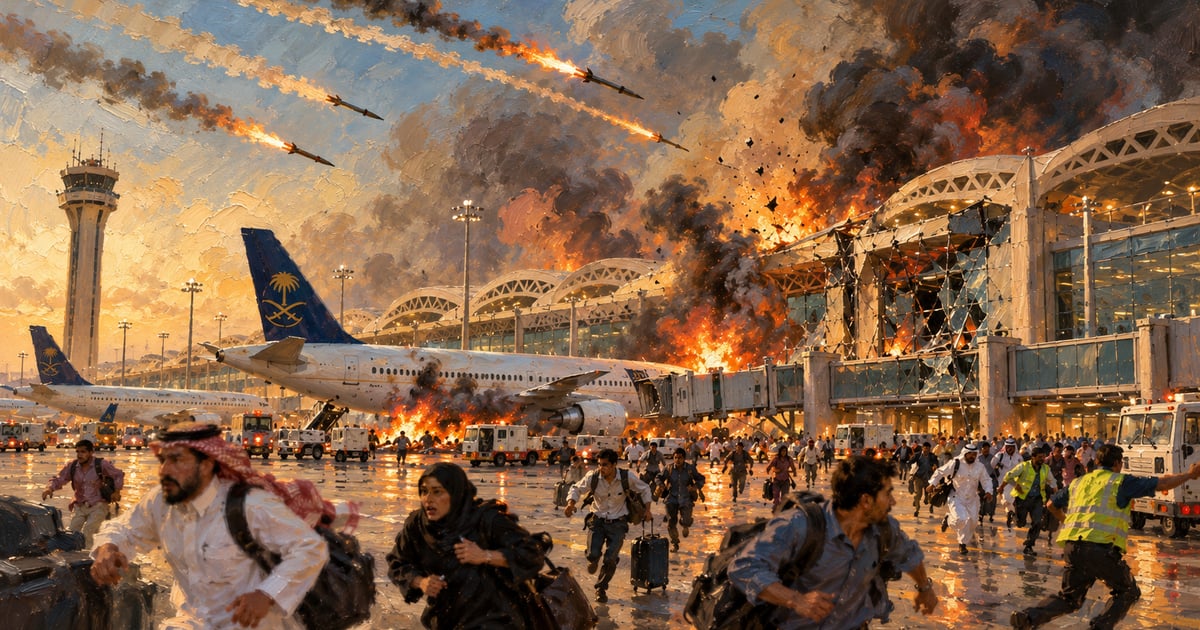
The assault hit the heart of Saudi Arabia's civil aviation network. According to the kingdom's General Authority of Civil Aviation (GACA) and reporting from the Associated Press, the bombardment began on 8 October with two missile impacts that struck airfield facilities and damaged an active Saudia commercial aircraft, killing three Saudi nationals—including a commercial pilot—and injuring several others.
Two days later, on 10 October, a heavier missile struck the terminal complex housing Terminals 3 and 4, which manage domestic and regional flight connections. That explosion killed 12 people and injured 309, spreading devastation across busy passenger boarding areas.
The scale of casualties and the direct penetration of the capital’s commercial terminal complex mark a sharp escalation from the perimeter drone harassment seen in southwestern border provinces between 2019 and 2022. The attack carries immediate strategic, economic, and humanitarian consequences.
Chronology: How the 8–10 October Strikes Unfolded
King Khalid International Airport, located 35 kilometres north of central Riyadh, handles tens of millions of passengers annually. The October attacks unfolded in two distinct phases:
Phase 1: 8 October 2026
During the morning operational peak, two ballistic projectiles targeted the airport grounds.
One missile impacted airside infrastructure; a second detonated adjacent to a Saudia airliner on the apron.
GACA confirmed the deaths of three Saudi citizens, including an on-duty Saudia captain, with multiple foreign nationals sustaining injuries.
International carriers, including Lufthansa, Air India, and Pakistan International Airlines, suspended Riyadh services or diverted inbound flights to Jeddah and Dammam.
Limited flight operations resumed late on 9 October after runways were cleared and inspected.
Phase 2: 10 October 2026
A missile breached the terminal perimeter and struck the commercial hub uniting Terminals 3 and 4.
The blast occurred inside a crowded passenger transit concourse, causing structural collapse and heavy shrapnel distribution.
Emergency medical services treated 309 wounded individuals at the scene and across Riyadh hospitals.
The death toll reached 12, reflecting a multinational passenger manifest: four Saudis, two migrant workers from Bangladesh, and individual citizens of the United States, Jordan, Palestine, Syria, Sudan, and Egypt.
Aviation authorities ordered an open-ended suspension of passenger departures and arrivals.
Why Now? The Yemeni Ground War and Retaliation Doctrine
The strikes did not occur in a vacuum. They follow the collapse of the informal de-escalation that held following the UN-brokered truce of April 2022.
Over the preceding weeks, ground warfare inside Yemen resumed along critical economic corridors. Pro-government formations, principally the Southern Giants Brigades affiliated with the Southern Transitional Council (STC), launched sweeping counter-offensives in Taiz province and along the Red Sea coast to secure the Bab al-Mandab Strait and Perim Island, as documented by The Guardian. The Houthis suffered significant logistical disruption and responded by declaring coalition supply lines legitimate targets.
Crucially, the Houthis tied the Riyadh attack directly to past coalition air activity over Yemen. Senior Houthi political official Mohammed al-Bukhaiti claimed formal responsibility, asserting the missile strikes were retaliation for coalition bombardments of Yemeni civilian facilities, notably an airstrike on Sanaa International Airport in July 2026 reported by Human Rights Watch.
Al-Bukhaiti stated the movement struck Riyadh "so that the world understands that airports, seaports, wedding and mourning halls, hospitals, and markets in Yemen are civilian facilities that must not be targeted." This statement underscores Ansar Allah's long-standing doctrine: establishing deterrence by imposing reciprocal vulnerability on Gulf urban centres.
From Abha to Riyadh: Evolution of Houthi Airport Targeting
Attacking civil aviation infrastructure has been a central pillar of Houthi military strategy since 2018, but the operational focus and weapon systems have evolved substantially.
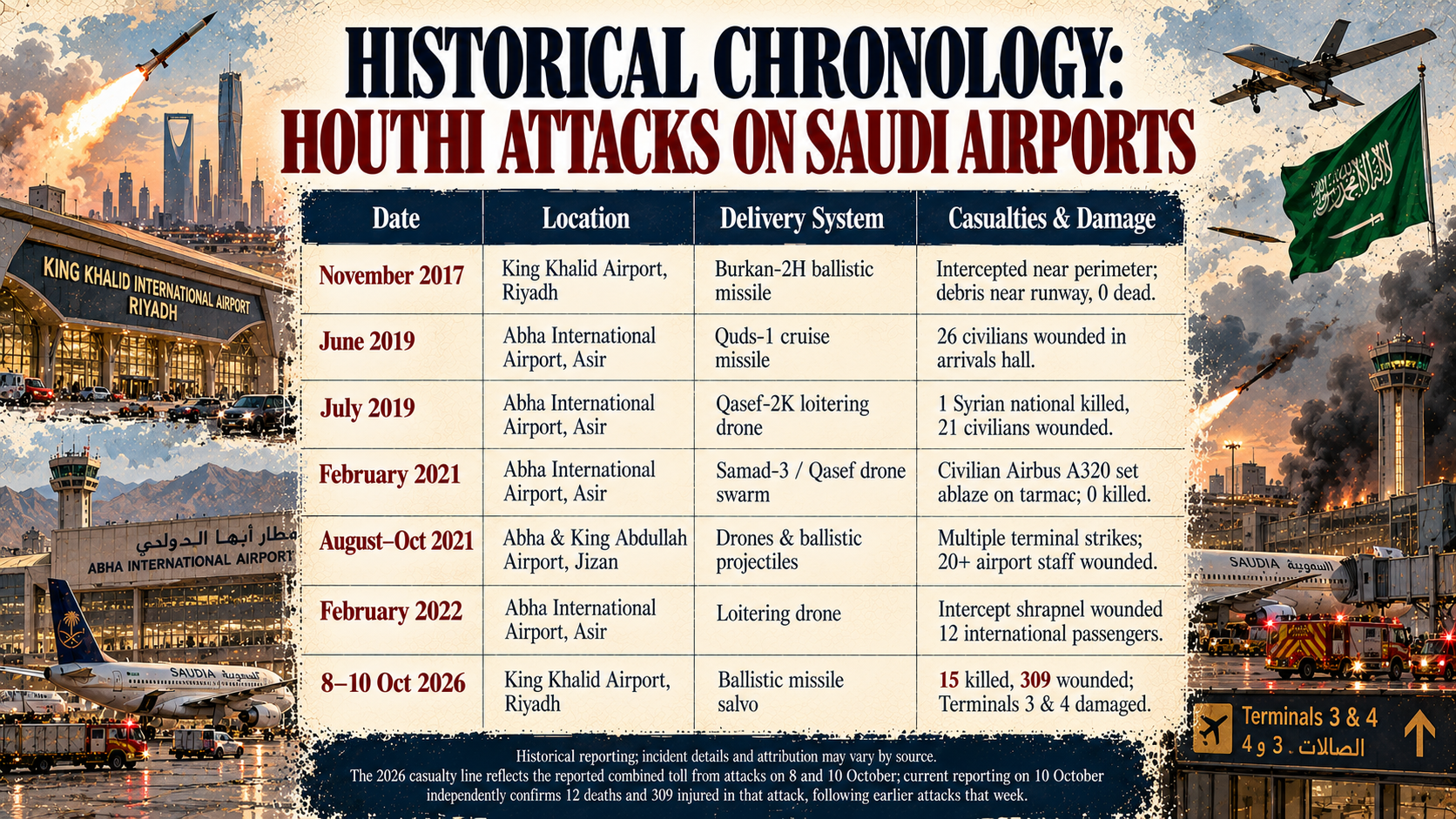
Between 2019 and 2022, Houthi strikes primarily targeted airports close to the border—Abha, Jizan, and Najran—using propeller-driven Qasef-2K delta-wing drones and Quds-series low-flying cruise missiles. These systems exploited radar terrain shadowing in the Asir mountains to evade regional air defences, causing intermittent terminal disruption and tarmac fires.
The October 2026 strikes on Riyadh represent a marked qualitative shift. Reaching the capital requires traversing approximately 900 to 1,000 kilometres of monitored airspace. Delivering heavy warheads capable of breaching reinforced terminal roofs demonstrates either improved terminal-guidance packages on medium-range ballistic missiles (such as derivatives of the Burkan or Toufan families) or saturation tactics designed to overwhelm Patriot PAC-3 point-defence interceptor batteries stationed around the capital.
Air Defence and Interception Mechanics: The Terminal Dilemma
The extensive damage to Terminals 3 and 4 raises urgent questions regarding Saudi Arabia’s air defence network. Riyadh is among the most heavily defended capital cities in the Middle East, ringed by US-manufactured MIM-104 Patriot PAC-2 and PAC-3 batteries and backed by Terminal High Altitude Area Defense (THAAD) architecture.
Military analysts point to two operational possibilities:
Direct Terminal Penetration: A high-velocity ballistic warhead equipped with terminal manoeuvring surfaces evaded interceptor engagement windows, scoring a direct hit on the concourse roof.
Defensive Interception Debris: An interceptor detonated or struck the incoming ballistic missile at low altitude directly over the airfield perimeter, sending intact heavy warhead sections, booster casings, and high-velocity shrapnel plunging into the lightweight aluminium and glass terminal structures below.
In both instances, the tactical outcome for civilian ground infrastructure remains catastrophic. Point-defence systems engaging incoming missiles in their terminal descent phase must intercept targets at substantial altitude to prevent kinetic debris showers from devastating populated facilities beneath the interception envelope.
Economic Fallout and the Vision 2030 Calendar
Beyond the civilian casualties, the timing of the attack struck at Saudi Arabia’s international economic strategy.
Riyadh was scheduled to host global delegates for the WPC Energy Congress beginning on 11 October 2026. The strikes forced incoming ministerial and executive delegations to divert flights to alternate Gulf hubs or cancel attendance outright, according to reporting by the Los Angeles Times.
The attack also casts a shadow over subsequent marquee events under Crown Prince Mohammed bin Salman’s Vision 2030 portfolio, including:
The Future Investment Initiative (FII): The annual sovereign wealth summit scheduled for late October, heavily reliant on international financial executives flying directly into King Khalid International Airport.
Tourism and Transit Ambitious Targets: Riyadh's drive to establish itself as a primary global logistics crossroads, spearheaded by the expansion of King Salman International Airport and the launch of Riyadh Air, depends on absolute airspace security guarantees.
When commercial airlines such as Lufthansa and Air India suspend flights to a sovereign capital, insurance premiums for commercial aviation skyrocket, undermining foreign investor sentiment and the narrative of insulated domestic stability.
Diplomatic and Military Repercussions
The response from Riyadh and international capitals has been swift, signalling potential regional escalation:
Saudi-led Coalition: Spokesman Major General Turki al-Maliki characterised the terminal strike as a "full-fledged war crime" and declared that the coalition would "respond decisively to this terrorist attack in accordance with Customary International Humanitarian Law."
United States: US President Donald Trump stated that Washington would "make a decision" regarding direct intervention, while Secretary of State Marco Rubio condemned the assault on civilian air transit.
Regional and Global States: Governments across the region—including Qatar, Jordan, Kuwait, Oman, Pakistan, and India—issued formal statements condemning the targeting of civil aviation infrastructure and expressing condolences to the families of foreign workers and passengers killed in the concourse.
Under the Geneva Conventions and Additional Protocol I, civilian international airports are protected non-military objects. Indiscriminate or deliberate missile strikes directed against commercial passenger terminals constitute serious violations of international humanitarian law. Conversely, Houthi officials argue that Saudi air blockades and past strikes on Sanaa Airport stripped their adversaries of moral immunity—an argument rejected by international legal experts, who maintain that reciprocal war crimes remain unlawful under the laws of armed conflict.
Strategic Outlook
The October 2026 strikes on King Khalid International Airport dismantle the premise that Gulf economic development can remain decoupled from the unresolved political crisis in Yemen.
If Saudi Arabia responds with a wide-scale aerial campaign against Sanaa and Hodeidah, the Houthis have demonstrated that their ballistic missile inventory can strike deep into the kingdom's commercial and transit heartland. With major investment summits on the immediate horizon and commercial airlines reassessing the safety of Saudi airspace, the attacks on Riyadh airport have returned the Yemen conflict to the centre of regional geopolitical instability.