In brief
- Sarvam AI is negotiating a fresh top up of between $250 million and $300 million (₹2,100 crore to ₹2,500 crore) that would double its post money valuation to $3 billion (approximately ₹25,000 crore).
- The round follows a $300 million Series B closed in June 2026 that gave Sarvam a $1.5 billion post money valuation backed by HCLTech Khosla Ventures Peak XV Partners and Bessemer Venture Partners.
- Sarvam plans to pretrain a 1 trillion parameter model by early 2027 needing about 10,000 GPUs and is seeking the top up to fund that hardware before silicon costs erode its balance sheet.
- The company also aims to expand government and enterprise deals such as the Maharashtra Indus sovereign AI workspace worth ₹11.26 crore over two years and convert pilot projects at LIC SBI Life and Tata Capital into multi year production contracts.
Four months after securing unicorn status with a $300 million Series B funding round, Bengaluru-based foundation model developer Sarvam AI is negotiating a fresh top-up of between $250 million and $300 million (₹2,100 crore to ₹2,500 crore) that would double its post-money valuation to $3 billion (approximately ₹25,000 crore). According to reporting by The Economic Times, the talks involve large domestic corporate houses and institutional investors, structured intentionally to keep primary equity control anchored within Indian borders.
The speed of the round underscores how quickly capital demands in frontier artificial intelligence escalate once a developer commits to training full-stack foundation architectures. For India’s broader technology landscape, which spent much of the past decade adapting Western consumer software to domestic logistics and payments, Sarvam’s trajectory represents the first serious domestic test of whether an independent laboratory can build, own, and commercialise deep foundation infrastructure at population scale.
Yet doubling a valuation to ₹25,000 crore in under half a year also compresses the runway between experimental promise and commercial delivery. As Sarvam prepares to scale compute from thousands to tens of thousands of GPUs, hire researchers in Silicon Valley, and deliver production workloads to some of the country’s largest public institutions, the company faces distinct technical, financial, and structural hurdles.
The June Foundation: Anatomy of a Rapid Escalation
To understand why Sarvam is returning to capital markets so quickly, one must examine the structure of its Series B round closed earlier in 2026. The startup initially announced a $234 million first close in June 2026 at a $1.5 billion post-money valuation, anchored by a $150 million strategic commitment from IT services giant HCLTech, alongside existing venture backers Khosla Ventures, Peak XV Partners, and Bessemer Venture Partners. Within weeks, the company expanded the round with a $75 million extension bringing total proceeds past $300 million, onboarding NVIDIA, Glade Brook Capital, Gaja Capital, and IndiGo Ventures.
That round did not sit idle. Founded in 2023 by Vivek Raghavan (former chief product manager at UIDAI and co-architect of AI4Bharat) and Pratyush Kumar (former Microsoft Research scientist and adjunct professor at IIT Madras), the company—registered legally as Axonwise Private Limited—moved swiftly to assemble an end-to-end sovereign stack:
Foundational Reasoning Models: In early 2026, the company launched Sarvam 105B, a 105-billion-parameter model trained from scratch in India on an estimated 4,000 GPUs, tailored for advanced reasoning and complex agentic tasks, alongside Sarvam 30B, an edge-optimised model engineered to run directly on consumer-grade enterprise hardware.
Document and Vision Intelligence: Sarvam Vision was deployed to ingest unstructured regional records and handwritten forms, processing more than 3.5 crore pages (35 million pages) across land revenue registries and financial services institutions.
Voice and Conversational Stack: Its proprietary speech engine, Samvaad, currently transcribes over 5 lakh hours (500,000 hours) of audio monthly and powers 20 lakh (2 million) daily interactions across 10 major Indian languages.
Developer Ecosystem: Its India-hosted inference platform processes over 1 crore (10 million) API calls per day, pricing 105B inference at roughly $0.80 per million tokens—substantially undercutting western proprietary mini-models for regional linguistic tasks.
The proposed $300 million top-up reflects the steep capital cliff of pre-training frontier models. In July 2026, at its Epoch developer gathering, Sarvam announced plans to pre-train a 1-trillion-parameter foundation model by early 2027, requiring a dedicated cluster of approximately 10,000 GPUs. Subsidised public infrastructure helps, but private institutional equity is essential to secure that hardware volume.
Enterprise Deployments and the Public Sector Moat
Unlike Western foundation labs that rely heavily on consumer subscriptions or uncommitted venture-funded developer tokens, Sarvam’s revenue model has taken a distinctly vertical, institutional shape.
The most prominent example of this strategy is its government footprint. In August 2026, the Government of Maharashtra formally cleared the deployment of Sarvam’s Indus sovereign AI workspace across state administration. Cleared by a High-Power Committee headed by the Chief Secretary, the two-year government order carries an outlay of ₹11.26 crore ($1.35 million), supporting 2,500 officials with automated administrative drafting, document summarisation, and multi-dialect translation. Crucially, the mandate requires all data pipelines and weights to remain hosted within Indian territory—a contractual restriction foreign hyperscalers struggle to satisfy natively.
Beyond state secretariats, Sarvam has secured enterprise production deployments within banking, financial services, and insurance (BFSI):
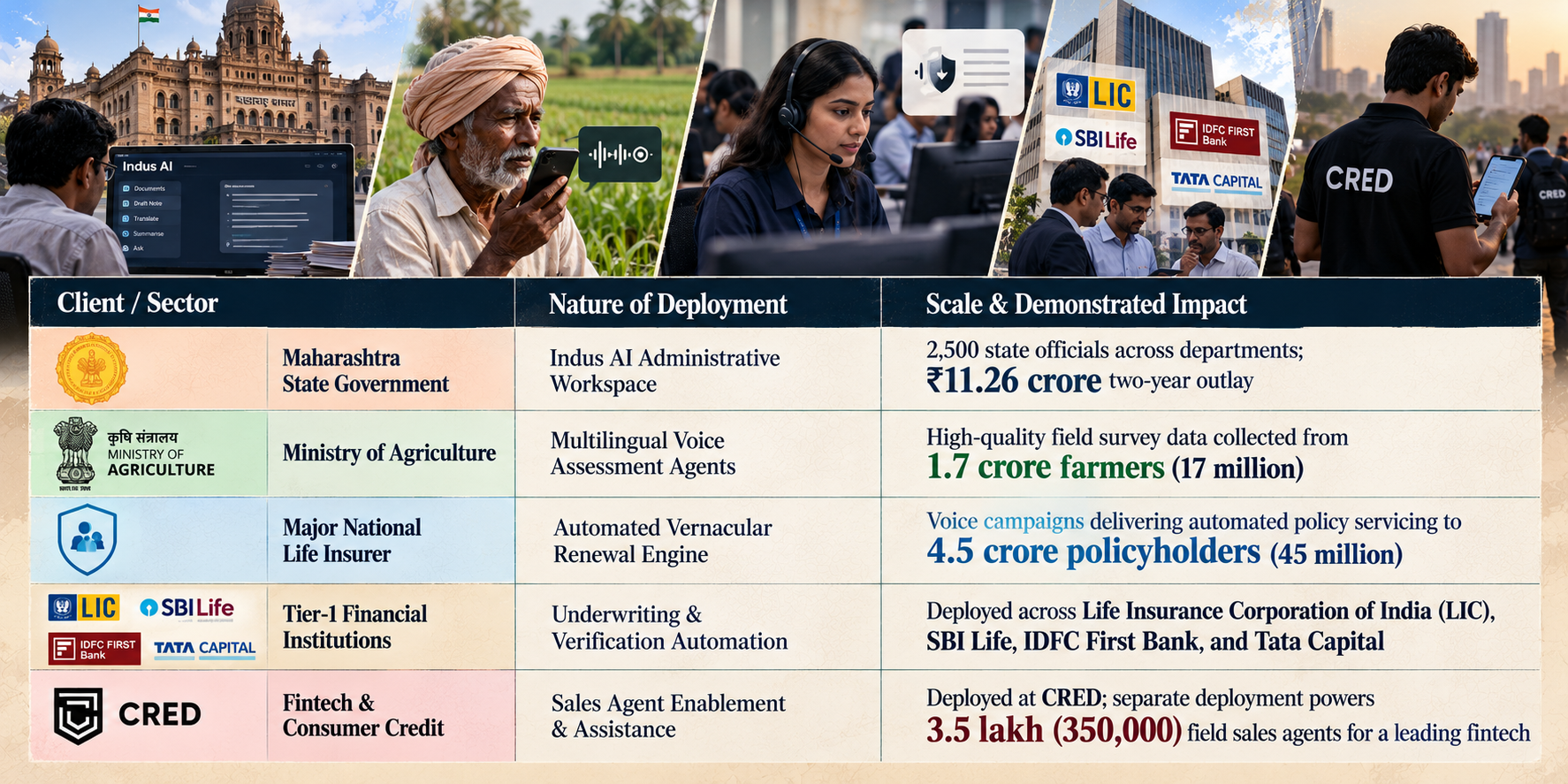
To accelerate these deployments into enterprise annual recurring revenue (ARR), Sarvam recently hired Sashikumar Sreedharan, the former Managing Director of Google Cloud India and Chief Operating Officer for Google Cloud APAC, appointing him President and Chief Business Officer. Sreedharan's arrival signals a shift from academic research pilots to formal enterprise procurement pipelines.
The Road Ahead: Four Structural Realities
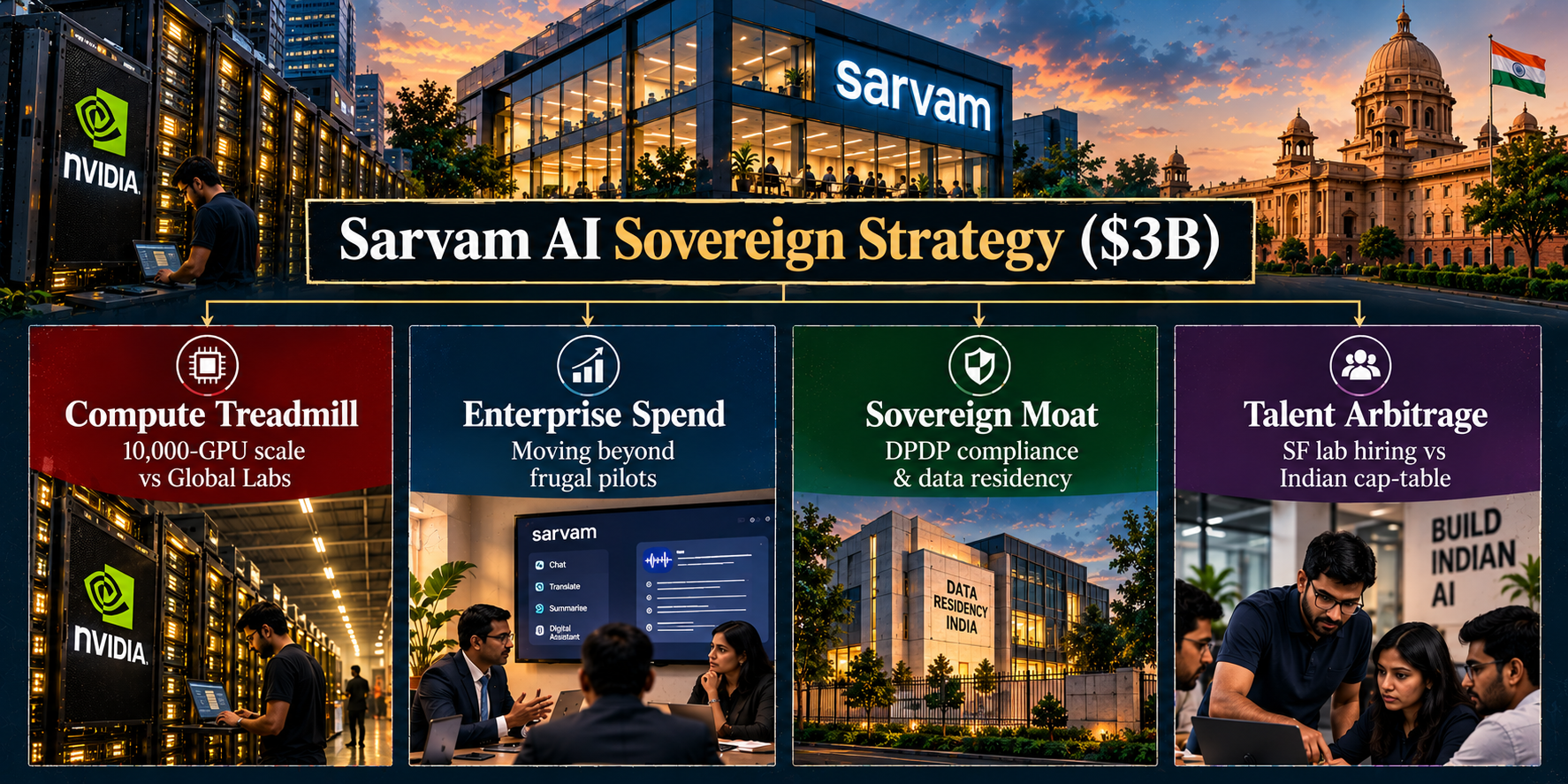
While the momentum behind Sarvam's ₹25,000 crore valuation is substantial, the path from foundation model darling to self-sustaining computing institution involves four demanding realities.
1. The Compute Treadmill vs Public Subsidies
Training a 1-trillion-parameter model demands capital that tests even well-funded venture-backed startups. While the Ministry of Electronics and Information Technology (MeitY) has onboarded 38,231 GPUs across 14 empaneled providers under the ₹10,372 crore IndiaAI Mission, public clusters are rationed across dozens of academic institutions and registered startups.
Sarvam cannot rely solely on subsidised national compute allocations to run uninterrupted, multi-month pre-training runs on dense architectures. It must lease, procure, or co-locate dedicated private clusters. With state-of-the-art accelerators costing upwards of $30,000 each—excluding networking, high-bandwidth memory, power, and data-centre cooling—a dedicated 10,000-GPU training environment rapidly absorbs tens of millions of dollars. At a $3 billion valuation, Sarvam's capital must directly fund hardware reservations before silicon costs erode its balance sheet.
2. The Frugality of Indian Enterprise Software Spend
Silicon Valley foundation labs justify multi-billion-dollar multiples by targeting North American enterprise software budgets, where seven-figure annual software contracts are common. Indian corporate buyers, by contrast, are notoriously price-sensitive.
Even large domestic banks and industrial houses have historically resisted paying premium software licences, preferring fixed-price IT services contracts or in-house engineering. Sarvam’s ₹11.26 crore two-year deal with Maharashtra represents meaningful validation, but sustaining a ₹25,000 crore valuation ultimately requires dozens of recurring private-sector contracts valued at ₹20 crore to ₹50 crore annually. Translating pilot engagements at firms like LIC, SBI Life, or IDFC First Bank into multi-million-dollar ARR commitments is the core challenge awaiting Sreedharan’s enterprise sales team.
3. Defining the Sovereign Moat Against Open-Source Weights
Sarvam’s core defensive argument rests on sovereignty: models pre-trained locally on Indian cultural, legal, and linguistic datasets, operating behind firewalls that comply strictly with the Digital Personal Data Protection Act.
However, open-source architectures continue to advance rapidly. Meta’s Llama family, Mistral’s open releases, and emerging open-weights reasoning systems can be fine-tuned on regional vernacular corpuses by domestic system integrators at a fraction of pre-training expense. To defend its pricing power, Sarvam cannot rely solely on the fact that its models comprehend Tamil, Marathi, or Bhojpuri. It must maintain demonstrable superior performance in end-to-end voice latency, acoustic resilience in noisy industrial environments, and autonomous multi-agent tool execution tailored to Indian business workflows.
4. The Cap Table Dilemma and the Silicon Valley Bridgehead
Sarvam’s current funding round has intentionally targeted Indian enterprises and financial institutions to preserve domestic shareholding thresholds. The government’s IndiaAI mandate explicitly favours entities where controlling equity remains domiciled in India.
Simultaneously, however, Sarvam is establishing an office in San Francisco to recruit elite research talent from leading AI labs. Attracting senior algorithmic researchers requires offering equity packages competitive with Silicon Valley compensations. Managing a cap table that remains sovereign enough to win sensitive Indian defence and administrative contracts, while offering liquid, globally attractive equity to recruit top-tier researchers, is a balancing act that few Indian deep-tech startups have had to navigate at this scale.
Key Milestones to Watch
As negotiations for the $300 million top-up conclude, three clear operational metrics will indicate whether Sarvam’s valuation reflects durable enterprise reality:
Pre-Training Timeline for the 1T Model: Whether the planned 1-trillion-parameter model completes training and validation on schedule by early 2027 without compute bottlenecks or architectural compromises.
State and Central Procurement Expansion: Whether administrative deployments extend beyond Maharashtra into other state secretariats and central ministries via formal IndiaAI Mission procurement frameworks.
Enterprise Contract Conversion: The proportion of conversational pilot projects at institutions like LIC, SBI Life, and Tata Capital that convert into multi-year, production-level platform commitments.
Sarvam’s ability to execute across these fronts will determine whether India’s artificial intelligence economy establishes an enduring domestic foundation layer, or whether it ultimately becomes an application tier built upon foreign infrastructure.