In brief
- Democrats are favoured to win the US House on 3 November, while the Senate is closer to a coin flip three weeks before the vote.
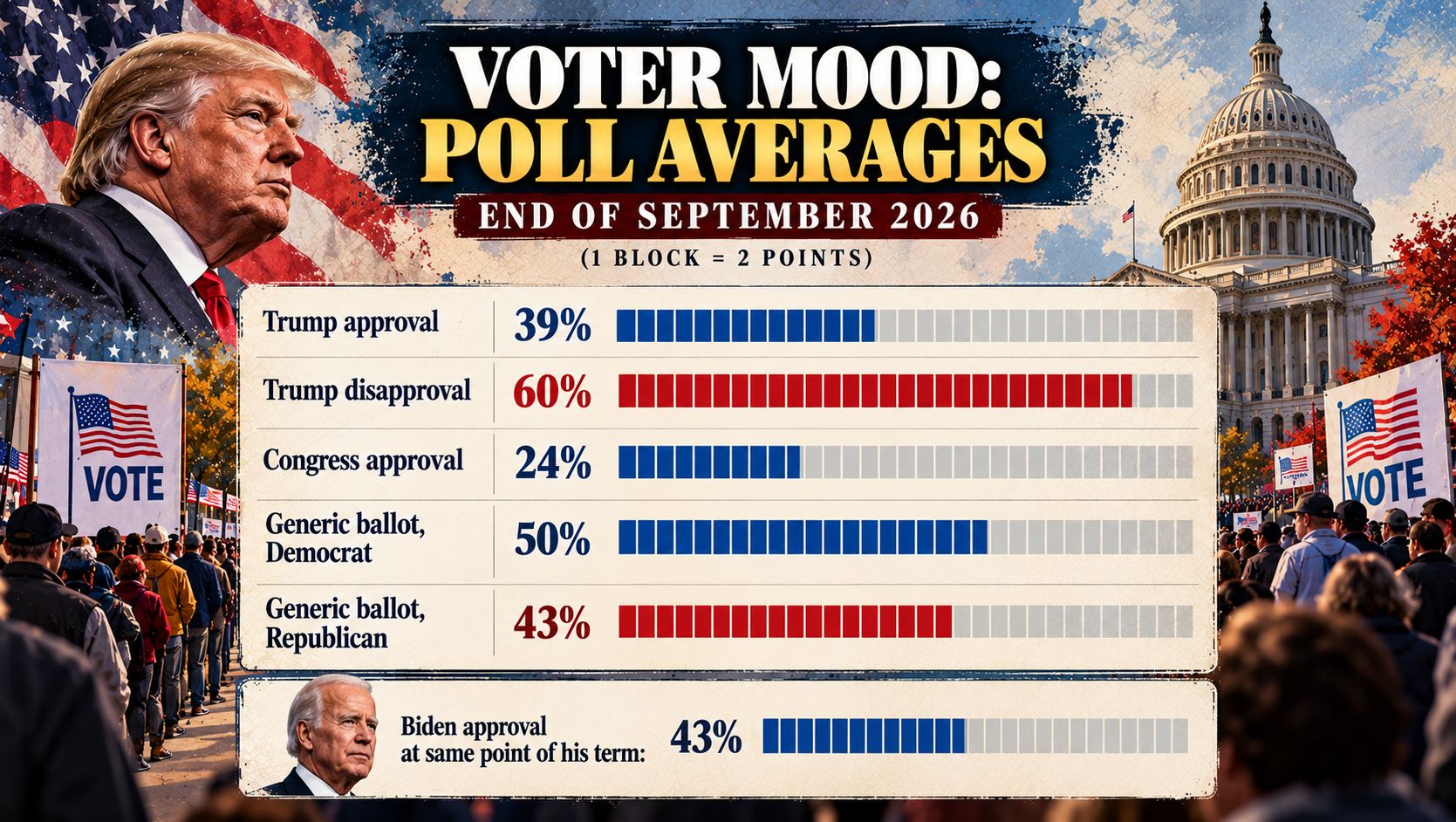
- Decision Desk HQ forecast updated on 16 October gives Democrats a 77% chance in the House and 56% in the Senate; Kalshi traders show a 62 percent chance for the Senate.
- Democrats need a net gain of four seats in both chambers to take control, with Republicans having redrawn district maps in several states.
- Voters are unhappy with the party in power, with Ballotpedia polls showing 39 percent approval for Trump and 54 percent disapproval in the end of September; general congressional backing for Democrats stood at 50 percent to 43 percent.
Democrats are favoured to win the US House on 3 November, and the Senate is closer to a coin flip. Decision Desk HQ's forecast, updated on 16 October, gives Democrats a 77% chance in the House and 56% in the Senate. Traders on the betting site Kalshi are more confident on the Senate, at 62%.
Neither number is a promise. Republicans redrew district maps in several states, and Democrats need a net gain of four seats in both chambers. This piece sets out where the numbers stand and which races will settle it.
1. Why the Mood Favours Democrats
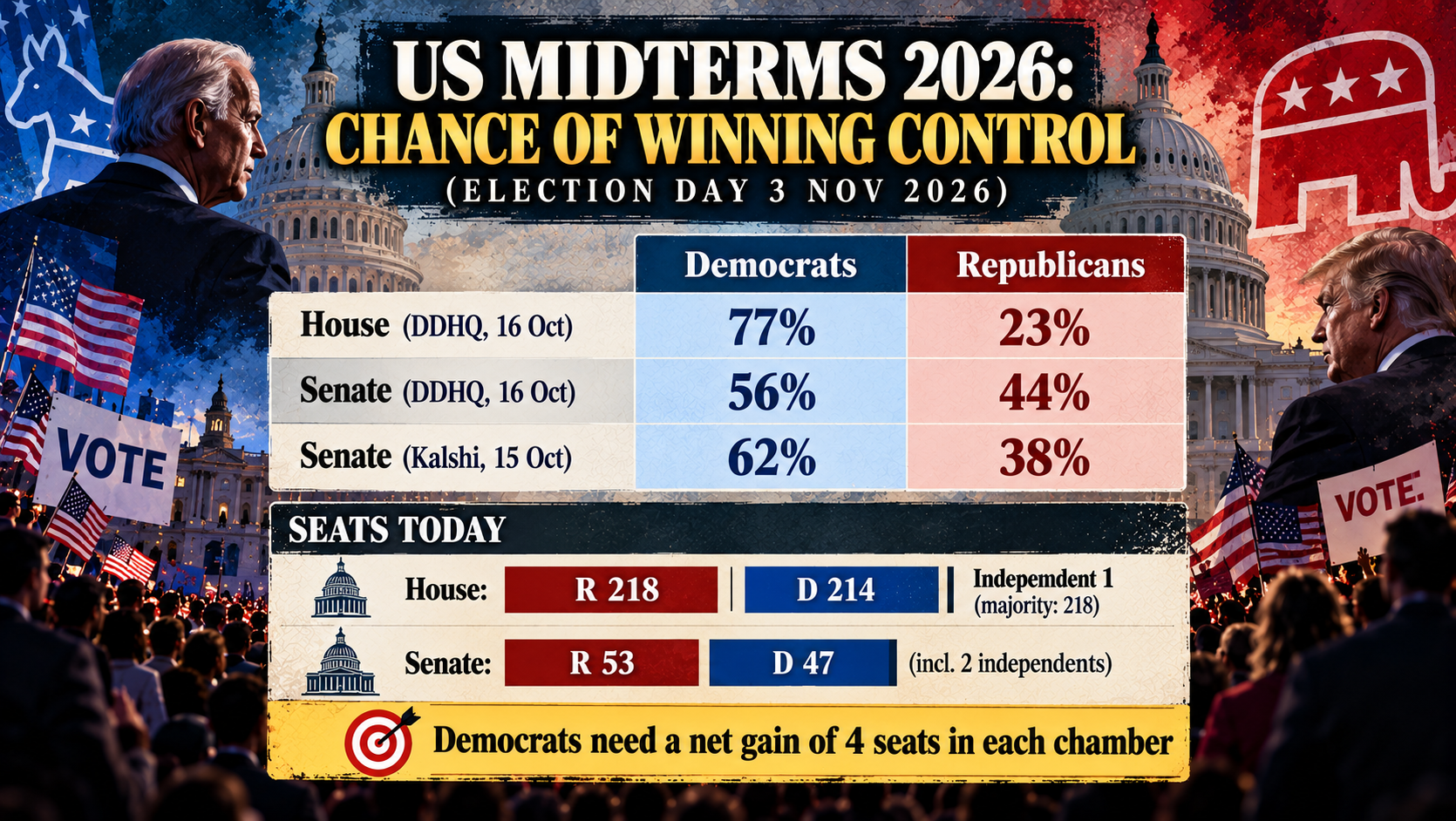
Voters are unhappy with the party in power. Ballotpedia's average of polls had President Donald Trump at 39% approval and 60% disapproval at the end of September. That month had the lowest average of his second term. At the same point in Joe Biden's term, approval was 43%, and in Trump's first term it was 40%. Asked which party they would back for Congress, voters chose Democrats 50% to 43%, the best Democratic figure of this term. Congress itself sits at 24% approval.
Silver Bulletin's average put the Democratic lead at 8.6 points in mid-October, up from 6.7 on 1 September, according to Forbes. The president's party also usually does badly in midterm elections, so this is no surprise. The harder question is how much of that lead turns into seats.
2. The House: Democrats Need Four More Seats
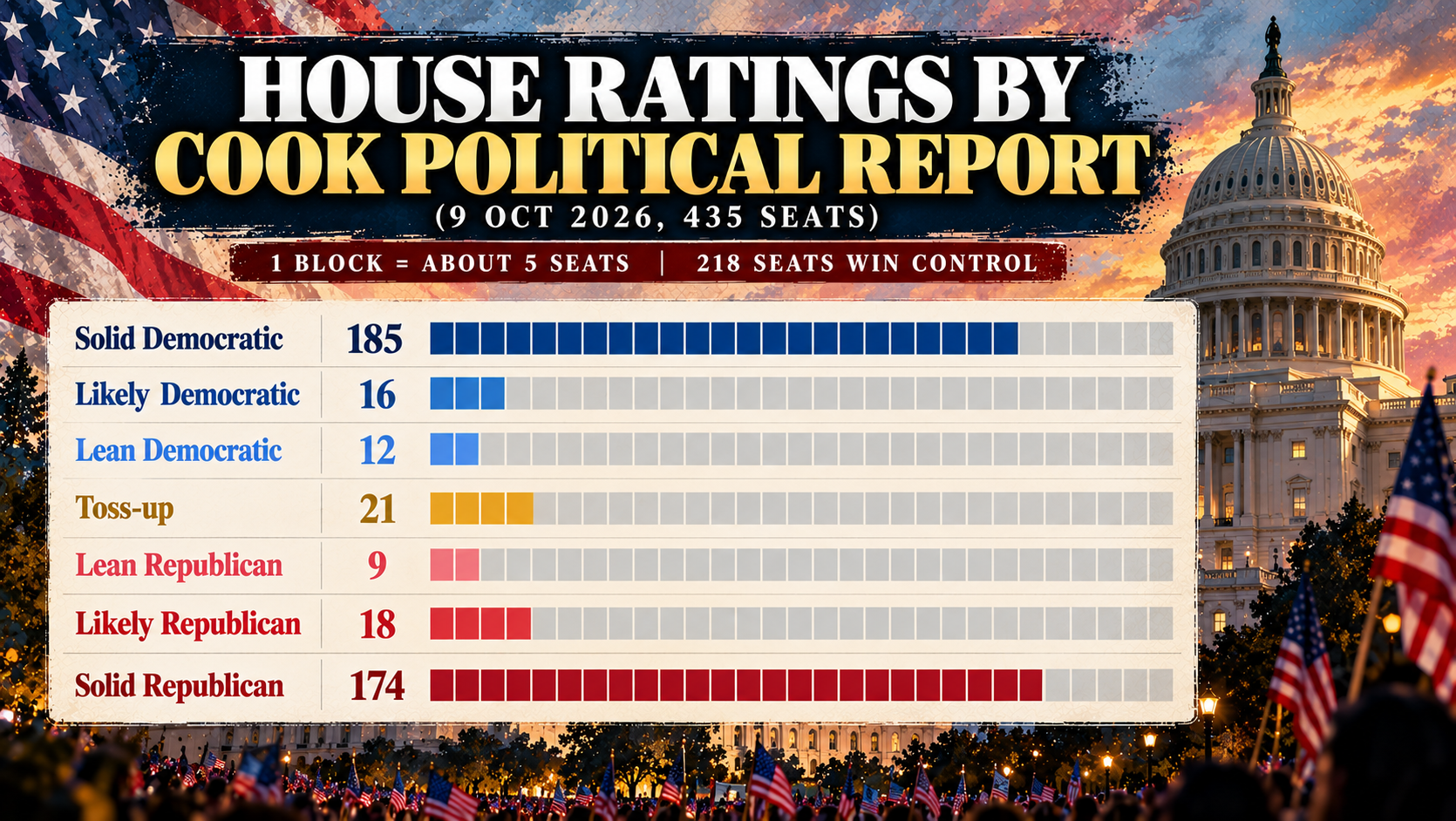
Republicans hold 218 House seats, Democrats 214, and one seat belongs to an independent. A majority is 218, so Democrats need a net gain of four. Cook Political Report's ratings from 9 October put 213 seats on the Democratic side, 201 on the Republican side and 21 too close to call. By my sum, Democrats need five of those 21 and Republicans need 17. Decision Desk's model projects 235 Democratic seats.
One caution. Cook's own site lists a 16 October update called "Eleven More House Races Shift Toward Democrats", but only paying members can read it. The counts above may already be out of date.
3. The New Maps: Big on Paper, Smaller in Practice
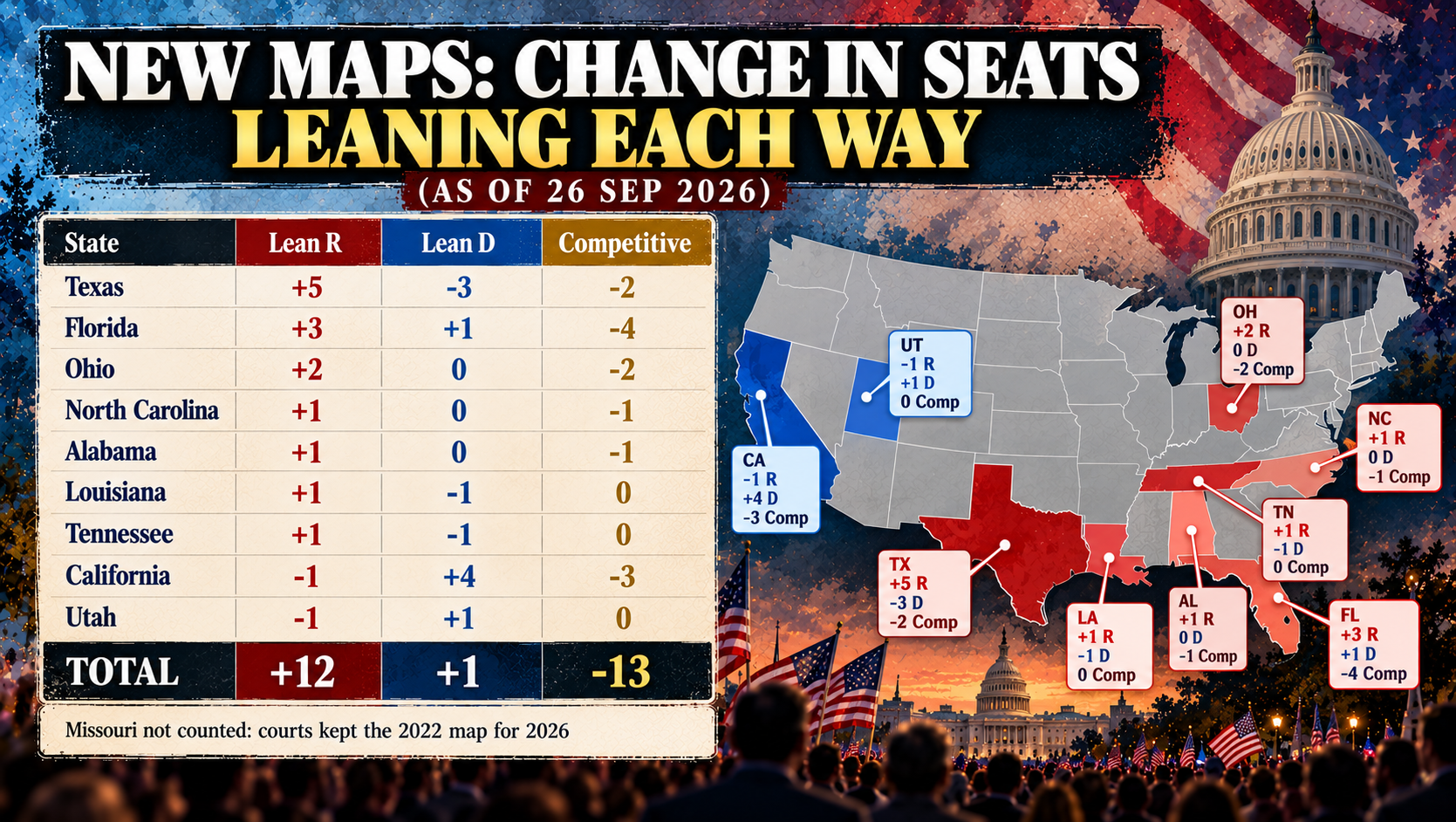
Since 2025, several states have redrawn their district lines in the middle of the usual ten-year cycle. According to Wikipedia's tally, Republicans did so in Texas, Florida, Ohio, North Carolina, Alabama, Louisiana and Tennessee. California voters approved a Democratic map, and a Utah court picked one that creates a safe Democratic seat. Alabama, Louisiana and Tennessee redrew after an April Supreme Court ruling, Louisiana v. Callais, which said claims under a section of the Voting Rights Act face a stricter test. Virginia's Democratic map was struck down by the state's supreme court on 8 May.
Counted on paper, the changes add 12 Republican-leaning seats and one Democratic-leaning seat. Cook's estimate is smaller: its likeliest result is that Republicans gain about four seats from the new maps. My reading of the gap is that a seat leaning one way on paper still has to be won, and Cook counts only the seats it expects to flip. Cook still favours Democrats for control, because the Republican majority is only three seats.
4. The Senate: Seven Races Decide It
Republicans hold the Senate 53 to 47 and are defending 22 of the 35 seats up this year. The 47 Democratic seats include two independents who vote with the party. Democrats need a net gain of four. Three would make it 50–50, and Vice President JD Vance would break the tie for Republicans.
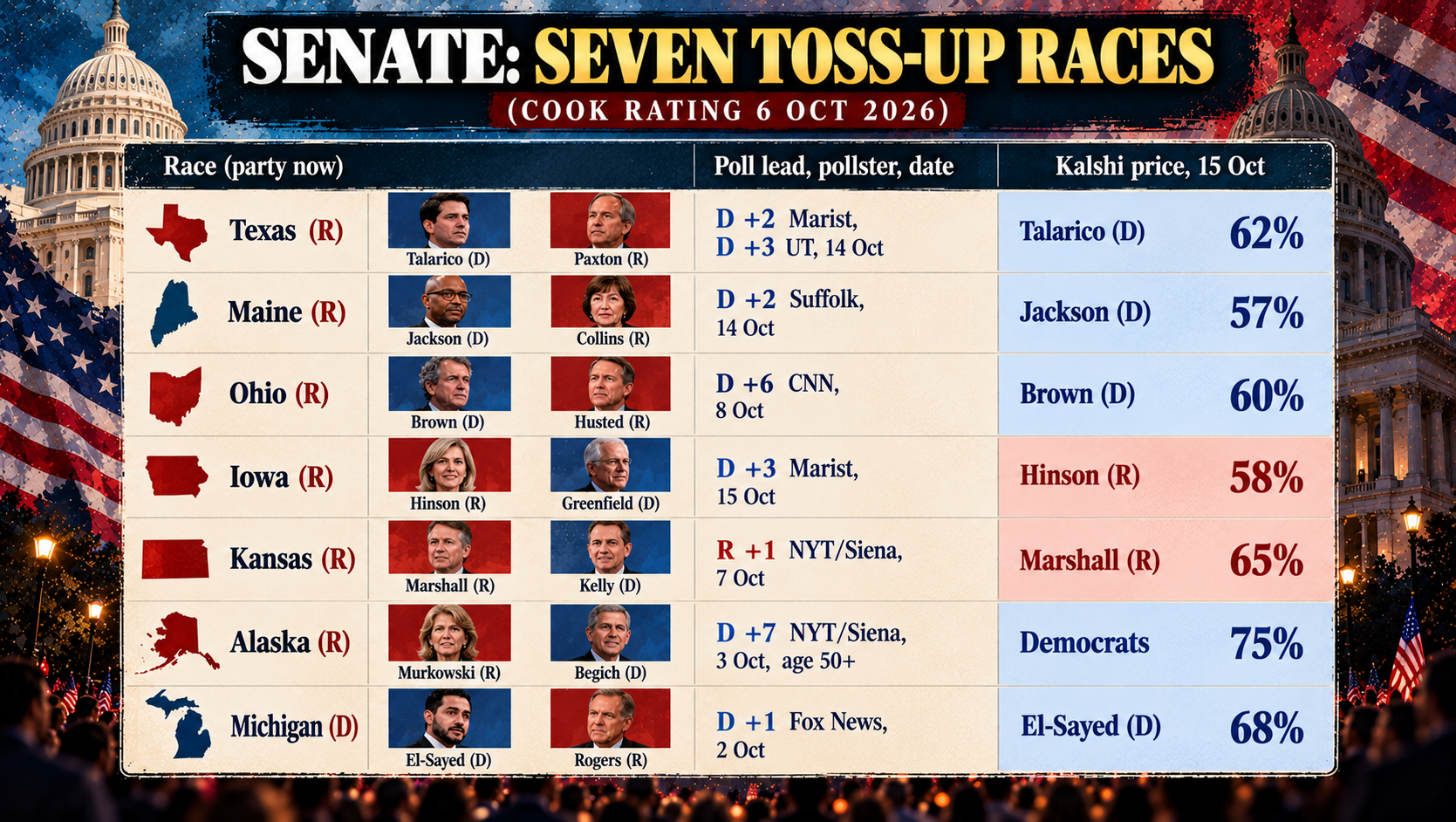
In the ratings Kalshi lists from Cook on 6 October, seven races are toss-ups: Texas, Maine, Ohio, Iowa, Kansas, Alaska and Michigan. Michigan is the only one Democrats now hold. If every other race goes as Cook rates it, with North Carolina flipping to Democrats, then by my sum Democrats need four of the seven. Republicans can lose a net three seats and still keep control, and their best chance of a gain is Michigan. The North Carolina assumption rests on Cook's move to "likely Democratic" and a WRAL/WSOC poll with Roy Cooper ahead of Michael Whatley, 54% to 40%. Forbes' poll roundup shows Democrats ahead in most of them:
Texas: Democrat James Talarico leads Republican Ken Paxton by 2 points in a Marist poll and 3 in a University of Texas poll. Paxton beat Senator John Cornyn in the primary.
Ohio: Democrat Sherrod Brown leads Senator Jon Husted by 6 points in a CNN poll.
Iowa: Democrat Josh Turek leads Republican Ashley Hinson by 3 in a Marist poll, yet Kalshi traders price Hinson at 58%.
Kansas: Republican Senator Roger Marshall leads by 1 point in a New York Times/Siena poll.
5. Forecasts and Betting Prices Do Not Match
Decision Desk gives Democrats a 54% chance of winning both chambers, 22% of winning the House only, 21% of losing both and 2% of winning the Senate only. Kalshi is more bullish. It priced a Democratic House at 90.1% in mid-October, against Decision Desk's 77%.
Kalshi's Senate price has moved a lot. Republicans led 56% to 44% in March, Democrats pulled ahead on 14 September, and by 15 October they were at 62%. The two measure different things. A model works from polls and race ratings, while a market reflects what traders will pay on a given day.
6. What Could Still Change the Result
Ratings are not results. Newsweek's look at Cook's October ratings shows why. In 2018, Democrats won 22 of 30 resolved toss-ups and finished with 235 seats. In 2022 they won 22 of 31 toss-ups, yet Republicans still took the House, 222 to 213, because Democrats held far more of the close seats. This year it is the other way round: 23 Republican-held seats are rated toss-up or worse, against 11 Democratic-held ones.
Open seats add doubt. NPR counts a record 14 senators and 57 House members not running again, 44 of them Republican and 27 Democratic, and Kalshi notes that seats with no incumbent are harder to call. Most of the answer sits in about 28 races, the 21 House toss-ups and the seven in the Senate. Cook has also moved Kansas from lean Republican to toss-up and New Hampshire from toss-up to lean Democratic, both in the Democrats' favour. Whether the national Democratic lead reaches those races is what no poll can yet say.