In brief
- More than half a million demonstrators marched across France on 17 October 2026, involving 110 towns and cities including Paris, Lyon, Limoges and Marseille, in a nationwide street protest.
- What began as a revolt by secondary school pupils over dilapidated classrooms in Créteil four weeks earlier widened to include student federations, major labour confederations, and factions of the Yellow Vests.
- Street protests in France are described as the functional counterweight to a hyper centralised state, acting as the only mechanism that reliably compels the government to listen.
- By 17 October 2026, police said 1,200 people were arrested that day, with 150 gendarmes and police officers involved in the arrests, as the mobilisation drew in large labour and pupil movements across the country.
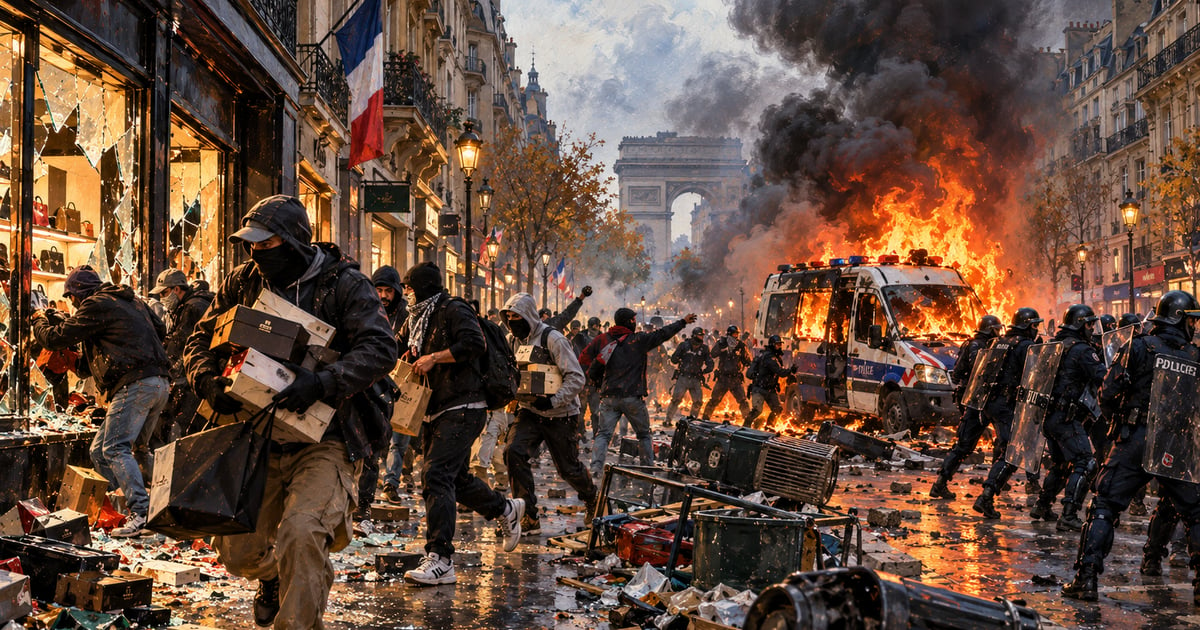
On Saturday 17 October 2026, more than half a million demonstrators marched through 110 towns and cities across France. In Paris, crowds packed the boulevards between Place de la République and Nation; in Lyon, smoke billowed from a municipal tourist office; in Limoges, fire swept the historic façade of the Hôtel de Ville; and in Marseille, protesters broke into the lobby of city hall. What had started four weeks earlier as a scattered revolt by secondary school pupils over dilapidated classrooms in the Paris suburb of Créteil had widened into a confrontation bringing together student federations, major labour confederations, and reviving factions of the Gilets Jaunes (Yellow Vests).
To outside observers, the spectacle has an air of predictability. Periodic eruptions—whether the Yellow Vest fuel rebellions of 2018–2019, the ferocious pension battles of 2023, the agricultural tractor blockades of 2024, or the rolling student-worker strikes of autumn 2026—are frequently dismissed in foreign commentary as an idiosyncratic national hobby.
Yet street protest in France is neither recreational nor accidental. It is the functional counterweight of a constitutional system that deliberately closes off alternative avenues of negotiation. When French citizens take to the streets, they are not bypassing the democratic process; they are operating the only institutional mechanism that reliably compels an aloof, hyper-centralised state to listen.
The Catalyst: The Lycée Revolt of Autumn 2026
The wave of unrest gripping France began on 18–21 September 2026 at the Lycée Antoine-de-Saint-Exupéry in Créteil, in the eastern suburbs of Paris. Following a one-day teachers’ strike over staffing shortages, pupils erected barricades of rubbish bins outside the school gates. Their complaints were practical: classes of 35 or 36 students, core subjects left without substitute teachers for months on end, broken plumbing, and classrooms where temperatures had reached 40 °C during the late-summer heatwave. At the Lycée Paul-Éluard in Saint-Denis, pupils described unheated temporary structures that dropped to −5 °C in winter alongside persistent rodent infestations.
Within a fortnight, the blockades spread across Val-de-Marne, Seine-Saint-Denis, Lille, Rennes, Nantes, Toulouse, and Marseille. The Union Syndicale Lycéenne (USL), led by Ryad Rani, formulated a national platform focusing on four grievances:
acute shortages of teaching and welfare staff,
crumbling, uninsulated school buildings,
exhausting timetables, and
the stress inflicted by Parcoursup, the state’s automated university admissions algorithm.
By early October, the Ministry of National Education reported that up to 500 lycées were closed or partially disrupted. The state's initial response relied on administrative coercion and riot police. Prefects banned assemblies outside schools, and police deployed tear gas, sting-ball grenades, and water cannons.
The human cost was immediate: in Saint-Ouen-l'Aumône, a 14-year-old boy suffered a double jaw fracture from a tear gas canister; in Lens, a 15-year-old pupil lost his hand when a kinetic dispersal grenade detonated during a blockade outside the Lycée professionnel Auguste-Béhal; and in Saint-Étienne on 17 October, another demonstrator suffered a severe hand mutilation under investigation by the police oversight body, the IGPN. Over 6,800 people—nine out of ten of them minors—were placed in police custody over three weeks, prompting condemnations from Amnesty International and scrutiny from the UN Human Rights Office.
Far from extinguishing the unrest, police repression acted as an accelerant. On 6 October, teachers' unions (FSU and SNALC) and university student groups joined the blockades. By 17 October, the mobilisation had converged with the country’s premier labour confederations—the CGT, Force Ouvrière, the CFDT, and Solidaires—alongside regional chapters of the Gilets Jaunes. According to the Ministry of the Interior, 550,000 citizens rallied nationwide; organisers put the turnout at 800,000. Prime Minister Sébastien Lecornu confirmed that 1,200 individuals were arrested that day alone, with 150 gendarmes and police officers injured.
The Constitutional Blueprint: Why the Street Replaces Parliament
To understand why a school funding protest escalated into a constitutional standoff, one must look at the mechanics of the French Fifth Republic.
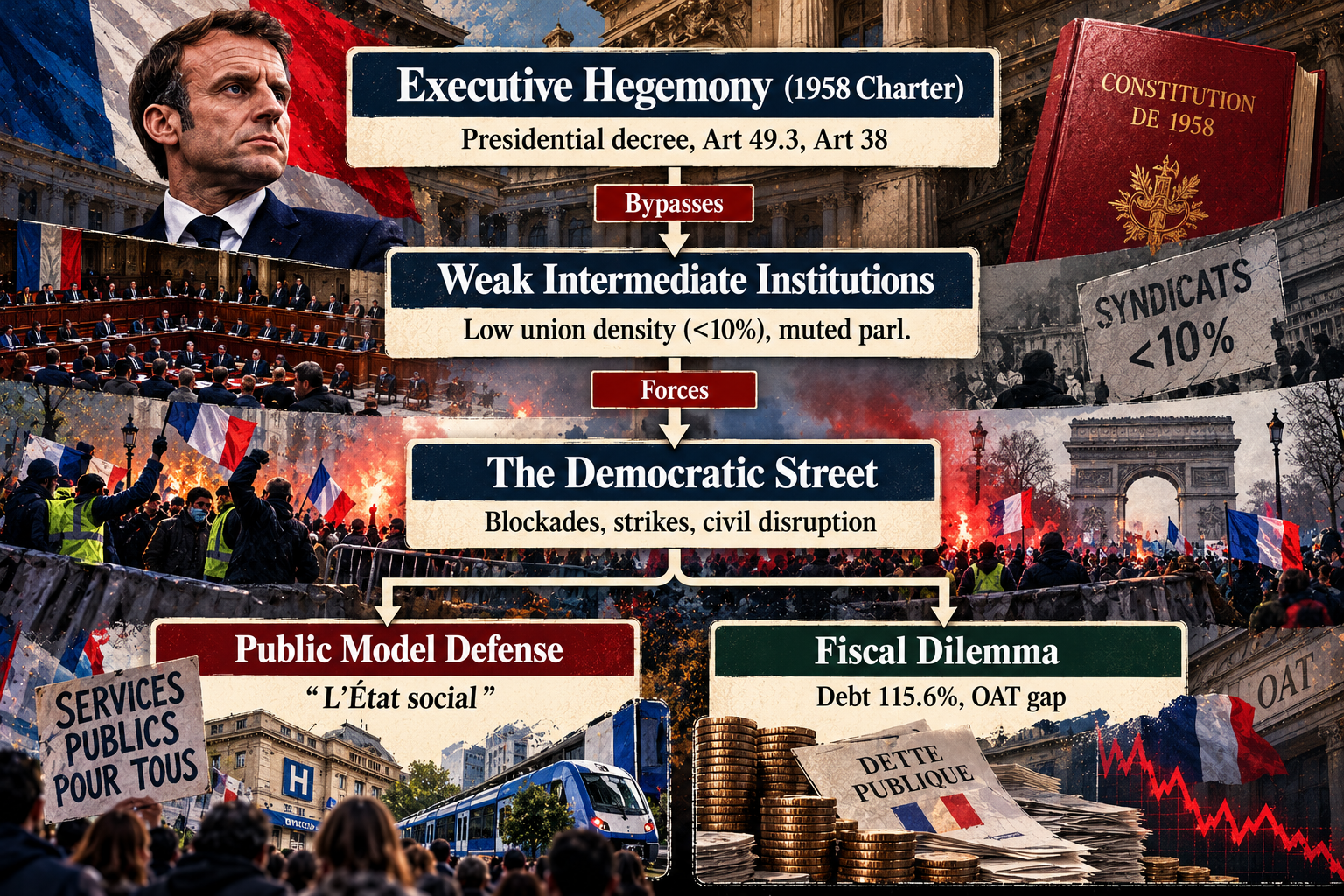
Crafted in 1958 by General Charles de Gaulle and Michel Debré against the backdrop of the Algerian War, the Constitution of the Fifth Republic was designed to dismantle parliamentary instability. It produced what political scientists call a "republican monarchy": an executive endowed with extraordinary authority, insulated from legislative control, and capable of enacting policy without a parliamentary majority.
Key constitutional levers include:
Article 49, Paragraph 3 (Article 49.3): Enables the prime minister to push a bill through the National Assembly without a vote, unless the opposition passes a motion of no confidence within 48 hours. Because passing a no-confidence motion requires an absolute majority across fractured party lines, governments routinely use this clause to enact deeply unpopular measures—such as Emmanuel Macron’s 2023 pension reform.
Article 38 (Ordinances): Authorises the government to ask parliament for temporary powers to enact measures that normally fall under the domain of statutory law by executive decree.
Article 44, Paragraph 3 ("Vote Bloqué"): Allows the executive to force the legislature to vote on an entire text, retaining only the amendments proposed or accepted by the government.
In consensus democracies such as Germany, the Netherlands, or Sweden, policy is negotiated through coalition bargaining, parliamentary committees, and institutionalised social partnerships. In France, the executive does not need to compromise with parliament if it is determined to govern by decree.
Because parliament is structurally disempowered, French citizens view the National Assembly not as an arbiter of popular will, but as an echo chamber for executive decrees. The only counter-power left capable of vetoing state policy is the street (le pouvoir de la rue).
The Union Paradox: Weak Membership, Formidable Disruption
A common misconception is that France protests frequently because its labour unions are exceptionally strong. The reverse is true: French unions are among the numerically weakest in the developed world.
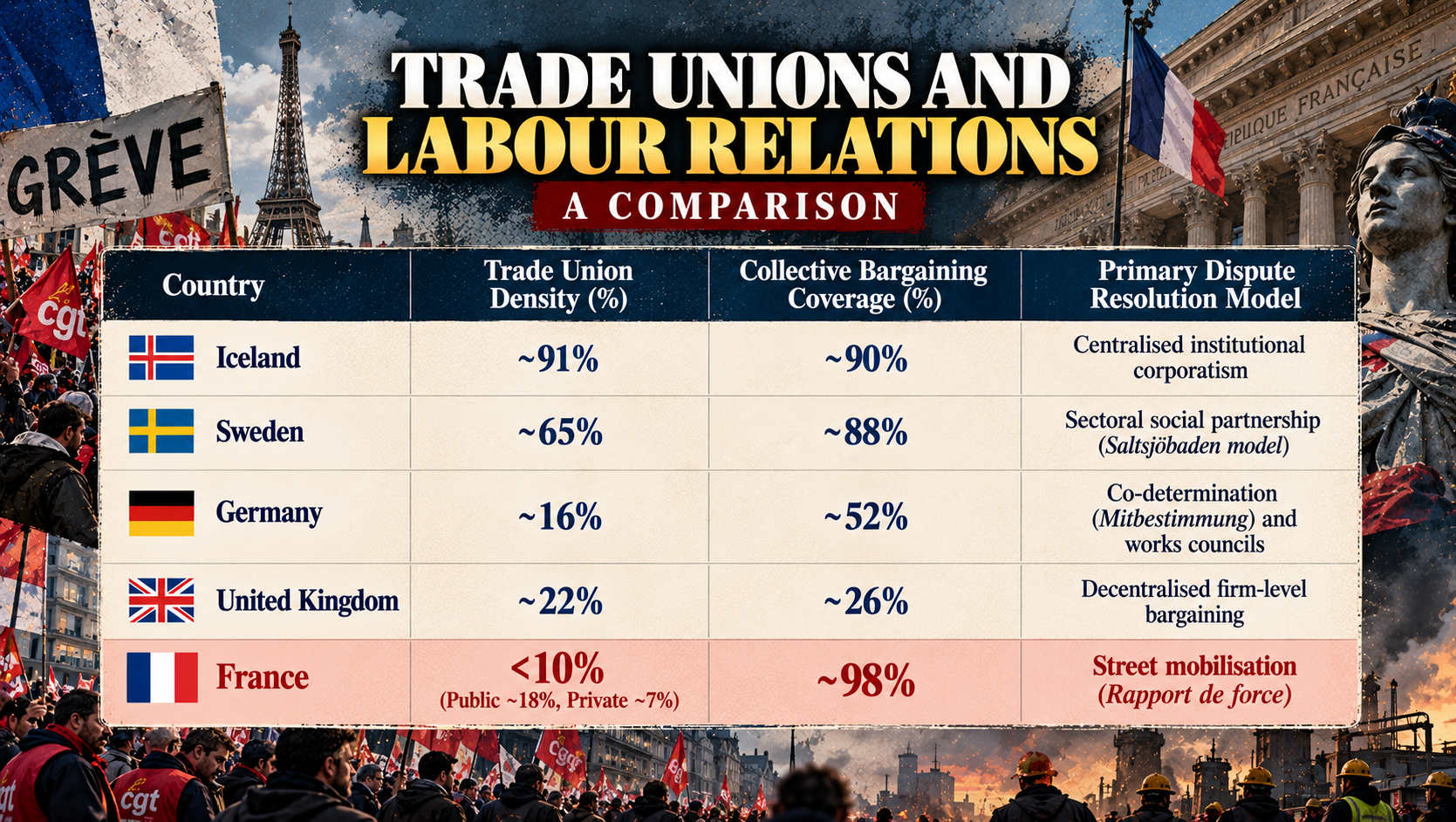
According to OECD labour data, trade union density in France hovers below 10%, dropping to less than 8% in the private sector. Yet France possesses a collective bargaining coverage rate of roughly 98%, because the Ministry of Labour routinely extends sectoral agreements across entire industries by administrative order.
This creates a peculiar dynamic. Because unions do not rely on high dues-paying membership rolls to secure agreements, they do not manage disciplined strike funds capable of supporting months of selective walkouts.
Instead, their survival and political relevance depend on their capacity to initiate mass street disruption. Without seats at an institutional bargaining table, unions cannot check government overreaches through quiet negotiation. They must build a rapport de force—a raw balance of power—by bringing transport systems, oil refineries, ports, and secondary schools to an absolute standstill.

The Republican Mythos: The Street as Democratic Tribunal
Protest in France carries an intellectual and historical legitimacy that has no equivalent in Anglo-American politics. In Britain or the United States, disruption is frequently framed by political elites as an assault on public order or an infringement on economic liberty. In France, the right of resistance is rooted in foundational republican mythology.
The French Republic was not born of gradual parliamentary reform; it was forged in the insurrectionary fires of the 1789 Revolution, the Three Glorious Days of 1830, the 1848 revolutions, and the 1871 Paris Commune. The preamble to the 1793 Declaration of the Rights of Man and of the Citizen declared insurrection to be "the most sacred of rights and the most indispensable of duties."
This legacy was revived in May 1968, when an alliance of university students and ten million striking workers extracted substantial wage increases and toppled the paternalistic social order of the early Gaullist era. It was confirmed again in the winter of 1995, when three weeks of public transport strikes forced Prime Minister Alain Juppé to withdraw his structural pension and welfare cuts.
Every French generation inherits this playbook. For a 16-year-old student blockading a school gate in Perpignan or Saint-Denis, participation in a manif (manifestation) is not delinquent behaviour; it is a civic rite of passage, an initiation into republican citizenship. Demonstrating is seen as an exercise of popular sovereignty asserting itself against the temporary occupants of executive office.
The Economic Dilemma: Bond Vigilantes vs The Social State
While the political mechanics of French protest remain constant, the economic landscape has shifted dramatically.
In previous decades, French governments could resolve protracted street mobilisations by opening the state treasury—offering emergency subsidies, creating public sector posts, or shelving deficit targets. In 1990, when secondary school pupils revolted over staffing shortages, Education Minister Lionel Jospin defused the crisis with an immediate multi-billion-franc emergency plan.
In 2026, that escape hatch is shut. France is caught in a vice between financial bond markets and an uncompromising electorate:
The Sovereign Debt Burden: According to IMF and Eurostat figures reported by The Guardian, France's debt-to-GDP ratio stood at 115.6% at the end of 2025, with an annual budget deficit reaching 5.4% in 2026.
The Bond Market Squeeze: Yields on 10-year French sovereign bonds (OATs) have surged towards 5%, substantially narrowing the spread with Italian debt and eliminating the historical safety discount France enjoyed relative to Southern Europe.
The Parliamentary Impasse: Following snap legislative elections that fragmented the National Assembly into three irreconcilable blocs (the left-wing Nouveau Front Populaire, Macron's centrist remnant, and Marine Le Pen's Rassemblement National), no prime minister can pass a budget without risking immediate collapse.
The French state faces an existential structural dilemma. Financial markets, monitored closely by the European Commission under the Excessive Deficit Procedure, require fiscal retrenchment, cuts to public infrastructure budgets, and a rollback of social expenditures.
Yet the French public views its social infrastructure—universal healthcare, free public universities, subsidised public transport, and well-funded schools—not as discretionary government perks, but as non-negotiable components of the republican social contract (l'État social).
When the state attempts to meet European fiscal rules by letting public schools decay or squeezing hospital budgets, it violates that unspoken contract. The street erupts. Yet when the government considers concessions, sovereign bond yields spike, threatening a fiscal debt crisis.
The Militarisation of Order: From Mediation to Confrontation
As the margin for economic concession has shrunk, the French state has increasingly relied on physical containment. Over the past decade, French crowd-control doctrine has undergone a documented militarisation.
Historically, the Compagnies Républicaines de Sécurité (CRS) and the Gendarmerie Mobile were trained in doctrines of distance and de-escalation: containing marches along negotiated routes, avoiding close-quarter physical engagement, and using tear gas primarily to maintain buffers.
Since the Gilets Jaunes mobilisations of 2018–2019 and the 2023 pension protests, policing has pivoted toward aggressive confrontation:
Kinetic Weaponry: France remains an outlier in Western Europe for authorising the widespread use of intermediate kinetic weapons against domestic demonstrators, including the LBD40 rubber bullet launcher and acoustic dispersal grenades.
Rapid Intervention Brigades: Units such as the BRAV-M (Brigades de répression de l'action violente motorisées)—motorcycle-mounted officers deployed to rapidly charge and disperse gatherings—have faced extensive criticism for aggressive tactics and arbitrary arrests.
Mass Preventive Detention: In the autumn 2026 protests, the judiciary and police relied on systematic detention under accusations of "participation in a group formed to commit violence." With over 6,800 detentions recorded by mid-October—the overwhelming majority released without charge—human rights observers have argued that detention is being deployed as a preemptive tool of political demobilisation.
This repressive turn creates an escalatory spiral. Confronted by riot units firing grenades, peaceful crowds dissipate, leaving behind radicalised fringes (les cortèges de tête and Black Blocs) armed with firework mortars and paving stones. The state then uses the ensuing property destruction to delegitimise the broader political message of the demonstrations.
The Outlook: A Republic at an Impasse
The confrontation of autumn 2026 marks an inflection point in contemporary French politics.
When a democratic system leaves its youth with classrooms lacking teachers and roofs that leak, while offering them no institutional conduit to affect national policy, the street is not a disruptive anomaly—it is a structural certainty.
As France approaches the end of Emmanuel Macron’s second presidential term in 2027, the Fifth Republic’s institutional equilibrium is breaking down. A political system founded on the supremacy of an all-powerful executive cannot easily function when that executive commands neither a parliamentary majority nor popular consent, and when the treasury can no longer buy peace from international bond markets.
Until France addresses the structural flaw at the heart of its democracy—the chasm between a monarchical executive and an unrepresented public—the barricades will continue to rise. In the French Republic, when the state ceases to listen, the street will always speak.