In brief
- India exports fuel to the West while importing 85 percent to 88 percent of its crude, highlighting a refinery based trade model rather than selling its own oil.
- India acts as a global toll-refining hub, turning discounted crude into high spec diesel for European and American markets.
- Reliance Industries’ Jamnagar mega-refinery in Gujarat supplied six of seven product cargoes unloaded at EU ports in September 2026.
- State run refiners import crude to supply India’s domestic economy with subsidised fuels, while private coastal refiners export high spec fuels to deficit Western markets.
In September 2026, refineries processing Russian crude in India, Turkiye, and Brunei shipped €1.0 billion (approximately $1.2 billion / ₹10,000 crore) worth of refined oil products to nations enforcing sanctions against Moscow—a 43% surge month-on-month, according to trade tracking data from the Centre for Research on Energy and Clean Air (CREA).
The primary destination was the European Union, which took in €667 million ($720 million) worth of these fuels—representing an 80% monthly increase in the value of shipments destined for European ports. Australia followed with €168 million, while the United States imported €154 million.
The vast majority of these exports originated from a single location: Reliance Industries’ mega-refinery complex at Jamnagar in Gujarat, which supplied six of the seven product cargoes unloaded at EU ports during the month.
To an outside observer, this trade flow presents an obvious paradox: India produces negligible crude oil domestically and relies on imports for over 85% to 88% of its national petroleum needs.
How does a country with almost no domestic oil wells become one of the Western world's most critical suppliers of transport fuels? The answer lies in the architecture of global refining, international customs law, and a lucrative price arbitrage.
1. The Core Distinction: Crude Exporter vs Refining Powerhouse
The fundamental confusion stems from conflating crude oil (the unrefined raw material extracted from the ground) with refined petroleum products (diesel, petrol, jet fuel, and naphtha).
India is structurally deficient in crude oil, producing only about 28 million to 29 million tonnes annually against domestic consumption that exceeds 230 million metric tonnes per annum (MMTPA).
However, over the past three decades, India deliberately pursued an industrial policy to become a global toll-refining hub.
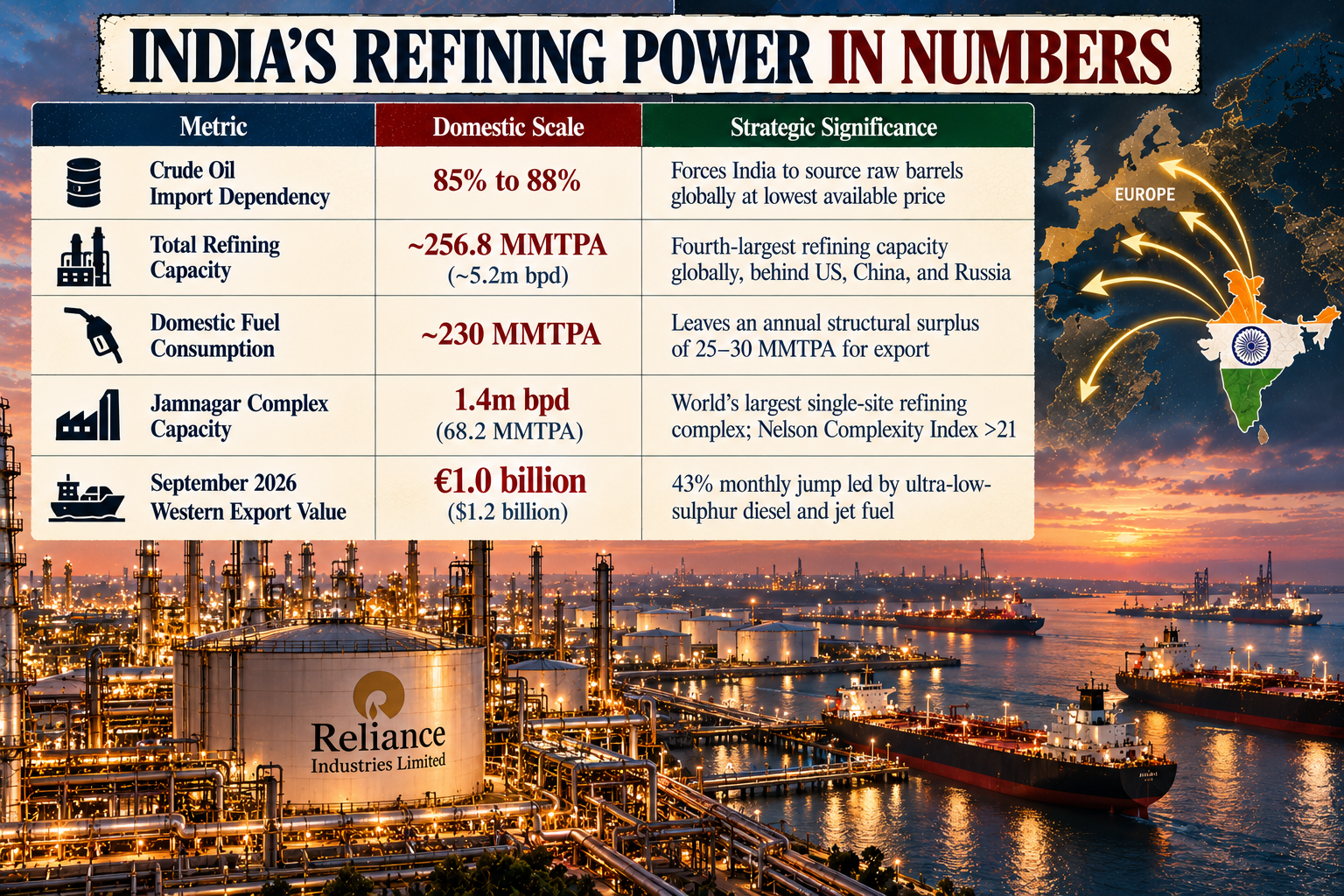
India’s total refining capacity stands at approximately 256.8 MMTPA (roughly 5.2 million barrels per day), comfortably exceeding its domestic demand. This structural surplus of refined fuels—particularly from coastal private refineries designed specifically for the export trade—is shipped overseas.
India does not export crude; it imports raw hydrocarbons, processes them into high-specification fuels, and exports the high-value finished products.
2. The Technological Advantage: High-Complexity Refineries
Not all refineries are created equal. Many older European and American plants are "hydroskimming" or basic cracking facilities that require sweet, light crude to operate efficiently.
By contrast, India’s coastal merchant refineries—chiefly Reliance Industries in Jamnagar and Nayara Energy in Vadinar—are among the most complex in the world. Jamnagar boasts a Nelson Complexity Index (NCI) exceeding 21.
Refinery complexity measures a plant's ability to take cheap, "sour" (high-sulphur), heavy, and contaminated crude oils and crack them into high-value, clean transport fuels with virtually zero heavy residue.
When Western buyers boycotted Russian Urals crude following the 2022 invasion of Ukraine, Urals began trading at steep discounts. In September 2026, Urals crude averaged $90.70 a barrel on global markets, but maintained a $23-per-barrel discount against the international benchmark, Brent.
Because of their technical sophistication, Indian private refiners can process discounted Russian barrels (which made up 32% of Jamnagar's crude intake between July and September 2026), remove the sulphur, and output Euro VI / BS-VI compliant ultra-low-sulphur diesel (ULSD) and aviation turbine fuel (ATF) that meet the strict environmental specifications of the EU and US.
3. The Legal Mechanism: "Substantial Transformation"
The central reason this trade is legally permissible under international commerce comes down to customs rules of origin.
Under the rules established by the World Customs Organization (WCO) and mirrored in EU and US customs codes, a product’s country of origin is determined by where it underwent its last "substantial transformation".
If raw crude oil mined in the Urals enters a refinery, undergoes vacuum distillation, catalytic cracking, and hydrotreating, its molecular structure is fundamentally altered.
It ceases to be crude oil (Harmonised System tariff code 2709) and becomes an entirely new commercial product, such as automotive diesel (tariff code 2710).
Legally, the resulting diesel is of Indian origin, not Russian origin.
While the European Union enacted an official ban in January 2026 on refined petroleum products produced from Russian crude, the enforcement mechanism contains a major operational exemption: it exempts net exporters of crude and relies on paper self-certifications.
Because refineries continuously blend crude from Saudi Arabia, Iraq, the UAE, and Russia inside massive shared storage tanks before feeding them into processing units, determining the precise molecular origin of a specific litre of diesel is chemically impossible once refined.
4. Why Did Exports to the West Surge by 43% in September?
The 43% month-on-month surge in September was driven by three converging supply disruptions in the Atlantic basin:
A. The European Diesel Shortage
Europe is structurally short of diesel, consuming far more than its domestic refineries produce. For years, European transport networks relied on direct imports of Russian diesel. Since the full-scale embargo on direct Russian refined fuels took effect in early 2023, Europe has had to replace those volumes with long-haul shipments from the Middle East, the US Gulf Coast, and India.
B. Western Refinery Outages
During August and September, severe heatwaves in southern Europe forced several regional refineries to curtail throughput because cooling water systems were running at temperature limits. Combined with seasonal autumn maintenance turnarounds across European plants, continental diesel inventories fell, causing regional "crack spreads" (the profit margin between crude and refined fuel) to widen.
C. Russian Export Bans and Drone Disruptions
Within Russia itself, sustained Ukrainian drone strikes against domestic oil terminals—including the Baltic port of Ust-Luga and the Black Sea terminal at Tuapse—curtailed domestic refining throughput. Facing domestic fuel shortages, Moscow extended an export ban on petrol and diesel to protect its own retail market. With direct Russian fuel supplies off the market, global buyers turned to Indian coastal refiners to fill the deficit.
5. The Geopolitical Reality: The West's Intentional Blind Eye
While Western political figures occasionally criticise third-party nations for importing Russian fossil fuels, energy economists and Western treasury officials view the dynamic differently.
The G7 price-cap policy was never designed to eliminate Russian oil from the global market. Doing so would remove roughly 7 million to 8 million barrels per day of global supply, instantly sending oil prices over $150 a barrel and triggering worldwide inflation.
Instead, the stated objective of Western sanctions was to limit Moscow's revenues while keeping oil flowing.
By purchasing Russian crude at a $23 discount, Indian refiners capture the economic margin that previously flowed to the Kremlin. When those barrels are refined into diesel and shipped to Rotterdam, New York, or Sydney, they stabilise global fuel supply without forcing Western consumers to bid against each other for scarce supplies.
Summary of the Trade Flow
The paradox of India exporting fuel while importing 85% of its crude is explained by a clear division of function:
State-run refiners (IOCL, BPCL, HPCL) import crude primarily to supply India's vast domestic economy with subsidised and price-regulated transport fuels.
Private coastal refiners (Reliance Jamnagar, Nayara Vadinar) operate as high-technology conversion engines, leveraging deepwater ports to buy discounted global feedstocks, process them at scale, and export high-spec fuels to deficit markets in the West.
India is not selling its own oil; it is selling its industrial refining capacity, chemical engineering efficiency, and geographical access to an energy-hungry Western market that closed its own refineries but still needs fuel to run.