In brief
- US Secretary of State Marco Rubio visits India from 19 to 22 October 2026, going to Mumbai and Jamnagar and skipping Delhi. He meets Jaishankar in Mumbai on 20 October.
- The article links the trip to a diesel price problem in the US. Diesel hit a record $6.529 a gallon on 21 September, and Trump’s approval is at 34% weeks before the midterms.
- Reliance’s Jamnagar is the world’s largest single-site refinery, at about 1.4 million barrels a day. It can process cheap Russian crude and export diesel, and sent 4-5 million barrels of diesel to Europe and the Americas in July.
- Two recent moves help: Trump’s 16 October waiver on the Russia sanctions, and India’s 15 October cut in the diesel export duty from ₹16 to ₹8.50 a litre. Reliance also backs a proposed Texas refinery.
- The trade deal talks have stalled, and there’s a dispute over green card approvals for Indian IT firms. Rahul Gandhi criticised the Mumbai venue, and the foreign ministry said hosting guests outside Delhi is normal.
When a visiting United States Secretary of State bypasses New Delhi to spend his itinerary in a commercial metropolis and a coastal industrial district, traditional diplomatic protocol has taken a back seat to raw economic necessity.
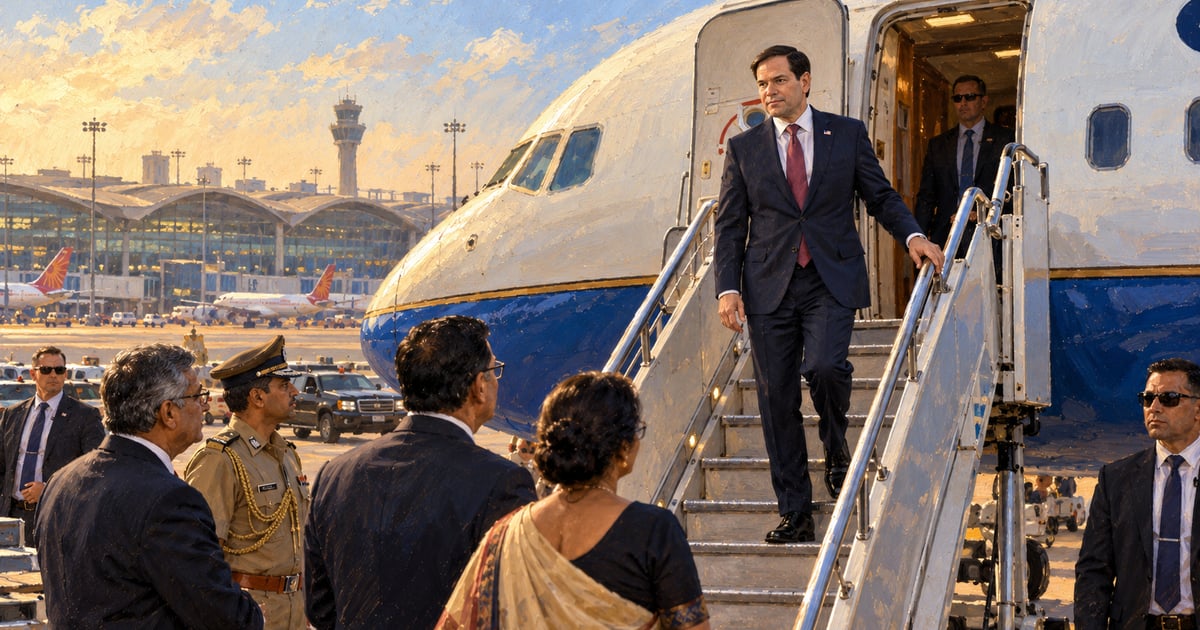
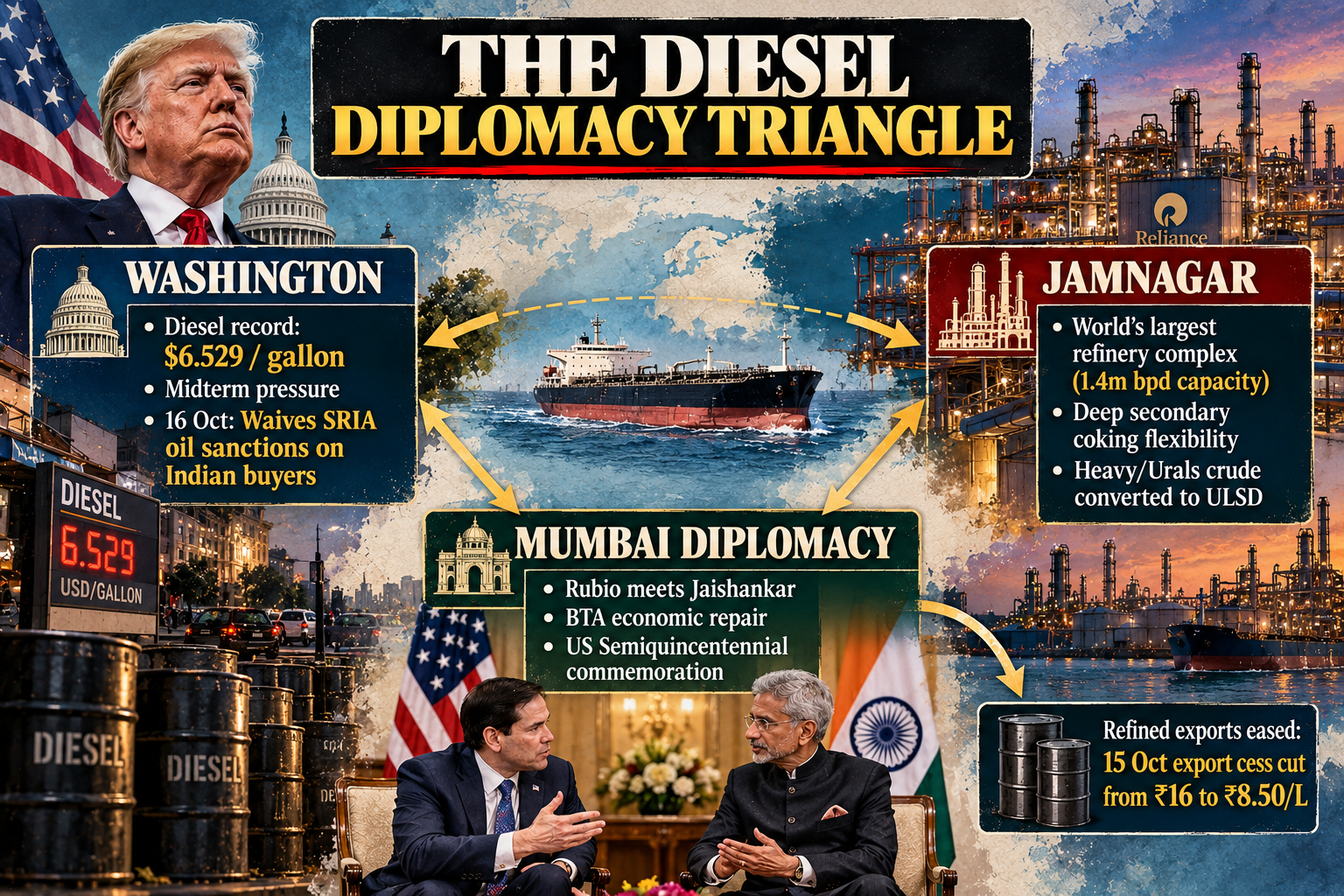
Between 19 and 22 October 2026, US Secretary of State Marco Rubio is travelling to India, following an initial stop in Samarkand, Uzbekistan. His destinations are Mumbai and Jamnagar. He will not travel to the capital. While official communiqués from the US Department of State describe the mission as an effort to ‘strengthen the US-India strategic partnership’ and ‘discuss prospects for enhanced energy cooperation’, the geography of the visit tells a far more concrete story.
Rubio is visiting Mumbai and Jamnagar because the Trump administration is grappling with an acute domestic diesel shortage, soaring transport inflation, and imminent midterm elections. To relieve that pressure, Washington is leaning directly on the world’s largest refining hub—Mukesh Ambani’s Jamnagar complex—while relying on Mumbai's financial corridors to stabilise a fraying bilateral economic agenda.
1. The US Diesel Emergency Ahead of the Midterms
The immediate driver of Rubio’s mission lies not in South Asian security architecture, but at American commercial fuel pumps.
The United States consumes approximately 4 million barrels of distillate fuel oil every day, accounting for roughly 22% of the country’s total transportation energy consumption. Diesel powers the long-haul trucking fleets that carry groceries and consumer goods, operates freight locomotives, and fuels agricultural equipment across the American Midwest. Unlike petrol, which directly impacts commuting motorists, elevated diesel prices function as an invisible, compounding tax across every segment of supply chains.
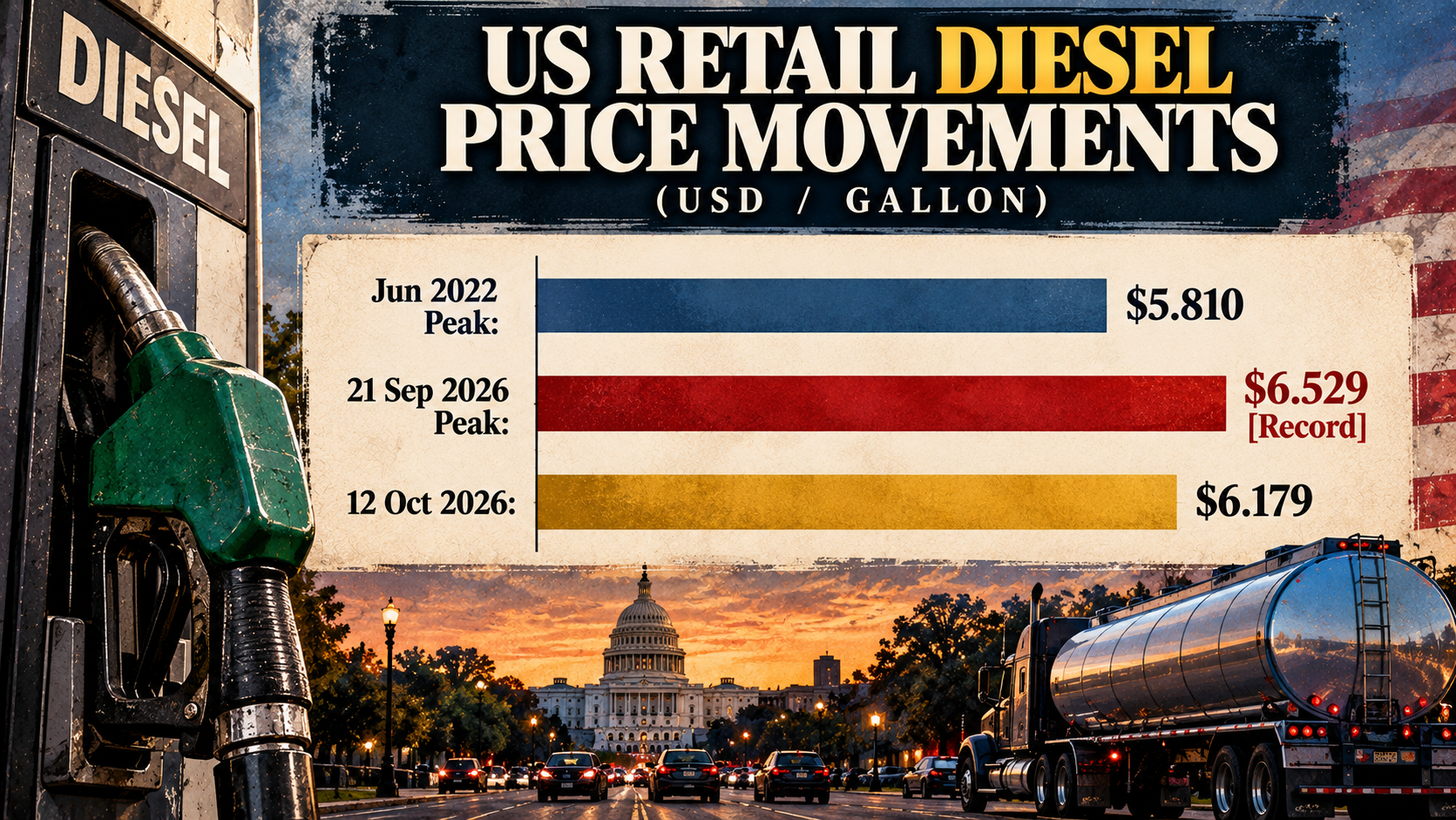
On 21 September 2026, the US average retail diesel price surged to an all-time nominal record of $6.529 per gallon, eclipsing the previous peak of $5.810 recorded in June 2022. While prices eased slightly to $6.179 per gallon by mid-October, distillate fuel remains painfully expensive. With President Donald Trump’s approval rating languishing at 34% in composite polling weeks before critical midterm congressional elections, energy-driven inflation has become the administration’s most pressing political liability.
This domestic fuel squeeze has been exacerbated by events abroad. Extensive Ukrainian drone strikes against Russian domestic oil refineries throughout late 2025 and 2026 severely impaired Moscow’s domestic fuel processing capacity. The resultant global distillate supply deficit prompted the White House to push for an ‘energy ceasefire’ between Moscow and Kyiv, urging Ukraine to halt strikes on Russian refining infrastructure to prevent global diesel prices from spiralling further.
2. Jamnagar: The World’s Swing Refiner
When global refining capacity tightens, international markets inevitably look to the western coast of Gujarat.
Reliance Industries’ Jamnagar complex is the largest single-site petroleum refining operation in the world, possessing an aggregate crude processing capacity of approximately 1.4 million barrels per day. The facility is not merely vast; it is among the most technologically sophisticated refineries in existence, featuring high Nelson Complexity Index ratings that allow its coking and secondary units to process sour, heavy, and discounted grades of crude oil that simpler facilities cannot handle.
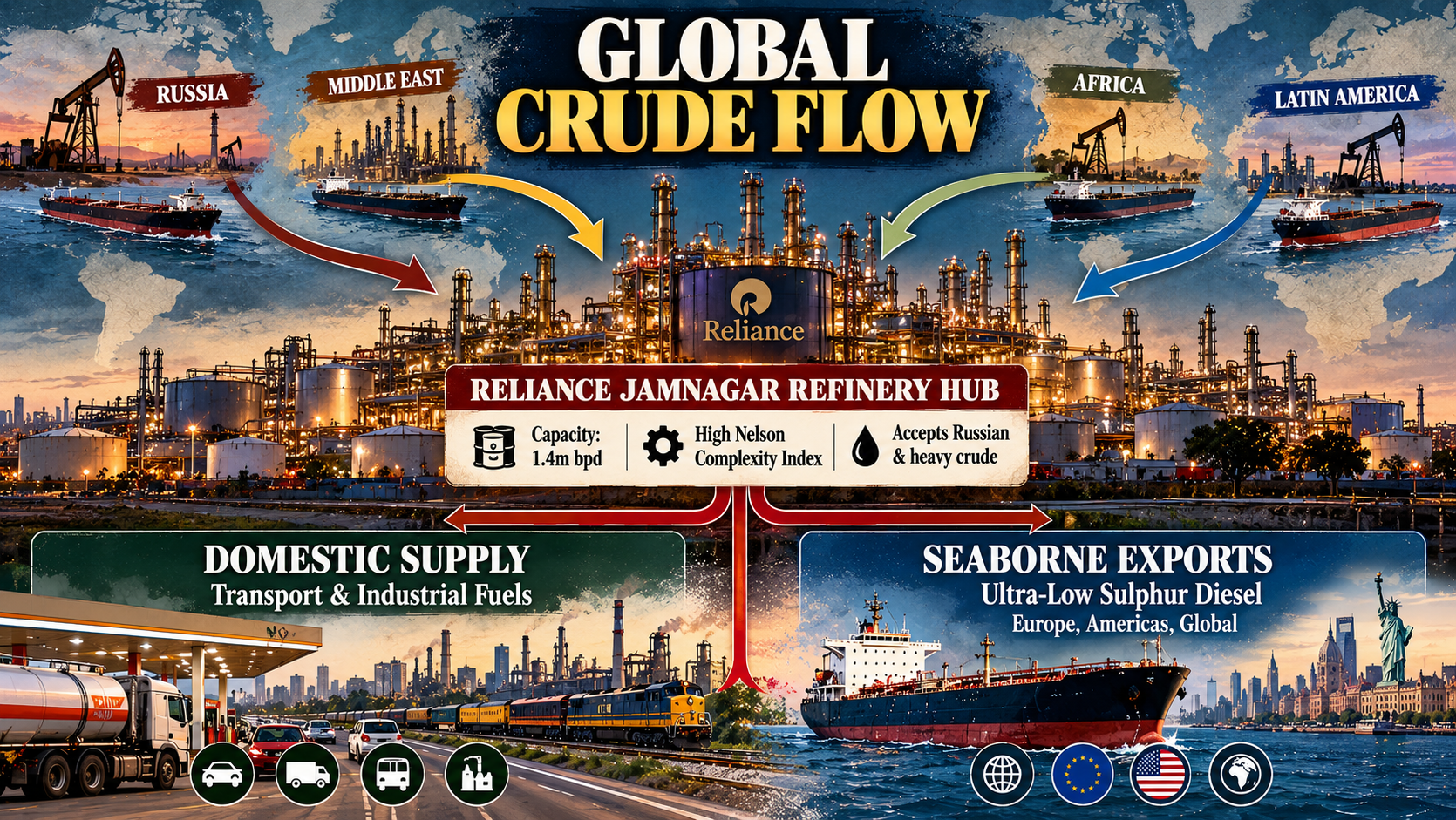
Since 2022, Jamnagar has functioned as a vital shock absorber for international energy markets. By importing discounted Russian Urals crude as well as heavy Venezuelan barrels, refining them into ultra-low sulphur diesel (ULSD) and aviation turbine fuel, and exporting finished distillates worldwide, Reliance kept European and Atlantic basin markets supplied despite sanctions. In July 2026 alone, ship-tracking data showed Reliance dispatching between 4 million and 5 million barrels of diesel to Europe and the Americas.
For Rubio and US energy planners, Jamnagar offers two distinct solutions:
Immediate Indirect Price Relief: Every tanker of high-grade diesel leaving Jamnagar for European, Mediterranean, or South American ports relieves competitive pressure on Atlantic fuel pools, indirectly driving down benchmark distillate prices in New York and the US Gulf Coast.
Long-Term Capacity Alignment: Reliance is a primary institutional backer of the proposed America First Refining project in Brownsville, Texas. Billed as the first major greenfield petroleum refinery constructed in the US in nearly 50 years, the facility secured an initial investment of at least $100 million (roughly ₹830 crore) from Reliance. Securing long-term technological and feedstock alignments with Reliance executives at their flagship Gujarat facility serves both current crisis management and future US refining strategy.
3. Sanctions Carve-Outs and Export Duty Cuts: The Policy Convergence
Rubio’s arrival follows swift, coordinated fiscal and sanctions manoeuvres in both Washington and New Delhi.
On 16 October 2026, President Trump officially invoked national interest waivers under the Lindsey O. Graham Sanctions Against Russia and Iran Act (SRIA). The legislation had mandated punitive sanctions and proposed 100% tariffs against major foreign buyers of Russian energy, placing Indian refiners in direct jeopardy. By granting an eleventh-hour waiver, the White House averted an economic rupture with India and ensured that Indian refineries could continue processing crude without triggering secondary American penalties.
Simultaneously, the Indian government made offshore shipments substantially more attractive. On 15 October 2026, the Ministry of Finance announced an immediate reduction in the Special Additional Excise Duty (export windfall tax) on diesel, slashing it from ₹16 per litre to ₹8.50 per litre effective 16 October. To balance domestic fiscal requirements, the export levy on petrol was modestly raised from 50 paise to ₹2.50 per litre.
The net reduction of ₹7.50 per litre on diesel export duties lowered the fiscal barrier for private Indian refiners to export distillates into supply-starved overseas markets, precisely as the chief US diplomat departed for Gujarat.
4. Why Mumbai? Capital Protocol vs Business Pragmatism
While Jamnagar addresses fuel, Mumbai serves as the venue for managing broader economic friction.
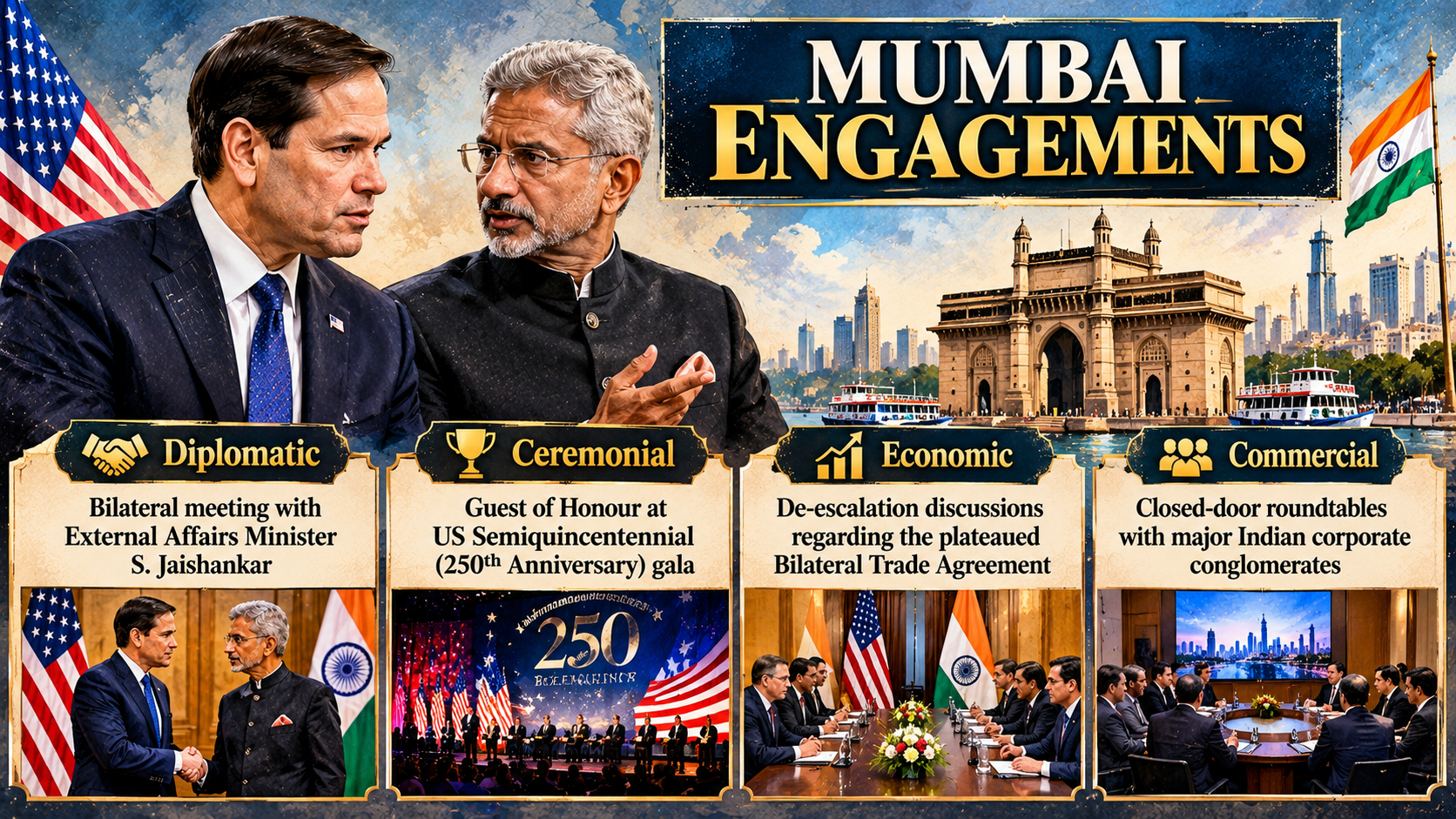
The US Ambassador to India, Sergio Gor, characterised the visit as deliberately ‘more business-focussed’, noting that Rubio would participate in high-level industrial and financial roundtables. Bilateral economic ties have faced headwinds throughout late 2026:
Bilateral Trade Agreement (BTA) Impasse: Formal negotiations on a comprehensive trade pact stalled, with Indian Finance Minister Nirmala Sitharaman publicly observing that discussions had ‘plateaued’.
Immigration and Services Disputes: Tensions escalated after the US administration suspended green card and permanent residency certification permissions for five major Indian technology outsourcing firms.
Direct Corporate Engagement: In Mumbai, Rubio can engage directly with corporate leaders across banking, infrastructure, and energy conglomerates without being encumbered by the formal ceremonial demands of the capital.
External Affairs Minister S. Jaishankar is scheduled to meet Rubio in Mumbai on 20 October, where both will attend a gala commemorating the 250th anniversary of American independence.
5. Domestic Political Repercussions in New Delhi
Rubio’s decision to bypass the national capital sparked immediate controversy within Indian domestic politics.
Congress MP and Leader of the Opposition Rahul Gandhi publicly attacked the central government over the arrangement, remarking in a critical statement that the US top diplomat had ‘summoned’ the External Affairs Minister to Mumbai and questioning why normal diplomatic protocol was being waived.
Ministry of External Affairs spokesperson Randhir Jaiswal dismissed the criticism, noting that hosting foreign dignitaries outside New Delhi has been an active Indian diplomatic convention for over a decade. Previous high-profile precedents include hosting Chinese President Xi Jinping in Ahmedabad in 2014, French President Emmanuel Macron in Varanasi and Jaipur, and Japanese Prime Minister Shinzo Abe in Ahmedabad.
From Washington’s vantage point, however, skipping Delhi was not an ideological statement. It was an efficiency choice. With midterm voting imminent, the State Department prioritised access to heavy refining infrastructure and corporate decision-makers over protocol-heavy state visits.